Axios Latino

December 14, 2021
¡Muy buen dĂa! Today we dive into health care coverage, fatal smuggling attempts, and poinsettias.
🚨 Job alert: Axios Latino is looking for a senior editor to lead the newsletter to its next milestone. If you have journalism experience and ideas to make this newsletter even better, apply here.
🎺Adiós al Rey de la Ranchera, Vicente “Chente” Fernández, who died on Sunday after a storied career.
Send us any feedback (quejas, sugerencias, chismes) by replying to this email. Sign up if you aren’t yet subscribed, and remember you can read the Spanish version here.
This newsletter — edited by Michele Salcedo — is 1,571 words, about a 6-minute read.
1 big thing: Getting Latinos into health insurance


U.S. Latino civil rights groups are running bilingual campaigns to get as many eligible people as possible signed up for health insurance under the Affordable Care Act before year’s end.
Why it matters: Latinos are one of most uninsured groups in the country, whether through public plans like Medicaid or through employers.
- This leaves them especially exposed when in need of hospitalization, preventive services, treatment of physical and mental ailments, or cases of pregnancy and childbirth.
- Latinos who are primarily Spanish speakers historically use health services up to 42% less than non-Hispanic adults proficient in English.
What’s happening: A campaign by the group UnidosUS has been using ads to complement efforts by the government and groups like the League of United Latin American Citizens to explain and demystify the ACA enrollment process before it ends Jan.15.
Between the lines: Latino uninsured rates have remained steady since 2018 — 1 in 4 Latinos don’t have health insurance coverage, per census data.
- Experts attribute the plateau to persistent fears from now-defunct Trump-era policies, such as a “public charge” rule, which prohibited immigrants who applied for benefits like housing subsidies or Medicaid from obtaining residency or citizenship.
The catch: During the pandemic, lack of insurance has been identified as a key obstacle in the timely testing or treatment of Latinos for COVID-19.
- Those with less English proficiency have often faced more significant barriers getting COVID-related care and vaccinations, per studies.
- Latinos overall are among those most affected by coronavirus infections and deaths, according to the CDC.
For reference: Open enrollment is the yearly period during which people in the U.S. can sign up for an insurance plan, renew it, adjust it or cancel it.
- Those interested in having health care coverage as soon as Jan. 1 would need to sign up tomorrow at the latest.
- If sign-up is done by Jan. 15, coverage would begin Feb. 1.
2. Study: Underpaying Latinos curbs U.S. economy

Illustration: Sarah Grillo/Axios
Latinos in the U.S. have a $288 billion income gap compared to white non-Hispanics, a disparity that stifles key business growth and job creation, according to an analysis by McKinsey & Company.
Why it matters: The report adds to the warnings about the financial inequality Latinos face, and the potential long-term effects for the country if it is not addressed.
By the numbers: Lower income, less wealth, and reduced access to goods and services translates to $660 billion lost from the economy, the study said.
- The disparities mean Latino-owned businesses cannot generate what McKinsey estimates could be $2.3 trillion more in annual revenue and up to 6.6 million new jobs.
- Barriers to wealth generation also result in a $380 billion gap between Latinos and white non-Hispanics in financial flows to the next generations, perpetuating the disparity.
Of note: The wage disparities are present even among college-educated Latinos, even if smaller than among less educated people, be they Latinos or white non-Hispanics.
What they're saying: "This report is about a call to action. How do we invest in this community and really see this community as the economic engine for the U.S.?" Lucy Perez, one of the authors of the report, told Axios.
- Perez said the numbers show Latinos are starting businesses at a faster pace than other groups. But they disproportionately rely on personal funds and credit cards to start those businesses, making debt a looming problem.
- That lack of investment comes as Latino entrepreneurs are responsible for about 50% of net new small business growth in the US over the past decade, according to data from 2007 to 2017.
3. Deadly crashes increase on migrant routes
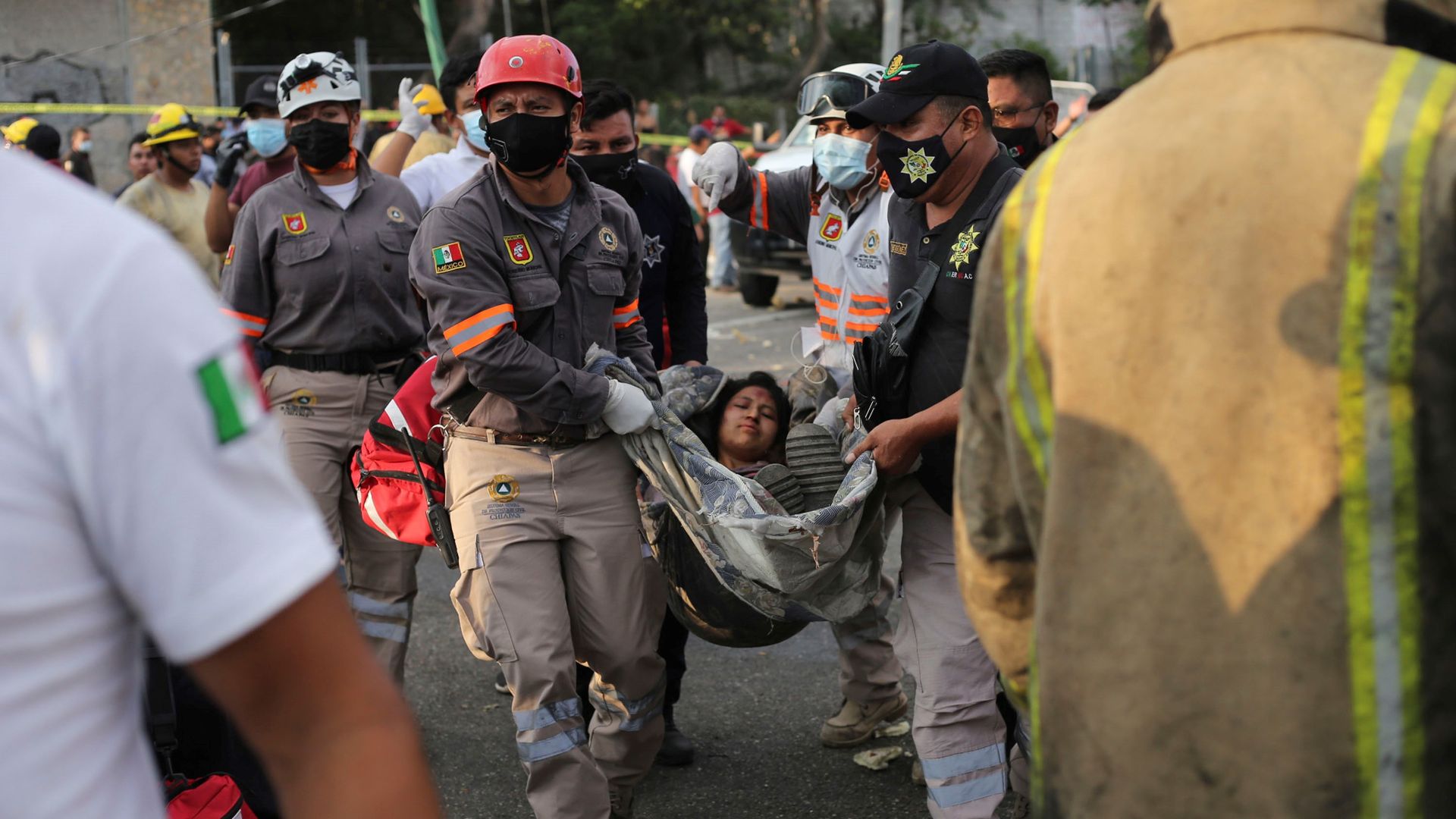
Rescue workers carry an injured woman from an accident that killed more than 50 migrants on a Chiapas road. Photo by Carlos DĂaz/Xinhua via Getty Images)
Mexico, the U.S. and five more countries have formed a task force to try to curtail groups that are smuggling migrants in overcrowded vehicles.
Why it matters: The group was set up on Friday after more than 50 people died and more than 100 were injured, some gravely, when the speeding truck they were in overturned in Chiapas.
- Many of the dead remain unidentified. Most of the people in the truck were Indigenous Guatemalans, although there were some Dominicans, Salvadorans, Ecuadorians and Nicaraguans, per authorities.
- A record number of people lost their lives the past year on the migrant routes through Mexico towards the U.S. and on the border, according to Border Patrol data and to the UN’s International Organization for Migration.
The big picture: The Chiapas crash shows how smugglers have become more brazen in the past couple of years as migration continues unabated.
- They have been cramming more people into vehicles to reduce the number of trips, and driving unsafely to evade the authorities, activists warn.
- Demanding documents from passengers on buses, closing off access to trains or blocking caravans on highways “does not stop migration. It just means these families try to seek alternatives that are increasingly dangerous,” says CĂ©sar RĂos of the Salvadoran Migrant Institute Insami.
- In March, 13 passengers packed into an SUV died when the vehicle crashed on a highway leading from the Mexican border to San Diego. Authorities investigated that crash, one of the deadliest on record for the border region, as a probable human smuggling operation.
- Ten people believed to be migrants were killed when a van crashed in early August in Texas.
4. Cartoons v. COVID misinformation
One of the cartoons used in the campaign against COVID vaccine misinformation. Photo: Courtesy of Lalo Alcaraz
A social scientist is taking on coronavirus-related misinformation though cartoons, Axios’ Yacob Reyes reports.
Why it matters: The project COVIDLatino aims to disseminate coronavirus information to U.S. Latinos through art and social media posts that prominently feature staples of Latino culture.
- The health campaign was launched by social scientist Gilberto Lopez, who enlisted Chicano artist Lalo Alcaraz to produce cartoons for the project.
Between the lines: Latinos are almost three times as likely to be hospitalized with COVID-19 as non-Hispanic white people, according to the CDC.
- They are also more frequently exposed to misinformation about vaccines and other COVID-related matters, per reports.
- Flagging that false content takes longer on social media like Facebook when it’s in Spanish or Spanglish, since only 13% of anti-misinformation spending is used for content in languages other than English, according to whistleblower Frances Haugen.
What they’re saying: “Cartoons are a great way to deliver a lot of information in one hit,” Alcaraz told Axios. “It’s an image that can stick with you.”
5. Stories we’re watching
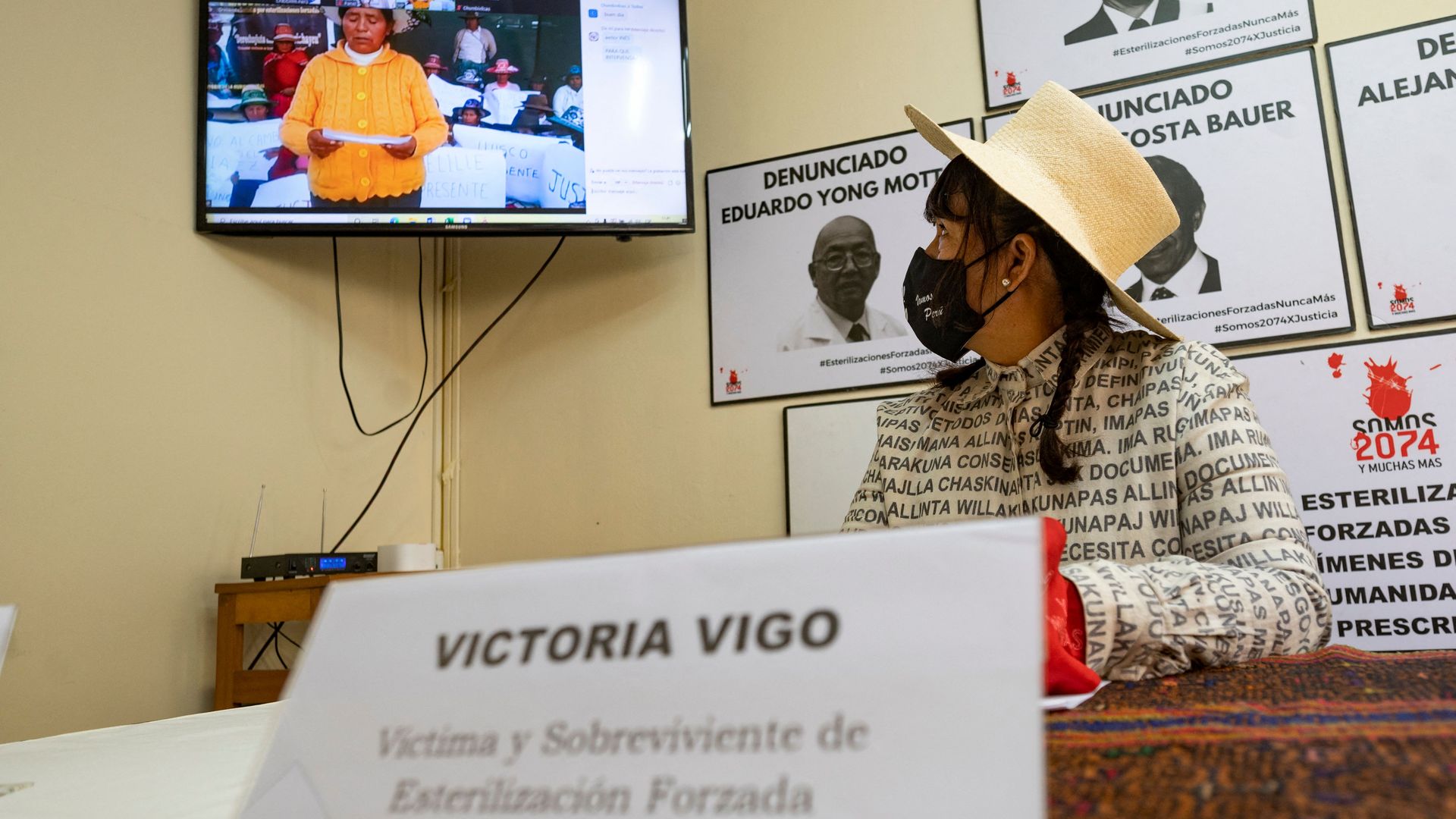
Two Peruvian women whose fallopian tubes were tied without their consent testify in-person and remotely during preliminary hearings on a forced sterilization case, Nov. 17. Photo: Cris Bouroncle/AFP via Getty Images
1. Peru’s former President Alberto Fujimori faces new charges of human rights violations, after a judge found on Saturday that criminal complaints against him can proceed in a case of forced sterilizations.
- The judge’s decision comes 12 years after the women affected by Fujimori’s “family planning” campaign first pressed charges. The case and its preliminary hearings had kept getting postponed.
- As many as 236,000 mostly Indigenous women were pressed into getting hysterectomies without being told what they were for, according to the case file. The trial focuses only on 1,300 forced sterilization victims.
- Fujimori is already serving a 25-year sentence for human rights crimes, accused of overseeing the kidnappings and killings of civilians in the 1990s.
2. The Chilean presidential race between far-right and far-left candidates has heated up days before the Dec. 19 vote. AP reports that the father of candidate José Antonio Kast was a full-fledged member of the German Nazi party and claims surfaced that the other candidate, Gabriel Boric, committed sexual harassment.
- Chile was one of the Latin American safe havens for Jews fleeing the Holocaust, though former Gestapo and SS soldiers also hid there after World War II.
- Ultra-conservative Kast, whose family had ties to dictator Augusto Pinochet (1974-1990), got the most votes in the first round but is trailing far left candidate Gabriel Boric in recent polls.
- Allegations that Boric made comments demeaning female colleagues when he was a student leader in 2012 surfaced this weekend. He apologized on Monday.
- An international group of leftist lawmakers, including U.S Rep. Rashida Tlaib (D-Mich.), signed a letter this weekend expressing “concern” over Kast’s proposed programs as a return to “Pinochetism.”
6. ✨ 1 smile to go: Holiday blooms

As December’s holiday festivities come into bloom, so does the work of poinsettia growers in Mexico City's floating gardens of Xochimilco.
Context: Nochebuenas, as the plants are known in Mexico due to their flowering around Christmas Eve, have adorned Mexican gardens since the 15th century. To the Aztecs, the flower signified rebirth after battle.
- Spanish colonists adopted it to use in Nativity scenes.
The intrigue: Studies show the flower is originally from Morelos and Guerrero, but Mexican growers have to pay commercial royalties to people in the U.S. for most varieties.
- Nochebuenas’ breeder’s rights belong to U.S. growers. Some years after the first ambassador of that country to Mexico, Joel Roberts Poinsett, sent seeds and plants home, American Paul Ecke registered the flower.
Thanks for reading. We’ll be back Thursday, have a good one.
Sign up for Axios Latino

Keep tabs on the stories that most affect the U.S. Latino community on both sides of the border, a collaboration with Noticias Telemundo.