Axios Houston

August 17, 2026

⏰ Rise and shine! It's Monday.
☀️ Today's weather: Hot and sunny.
🎤 Sounds like: "Rolling in the Deep" by Adele. Go ahead, belt it out.
Today's newsletter is 844 words — a 3-minute read.
1 big thing: 📉 Violent crime continues to fall in Houston

Homicides and other violent crimes fell across the country and in Houston through the first half of this year, according to preliminary data reviewed by Axios.
The big picture: Homicides are down by a sharp 38% in Houston, according to data compiled by the Major Cities Chiefs Association (MCCA). Houston recorded 95 homicides in the first half of 2026, down from 154 during the same period last year.
- Other violent crime also dropped, continuing a decline the city has seen in the past couple of years. Robberies decreased nearly 27%, aggravated assaults fell by over 17% and rape cases by about 20%.
Zoom in: Mayor John Whitmire has repeatedly said public safety is one of his priorities, pushing to put more officers on Houston's streets.
Zoom out: Violent crime is down nationally. Homicides across the cities included in the MCCA report fell 17%.
- Robberies dropped nearly 17%, rapes declined 6%, and aggravated assaults fell 6%.
- Taken together, the four categories were down about 8%, for roughly 14,200 fewer reported violent crimes, according to the Axios review.
Between the lines: The decline now spans two presidencies — it began falling under President Biden after the pandemic-era surge, and has kept dropping under President Trump.
- Trump came into office casting America as being overrun by crime at a time when the numbers were already declining dramatically.
- As that decline has continued during his watch, he's taken credit for it, often linking it to his deployment of the National Guard in cities such as Washington, D.C., and Memphis, Tennessee.
The intrigue: The homicide drops are striking in several cities that have struggled with high levels of violence, including Houston and D.C., where 46 homicides were reported, down 44% from 82 in the first half of 2025.
Worthy to note: Aurora, Colorado — a city Trump falsely singled out as being overrun by Venezuelan immigrant gangs during the 2024 election — saw a 59% drop in homicides.
Caveat: Some of the biggest percentage drops came in places with relatively few killings to begin with, like Newark, which fell nearly 65% from 17 to six homicides.
Rooted in your community
The strongest communities are built on clear, reliable local news.
The big picture: Reader support helps our newsroom continue covering the changes, challenges and moments shaping our city every day.
🌱 Become a member today. You'll help support trusted local reporting and keep our newsroom focused on the stories that matter most to your community.
Thank you for reading and supporting local journalism.
2. 👶 Texas bucks U.S. fertility trend

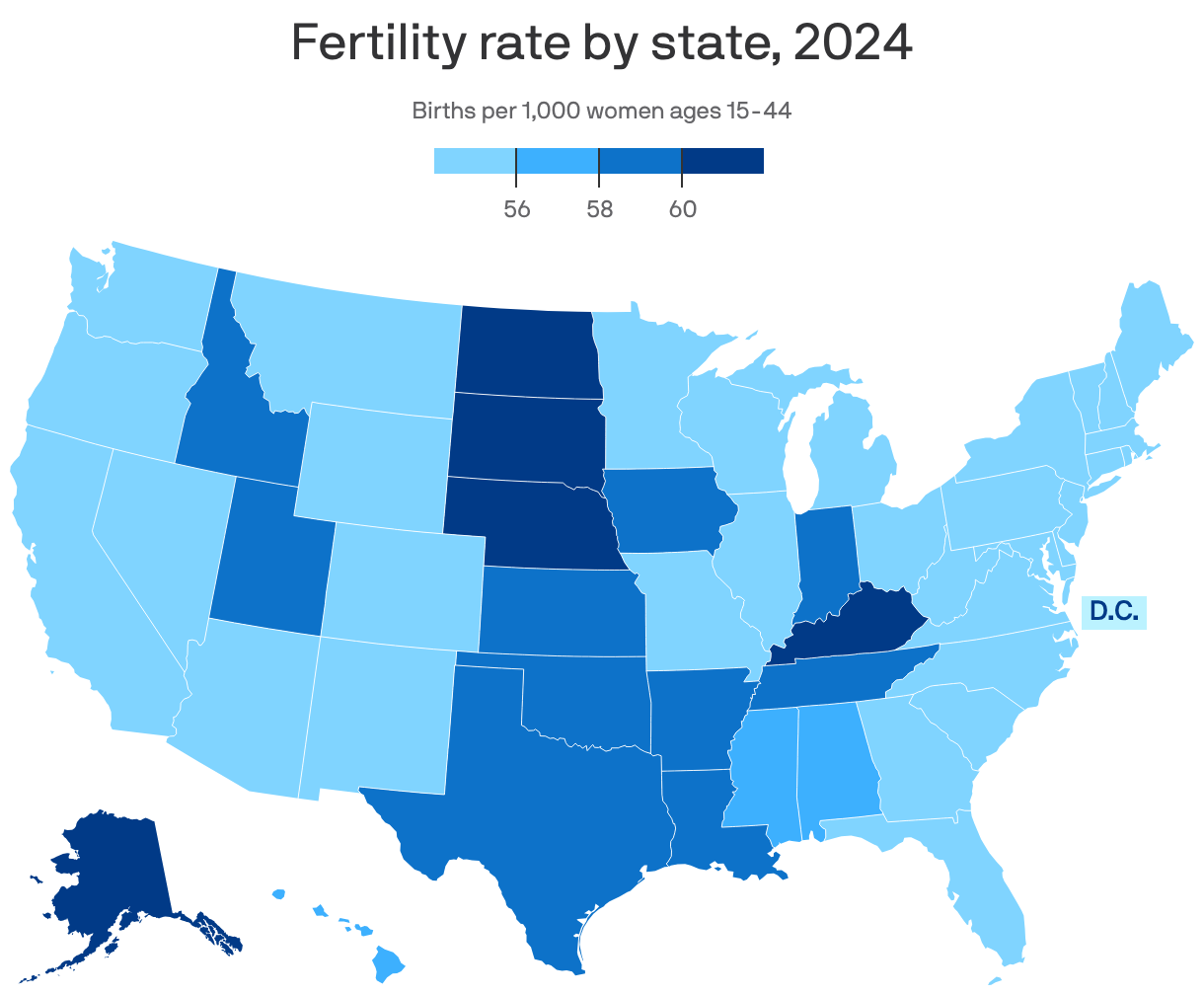
Despite a decades-long decline in U.S. fertility rates, a corridor of central Plains states — including Texas — continues to post higher rates than the rest of the country on average.
Why it matters: The national fertility decline isn't uniform, with a mix of demographic, economic and cultural factors at play.
What they're saying: "Generally in demography we find more births where moms can (more) easily find higher-waged jobs," family demographer Jennifer Glass tells Axios.
Researchers point to several other factors:
- Demographics: U.S. Census data shows Texas and North Dakota rank behind only Utah among the nation's youngest states, meaning more women are in their 20s and early 30s, when birth rates are highest.
- Child care: Glass notes these costs are comparably lower here, while they have soared in coastal states.
- Housing: Family-sized homes remain far more affordable across much of the Plains than on the coasts.
- Culture: Americans are partnering, marrying and starting families later than previous generations, especially in larger metropolitan areas. But rural regions and more religious communities tend to see earlier marriage and childbearing, extending the years during which families might have additional children.
How it works: The CDC defines the fertility rate as births per 1,000 women ages 15–44.
- The U.S. fertility rate was 53.8 in 2024, compared to about 59 in Texas.
Yes, but: The state's fertility rate is still declining overall. It stood at 62.5 in 2019.
3. Bayou Buzz

🖍️ Houston ISD had four elementary schools earn F ratings in TEA's annual accountability scores, breaking from last year's milestone when the district had no failing campuses.
- Notably, Wheatley High School, whose failing ratings triggered the ongoing state takeover, earned an A for the first time. (Houston Public Media)
💻 Apple opened a new 250,000-square-foot manufacturing facility in Houston late last week. (Houston Business Journal)
💍 The Crystal Ballroom at Rice has closed, leaving some Houston-area couples scrambling to rebook venues ahead of upcoming weddings. (KHOU)
4. 🍿 Social Calendar
🚆 Catch a viewing of "The Girl on the Train" at the Alley Theatre.
- 7:30pm viewings from Tuesday-Friday. Tickets start at $32.
🎶 Watch DJs compete for the top spot and pick up DJ tips at CommonGround 2026 at Raven Tower.
- 8:30pm Tuesday.
🎂 Decorate cake and learn how to make tulips from buttercream at Lyric Market.
- $60. 7pm Wednesday.
🐢 Cheer on your favorite turtle at a turtle race at Little Woodrow's Midtown.
- Race kicks off at 7pm Thursday.
🎥 Watch "F for Fake" at the Contemporary Arts Museum Houston, as part of its Cinema Club.
- 6pm Thursday. Free.
Thanks to Astrid Galván for editing this newsletter.
🪡 Shafaq is perusing Art League Houston's list of fall classes.
Congrats, Josephine O.! You answered all the questions in the Friday news quiz correctly. Answers: Houston airport workers got a pay raise; Buc-ee's is suing companies over the cartoon beaver; and small robots are fishing for lithium.
Sign up for Axios Houston