Axios Hill Leaders

March 07, 2025

1 big thing: 🚨 Jeffries' flex

House Democrats are playing for keeps in the government funding fight, explicitly withholding their support from a bill to stop a shutdown.
- "Medicaid is our redline," said a letter from House Minority Leader Hakeem Jeffries' leadership team to Democratic members.
Why it matters: It's the most consequential and calculating threat from Jeffries in the Trump era, using his power as minority leader to extract clear concessions from the majority.
- Jeffries' threat clashes with Minority Leader Chuck Schumer's advice to his Senate Democrats. Schumer thinks it's awful politics for Democrats to talk about wanting a shutdown.
House Speaker Mike Johnson is now on notice that Jeffries is willing to play chicken over a potential government shutdown.
- House Democrats are holding out for guarantees that President Trump and DOGE won't slash programs already authorized by Congress.
- That's delayed a grand appropriations bargain for weeks, but today is the first time leadership has been so blunt with their warning about a stopgap.
💣 That brings us to Johnson, who's working with a margin of none: A Trump flip-flop or Elon Musk tweet about spending could blow up the GOP's unity.
- Republicans united this week around a "clean" funding extension, but they don't have the votes to go it alone.
- Johnson knows Rep. Thomas Massie (R-Ky.) is a "no," but Trump is helping hold the line. Another GOP "no" vote could force Johnson to seek Democratic help.
If Johnson does manage to pass a bill, Senate Majority Leader John Thune will need at least eight Democratic votes.
- Republicans are eyeing about a dozen possible Senate Democrats among those up for tough 2026 races, states packed with federal workers and moderates from Trump states.
- But if the Senate GOP defector list grows beyond Sen. Rand Paul (R-Ky.), Thune's math gets harder fast.
The bottom line: Both Johnson's and Jeffries's strength is a function of their numbers. For both leaders, there's power in unity — and they will look to enforce it.
— Hans Nichols, Andrew Solender and Stephen Neukam
2. 📉 Charted: DOGE-vulnerable districts
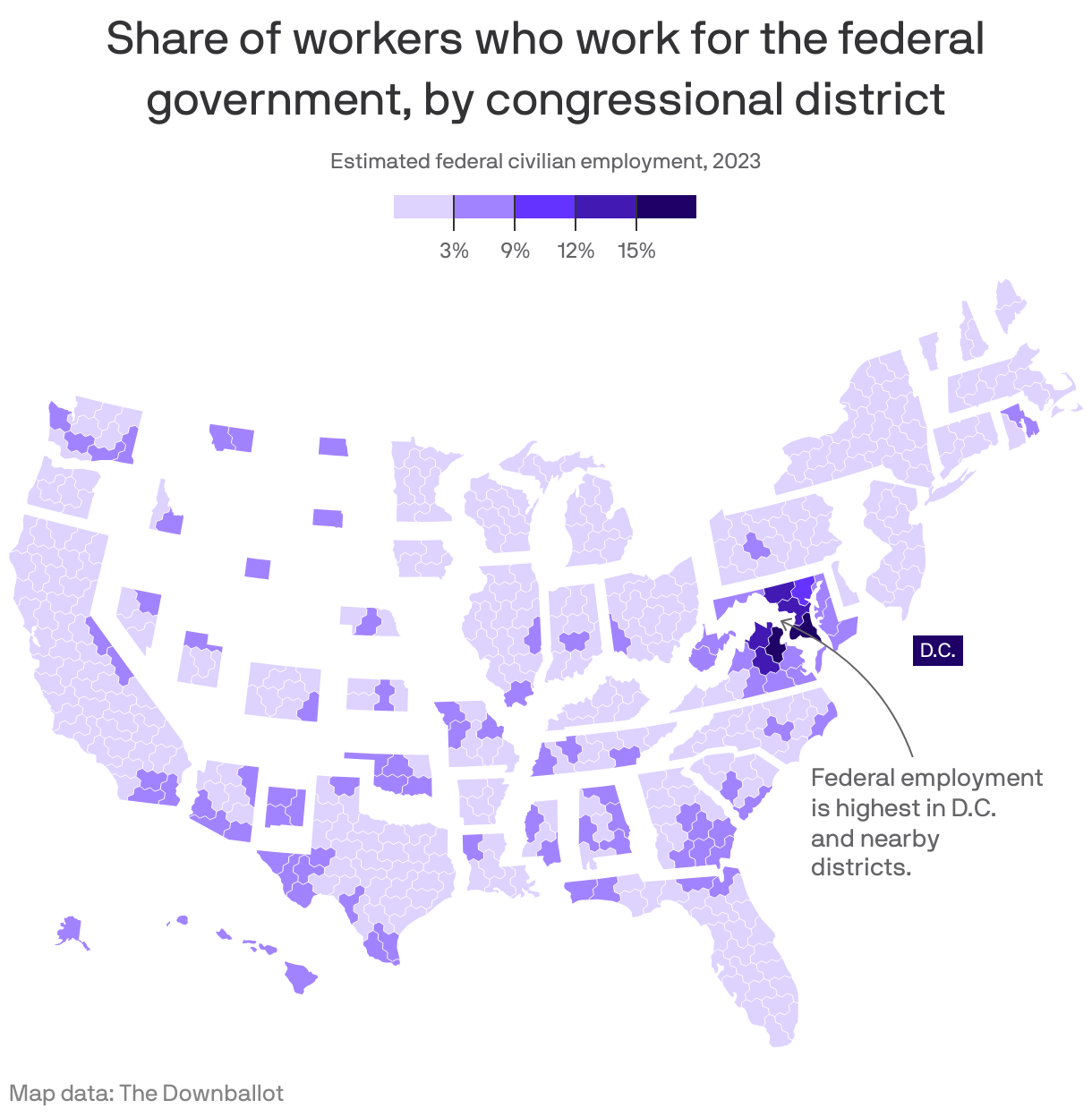
Republicans represent a slight majority of the 60 congressional districts with the highest share of federal workers, including many lawmakers publicly cheering on Elon Musk's hack-and-slash efforts.
Why it matters: At first glance, it seems like DOGE's stabs at slashing the federal workforce mainly affect the solidly Democratic areas in the D.C. metro area.
- But dig a little deeper, and the story changes.
- Speaker Johnson (R-La.) is on the list. So is Rep. Andy Harris (R-Md.), who leads the ultra-conservative Freedom Caucus, and Rep. Tom Cole (R-Okla.), the chair of the House Appropriations Committee.
- Several endangered GOP incumbents — including Reps. Jen Kiggans (R-Va.) and Juan Ciscomani (R-Ariz.) — are on that list.
By the numbers: According to a Congressional Research Service report published in December, nearly all of the 10 districts with the highest proportions of federal workers are in Washington, D.C., Virginia and Maryland.
- D.C. is essentially a company town where the factory is the vast federal government bureaucracy, as Axios' Cuneyt Dil recently noted. Many of its workers live in D.C.'s surrounding suburbs and exurbs.
- Once you get past the top 10 districts, red states like Oklahoma, Alabama and Texas start to show up.
Zoom in: Beyond D.C., the Defense Department — which isn't being spared DOGE's wrath — accounts for high concentrations in some districts.
- Kiggans and Cole represent districts with large military installations that have long been major employers for their constituents.
- Rep. Nick Begich (R-Alaska), who is in a competitive district, has a large military constituency. But agencies like the Interior Department, FAA and Postal Service also have significant presences, according to the Anchorage Daily News.
Between the lines: Even as they have applauded DOGE's cuts in public, some Republicans have privately worried about Musk's ruthless tactics.
- "It would be more helpful if some of those DOGE folks showed more sensitivity to the people who are being terminated this way ... who didn't do anything wrong," one House Republican told us last month.
- Another said Musk is "more liked by people in the White House than anyone here [in Congress] because we have to deal with the ramifications of what he says."
Axios Hill Leaders