Axios Hill Leaders

September 30, 2026

🧃 Juicy one tonight: This issue is 965 words, 3.5 minutes.
- 👎 GOP's lost week
- ‼️ Senate real talk on AI
1 big thing: 👎 GOP's lost week
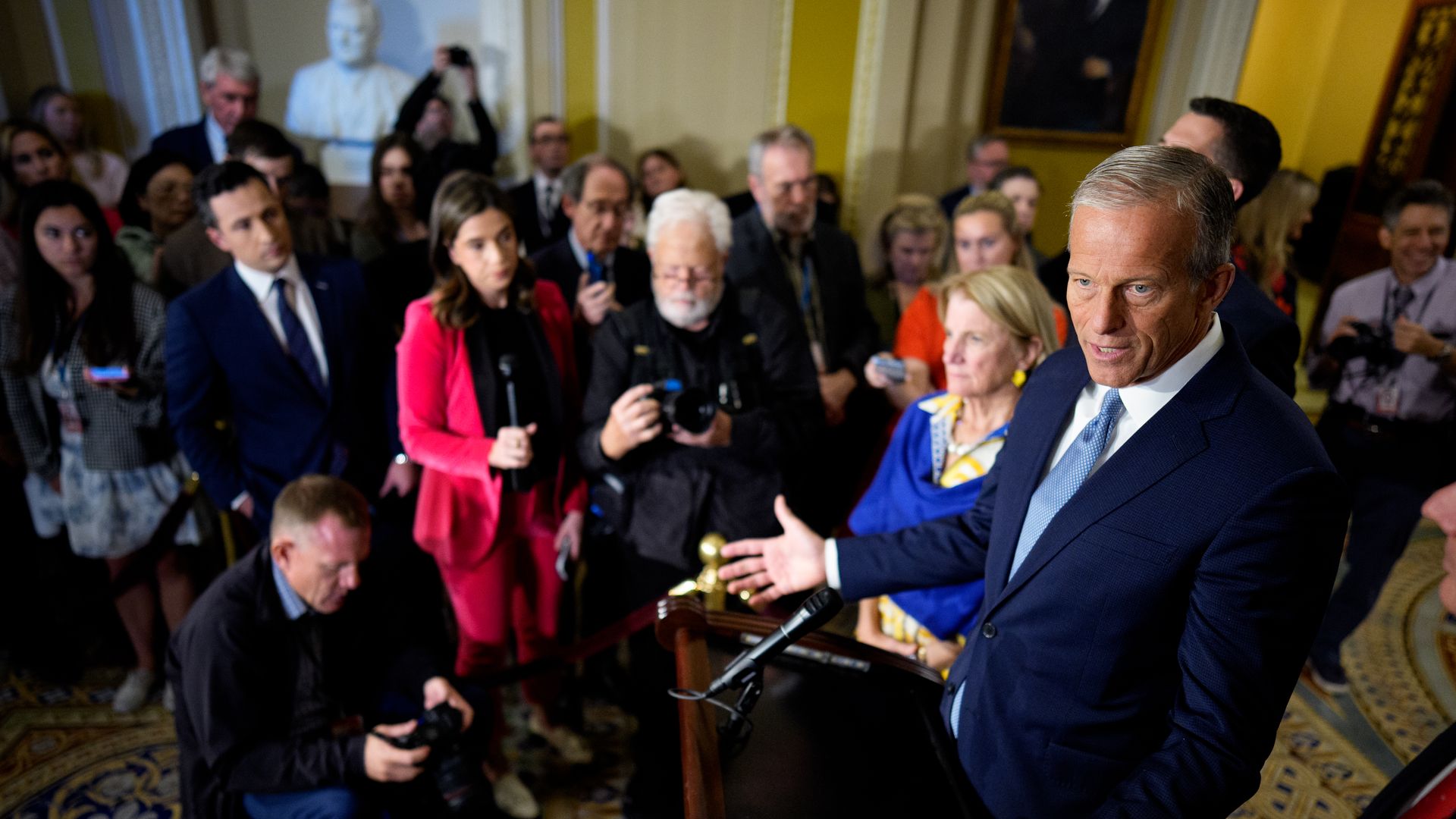
😩Exhausted GOP senators are preparing to fly home mostly empty-handed after staying in D.C. longer than expected.
- 👎 Why it matters: The midterm outlook is getting bleaker by the day, and Republicans have a monster to-do list for the lame-duck session that could be a last chance to capitalize on their trifecta.
Between the lines: Republicans decided against breaking for an early recess last week.
- The biggest thing to show for it: A historic — and bipartisan — college sports package that doesn't do much for those defending their seats in November. It faces long odds in the House.
😖 Otherwise it was a week of pain:
- Failed votes: A vote addressing Americans' concerns about data centers driving up energy costs failed today, as did another to curb congressional stock trades and enforce voter IDs.
- A line of attack that backfired: A major hearing with Jack Smith was overshadowed by a failed attempt by Sen. Eric Schmitt (R-Mo.) to link the special counsel and Atlanta prosecutor Fani Willis.
- The Trump issue: Republicans have been tiptoeing around whether Trump's unpopularity will hurt the party in November, only for Texas nominee Ken Paxton to be caught blaming Trump's midterm convention for hurting his polling.
- NRSC Chair Tim Scott (R-S.C.) said Paxton's analysis was "just wrong" and called the convention "a boost in the right direction."
🤕 Zoom out: Some of the GOP senators are returning to fresh campaign headaches.
- Sen. Susan Collins (R-Maine) lost a week of in-state campaigning and didn't even get a vote on one of her key priorities: a bipartisan bill to lower insulin costs.
- Sen. Pete Ricketts (R-Neb.) is the target of a new ad campaign hitting him over his pardon of a man who pleaded guilty to first-degree sexual assault.
- Sen. Roger Marshall (R-Kan.) has been batting down accusations that he went after mothers of new babies over unpaid medical bills. His lawyers sent a cease-and-desist letter to his opponent — Rev. Adam Hamilton — on Monday.
The GOP has a cash advantage, but the campaign apparatus now has to spend heavily in states Trump handily won in 2024 — Ohio, Iowa, Alaska, Texas, Kansas, Nebraska and Florida.
‼️ The other side: Former Rep. Mary Peltola (D-Alaska) was also hit with a damaging report from the New York Times about her personal behavior and office culture (some of which she denied). She is challenging GOP Sen. Dan Sullivan.
What to watch: The Senate will return in November staring down a list of must-pass items.
- Fund the government
- Pass the National Defense Authorization Act
- Reinstate FISA Section 702, the warrantless wiretap authority
- Pass the farm bill
💰 The bottom line: That's just what they must get done. There's also a growing list of maybe-to-dos, like:
- Take a whack at a bipartisan permitting reform bill that finally came together hours before the Senate took off for home.
- Pass some form of AI guardrails.
- Raise the debt ceiling, potentially through reconciliation.
— Stef Kight
2. ‼️ Senate real talk on AI

Senate Majority Leader John Thune welcomed the new "constitution" that President Trump and tech and AI leaders signed yesterday but said he would work to "codify" some safety protections with legislation.
🤖 Why it matters: Thune and other GOP senators aren't directly challenging Trump's preference for industry-led safeguards. But they suggest yesterday's accord — which Trump called "morally binding" — might not be enough.
- "I think this is good," Thune told us today. "This is certainly a step in the right direction."
- "We are continuing to have those conversations up here on whether or not we can come up with some sort of a legislative framework that would codify some safety protections too."
🤔 The intrigue: There's an undercurrent of skepticism in the Senate GOP about AI and the frontier labs.
- "I'm not saying they don't care about humanity, but they also care — I'll give you three letters: I-P-O — and they care about profits," said Sen. John Kennedy (R-La.).
- "I pretty much trust them like a rest-stop bathroom," Kennedy said.
🪑Between the lines: Speaker Mike Johnson was at the White House meeting, sitting at a table with some of the world's wealthiest and most powerful tech executives.
- Thune was not, but he had a separate meeting Monday night in his Senate office with Anthropic CEO Dario Amodei, one of the industry's leading advocates for regulating frontier AI.
Zoom in: Thune has been more assertive than Johnson about the need for Congress to regulate the AI industry.
- "I do think that the threats are real," Thune told us last week. "I think you have to have at least some sort of a plan and some guardrails around it."
- Johnson appears to favor a more hands-off approach: "The challenge has been that finding consensus on all of this in Congress is very difficult. The technology changes rapidly," Johnson said yesterday.
- "The White House and Congress will continue to guide the industry's development in a safe manner," Johnson said. "Congress is going to keep steady hands at the wheel on this."
⚖️ The bottom line: Some of Thune's GOP colleagues agree Congress needs to act, while others favor Trump's laissez-faire approach.
- "You have to have the strength of statute and law and regulation," said Sen. John Hoeven (R-N.D.). "Like for any other industry, this is not unique to super intelligence."
- "Ultimately, the companies have got to do the right thing themselves," said Sen. Rick Scott (R-Fla.).
- "Do I have confidence Congress would craft the right solution on AI? Not really," said Sen. Ron Johnson (R-Wis.). "In the end, I think what we need to do is preserve competition."
- "Congress should do something too, rather than sit back and spectate," said Sen. Josh Hawley (R-Mo.).
— Hans Nichols and Stef Kight
This newsletter was edited by Justin Green and copy edited by Kathie Bozanich.
Sign up for Axios Hill Leaders