
Axios Generate

June 23, 2025

🧇 Welcome back! We've got a newsy 1,104 words, 4 minutes to start the week.
🥵 Situational awareness: With dangerous temps spanning the Midwest to the East Coast, grid manager PJM declared a "maximum generation emergency."
- Why it matters: It expects peak demand to top 160 gigawatts in its region today, which Bloomberg notes would be the highest since 2011.
🎛️ At this moment in 2002, Ashanti was closing out a 10-week run atop the Billboard Hot 100 with today's beautiful intro tune...
1 big thing: The medium chill in a hot war


Oil prices are relatively modest in the wake of U.S. strikes against Iranian nuclear sites over the weekend.
The big picture: Sure, there's geopolitical risk premium built into what's a well-supplied market — you can see the initial jump when Israel struck Iran on June 13.
- But prices are not heading into orbit despite Iran's parliament weekend saber-rattling about closing the Strait of Hormuz.
- Brent prices rose around 5% when trading opened last night but quickly fell back.
Why it matters: Traders don't appear to believe — for now — that the conflict will expand in ways that significantly stymie oil flows in the region.
What they're saying: Oil analyst Ellen Wald tells me it would be "incredibly difficult" for Iran to block the strait that handles about a fifth of the global oil trade.
- Ships can be re-routed away from the Iranian portion of the channel that also includes Omani waters, she notes.
- Israel and the U.S. have air superiority, so attempted naval action could be deterred from above. "Iran also doesn't want to jeopardize its own oil exports," she said via email.
The intrigue: The aftermath of Iranian proxies' 2019 strikes on a critical Saudi oil site offers a lesson, said Wald, a senior fellow at the Atlantic Council.
- "[T]raders learned from the Abqaiq attacks that Aramco has incredible reserves of crude oil stored away and the ability to tap into that to ensure the uninterrupted flow of oil."
- With the Saudis currently holding back considerable output, an oil market disruption would be temporary, she adds.
Catch up quick: Iran's parliament yesterday offered a symbolic endorsement of closing the waterway, but any decision would rest with regime leaders.
Yes, but: Iran retains capacity to interfere with the strait in ways that prompt shippers to avoid it, RBC Capital Markets' Helima Croft said in a note, though extended closure would be very tough given the U.S. Navy's Fifth Fleet in Bahrain.
- "[W]e do not believe it is a 'full closure or nothing' scenario when it comes to the waterway, and Iran may deploy their asymmetric capabilities to raise the economic cost of the combined US/Israeli operations," she writes.
Threat level: "It's remarkable to have such a limited risk premium in the face of this uncertainty and potential for escalation," oil scholar Ben Cahill of UT-Austin tells me via email.
The bottom line: "The market continues to shrug off more geopolitical risk than I would have thought possible a few years ago," Cahill said.
- "But that's been the story of the oil market since Oct 7, 2023, and arguably since Abqaiq," he said.
2. ⚠️ Charted: The Strait of Hormuz chokepoint
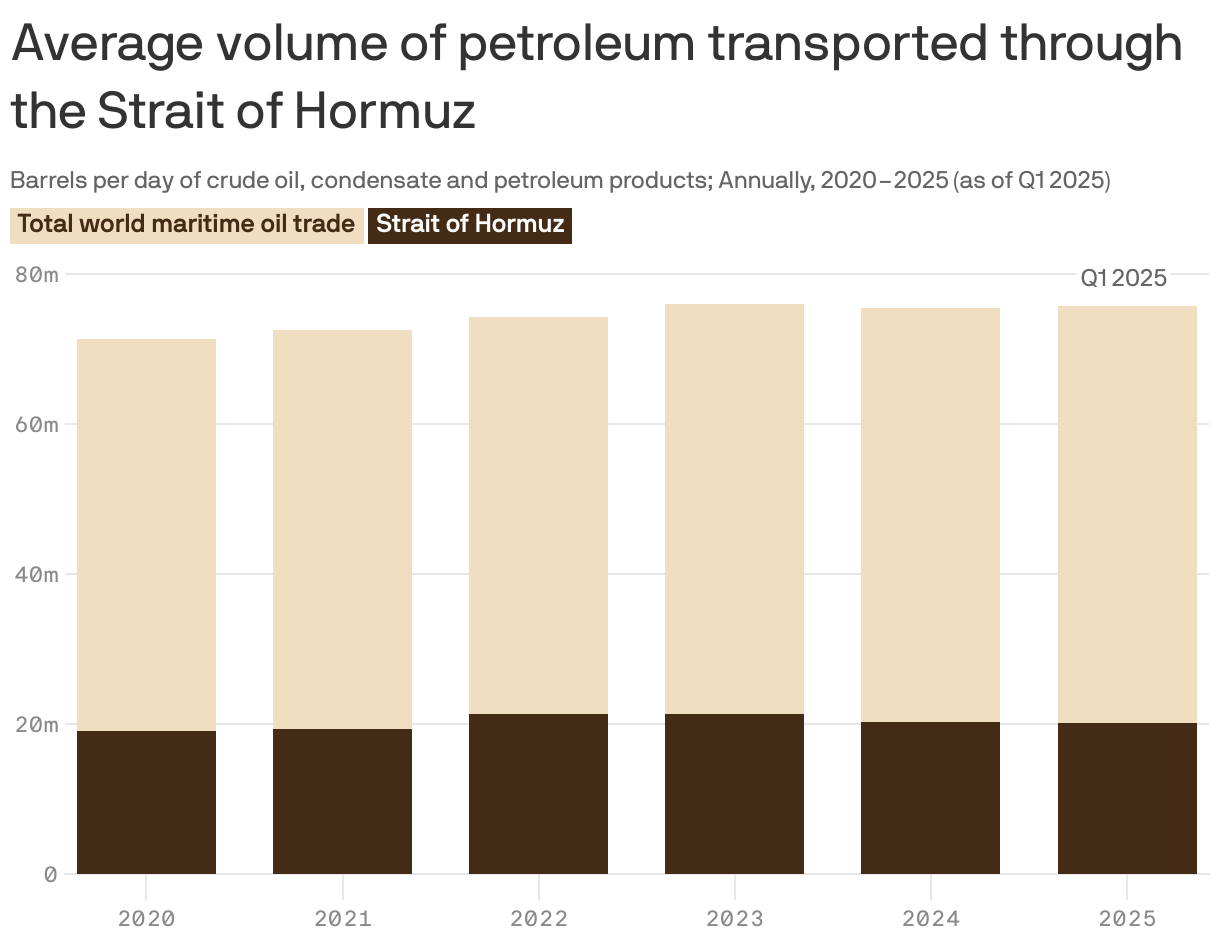
I'm re-upping this chart we ran recently because of (waves arms around) all that's happening right now.
3. 🌏 A nuanced climate case for LNG over coal
LNG brings fewer Earth-warming emissions than coal, but that oft-debated comparison sets the bar way too low, a new report finds.
Why it matters: The International Energy Agency analysis arrives amid a growing global LNG market.
- In the U.S. — already the world's largest player — another wave of projects is under construction or getting closer to it.
Catch up quick: While gas produces far less CO2 than coal when burned, LNG's climate case is tricky.
- That's largely due to competing, hotly debated estimates of methane emissions in the value chain from gas wells, processors and more.
- The IEA report looks across the LNG network, spanning data from hundreds of facilities and ships.
What they found: There's lots of variation, but overall LNG "results in about 25% fewer emissions than coal across energy use cases."
- "More than 99% of the LNG consumed in 2024 had fewer life-cycle emissions than coal," it finds. That's based on methane's 100-year global warming impact.
- Methane is more potent yet shorter-lived in the atmosphere than CO2, but IEA found that when you shrink the comparison to 20-year scales, that 2024 total is still 90%.
Yes, but: The LNG value chain before combustion is nonetheless a really big emissions source — Bloomberg points out its annual output is larger than Italy's!
- The report finds lots of cost-effective opportunities to cut emissions.
- It explores investments needed for electrification, methane reduction, and even carbon capture, seeing an overall opportunity to slash 60% of value chain emissions for $100 billion.
The bottom line: Get past the coal comparisons, IEA urges.
- "Those making an environmental case for LNG use need to focus on minimising its GHG emissions intensity; it is not enough just to surpass the emissions performance of the most carbon-intensive fuel."
4. ⚖️ SCOTUS widens EV battlefields in California
A Supreme Court decision could give fuel industry groups fresh chances to challenge aggressive California EV policies.
Why it matters: California is by far the nation's biggest auto market, and other states have discretion under the Clean Air Act to follow its rules.
Catch up quick: The high court ruled 7-2 Friday that fuel producers have standing to challenge EPA approval of California rules first imposed over a decade ago.
- Justice Brett Kavanaugh's ruling overturns an appellate decision on standing, siding with fuel producers who say they're harmed by the "clean car" rules.
- It doesn't address the merits of the EPA Clean Air Act waiver issued in 2022 that reinstated rules first issued in 2012.
What we're watching: Whether and how it could influence separate battles over EPA's 2024 blessing of California's newer rules that mandate the end of gas-powered car sales in 10 years.
- Congress passed and President Trump recently signed a measure to scuttle EPA waivers that allowed those rules. But California officials are litigating the matter.
The bottom line: The SCOTUS ruling "certainly establishes a good precedent for us to engage as impacted parties in future challenges," Ericka Perryman, a spokesperson for American Fuel & Petrochemical Manufacturers, said via email.
- She also notes the case over the older California rules now reverts to the appellate court, where the question of what EPA Clean Air Act waivers can and can't do is "squarely at issue."
5. 🚧 Where the data centers are heading


This chart shows how data center development is spreading across the nation as hyperscalers expand their AI operations.
The big picture: A new Wood Mackenzie report notes that securing grid connections and power supplies are the biggest constraint on hyperscalers.
- As a result, planned projects are "extending beyond traditional markets into states such as Pennsylvania, Ohio, Indiana and Iowa, where large-scale data centre construction is a new phenomenon."
6. 🧮 Number of the day: nearly $15.5 billion
That's the value of U.S. low-carbon manufacturing and energy projects that have been scuttled or downsized this year, per the latest tracking data from the nonprofit E2 out this morning.
Why it matters: The tally can be partly chalked up to Trump 2.0 pulling back support and uncertainty as Congress weighs vastly paring back the IRA.
📧 Did a friend, colleague or an AI chatbot send you this newsletter? Welcome, please sign up.
🙏 Thanks to Chris Speckhard and Chuck McCutcheon for edits to today's edition, along with the brilliant Axios Visuals team.
Sign up for Axios Generate


/2025/06/22/1750619359602.gif?w=3840)