Axios Generate

August 19, 2024

🥞 Welcome back! We're sprinting into the week with 1,074 words, 4 minutes.
🎸 Exactly two years ago, young Aussie punk rockers The Chats dropped their second studio album, which provides today's intro tune...
1 big thing: Nvidia's forecasting advance
Exclusive: A new generative AI weather model from Nvidia Research significantly advances the accuracy of short-range weather forecasting, helping to predict hazards from flash floods to tornado outbreaks, the company first told Axios.
Why it matters: This is the first AI model to demonstrate improved skill at simulating extreme weather events down to the kilometer scale, Nvidia claims.
- If this advance is replicated by other researchers, it could usher in a new era of even more accurate short-term forecasts.
- That could save lives and money by helping people stay safe and protect their property.
The big picture: Until now, AI weather and climate models from Nvidia, Microsoft, Google and researchers elsewhere had demonstrated advances in using AI and machine learning to produce medium-range, global weather projections that rival or beat conventional, physics-based models run on supercomputers.
- In addition to accurate forecasts, the new model, outlined in a study out today as a preprint, could help scientists take global climate change projections and more accurately apply them to local scales.
- This is called "downscaling," and it too has historically been computationally limited.
What they're saying: "I'm convinced we're at that moment now where AI can compete with physics for storm-scale prediction," study coauthor Michael Pritchard, a climate scientist at Nvidia, told Axios.
Zoom in: The new model, discussed in a paper submitted for peer review, is known as StormCast. The paper is written with scientists from the Lawrence Berkeley National Laboratory and University of Washington.
- Nvidia Research claims the model can operate at the mesoscale level, which means it can resolve small-scale weather systems and includes some of the complicated physics of how thunderstorms form, intensify and dissipate.
- Such "convection-allowing models" are used to predict the evolution of derechos, squall lines and deadly flash flood events, among other applications.
- According to the study, the model already beats the accuracy of the top U.S. short-range weather prediction model, known as high-resolution rapid refresh, or HRRR, when it comes to predictions of how storms will evolve on weather radar.
Yes, but: Pritchard cautioned that physics should not give way entirely to generative AI but could be used to help test new models' "physical credibility that [enables] us to trust AI predictions and to understand their boundaries."
What's next: Nvidia is working with The Weather Company as well as Colorado State University to test the new model, and may eventually make it more widely available.
2. On our radar: Kamala Harris and climate
We're very curious to see how Democrats shape their energy and climate message at their convention that opens today.
Why it matters: Party conventions are high-profile, prime-time chances to pitch big themes — and maybe even offer real policy hints.
A few things we're watching...
⏱️ How much time the top speakers devote to the topics. To date Kamala Harris and Tim Walz have put scant focus on climate, a sign they see other topics like health care and food costs being far more important to voters.
đź‘€ Whether Harris goes there. Republicans are frequently reminding voters of her 2019 calls to ban fracking, which her campaign has walked back.
- I highly doubt she'll address it head-on. But keep an eye on whether Harris offers any views on the domestic oil and gas industry — on prices, on climate, on production, and more.
The latest: The Democratic National Committee unveiled its 2024 platform this morning.
- Platforms are nonbinding messaging documents, but offer clues.
- The new one backs aggressive climate steps, but it's also heavier on energy affordability than the 2020 document.
- It doesn't repeat the 2020 goal of banning new oil and gas permitting on federal lands.
- There are a few new policy ideas, like a "disaster resilience tax credit" to help families and small businesses.
What's next: Look for Democrats to mostly stitch climate into their economic pitch, casting Biden-Harris policies as ways to support domestic clean tech industries and jobs.
- Convention organizers told E&E they expect a part of one evening to highlight climate messaging.
3. The equity funding slump — and AI's potential role
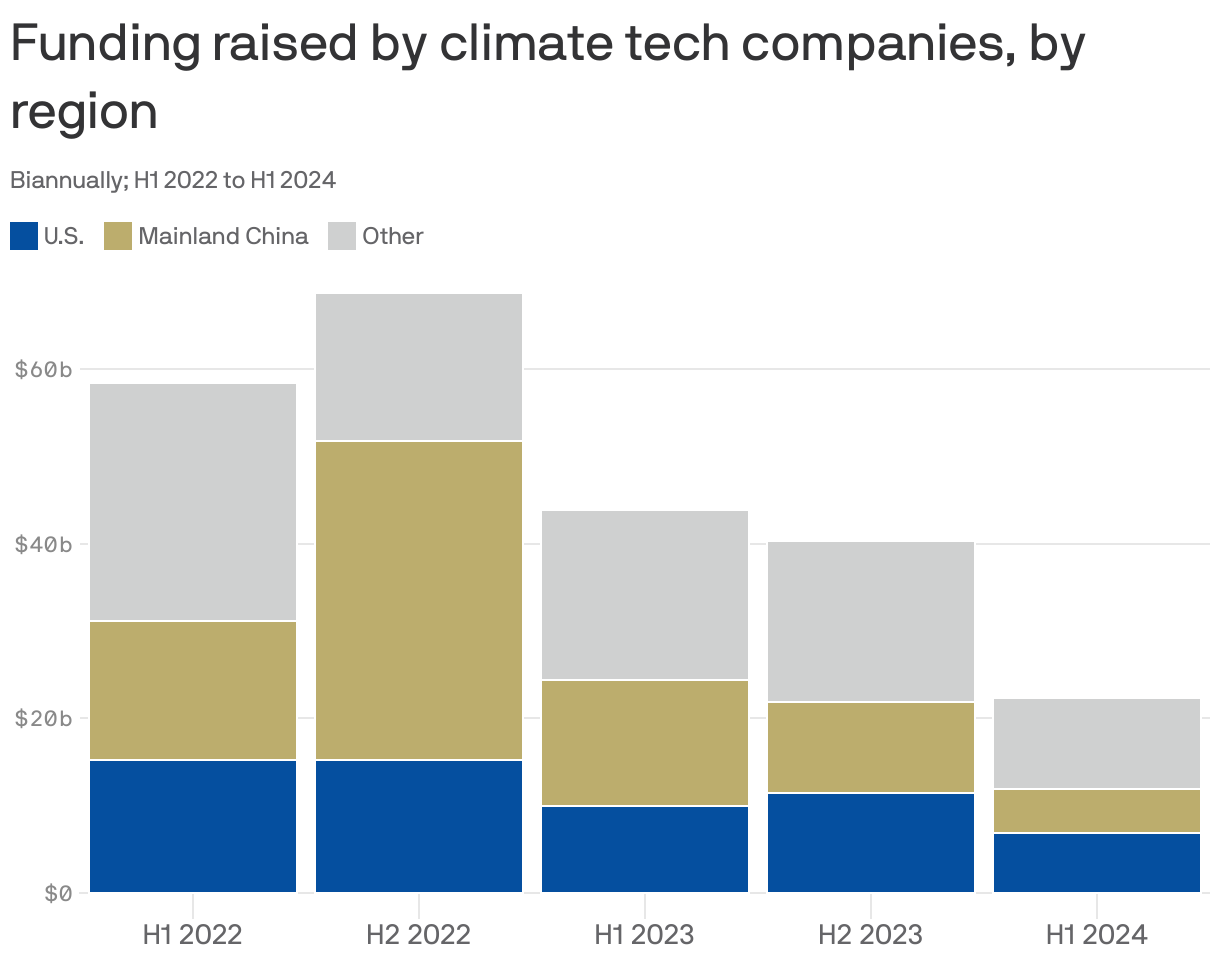
Equity funding for climate tech companies in public and private markets is slumping in 2024, per new data from the research firm BloombergNEF.
Why it matters: These companies provide — or are developing — goods and projects that help cut emissions.
Threat level: Macroeconomic trends like higher interest rates help explain the slowdown, BNEF analyst Musfika Mishi tells Bloomberg.
- But the report also suggests that investor "fascination" with AI startups may be redirecting some cash.
The big picture: The U.S. has a larger piece of this smaller pie, moving ahead of China as the top market with $6.7 billion mobilized, BNEF said.
- The report said the U.S. is increasingly seen as a lucrative region thanks to the IRA, which helps provide a market for climate tech.
- Total funding in the first half totaled $22 billion, about half of 2023's first half.
The bottom line: The slowdown is pronounced but only captures one feature of the finance landscape.
- Overall investments in manufacturing and energy projects are rising domestically amid unprecedented U.S. tax and grant support.

4. Analysis: IRA drives CO2 cuts but misses Paris target
The IRA and other policies are driving U.S. CO2 cuts, but higher project costs and other forces are slowing the pace, a new study shows.
Why it matters: The Princeton-led REPEAT Project provides some of the most sophisticated U.S. policy analysis out there.
The big picture: It sees a 32%-34% cut in U.S. greenhouse gas emissions by 2030 relative to 2005 levels, reaching 40%-43% by 2035.
- That's a lot! But it lags the White House goal under the Paris Agreement of a 50% drop by 2030.
Threat level: Updated assumptions yield smaller emissions cuts than the 2023 version of this annual study.
- There's a stronger economic outlook, higher energy demand, and higher project finance and capital costs.
- There's also more info project announcements to work with.
- Add it up and 2035 emissions are 9-12 percentage points higher than in last year's version.
The intrigue: Recent regulations — like EPA CO2 rules for power plants and cars — would claw back a chunk of those losses if they survive the election and the courts.
The bottom line: Lots of uncertainties — like levels of data center demand — are stuffed into these kinds of estimates. But it's an important guide.
Go deeper: 2024 analysis...lead author Jesse Jenkins' summary thread on X.
📨 Did a friend, colleague or even a frenemy send you this newsletter? Welcome, please sign up.
🙏 Thanks to Chris Speckhard and Chuck McCutcheon for edits to today's edition, along with the brilliant Axios Visuals team.
Sign up for Axios Generate