Axios Generate

September 06, 2024

🕺 Made it! Friday. We're cruising into the weekend with 1,156 words, 4.5 minutes.
📻 We've got Texas on our minds (as you'll see below), so the Lone Star State gets top billing in today's intro tune...
1 big thing: Texas is everything
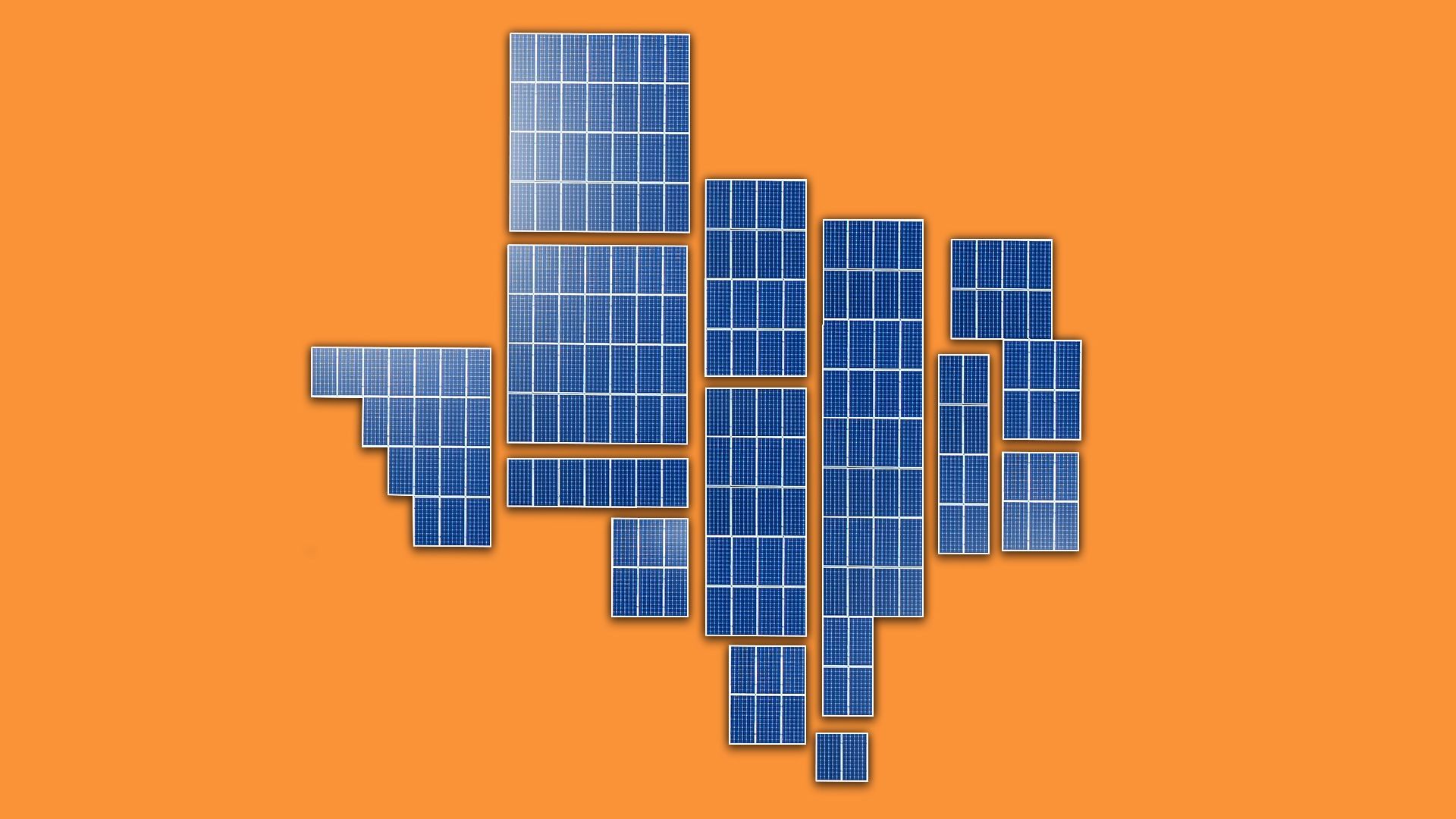
Texas passed California as the state with the most power-generating capacity from big solar projects, new industry data shows.
Why it matters: Growth of these utility-scale arrays highlights the wider trend that Texas is a lab for almost every aspect of the energy and climate future.
The big picture: Long the country's biggest wind producer, Texas is now second in battery storage.
- The state's utility-scale solar capacity reached 21.9 gigawatts in Q2, moving ahead of California's 21.1 GW, the American Clean Power Association (ACP) said yesterday.
- That's one-fifth of the country's total, the industry group said. And another 12 GW are under construction, more than the next five states combined, per ACP.
- California remains ahead on solar when you include rooftop systems.
How it works: My in-depth research suggests Texas is big, sunny, and windy. So that's one reason it's a renewables hotspot as demand grows and peaks get higher. But that alone doesn't explain why developers flock there.
- University of Texas at Austin expert Joshua Rhodes said via email that the state's cost allocation process for building transmission is simpler than other jurisdictions.
- Phil Sgro, an ACP spokesman, calls Texas a "unique" market with a "timelier permitting and interconnection process in ERCOT than in other regions."
- Grid stability is a big focus in a changing climate, with crises in recent years in the state exposed to extreme heat, cold, and hurricanes.
- Batteries boost flexibility, and Sgro said via email that ERCOT is helping storage "effectively participate" in wholesale markets.
Rhodes also points to the state's Competitive Renewable Energy Zones program launched in the mid-2000s that helped get wind to population centers. Now that transmission helps solar too.
- Other reasons include grid manager ERCOT allowing new resources even if transmission constraints mean some waste, called curtailment, Rhodes said.
- Also on the list: Texas' deregulated system makes it easy for corporations to contract directly for renewables, he said.
🛢️ State of play: Other things to watch in Texas:
- If U.S. oil giants based there can truly scale low-carbon businesses adjacent to their fossil fuel lines.
- Exxon and Chevron are investing in carbon capture, hydrogen and more, while Exxon is venturing into lithium extraction too.
- Occidental Petroleum is heavily involved in building direct air capture — helped along by DOE funding.
- And watch the country's largest oil and gas producing state to see how long frackers can keep learning how to extract more and more resources.
Meanwhile, Texas is increasingly a hotbed for climate tech startups, who now rub shoulders with incumbent energy companies.
- It's not random that the prominent startup incubator Greentown Labs chose Houston as their second location in 2020.
The bottom line: Texas is everything.
2. The globe just had its hottest summer on record
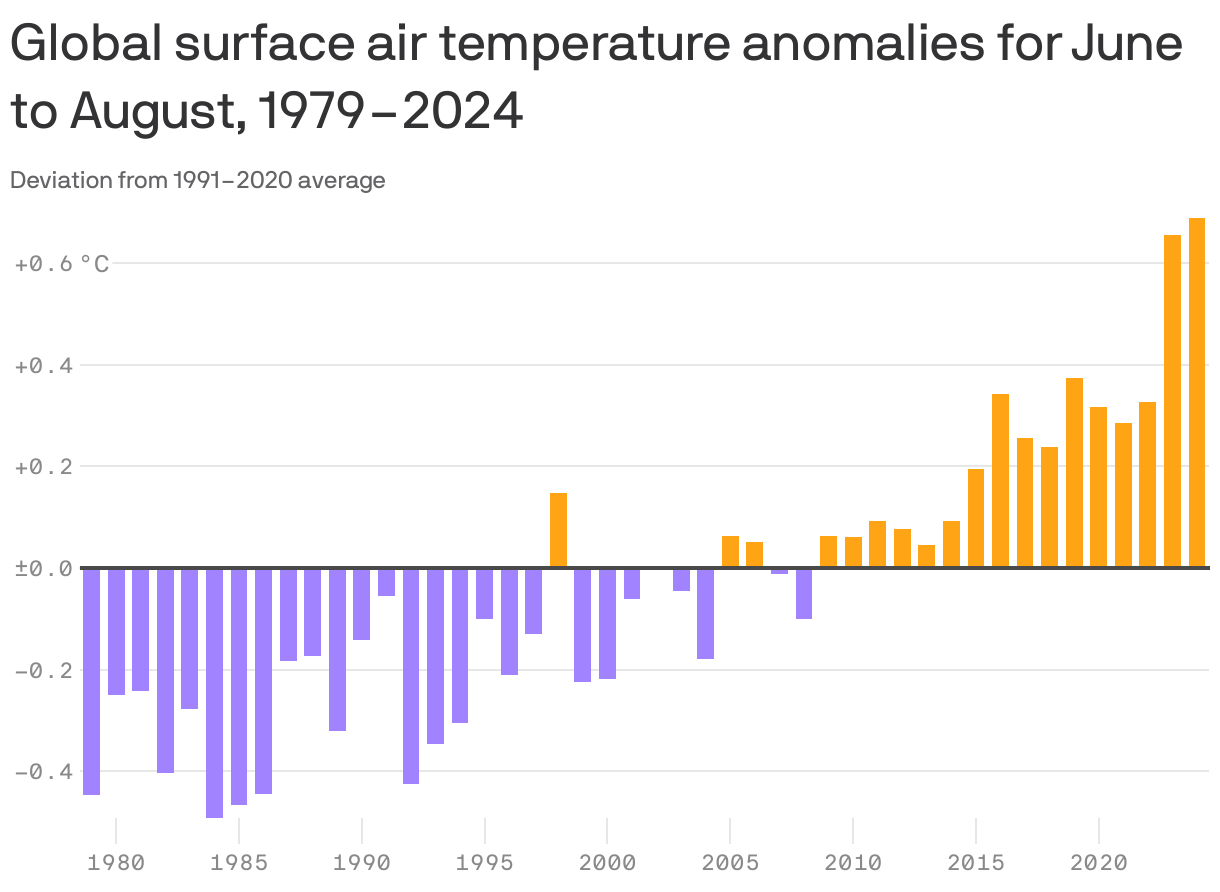
The global average temperatures from June through August were the hottest on record, according to the Copernicus Climate Change Service.
Why it matters: The period, which comprises summer in the Northern Hemisphere, brought a spate of extreme heat, wildfires and other extreme events.
- Europe had its hottest summer on record, with deadly heat events repeatedly affecting Greece, Italy and Spain, along with wildfires.
Zoom in: Copernicus, an EU science center, now projects that 2024 will surpass 2023 as the globe's hottest year on record.
- Thirteen of the past 14 months have seen global average surface temperatures that exceeded 1.5°C above preindustrial levels, which is a key warming target under the Paris Agreement.
- In July, the globe recorded a string of the four hottest days on record stretching back for at least 100,000 years.
Yes, but: The Paris pact referred to long-term averages, on the timescale of several decades, rather than a far shorter timespan of 13 months.
By the numbers: The difference between the year-to-date and the previous hottest year in 2023 is 0.23°C (0.4°F) above the 1991-2020 average, Copernicus scientists found.
- This effectively seals the deal for a warmest year in their books. "The average anomaly for the remaining months of this year would need to drop by at least 0.3°C for 2024 not to be warmer than 2023," Copernicus said in a statement.
- The heat was not confined. In Longyearbyen, on the Arctic island of Svalbard, Norway, August was the hottest month on record, crushing previous records, with an average temperature of 11°C (51.8°F).
What they're saying: "The temperature-related extreme events witnessed this summer will only become more intense, with more devastating consequences for people and the planet unless we take urgent action to reduce greenhouse gas emissions," Samantha Burgess, deputy director of the Copernicus Climate Change Service, said in a statement.

3. 🛢️ What they're saying as OPEC+ delays production hike
Wondering what to make of OPEC+ backing off plans to boost production?
Catch up quick: The group now won't start phasing out 2.2 million barrels per day of voluntary curbs until December — two months later than planned.
- The recent price slide halted after yesterday's decision, with Brent crude trading just above $73 a barrel this morning.
What they're saying: "Essentially, [yesterday's] move undermines the argument that the proposed taper plan was something of a runaway train without a brake," RBC Capital Markets' Helima Croft writes in a note.
- While some producers have been eager to boost sales even amid ample supplies, the price decline may be beyond what OPEC+ will tolerate. ClearView Energy Partners calls the $14 per barrel drop since July 4 the "primary" reason.
- HSBC analysts, in a note ahead of the decision, said a delay would signal a "belated admission" by the cartel that demand growth is weak.
Between the lines: ING analysts said OPEC+ may be waiting on the U.S. election. A Trump win could bring tougher enforcement of sanctions against Iran, creating more space for new OPEC+ barrels.
What's next: "[L]ooking at the projected balance of supply and demand, OPEC+ is simply kicking the can down a very uphill road." Bloomberg columnist Javier Blas writes.
4. 🏃Catch up quick on policy: mining and Trump
⛏️ Biden officials have tentatively approved Perpetua Resources Corp.'s mining project in Idaho that includes antimony, a metal used in EV batteries and defense applications.
- Our thought bubble: New U.S. mines are hard to advance. But this shows a path to approval under a Democratic administration for mineral projects tied to national security, Axios Pro's Daniel Moore writes.
- Go deeper: Unlock more of Daniel's reporting on the mine, and if you need more smart, quick intel on energy and climate policy for your job, get Axios Pro.
🗳️ Former President Trump said during an economic speech yesterday that if elected, he would look to "rescind all unspent funds" in the 2022 climate law.
- Why it matters: It's a clear signal of his intent to end unprecedented tax breaks and grants for low-carbon energy.
- Reality check: While getting Congress to repeal the IRA is unlikely, Trump could slow implementation and make credits harder to access.
5. 🚗 Number of the day: over 50%
That's the share of ride-hailing trips in three big California metro areas that replaced more sustainable options, or created new vehicle miles, UC-Davis research shows.
Yes, but: It reflects rides in 2018 and 2019 (good data takes time!). Peer-reviewed paper...summary release
📨 Did a friend, colleague or even a frenemy send you this newsletter? Welcome, please sign up.
🙏 Thanks to Chris Speckhard and George Moriarty for edits to today's edition, along with the brilliant Axios Visuals team.
Sign up for Axios Generate