
Axios Generate

August 20, 2024

✅ Tuesday. We've got a speedy 994 words, 4 minutes.
🎹 On this date in 1982, synth-pop duo Yazoo released their debut album "Upstairs at Eric's," which provides today's heartfelt intro tune...
1 big thing: Why climate is missing from climate groups' ad splurge

The first three spots in climate groups' new $55 million, swing-state ad buy supporting Kamala Harris don't mention climate change or global warming.
Why it matters: It's a striking example of a wider — and longstanding — strategy from Democrats and allies to make economics and jobs the tip of the spear.
- And it's one that emphasizes consumer costs right now as inflation is high on the political radar.
🗞️ Driving the news: The political arms of the League of Conservation Voters, Climate Power and the Environmental Defense Fund unveiled the campaign yesterday.
- The effort, working with the Future Forward PAC, focuses on Arizona, Georgia, Michigan, Nevada, Pennsylvania and Wisconsin, and Nebraska's 2nd congressional district.
- It's the largest ad buy ever from climate groups in a presidential race, per LCV. The NYT first reported on it.
What's inside: One spot backs into energy, opening by touting Harris going after banks that "unfairly foreclosed" on people when she was California's AG.
- It then cites her prosecution of oil companies' environmental violations, while saying Donald Trump "has always stood with corporations that rip us off."
- Another starts with "prices are too high" and says Harris will attack oil industry "price gouging," and that growing "clean" energy production will cut power bills.
A third begins by saying a Harris presidency's goal would be strengthening the middle class. It lists "advanced manufacturing and clean energy" as ways to get there, alongside capping drug prices and strengthening social security.
🖼️ The big picture: The ads are consistent with the pocketbook topics central to the race and voters' longstanding concerns — and efforts to help Harris on the economy, where polls show her lagging Trump.
- Danielle Deiseroth, executive director of the lefty polling outfit and think tank Data for Progress, notes "kitchen-table economic issues have been a major concern this cycle."
- "So communicating to voters how clean energy will help relieve the pain in their wallets is key to defining the vice president's broader narrative around curbing high prices," she said via email.
Yes, but: There's a political upside to talking about climate head-on, said Ed Maibach, who directs the Center for Climate Change Communication at George Mason University.
- He tells me this may alienate 20%-30% of voters, but "those voters aren't going to vote for Harris anyway."
- "Among the 60 percent who might vote for Harris, they don't turn off when they hear the words climate change. Indeed, many of them turn on when they hear those words," he said via email.
🎽 Catch up quick: A note on the price gouging thing: Multiple Federal Trade Commission probes over the years have found little to no evidence of this in gasoline markets.
- But the FTC recently accused ex-Pioneer Natural Resources CEO Scott Sheffield of attempting to collude with OPEC on oil prices — claims he disputes.
What we're watching: Whether later phases of this ad buy will tackle climate directly.
2. 🏃🏽♀️Catch up quick: Crude, tech finance, Trump


🛢️ Oil prices are tumbling again this week, continuing the latest decline that began a few days ago.
- Why it matters: The drop shows traders weighing the prospect of negotiations paving the way for a Middle East cease-fire, and weak Chinese economic signals are also weighing on prices, ING analysts note.
- State of play: Brent crude is trading at $77 this morning.
🏗️ Low-carbon cement startup Fortera closed an $85 million Series C round to expand deployment of tech that's already operating at a California plant.
- Why it matters: Cement production creates around 7% of global fossil CO2 emissions.
- Driving the news: Existing backers Khosla Ventures and Temasek joined first-time investors including Wollemi Capital and Presidio Ventures in the round.
- How it works: Fortera's tech operates alongside existing cement plants, capturing CO2 from high-heat kilns and mineralizing it as feedstock for its "ReAct" cement product.
🗳️ Via Reuters, "Donald Trump said on Monday that if elected he would consider ending a $7,500 tax credit for electric-vehicle purchases and that he would be open to naming Tesla CEO Elon Musk to a cabinet or advisory role."
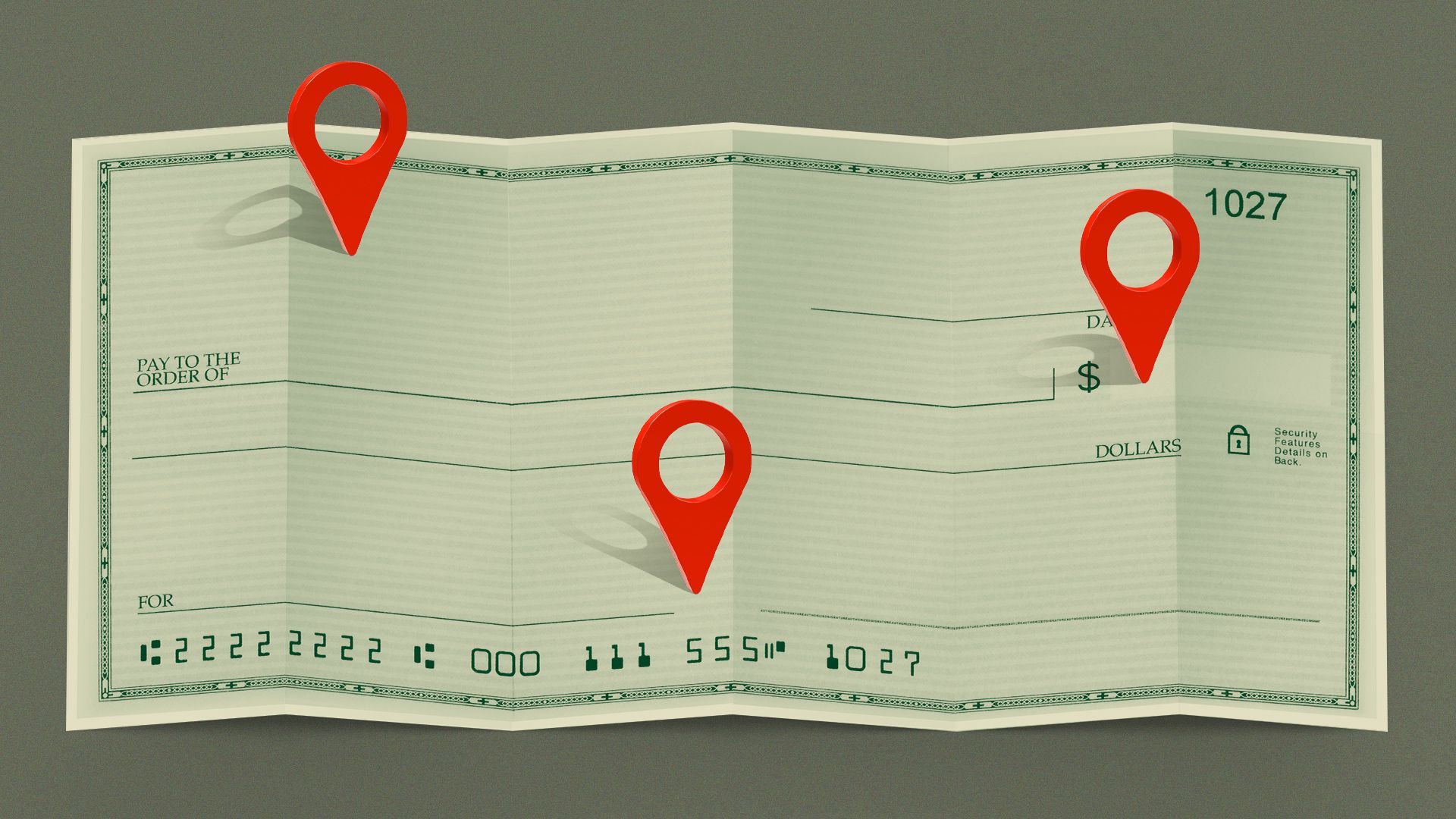
3. Wanted: a better map for place-based policies
Federal climate policies that prioritize disadvantaged areas and places tethered to fossil fuels aren't precise enough to help intended recipients, a new analysis finds.
Why it matters: "[T]ens of billions of dollars, if not more, will flow to places that don't need the money," per analysts with the nonpartisan Resources for the Future.
- With limited resources, the benefits will be "spread a mile wide and an inch deep." They'll often fail to reach people facing the biggest environmental and socioeconomic burdens.
State of play: They explored the cross-agency Justice40 Initiative and IRA policies like tax incentives for zero-carbon projects in low-income or "energy communities."
- The latter term means places with closed coal mines or coal-fired power plants; regions with jobs and revenues linked to fossil fuels that have certain unemployment levels; and areas with contaminated industrial sites.
Threat level: These instruments are too blunt, RFF researchers say, noting the four policies examined cover 79% of U.S. land mass and 64% of the population.
- The analysis finds "absurd outcomes."
- Think San Francisco, San Diego, and Chicago qualifying as "energy communities," while much of the West Texas oil patch doesn't. Or affluent places with big university campuses qualifying as low-income.
Yes, but: The White House says its overall "Investing in America" agenda — the IRA, CHIPs and infrastructure laws — is helping disadvantaged areas.
- High-poverty counties are receiving 58% more federal funding per capita, and over three-fourths of "IRA-related private sector investments" are in counties with below-average household incomes, per the White House.
What we're watching: RFF urges policymakers to use more precise targeting, tighten eligibility requirements, and adjust criteria to find areas facing the biggest cumulative burdens.
4. 🚗 Number of the day: 64.6 minutes
That's the average amount of time each day that household vehicles were driven in 2022, per Transportation Department figures.
Why it matters: There's plenty of parked time for charging in most cases, even relatively slow chargers.
The stat comes from DOE's handy "Transportation Fact of the Week" series.
📨 Did a friend, colleague or even a frenemy send you this newsletter? Welcome, please sign up.
🙏 Thanks to Chris Speckhard and Chuck McCutcheon for edits to today's edition, along with the brilliant Axios Visuals team.
Sign up for Axios Generate