
Axios Generate

November 27, 2024

🦃 Happy Thanksgiving eve! We're keeping things light before the big day with just 1,027 words, 4 minutes.
🧹 Housekeeping note: We're taking a quick break and returning Monday.
🎸 This month marks 45 years since Texas blues-rock geniuses ZZ Top released the album "Degüello," which has today's intro tune...
1 big thing: Record-breaking, damaging Atlantic hurricane season ends
The active and destructive 2024 Atlantic hurricane season is nearing its official end on Saturday after a puzzling yet profoundly damaging run.
- The season featured an early flareup of activity — then a long, mysterious pause, followed by a backloaded blitz of storms that included two major hurricane U.S. landfalls.
Why it matters: Some of the season's storms bore the hallmarks of human-caused global warming, especially their rapid intensification and devastating amounts of rainfall.
Zoom in: Due to a combination of record hot ocean temperatures and predicted La Niña conditions in the tropical Pacific Ocean, forecasters universally projected an above-average to much-above-average season.
- In the end, the North Atlantic basin spun up 18 named storms, with maximum sustained winds of at least 39 mph. Eleven of these storms were hurricanes, along with five major hurricanes of Category 3 or greater, according to NOAA.
- Five hurricanes hit the mainland U.S., including two major hurricanes, Hurricanes Helene and Milton. Helene alone caused more than 200 fatalities.
- On July 1, the Atlantic saw its earliest Category 5 storm on record, with Hurricane Beryl.
A typical Atlantic hurricane season features 14 named storms, seven hurricanes and three major hurricanes.
Between the lines: The unusually hot sea surface temperatures that existed throughout the season across the Atlantic — from the Gulf of Mexico and Caribbean to the central and eastern Atlantic — set records and stemmed in part from human-caused global warming.
- When the atmosphere was cooperative, these hot ocean waters served as a key ingredient for extraordinarily rapid hurricane intensification rates throughout the season.
- Hurricane Milton's maximum sustained winds, for example, jumped by an astonishing 90 mph in a 24-hour period from Oct. 6 to Oct. 7, one of the most significant intensification rates on record.
Researchers found that climate change worsened the flood impacts of Helene by boosting its total rainfall by about 10%, and increasing the likelihood of such a severe event by up to 70%.
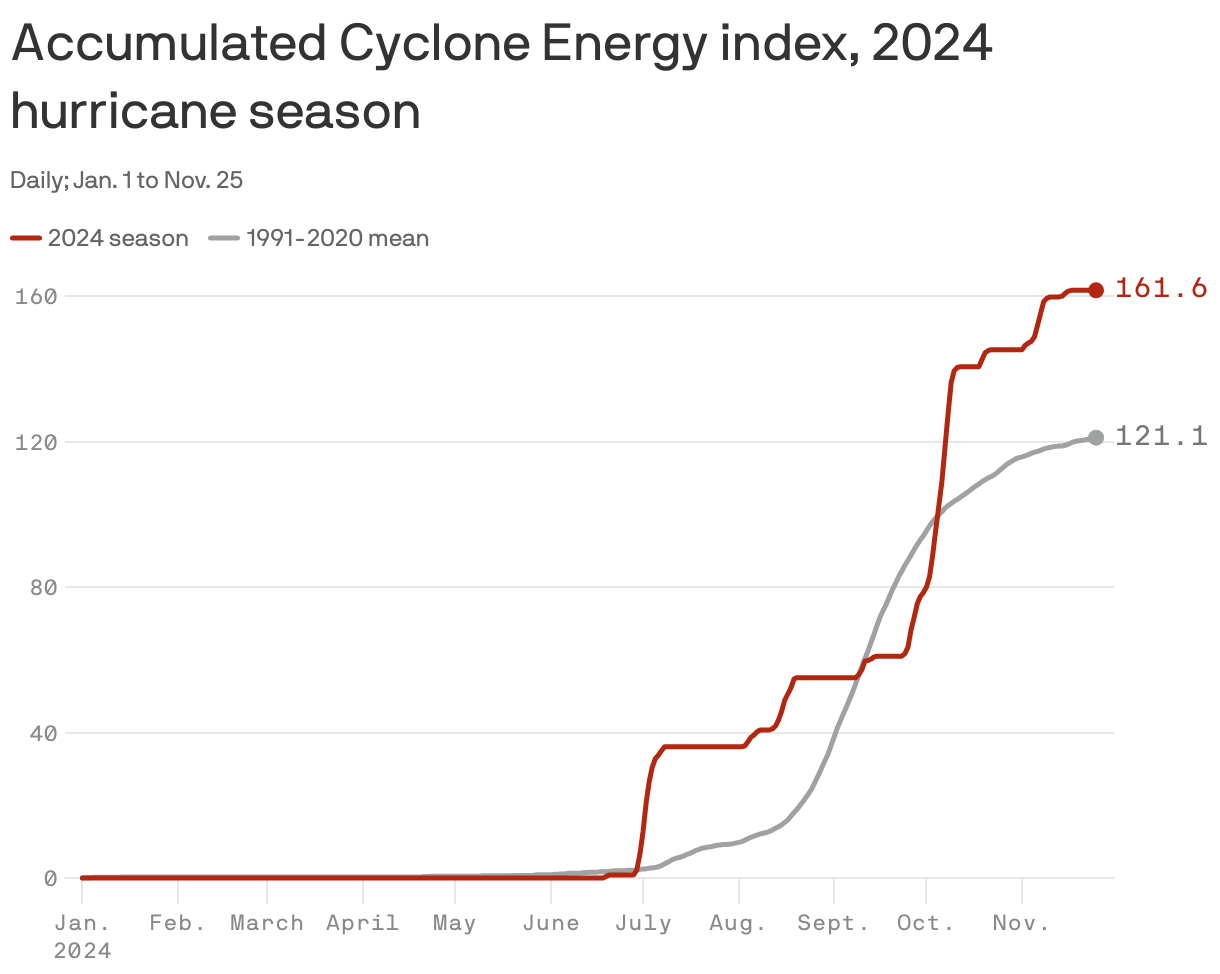
The intrigue: The Accumulated Cyclone Energy, or ACE Index, is a metric that incorporates the number of storms and their intensity and duration. It's considered to be a reliable indicator of a season's overall activity level.
- Going by this index, the 2024 Atlantic hurricane season was clearly exceptionally active.
The bottom line: While the season wasn't quite as extraordinarily active as some had predicted, it was above average in virtually all categories and wrought impacts that will be remembered for generations.
2. 🛢️Tariff pushback and more petro-notes
💵 Oil companies aren't happy with President-elect Trump's plans to impose new tariffs on imports from Canada — the largest foreign petro-source — and Mexico.
- Why it matters: While the industry generally supports Trump policies, the new 25% tariffs announced this week are a huge exception — if they indeed apply to oil.
- Friction point: Chet Thompson, CEO of American Fuel & Petrochemical Manufacturers, said refiners depend on Canadian and Mexican crude to "produce the affordable, reliable fuels consumers count on every day."
- State of play: While the U.S. produces massive volumes of crude, a number of refineries are equipped to run on imported heavier grades from Canada and elsewhere. It bounces around but the U.S. imports roughly 4 million barrels of Canadian crude per day.
- What we're watching: The specifics of Trump's wide-angle vow for 25% new tariffs, and how much they might boost pump prices if they proceed. Industry calls for oil to be exempted may be falling on deaf ears.
🗓️ The smart money is probably on OPEC+ again pushing back plans to start unwinding production cuts when they meet virtually on Sunday.
- Why it matters: Tepid demand growth (though how tepid is up for debate) and robust non-OPEC production are making life tricky for the cartel, even though some members are keen to boost sales.
- State of play: Bloomberg and Reuters, citing unnamed sources within the group, say they're discussing another delay in beginning the phased, incremental return of 2.2 million barrels of production.
- What they're saying: Analysts with RBC Capital Markets, in a note, said market "wildcards" stemming from Washington's change in power will help tilt things toward delay, possibly until Q2 2025.
3. ☀️ On my screen: The deeper message behind the Adani scandal

Development advocate Todd Moss says there's a much bigger message in the bribery charges against Indian renewables magnate Gautam Adani and colleagues.
Why it matters: It reveals a need for transparency in opaque power deals — including renewables contracts — in many countries.
- The sector is "rife with overpayment, questionable deals, and lack of competition, all because of closed buying systems and secret contracting," Moss, executive director of the Energy for Growth Hub, writes on his personal Substack.
Threat level: Moss, a former State Department official, notes many countries are adding cheaper renewables to their power mix, yet prices are going up.
- "Is that discrepancy because countries actually aren't getting such great prices? Are there other hidden costs and giveaways? We don't know because the contracts are secret."
What we're watching: His post says some governments, including Ghana, have made progress on transparency.
- But the World Bank should help spur more open books in power markets, Moss argues.
The bottom line: "The [Adani] scandal will undoubtedly be a setback for energy deployment in many countries," he writes.
- "But it could help to spur changes that will allow clean energy to scale even faster and cheaper, if we draw the right lessons. That's a big IF." Full post.
4. 💼 Biz notes: Hydrogen slump and the UAE's new fund
🛑 Norsk Hydro, the Norwegian aluminum and energy heavyweight, will phase out its green hydrogen and battery materials businesses.
- Why it matters: The company today cited "challenging market conditions" when announcing the move in a wider strategy update.
➡️ ADNOC, the UAE's state oil giant, today unveiled a major new international investment arm focused on chemicals, gas, and climate-friendly tech like low-carbon ammonia. The WSJ has more.
5. ⚡Quote of the day
"The net-zero targets get sacrificed on the altar of economic growth. If a utility has a corporate net-zero target, and it's not tied to some state law, it's really not worth the paper it's written on."— Wood Mackenzie power and renewables director Ryan Sweezey, speaking to Bloomberg
That's from a story on power demand growth — partly AI-driven — and Trump policies together giving new momentum to coal and gas.
📨 Did a friend, colleague or even a frenemy send you this newsletter? Welcome, please sign up.
🙏 Thanks to Chris Speckhard and Chuck McCutcheon for edits to today's edition, along with the brilliant Axios Visuals team.
Sign up for Axios Generate