
Axios Generate

May 01, 2023
🥞 Good morning! Today's newsletter has a Smart Brevity count of 1,118 words, 4 minutes.
📬 Did a friend send you this newsletter? Welcome, please sign up.
🎶 This week marks 35 years since genre-bending rock greats Living Colour dropped their debut album "Vivid," which provides today's intro tune...
1 big thing: Ocean temperatures' ominous spike
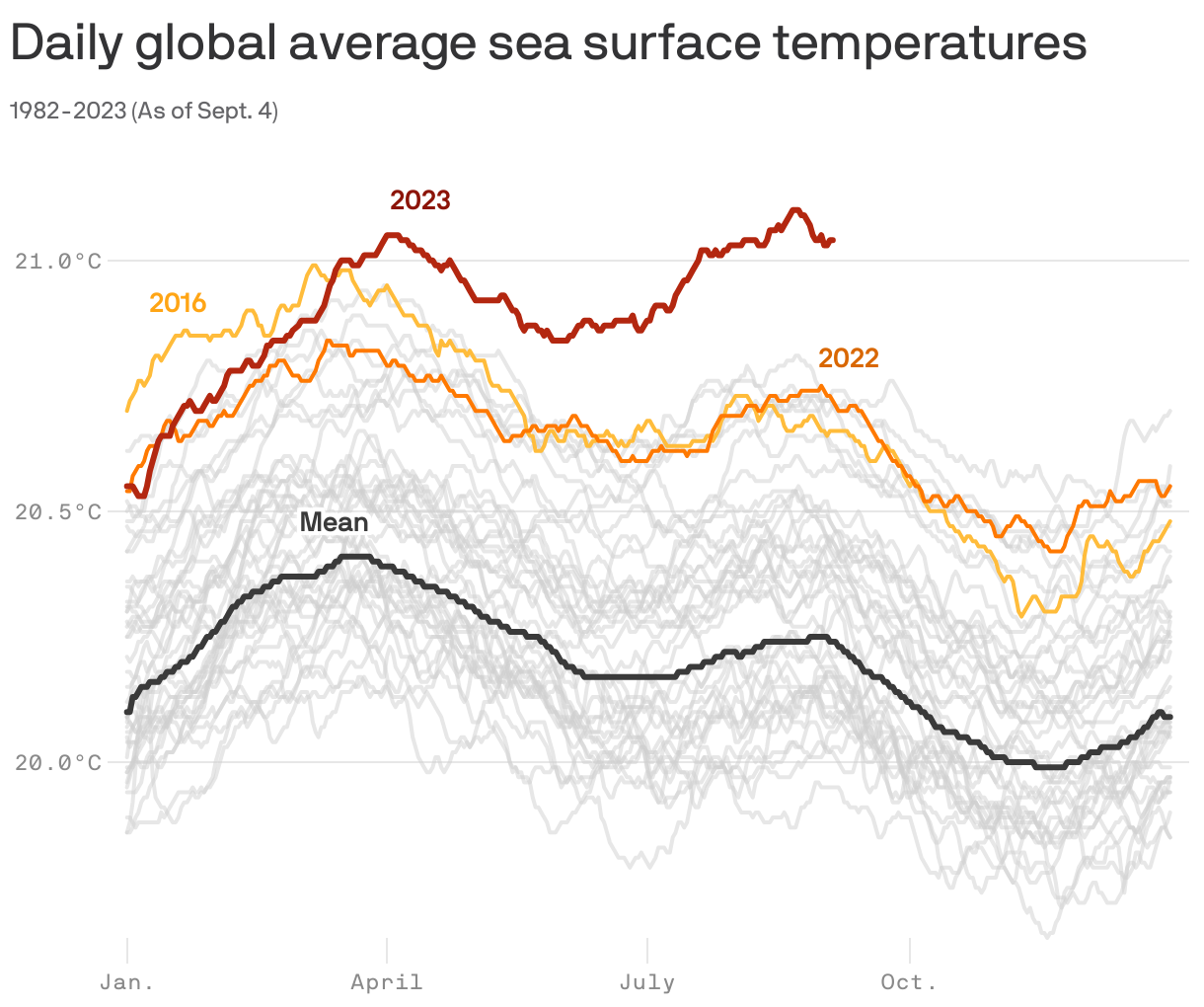
Since mid-March, the world’s oceans have been hotter than at any time since at least 1982, raising concerns among some climate experts about accelerated warming, Andrew writes.
Why it matters: Hotter oceans are hugely consequential for land areas, because they can contribute to more frequent and severe extreme weather and climate events, from deluges to heat waves.
- In addition, the temperature spike could be a sign that warming is speeding up in ways that climate models failed to anticipate.
Zoom in: While the global average sea surface temperature record is noteworthy and has ramifications, it’s not a reason to panic, climate scientists told Axios.
- The sea surface temperature spike, detected by a network of ships, buoys and satellites, is likely due to the combination of an emerging El Niño in the tropical Pacific, and another trend that scientists are far more concerned about.
- When a La Niña event gives way to an El Niño, as is happening now, large amounts of ocean heat that had been lurking beneath the ocean surface are drawn upward, according to Michael Mann, a climate scientist at the University of Pennsylvania.
Context: El Niño events are defined by above-average ocean temperatures in the equatorial tropical Pacific, along with myriad shifts in weather patterns.
Threat level: The steady and record-setting accumulation of ocean heat throughout the water column, not just at the surface, actually has climate scientists more concerned than the recent sea surface temperature spike.
- Researchers like Mann and Kevin Trenberth of the National Center for Atmospheric Research told Axios this is a clearer sign of human-caused global warming than the ongoing record sea surface temperatures.
The intrigue: Record warm ocean surface temperatures also reflect the fact that since the last major El Niño in 2016, global average temperatures have increased on land and sea.
What we’re watching: How global average surface temperatures evolve during the course of the projected El Niño, which is anticipated to take hold between the summer and fall and potentially become a strong event.
2. EPA moves to enable Louisiana CO2 storage
Illustration: Gabriella Turrisi/Axios
The Environmental Protection Agency plans to grant Louisiana state regulators permitting authority to inject carbon dioxide into underground rock formations, Ben writes.
Why it matters: It could speed up pending and future projects in a state that oil companies and others see as a key region for CO2 storage.
Driving the news: EPA floated draft plans Friday to approve the state's application for "primacy" under the Safe Drinking Water Act for permitting injection wells.
- Xan Fishman, a carbon storage expert with the Bipartisan Policy Center, said state officials must meet the same environmental standards as EPA.
- EPA has crafted "specific criteria" to ensure underground CO2 injection protects drinking water sources, the agency said.
What they're saying: State officials can act "more quickly and more predictably than [the] EPA" in Louisiana, which has "great geology" for CO2 storage, Fishman said via email.
The big picture: Carbon capture from industrial plants and permanent storage has not commercialized nearly as much as advocates have hoped.
- But the tech — and nascent plans for "direct air capture" of CO2 already in the atmosphere — has new momentum.
Catch up fast: The 2021 infrastructure law has billions of dollars in funding, and the climate law expands tax credits for storage projects.
- "Primacy would also drive private investment into the state given the increased certainty in permitting timelines," Fishman added.
The bottom line: It's a wonky but important development.
3. New York's gas ban, and more policy notes

Illustration: Annelise Capossela/Axios
🛑 New York may become the first state to ban natural gas heating and stoves in new buildings under a preliminary budget deal Gov. Kathy Hochul (D) reached with lawmakers, Ben writes.
- Why it matters: Buildings are the largest single source of state greenhouse gas emissions, including methane, state data shows. New York's total energy-related CO2 emissions were the ninth-largest in 2020, per federal data.
- Driving the news: "We’re going to be the first state in the nation to advance zero-emissions new homes and buildings, beginning in 2025 for small buildings [and] 2028 for large buildings," Hochul said late last week.
- The big picture: It's among the highest-profile steps in a larger nationwide battle over the use of gas in homes and buildings. The NYT has more.
🚚 "New big rigs and buses that run on diesel would not be sold in California starting in 2036, according to new rules approved by state regulators Friday to wean the state off fossil fuels and combat climate change." (Associated Press)
🧳 Amos Hochstein, a top State Department energy official, is moving to the White House to serve as President Biden's senior adviser for energy and investment, Axios' Barak Ravid reports.
- Driving the news: His White House portfolio will include domestic and international matters, including gasoline prices, infrastructure, supply chains and global competition. Relations with Saudi Arabia and China are within his purview.
- The intrigue: The move comes several days after Biden announced his reelection campaign. Hochstein is one of Biden's closest confidants and the timing here is not a coincidence, Ravid notes. Politico first reported the move.
4. EVs are very heavy — and that's a problem
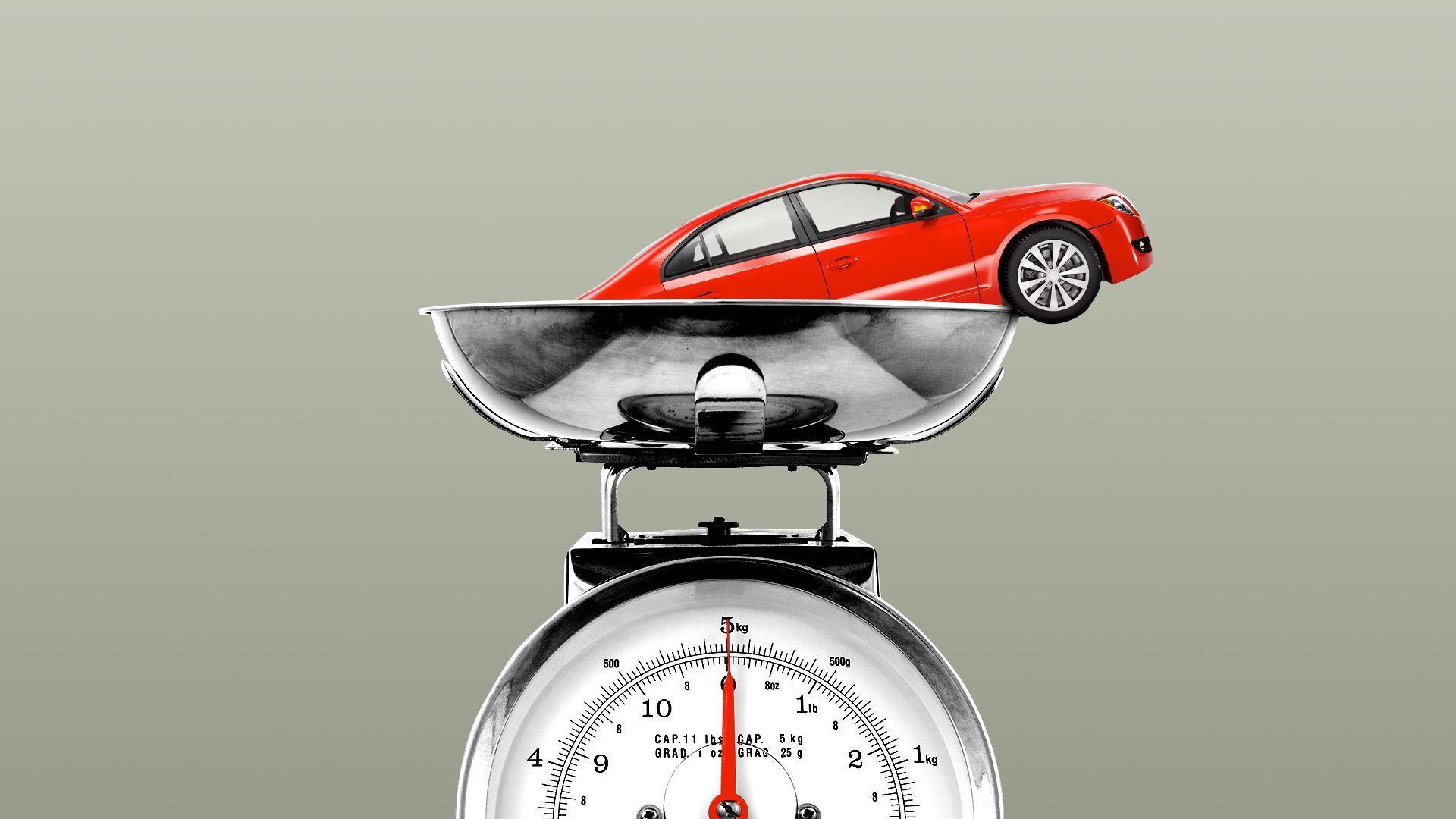
Illustration: Aïda Amer/Axios
Vehicles are adding poundage as the auto industry goes electric — and that's problematic for traffic safety, parking garages and roads, Axios' Nathan Bomey reports.
Why it matters: Gas vehicles are slowly giving way to EVs as investors, regulators and consumers clamor for more environmentally sustainable transportation.
State of play: EVs can be anywhere from hundreds to thousands of pounds heavier than similarly sized gas vehicles, because EV batteries are so much heavier than engines.
Zoom in: For example, the 2023 GMC Hummer EV, a full-size pickup, weighs more than 9,000 pounds, sporting a 2,900-pound battery.
- In comparison, the 2023 GMC Sierra, also a full-size pickup, weighs less than 6,000 pounds, according to Kelley Blue Book.
Threat level: In crashes, the "baseline fatality probability" increases 47% for every 1,000 additional pounds in the vehicle — and the risk is even higher if the striking vehicle is an SUV or pickup truck, per a 2011 study published by the National Bureau of Economic Research.
- Another area of concern is whether aging roads and old parking garages can handle the extra weight.
5. 🧮Number of the day: $1 trillion
That's the estimated 1o-year federal cost of energy and climate provisions in the Inflation Reduction Act, per analysts at UPenn's Wharton School, Ben writes.
Why it matters: The tally — with an assist from Goldman Sachs experts — is the latest to project that the law's tax subsidies for low-carbon energy will be used more widely than congressional analysts initially estimated.
💬Quoted
"This feels a bit like the U.S. shale boom 15 years ago."— Nick Cooper, CEO of the carbon storage firm Storegga
That's Cooper in a Financial Times feature about growing corporate and policymaker support for carbon removal.
🙏 Thanks to Gail Hughes and Javier E. David for edits to today's edition.
Sign up for Axios Generate

Untangle the energy industry’s biggest news stories


