Axios Generate

August 13, 2025

🐪 Hi midweek! We've got a newsy 1,238 words, 4.5 minutes.
🎧 At this moment in 2003, Beyoncé (featuring Jay-Z) ruled Billboard's Hot 100 with today's iconic intro tune...
1 big thing: Power and gasoline are diverging — in dollars and politics


Average costs to power homes have been trending upward while gasoline costs have moved largely the other way, Labor Department data shows.
Why it matters: Steadily rising demand from AI, heat, an increasingly electrifying economy and more are all pushing up power bills.
The intrigue: It all makes the politics of energy prices heading into next year's midterms worth watching.
- Democrats and green groups hope to impose a political cost for rising electricity bills.
- The killing of renewables subsidies in the budget law will send prices higher, they argue in speeches and ads.
- Trump officials, meanwhile, say they're unshackling policy constraints on fossil fuels to keep prices in check.
What we're watching: DOE's independent stats arm sees residential power costs up 4% in 2025 to 17 cents per kilowatt-hour.
- The Energy Information Administration outlook released yesterday sees another rise to 18 cents per kWh next year.
Yes, but: Gasoline prices are going the other way amid ample oil supplies and rather tepid global oil demand growth.
- EIA projects that the nationwide average retail price will be $2.90 per gallon next year, around 6% less than 2025.
What's next: The diverging costs set up a political experiment.
- If these trends hold, what matters more politically for the GOP as it seeks to keep control of Congress — higher bills to keep the lights on, or lower costs to fill up?
- One thing to keep in mind: gasoline costs are very visible and typically incurred more often than electricity payments.
- Lots of homes are heated with natural gas, too, and EIA sees a slight rise in residential prices this year and slight dip next year.
2. ⚔️ Early skirmishes in the endangerment finding war
A seemingly routine filing helps show why EPA's plan to nix the "endangerment finding" is the World War III of regulatory and legal battles.
Why it matters: The finding is the legal underpinning for regulating heat-trapping emissions under the Clean Air Act.
Driving the news: Democratic AGs from roughly two dozen states are asking EPA to extend the 45-day comment period on the proposal to at least 120 days.
- OK, that's boring inside baseball. But the filing is also a look into arguments that could be deployed later.
The intrigue: The AGs see DOE's rather contrarian report on greenhouse gas impacts — which helps inform EPA's proposal — as a lever to slow things down and a potential legal vulnerability, one section of the AGs' lengthy filing shows.
- The officials — from Massachusetts, California, New York and elsewhere — note that DOE has put the report out for comment.
- "If EPA intends to rely on any form of this report or draft thereof, it must extend the public comment period to at least 60 days after the report is complete and all laws governing disclosure of Climate Working Group materials have been followed," the AGs state.
- EPA didn't respond to a request for comment.
The bottom line: Nearly every inch of EPA's decision, if finalized, will be contested legal terrain.
3. 🏃 Catch up quick on policy: Shipping, nuclear, wind, coal, EV charging
⚔️ Trump officials are threatening to retaliate against countries that back the UN shipping agency's net-zero plan, calling it "effectively a global carbon tax" levied on Americans that helps China.
- Why it matters: The joint statement from four Cabinet secretaries shows that U.S. withdrawal from UN climate efforts could bring risks to other nations.
- Threat level: "Our fellow [International Maritime Organization] members should be on notice that we will look for their support against this action and not hesitate to retaliate or explore remedies for our citizens should this endeavor fail," they said. Go deeper.
⚛️ DOE named 10 nuclear startups that it will initially work with on plans to build pilot projects, with the goal of three test reactors running by July 4, 2026.
⛏️ The Interior Department said it's fast-tracking review of Black Butte Coal Company's plan to access additional coal deposits on federal land in Wyoming.
- Mining regulators aim to complete the environmental impact study in 28 days.
🦅 Via Heatmap, the U.S. Fish and Wildlife Service is pressing wind developers of records about eagle deaths, "indicating an imminent crackdown on wind farms in the name of bird protection laws."
⚖️ Two green groups filed litigation to thwart DOE's contrarian climate report and EPA's reliance on it to justify plans to kill the endangerment finding.
- Their suit alleges DOE's convening of a group to write the study violated transparency requirements for advisory bodies. The Hill has more.
⚡️ ICYMI: The Transportation Department says it will resume a multibillion-dollar program to fund EV chargers from the 2021 infrastructure law, but with less "red tape" than the Biden-era effort. Revised policy document...Canary Media coverage.
4. ⚛️ EPA backs expanded nuke waste storage at New Mexico site

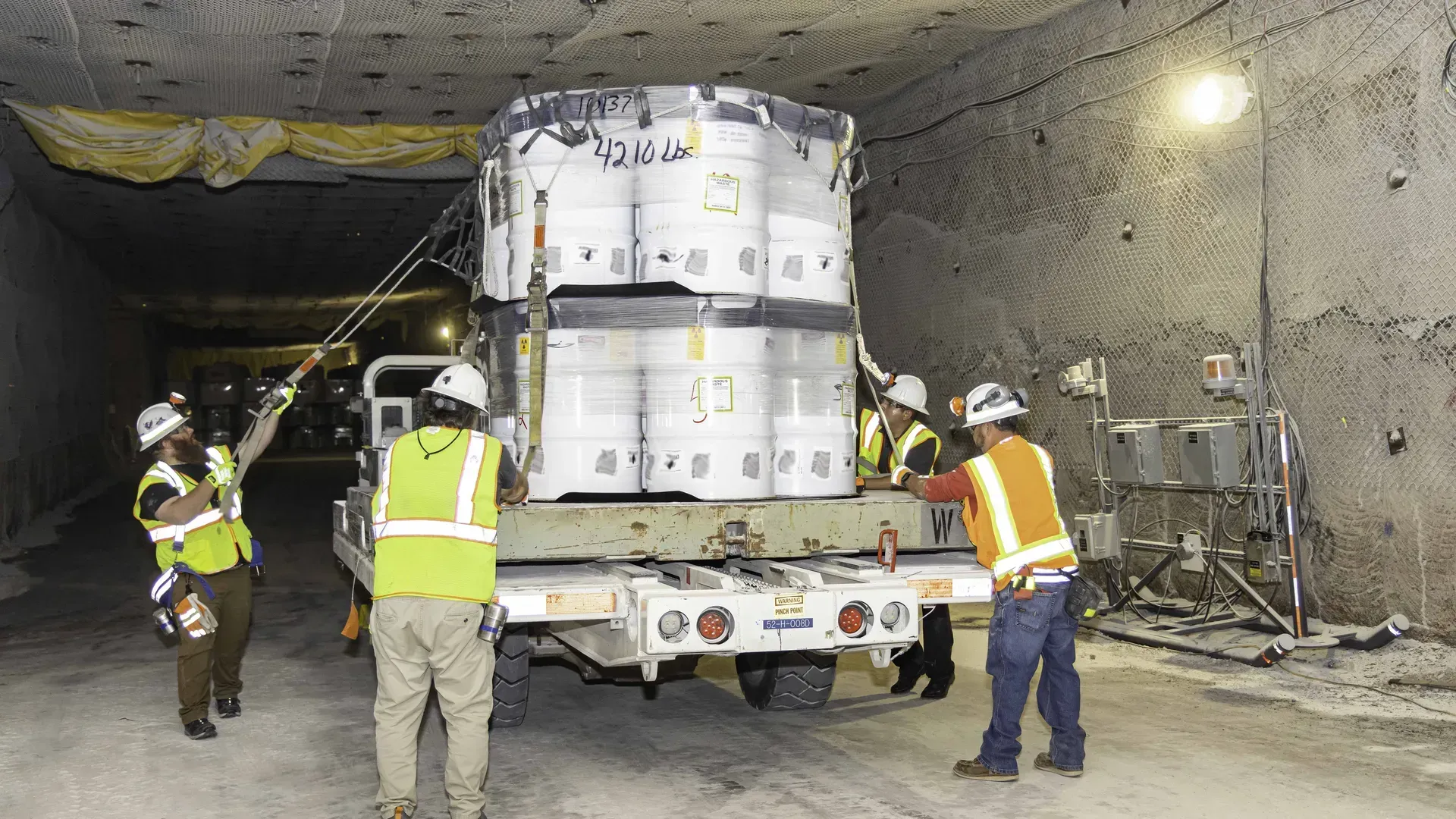
The EPA has agreed to the Energy Department's request to dig out two new underground areas to store nuclear waste at the only permanent U.S. burial site for radioactive materials.
Why it matters: Critics of the Waste Isolation Pilot Plant (WIPP) say the approval represents a significant expansion of the southeastern New Mexico facility, which they say was only intended to dispose of wastes for several decades before closing permanently.
Driving the news: The Energy Department sought a change in its permit for WIPP because of storage capacity it said was lost in part from a 2014 drum eruption that forced a shutdown of the site for more than two years.
- "EPA is in general agreement with DOE's approach and DOE's interpretation" of computer modeling showing the two additional waste areas wouldn't result in excessive radiation releases, Abigale Tardif of EPA's Office of Air and Radiation said in a July 31 letter to DOE.
Catch up quick: WIPP has been open since 1999 to dispose of discarded tools, clothing and other materials generated from making nuclear weapons, as well as surplus plutonium from the bombs themselves.
5. 👟 Catch up quick on oil and gas
🛢️ Crude prices dipped again this morning as the International Energy Agency revised its supply numbers upward and again trimmed "lacklustre" demand forecasts.
- What we're watching: "While oil market balances look ever more bloated as forecast supply far eclipses demand towards year-end and in 2026, additional sanctions on Russia and Iran may curb supplies from the world's third and fifth largest producers," IEA's latest monthly outlook states.
💵 Exxon has an agreement with officials in Trinidad and Tobago that could bring development of offshore blocs.
- Why it matters: The oil giant is already producing oil from vast fields off the coast of nearby-ish Guyana. "We're going to bring Exxon Mobil's leading technology capability directly from Guyana," said John Ardill, Exxon's VP for exploration, via Bloomberg.
6. 🧮 Number of the day: $1,065
That's the average cost, per ton, of CO2 removal via direct air capture in 2025, per research firm BloombergNEF.
Why it matters: DAC is "prohibitively expensive for all but a select few large companies with ambitious sustainability goals," its report states (here's a summary).
- Costs are falling as industry ascends the learning curve. How much they decline helps dictate whether DAC becomes a real weapon against global warming.
What we're watching: Getting under $100/ton, a benchmark for scale, in the not-too-distant future is tougher than once hoped, it notes.
- "Technology developers now believe that costs will hover around $300-$400/tCO2 in 2030."
📧 Did a friend send you this newsletter? Welcome, please sign up.
🙏 Thanks to Chuck McCutcheon and Chris Speckhard for edits to today's edition, along with the brilliant Axios Visuals team.
Sign up for Axios Generate