
Axios Generate

April 02, 2025

🐪 Wednesday. Tariffs are looming and we'll catch you up on the energy fallout tomorrow. Today we've got a newsy 1,383 words, 5 minutes.
🚨 Situational awareness: Staff running the low-income home energy aid program lost their jobs amid wider cuts at HHS, per CNBC and CNN.
- HHS did not respond to an inquiry about the LIHEAP program.
🎹 At this moment in 1980, The Whispers were No. 1 on Billboard's R&B charts with today's brilliant intro tune...
1 big thing: Severe storms to hit Midwest and South with flooding risk, tornadoes
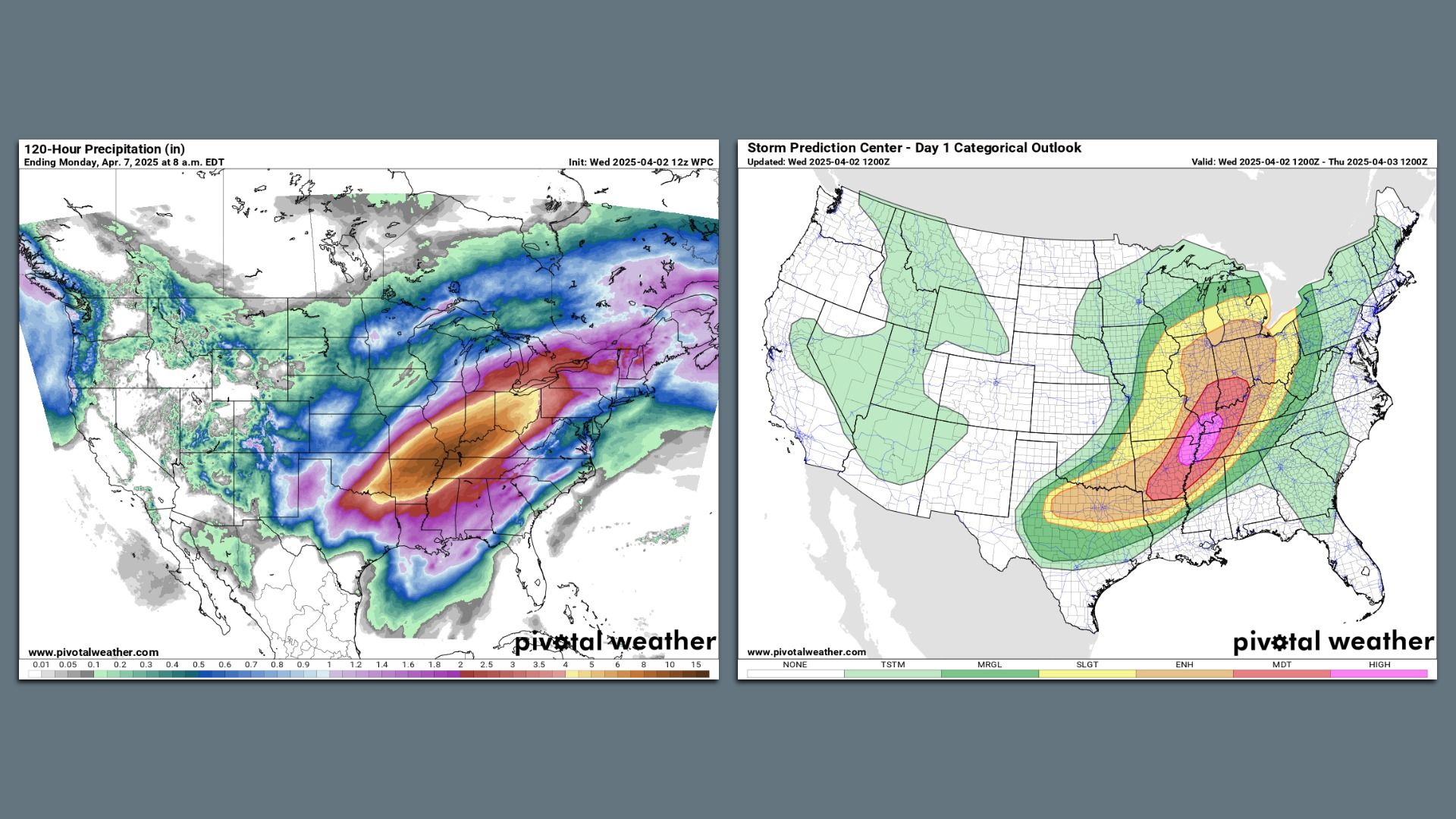
A highway of moisture flowing off unusually warm waters — combined with a storm system — will result in dangerous flooding from Arkansas through the Ohio and the Tennessee valleys over the next few days.
Threat level: In the hardest-hit areas, rainfall totals could reach a few Aprils' worth in just four to five days.
- The National Weather Service is warning of an "increasingly significant setup" with the potential for "catastrophic" flooding.
- It is forecasting rainfall totals that could exceed 15 inches in the hardest-hit locations, describing it as an "extreme flooding scenario."
- Forecasters will be closely watching as rains add up in northeastern Arkansas, northwest Tennessee and western Kentucky in particular.
State of play: The flooding is only one of this upcoming storm's hazards, as a powerful and slow-moving low-pressure area slides across the Central states and Midwest.
- Severe thunderstorms with the threat of damaging winds and a large-scale, "major" tornado outbreak are forecast today and tonight across the Mid-South.
- The Storm Prediction Center is predicting a "high risk" — or level 5 out of 5 on its scale — of severe weather in the mid-Mississippi Valley to the Lower Ohio Valley today, including the threat of "[n]umerous tornadoes, along with multiple long-track EF-3+ tornadoes."
- Cities in the high risk zone include Memphis and Jonesboro, Tenn., with Louisville, Little Rock, Ark., Evansville, Ind., and Bloomington, Ind., in the moderate risk zone.
To top it off, heavy snow is forecast for parts of the Dakotas, Minnesota and Wisconsin as seasons collide.
Context: Extreme precipitation events are becoming more common and severe due to climate change, as warmer air temperatures hold more moisture.
- A new analysis from the research group Climate Central found that heavy precipitation extremes are increasing in frequency in all regions of the country, though there is greater variability at the local levels.
- A marine heat wave in the Gulf of America (renamed by the U.S. from the Gulf of Mexico) and the Caribbean — a phenomenon increasingly tied to climate change — is also a factor, since this area will be the moisture source region for the heavy rainfall.
In another sign of the event's unusual nature, there is the potential for some spots to set records for the amount of precipitable water in the atmosphere.
- This is a way of measuring the precipitation that would result if all of the moisture in a column of air were to condense and fall as rain.
What we're watching: Where the heaviest rainfall sets up, and how severe the ensuing flooding gets.
2. ☂️ Bonus chart: Rainstorm intensity rises

Rainstorms are getting more intense in many U.S. cities amid human-driven climate change, a new analysis finds.
Why it matters: More intense precipitation events can cause flash flooding, landslides, dangerous driving conditions and other potentially deadly hazards.
The big picture: Hourly rainfall intensity increased between 1970 and 2024 in nearly 90% of the 144 locations analyzed, per the report from Climate Central.
3. 😬 Warnings and progress on energy innovation


This chart ☝️ helps tell the story of a wider new IEA report: unprecedented cash poured into energy innovation over the last decade, but momentum is slowing.
State of play: In VC, part of the innovation ecosystem that IEA analyzed, over $230 billion flowed to startups since 2015, with funding up 570% from 2015-2022.
- But things slowed in 2023-2024 thanks to interest rates and other macro headwinds.
- The shakiness of political climate commitments is a problem for companies with demo-scale or larger projects, IEA said.
Threat level: The "rush of funds" into AI "may even have drawn capital away from energy technologies."
The big picture: Other themes in the broader report:
- Public finance has grown, but IEA member countries are spending just 0.04% of GDP on energy R&D, less than half of early 1980s levels.
- Corporate energy R&D spending grew 7% annually since 2019, but likely slowed in 2024.
What we're watching: IEA is tracking 580 proposed demonstration projects in areas like advanced nuclear, hydrogen, and CCS.
- "[M]ost have not yet reached a final investment decision, and inflation and policy uncertainty have caused delays," it warns.
The bottom line: Innovation matters, even as mature tech is the biggest weapon against global warming.
- IEA estimates that 35% of the emissions cuts needed to reach net-zero require tech not yet demonstrated at commercial scale.

4. 🍨 Two NOAA scoops: Trump reshuffles the deck...
NOAA chief of staff Laura Grimm is now the agency's acting administrator after the Commerce Department moved Nancy Hann back to her career position.
Why it matters: This move — confirmed to Axios by current and former NOAA staff — puts a political appointee in charge of the weather, climate and oceans agency.
Zoom in: Hann will return to her position as NOAA's deputy undersecretary for operations, while Grimm will presumably hold the role until the Senate determines the fate of Neil Jacobs, President Trump's pick for administrator.
- No reason was given to other NOAA leadership for the change, sources said. They spoke on condition of anonymity because they weren't authorized to speak to the news media and feared retribution.
What's next: Grimm inherits an agency under strain from constraints placed on it by the Commerce Department. It will need to ensure continuity of functions despite upcoming early retirements and layoffs this spring or summer.
- She has a background in oceans and fisheries work, based on her LinkedIn profile.
5. ... and its Commerce boss slows the agency down

A Commerce Department requirement to have Secretary Howard Lutnick approve many NOAA contracts or extensions is slowing the agency's operations to a crawl, current and former NOAA staff tell Axios.
Why it matters: The requirement of Lutnick's approval on contracts and extensions over $100,000 is also having ripple effects for contractors around the country as some contracts expire or are canceled because the time to review them has elapsed.
- It's also raising the possibility that high-priority, previously awarded contracts will be canceled or modified, depending on Lutnick's views.
Six current and former NOAA staffers described dozens of contracts currently awaiting Lutnick's sign-off, with only a tiny fraction having been reviewed so far.
The other side: The department didn't immediately respond to a request for comment.
Zoom in: As severe thunderstorms rumbled along the East Coast on Monday, the NWS faced the possibility of losing its ability to bring satellite and observational data into forecast offices in a timely manner, starting at midnight, current and former NOAA staff told Axios.
- The department had yet to sign off on an extension to a contract for Raytheon to maintain and help upgrade the software system, known as AWIPS, that powers every Weather Service forecast office nationwide.
The intrigue: Even though a contract extension was signed a few hours before midnight, it rattled nerves among some inside and outside the agency.
6. 👟 Catch up quick on tech finance: CO2 removal, lithium, fusion

🇳🇴 The Frontier consortium of CO2 removal buyers brokered $31.6 million worth of offtake deals with Norwegian heating provider Hafslund Celsio.
- Why it matters: "This offtake enables the first-ever carbon removal retrofit of a waste-to-energy facility," the announcement states.
- What's next: The deal is for 100,000 tons of removal in 2029-2030.
▶️ The Lithium Americas-GM joint venture made a final investment decision on the long-planned Thacker Pass lithium mine in Nevada. Reuters has more.
⚛️ Focused Energy, a startup using lasers to spark fusion energy reactions, is raising a $150 million Series A, Axios Pro Deals scooped.
- The big picture: Focused Energy uses laser pulses to rapidly heat and compress a polymer-encased fuel pellet made of deuterium and tritium.
- What we're watching: The company aims to bring its pilot plant online by 2035, and it is expected to cost "single-digit billions," a person familiar with the raise says.
- Go deeper: Unlock the whole story, and talk to our sales team about Axios Pro Deals for a steady diet of scoops and smart analysis.
📉 "A growing list of hydrogen fuel cell trucking bankruptcies the last few months indicates another cycle is ending," Bloomberg reports, citing the collapse of Nikola, Hyzon Motors, Quantron and Hyvia.
7. 🛢️ Policy number of the day: 500%
A bipartisan group of 50 senators — evenly split between parties — floated a Russia sanctions bill that includes 500% tariffs on U.S. imports from countries that buy Russian oil, gas and other goods.
Why it matters: The bill from Sens. Lindsey Graham (R) and Richard Blumenthal (D) signals Capitol Hill's appetite for pushing Russia, and by extension President Trump, to end the war.
- There's a House companion bill. Bloomberg has more.
📧 Did a friend, colleague or an AI chatbot send you this newsletter? Welcome, please sign up.
🙏 Thanks to Chris Speckhard and Chuck McCutcheon for edits to today's edition, along with the brilliant Axios Visuals team.
Sign up for Axios Generate