
Axios Generate

March 24, 2025

π₯ Welcome back! We're sprinting into the week with 1,249 words, 4.5 minutes.
ποΈ On this day in 1992, R&B greats En Vogue released the album "Funky Divas," which provides today's unstoppable intro tune...
1 big thing: AI weather forecasting's big step forward

The field of AI-driven weather modeling is advancing at a rapid pace, as illustrated by a new model that has critical advantages over other approaches.
Why it matters: Applying artificial intelligence to weather prediction holds the promise of significantly advancing forecast precision, reliability and delivery to the developing world.
- It could augment the role of human weather forecasters, providing them with another tool for forecasting extreme weather events as well as routine conditions.
Driving the news: The new model is the result of an international effort among the University of Cambridge, Alan Turing Institute, Microsoft Research and European Centre for Medium-Range Weather Forecasts (ECMWF).
Zoom in: The model, detailed in a study in the journal Nature, is known as Aardvark Weather. It offers what its creators call an "end-to-end AI forecasting system."
- Previous AI models developed by technology giants like Nvidia and Google take in real-world observations and apply AI methods to predict how weather conditions would unfold over time.
- These models don't require supercomputers and can be run at a fraction of the time of regular physics-based numerical models like the U.S. Global Forecast System, or GFS.
Yes, but: The AI models developed to date are still somewhat dependent on the work of traditional numerical systems at the initial step of incorporating vast amounts of weather data, a process known as data assimilation.
- What sets Aardvark Weather apart β and may usher in a new era in AI-driven models β is that it uses a single machine-learning model that takes in observations from satellites, weather stations, ships and other sensors, and yields high-resolution global and local forecasts.
- It doesn't involve traditional numerical weather models at any step of the process, setting it apart from other new AI systems.
- In other words, it's a purely AI-driven weather play.
Aardvark also uses far fewer observations as inputs compared to both traditional models in use and other AI-driven ones.
The intrigue: The researchers tout Aardvark's ability to result in specially-tailored forecasts while being run on a desktop computer, providing results that are available within minutes.
- Importantly, they claim that even with just a fraction of the input data from current weather observations, the system outperforms the GFS model on particular variables and competes with National Weather Service forecasts made using a combination of modeling and human forecast expertise.
- Perhaps the biggest breakthrough of the new model is that its simplicity and the way it's designed to learn from input data can provide a means for tailoring forecasts for specific applications and regions.
- These could include forecasting wind speeds for renewable energy installations or predicting rainfall for agricultural interests.
What we're watching: How the broader field of AI weather modeling evolves and is incorporated into the work of government forecast agencies.
2. βοΈ What's next after Trump's mining order

President Trump's exec order on mining could help projects get closer to reality, but big hurdles remain for the costly efforts, analysts say.
Why it matters: It creates a more muscular federal role in extraction of critical minerals, copper, and far more.
- Major pieces include using the Defense Production Act, expediting permits and using the U.S. Development Finance Corp. to support new mines.
π¬ What they're saying: While Thursday's order redirects federal finance toward mineral projects, it's unclear how much confidence it'll give private investors.
- "It could help, but it does not fundamentally change the core issue: mining is capital-intensive, and many minerals currently trade at prices too low to justify large new investments," Tom Moerenhout, a researcher with Columbia University's energy think tank, in a primer on Thursday's order.
- It also lacks provisions on working with indigenous communities, he notes.
βοΈ Friction point: Atlantic Council analysts point out that presidential terms are much shorter than development timelines.
- Trump himself underscored policy volatility last week when he revoked Biden-era blessings for using the DPA to support green tech manufacturing.
- "Given the relatively short-term nature of four-year presidencies, companies remain hesitant to make multi-decade investments with uncertain returns," Alexis Harmon and Reed Blakemore write.
πWhat we're watching: One thing is whether Congress allocates more money for using the DPA.
- Another is Trump's related move to re-orient the DFC around domestic investment.
- That DFC shift is a "remarkable flexing of executive power," the Atlantic Council analysts write.
- With the agency up for reauthorization this year, analysts are looking to see if Congress bolsters this approach.
3. π¨ Scoop: Top DOE lawyer gives advice on DOGE cuts

The Energy Department's top lawyer is urging caution as the agency weighs massive cuts to active contracts and grants, according to a guidance memo obtained by Axios.
Why it matters: The memo provides the most specific advice yet for how agency officials should complete DOGE spreadsheets that justify retaining, terminating or renegotiating contracts and grants worth tens of billions of dollars.
- The DOGE spreadsheets should be marked as "legal privilege" documents to protect against disclosure and release under FOIA, it stated.
What's inside: Political appointees at the agency are tasked with deciding whether grants and contracts are both "efficient" and "consistent with DOE policies and priorities," according to the memo, dated March 17 and signed by Acting General Counsel David R. Taggart.
- If the award is found inefficient or inconsistent with DOE policies, officials must recommend termination or modification, possibly through renegotiation of the award, it said.
What's next: The awards on the chopping block are "expected to include most types of DOE discretionary spending agreements," the memo stated.
- That includes national laboratory management and operations contracts and some subcontracts and sub-awards.
Unlock the whole story, and if you need smart, quick intel on energy and climate policy for your job, get Axios Pro Policy.
4. π Tesla trade-ins jump


Tesla trade-ins hit an all-time high amid political backlash to Musk's leadership of DOGE.
Why it matters: The company is facing customer protests at Tesla stores throughout the world, sales boycotts, vehicle vandalism and online opposition.
- Meanwhile, current owners are embracing bumper stickers disavowing themselves of Musk's rightward turn.
By the numbers: 1.4% of dealership trade-ins this month have been Teslas, according to Edmunds data through March 16.
- That's up from 0.4% a year earlier and would mark an all-time high for a full month.
Reality check: Prices on Teslas aren't falling at an abnormal rate compared to other EV models, Edmunds notes.
- That suggests the market isn't being flooded ... yet.
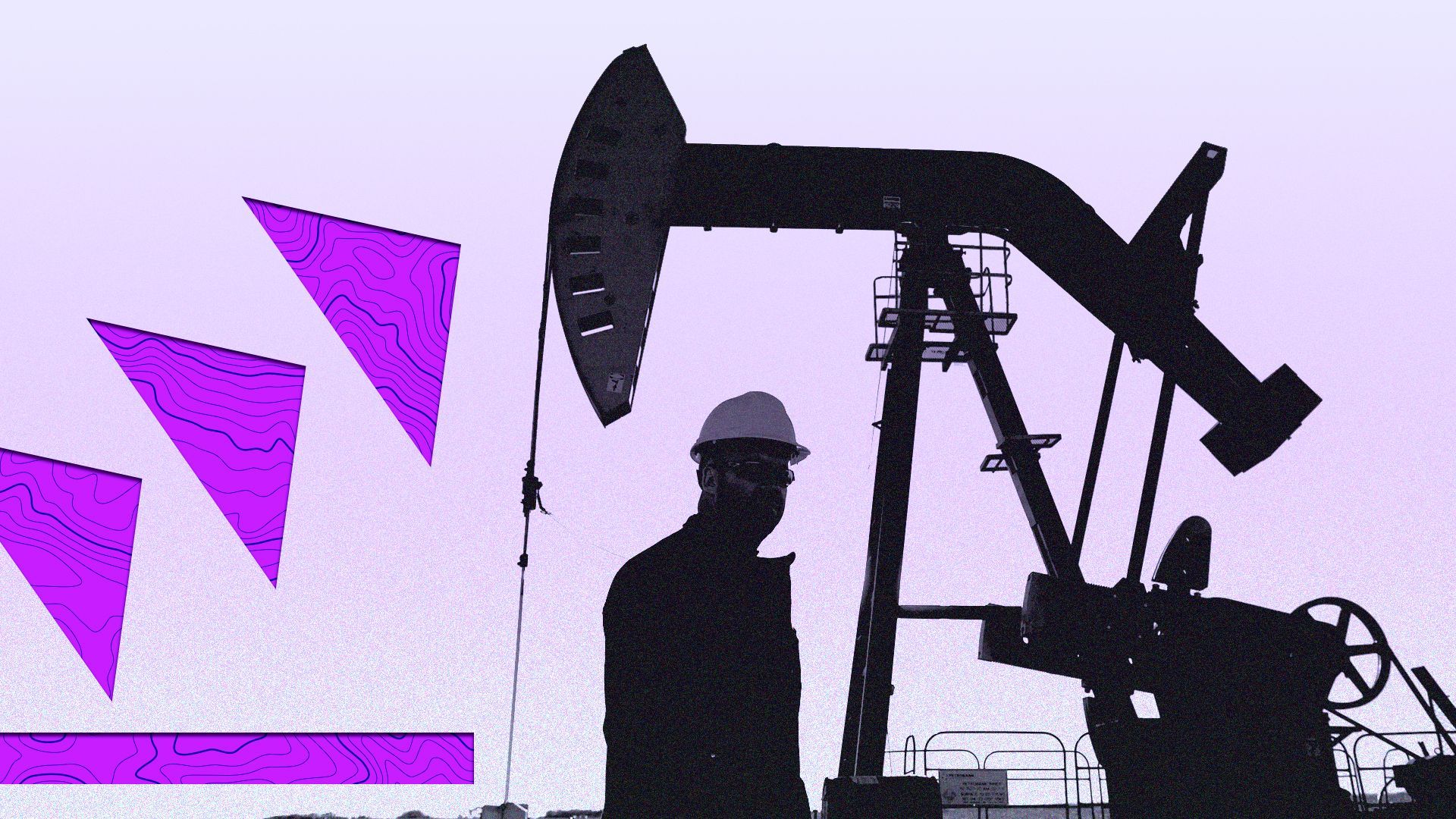
5. πCatch up quick on oil and gas
ποΈ This week should bring revealing moments: Shell will offer a strategy update tomorrow, while the Dallas Fed releases its latest survey of U.S. execs on Wednesday.
βοΈ Via the WSJ, oil and gas industry lobbyists are urging members of Congress to "consider granting legal protection for oil companies against lawsuits over their contributions to climate change."
- Inside the room: The paper also reports that they're urging Trump officials to enter the legal fray against "climate superfund" laws in New York and Vermont.
βΆοΈ "A flurry of oil projects from Brazil to Saudi Arabia are set to come online this year, providing the biggest infusion of new crude production in more than a decade," Bloomberg reports based on Raymond James data.
6. π§ Quote of the day: COVID's data center legacy
"We're witnessing now, with AI data centers, the direct evolution of the digital acceleration from the lockdown years."β Latitude Media exec editor Stephen Lacey
That's part of his take on COVID's energy legacy, the topic of Latitude's latest Open Circuit podcast episode.
- Pandemic demand for digital services β like Zoom β brought capital into data centers, pushed tech giants to expand their energy teams, get smarter on grid integration and more, Lacey said.
- But that's just one way COVID changed the landscape, so I recommend checking out the whole pod.
π§ Did a friend, colleague or an AI chatbot send you this newsletter? Welcome, please sign up.
π Thanks to Chris Speckhard and Chuck McCutcheon for edits to today's edition, along with the brilliant Axios Visuals team.
Sign up for Axios Generate