Axios Generate

September 15, 2025


👋 Hello readers! Amy here, writing from Seattle and launching your week with 1,168 words, 4.5 minutes.
We have some news! We're rebranding Generate as Future of Energy starting next Monday. We'll focus even more on the people, tech and resources shaping our energy mixes of tomorrow.
- What does that mean? We'll share more next week. Rest assured, we'll still do much of what Generate has done for years: Keeping you updated on the energy and climate news that matters most.
- Future of Energy will automatically arrive in your inboxes every weekday morning.
🎸 To honor "Spinal Tap II: The End Continues," the sequel to what our editor Chuck considers the greatest movie ever made, here's "Stonehenge" featuring Elton John.
1 big thing: ☀️ How extreme weather fuels interest in geoengineering

Pakistani politician Hina Rabbani Khar remembers the horrific 2022 floods in her country as a turning point in the debate over climate change — and to what extent the practice of solar geoengineering should be considered.
Why it matters: Solar geoengineering — reflecting a small portion of the Sun's rays back into space to temporarily cool the planet — is increasingly being considered as climate change worsens extreme weather.
- Once dismissed as science fiction, it's a technology that divides scientists and provokes conspiracy theories online.
Flashback: Three years ago, some Pakistani provinces saw more than 500% the normal annual rainfall. By September, one-third of the country's land was underwater, and 33 million people were directly impacted.
- In a peer-reviewed report released this summer, scientists said climate change made the flooding worse.
What they're saying: "The number that really stuck with me — as a mother of three children — was that during this time when people were homeless and didn't even have the shelter of a tent, let alone a home, there were 600,000 women who were going through different stages of childbirth," Khar told me for a new episode of the "Shocked" podcast airing today.
How it works: Solar geoengineering would involve intentionally injecting particles of sulfur dioxide into the upper atmosphere to reflect more sunlight back into space.
Where it stands: The technology isn't currently being deployed, but Khar was part of a global consortium that began studying the issue the same year as the floods.
- "I will happily admit that I am a convert on the question of exploring and researching geoengineering," Khar told me, emphasizing that she does not yet support actually deploying it.
The intrigue: Scientists are deep into research on the topic.
- A peer-reviewed article earlier this year quantified the risks and found more people would die because of the heat from unabated climate change than would die from any additional pollution caused by deploying the sulfur dioxide into the sky.
Between the lines: Putting science aside, perhaps the highest-level concern is that this technology could make oil companies, nations and others less inclined to reduce greenhouse gas emissions.
- "It is likely that fossil-rich nations or fossil-fuel companies will at some point choose to exaggerate how well solar geoengineering is working, or could work, in order to reduce the political pressure to cut emissions," said David Keith, a University of Chicago professor who's among the world's leading experts on this topic.
But he said that shouldn't stop consideration of the technology, particularly for lower-income nations like Pakistan.
Editor's note: This article was written partly based on content from the podcast, which was created by a team that includes experts at the University of Chicago's Institute for Climate and Sustainable Growth and producers at Magnificent Noise. Amy is the institute's inaugural journalism fellow.
2. U.S.-U.K. nuclear deals aim for sped-up work

U.S. advanced nuclear companies are giving President Trump's "energy dominance" agenda a British accent.
Why it matters: A series of deals unveiled last night on the eve of Trump's visit to the United Kingdom will give leading companies lots of new business — which they expect can be conducted quickly.
Driving the news: The agreements are aimed at expanding cooperation between the two countries and making it easier for companies to build new plants.
- Both countries will fast-track reactor design checks, the British Embassy in D.C. said in a statement.
- That means if a reactor has passed safety assessments in one country, the other can use it to support its own work to avoid duplication.
- This "smarter, streamlined approach" is hoped to speed what are now often lengthy approvals for nuclear to around 24 months for advanced designs like Rolls-Royce's small modular reactor (SMR), the embassy said.
What they're saying: "Regulatory simplification and harmonization will help to reduce costs and speed up the construction of the first wave of SMR plants," said Roger Martella, GE Vernova's chief corporate officer, in the embassy's statement.
- The agreement also will "strengthen the energy security and resilience of both nations, creating thousands of high-skilled jobs, attracting billions of investments and supporting economic growth," Rolls-Royce CEO Tufan Erginbilgic said.
Reality check: Nuclear critics and others outside the industry will be watching closely to ensure no corners are cut.
3. EPA to companies: Don't report greenhouse gases
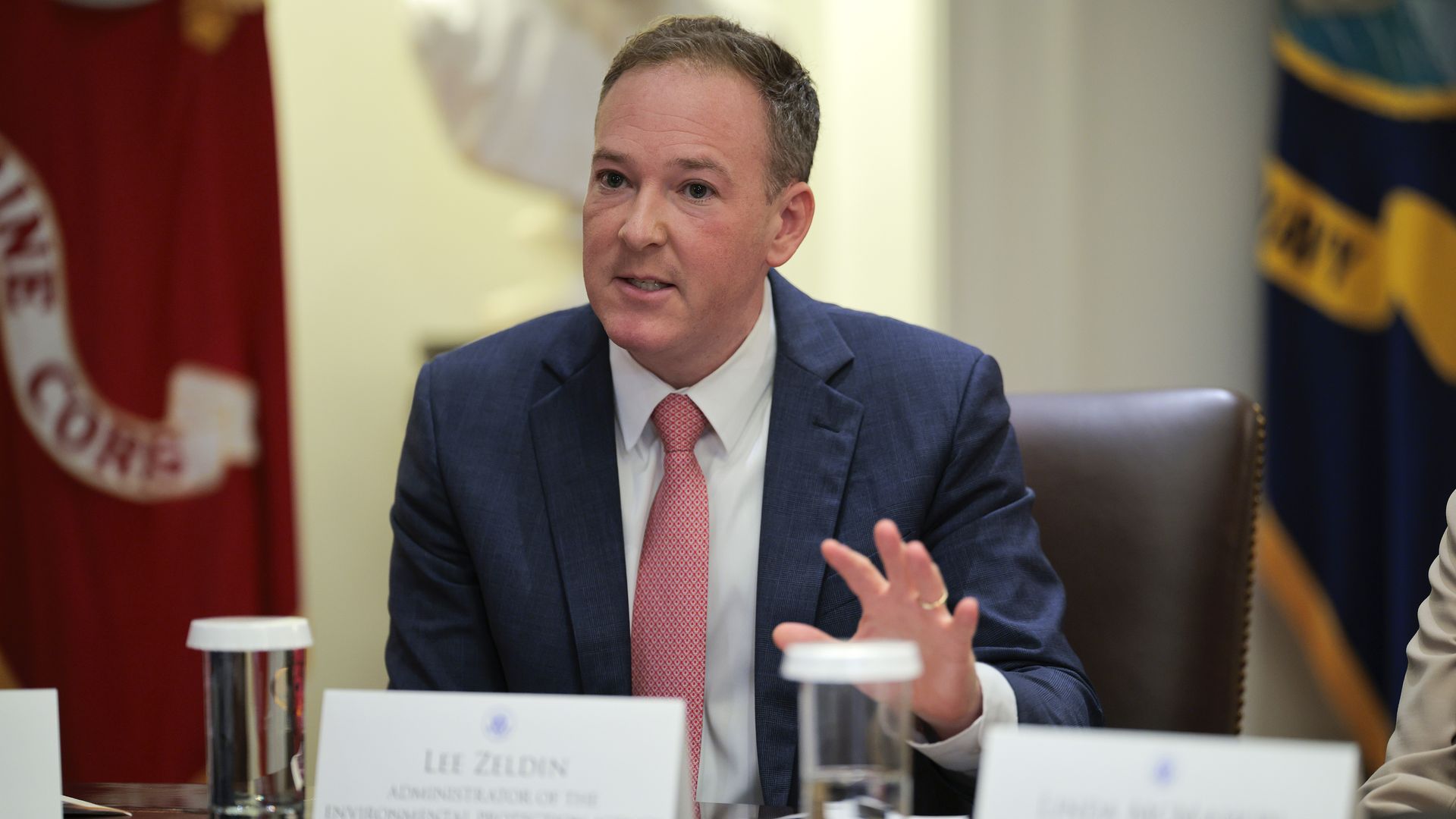
The EPA formally proposed ending longtime requirements for many polluters to collect and report emissions of heat-trapping gases responsible for climate change.
Why it matters: Democrats and environmentalists widely condemned ending the Greenhouse Gas Reporting Program when the agency announced earlier this year it was considering doing so.
- The 15-year-old program requires reporting of carbon dioxide, methane and other emissions data from about 8,000 facilities.
Driving the news: EPA Administrator Lee Zeldin on Friday called the program "nothing more than bureaucratic red tape that does nothing to improve air quality."
- The agency said it would propose to end reporting requirements in more than 40 different sectors, including electricity generation, iron and steel production and petroleum refineries.
- It also said it would propose to suspend until 2034 reporting requirements for onshore and offshore petroleum and natural gas production, onshore natural gas processing and transmission pipelines and liquefied natural gas (LNG) storage.
The other side: Ending the program will "allow polluters to poison our air without accountability" and "rob American industries of the data that give them a competitive advantage over foreign rivals," Sen. Sheldon Whitehouse (D-R.I.) said in a statement.
- The Carbon Capture Coalition warned that the move "endangers billions of dollars in investments from American businesses" because it would complicate access to a tax credit for companies that seek to capture the greenhouse gas.
4. Number of the day: 44%
That's the percentage of respondents who told a Heatmap Pro poll they would support or strongly support a data center being built near them, while 42% said they would oppose or strongly oppose it.
- "That's a net support of only +2%," Heatmap said. "Nearly all energy projects, renewable or not, fared better with the public."
5. Quote of the day
"This is more than a matter of policy — it is a test of resolve."— Sen. Lindsey Graham (R-S.C.) and Rep. Brian Fitzpatrick (R-Pa.) in a Saturday statement announcing they will urge colleagues to attach their Russian sanctions bill to a continuing resolution
📬 Did a friend send you this newsletter? Welcome, please sign up.
🙏 Thanks to Chuck McCutcheon and Chris Speckhard for edits to today's edition, along with the brilliant Axios Visuals team.
Sign up for Axios Generate