
Axios Generate

June 04, 2025

๐ญ Hi! Our newsletter factory has produced an exclusive look at what the IRA fight could mean for real factories.
- We've also got plenty more, all in just 1,119 words, 4 minutes.
๐ง This week in 2021, eclectic rockers Wolf Alice released the album "Blue Weekend" (h/t Albumism), which provides today's intro tune...
1 big thing: Exclusive โ Red-state factories most at risk in climate fight
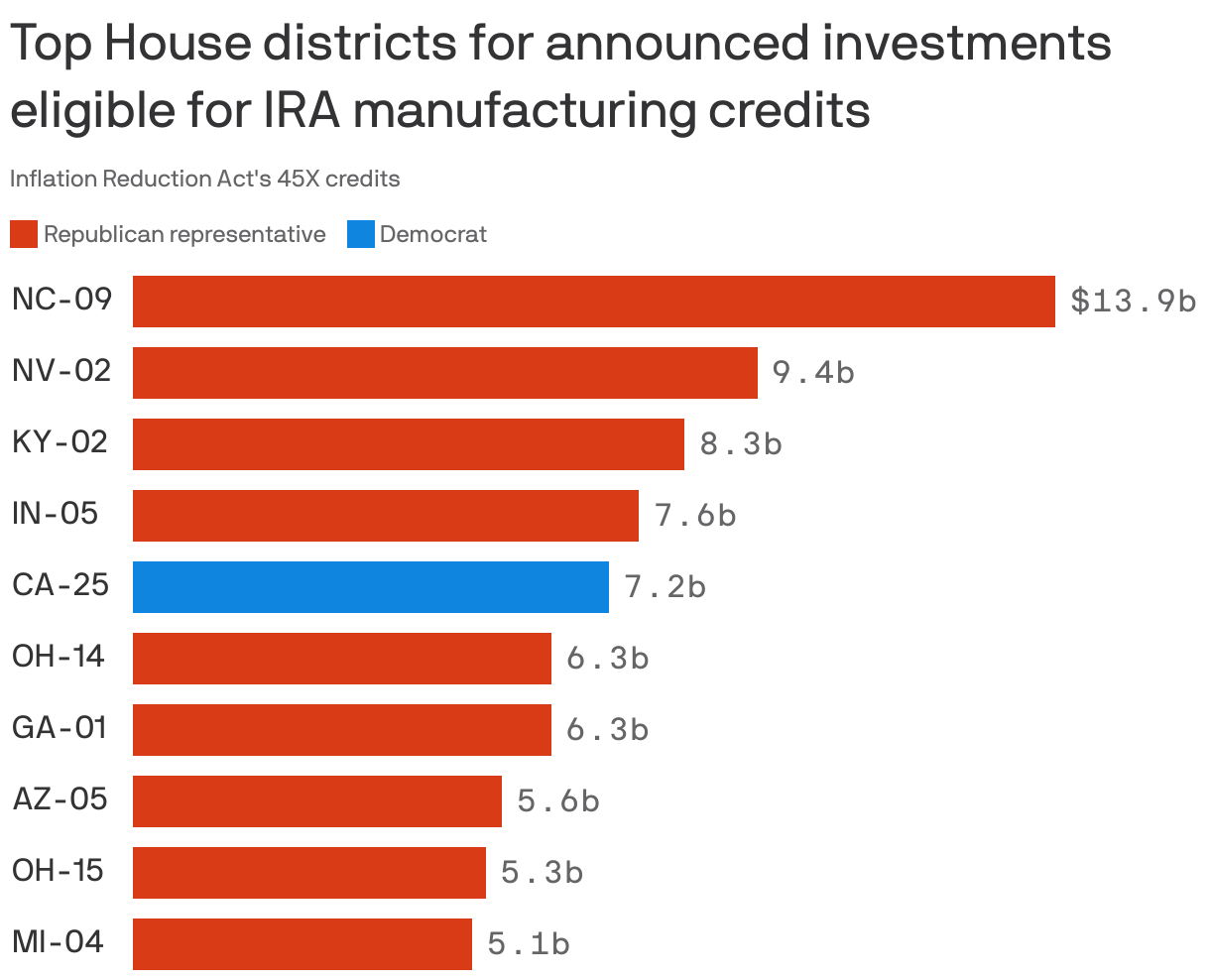
๐ First look: IRA tax credits for making low-carbon energy equipment are spurring over $185 billion in planned or operating factory investments, a new analysis finds.
Why it matters: The Atlas Public Policy report arrives amid Capitol Hill debates that could vastly scale back the incentives.
- The research and advisory firm found that 77% of planned spending on credit-eligible projects it's tracked is in GOP-held House districts.
- You can see the top 10 above.
Catch up quick: The 2022 climate law created subsidies for manufacturing a suite of products โ think solar cells and wafers, wind blades and towers, EV batteries, processing critical minerals and more.
Yes, but: The House-passed budget plan would restrict the timeline and access in several ways that may render it "effectively impossible to claim," Atlas notes.
- It ends "transferability" that makes the credit market more fluid and available to more projects.
- It bars credits for projects with any links to China, including materials. The bill also ends the incentive for wind in late 2027.
Zoom in: "To date, a total of $48.3 billion in announced investments and 62,700 jobs are associated with operational facilities that qualify for the tax credit," the Atlas report finds.
- It shows another $137.2 billion and 103,100 jobs in "tracked announcements at facilities that are planned or under construction."
- Battery and related component manufacturing is the biggest slice, such as Toyota's planned investments in North Carolina.
- Atlas also says their tallies are likely undercounts of the credits' impact.
State of play: Credit backers say it drives projects that will make the U.S. competitive in growing global clean tech industries and boost energy security.
- But GOP critics call it part of an expensive "green new scam" aimed at forcing preferred technologies onto consumers.
What we're watching: Senate Republicans' ongoing work to craft their version of the House-passed "One Big Beautiful Bill."
- A number of GOP senators call House repeals and limits on various IRA credits too aggressive, but what that means for the manufacturing incentives is unclear.
- Low-carbon energy industries are lobbying aggressively for changes to the House-passed bill.
The bottom line: "Elimination of the tax credit or reforms that make it inaccessible could have severe consequences for American manufacturing, weakening investor confidence, and potentially allowing China and Europe to dominate the future of clean energy production," the report argues.

2. ๐ On my screen: contrarian takes edition
๐ซทDespite the backlash to ESG, hold those obits for corporate decarbonization, writes Gopal Vemuri of the big infrastructure and investment firm Generate Capital.
- Why it matters: Corporate climate efforts face lots of cultural and financial friction โ it's a different world from the heady days of the net-zero frenzy.
- Yes, but: There are still plenty of drivers, writes Vemuri, Generate's VP for development and origination, in a recent post. One is that amid rising power prices and demand, efficiency and on-site renewables make sense.
- The intrigue: Another factor is that U.S. federal policy is just one variable. "Though ESG regulations face backlash and scrutiny at the federal level in the U.S., many corporates are still subject to state-level or European regulations," he writes.
- The bottom line: The setbacks are certainly real, but "the data shows that by and large companies are continuing to invest in sustainable solutions." Full post.
๐ข Morgan Stanley analysts have an interesting note on what's overhyped and what's underhyped in the world of U.S. AI data center development.
- The big picture: On their list of "overblown" risks is that "hardware and software efficiency gains (such as those exhibited by DeepSeek) will reduce the demand for compute."
- The intrigue: "In terms of under-appreciated risks, we would highlight the risk of insufficient power access in the US."
- The bottom line: "We believe that investor pessimism regarding the likely magnitude and pace of large US data center announcements is misplaced โ we expect to see a large volume of transactions, most of them using natural gas-fired turbines and fuel cells, in the coming weeks and months," it states.
3. ๐ Catch up quick: Offshore wind, rare earths, U.S. mining

โ๏ธ A coalition of fishing industry and ocean advocacy groups is suing Trump officials for allowing the Empire Wind project to proceed.
- Why it matters: The litigation is the latest risk to the coastal New York offshore wind project.
- State of play: The groups say the Interior Department's decision to end its stop-work order violated the Administrative Procedure Act. Full complaint.
๐ U.S. and European automakers face disruptions due to China's export restrictions on rare earth elements and magnets.
- Why it matters: "Some European auto parts plants have suspended output," Reuters reports, citing a supplier industry group. Car companies are also warning of U.S. production interruptions.
- Threat level: "The lack of magnets hits EVs and hybrid vehicles harder than conventional cars and trucks," per the WSJ, which reports that "major automakers are racing to find workarounds" to China's "stranglehold."
โ๏ธThe Interior Department said it's rescinding 18 "obsolete or redundant" rules largely addressing mining and geothermal energy on public lands.
- The big picture: The moves will "advance America's energy independence and economic vitality," Interior said.
- The other side: Trump officials are "forcing through changes that make it easier for corporate polluters to profit off the public lands that are held in trust for the American people," the Sierra Club said in a statement.
4. โ๏ธ Why Elon Musk went ballistic on the GOP's big bill

Elon Musk blasted President Trump's legacy bill this week, casting it as a bloated mess. But two sources who have spoken to Musk say he was frustrated at failing to win favorable treatment in the bill and the administration at large.
The big picture: Musk and Trump remain friends and allies, the two people in frequent communication with both told Axios. But they said Trump was somewhat irked by Musk's social media sabotage.
Friction point: The sources familiar with the Trump-Musk relationship say there appeared to be four inflection points that led to his caustic attack on Trump's bill โ and one of them is about EVs.
- The legislation cuts the electric vehicle tax credit that helps car makers like Musk's Tesla. As of late April, his company had spent at least $240,000 lobbying on behalf of the credit and other company matters.
- Behind the scenes, sources say, Musk also advocated for the measure in the legislation, but to no avail.
5. ๐งฎ Number of the day: over $115 billion
That eye-popping tally is the "strategic partner interest" that Glenfarne says it has corralled behind the huge Alaskan gas pipeline and LNG project it's hoping to develop.
State of play: Companies worldwide have "formally expressed" interest in supplying equipment, becoming gas customers, providing services, investment and more, Glenfarne announced.
- The project has strong Trump 2.0 support.
Reality check: Getting enough firm investment to actually build is a massive challenge for the costly and remote plan.
- But the short route to gas-hungry Asian buyers is a selling point.
๐ง Did a friend, colleague or an AI chatbot send you this newsletter? Welcome, please sign up.
๐ Thanks to Chris Speckhard and Chuck McCutcheon for edits to today's edition, along with the brilliant Axios Visuals team.
Sign up for Axios Generate