Axios Generate

March 31, 2025


🥞 Good morning readers, goodbye March. We've got news about a trio of corporate giants and much more, all in just 1,097 words, 4 minutes.
🎶 Change is good, so Ben's briefly ditching the throwbacks and opening the newsletter with John Splithoff, whose new album has today's intro tune...
1 big thing: Tesla is under pressure and rough numbers loom
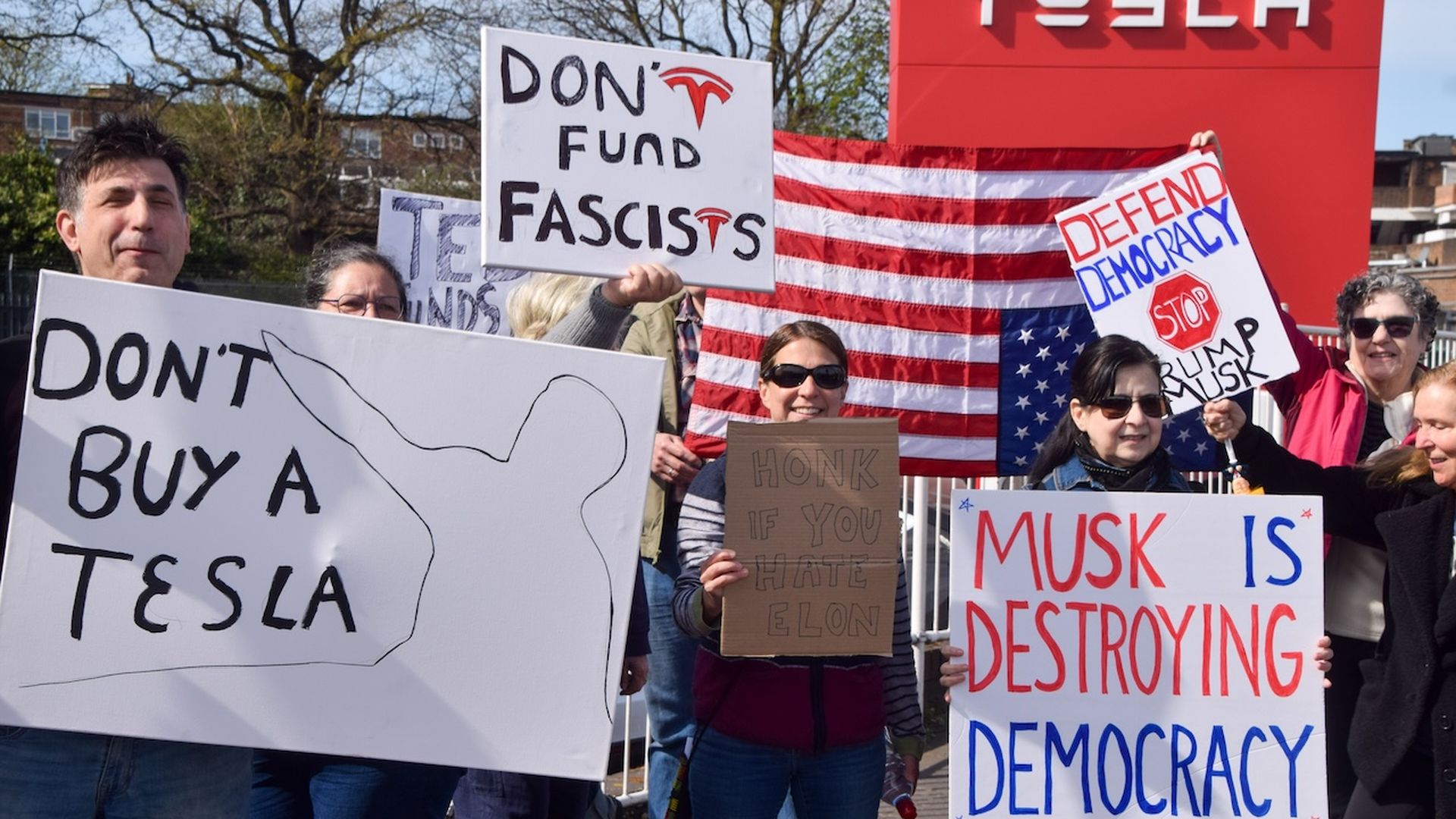
Tesla's Q1 delivery total is landing this week and will bring fresh signs that CEO Elon Musk's politics and job in Trump 2.0 are turning off more buyers than they attract.
Why it matters: Even Tesla optimists say the pioneering EV brand has an image problem.
- Plunging European sales data has already been rolling in, along with lesser declines in the U.S. and China, per data from third-party providers (Tesla doesn't provide regional tallies).
- Political fury around Musk was on display over the weekend with anti-Tesla protests in the U.S. and abroad.
What they're saying: "I think a great wrong is being done to the people of Tesla and to our customers," Musk told Fox News last week.
What's next: Estimates vary but point to a decline compared to Q1 2024, when Tesla delivered roughly 387,000 vehicles.
- Deutsche Bank estimates something in the 340k-350k range, while Morgan Stanley Tesla optimist Adam Jonas sees a 9.3% decline to 351k.
- Wedbush Securities' Dan Ives (also a Tesla bull) projects 355k-360k. Per multiple reports, Tesla itself compiled a wider analyst consensus of roughly 377.5k.
Yes, but: There's no way of knowing exactly how much of the sales slump is about Musk vs. other headwinds — notably an aging lineup and rising competition.
- Ives sees 30% of "very soft" Q1 deliveries stemming from "Musk/brand/DOGE" while 70% "is more timing and non-brand headwind issues."
- But he remains a Tesla bull, arguing that customers are waiting on a Model Y refresh and a long-planned low-cost vehicle.
- Other analysts remain similarly optimistic long-term, largely agreeing with Musk's thesis that Tesla's true edge lies in automation, robotics and AI.
The bottom line: "There is some level of brand damage happening in Western Europe and pockets within the US/Canada caused by Elon Musk's political activities, in turn hurting demand," Deutsche Bank's note states.
- "How material is this? It is difficult to quantify but it is something we will certainly continue to monitor."
2. 🍰 Bonus: Tesla's delivery history


The automaker's deliveries, a proxy for sales, fell on a yearly basis last year despite a record Q4.
- 2025 could very well bring another decline.
3. 🛠️ BlackRock's Fink: Fix "slow, broken" energy permitting

The "pragmatism" needed to meet surging energy demand "starts with fixing the slow, broken permitting processes in the U.S. and Europe," BlackRock Chairman Larry Fink said this morning.
Why it matters: BlackRock is the world's largest asset manager, and Fink's annual letters are a closely watched barometer of financial sector sentiment.
- President Trump has vowed faster permitting for energy projects, but the prospects for lasting, structural changes on Capitol Hill are cloudy at best.
State of play: Fink's 2025 letter calls out the "massive" investments needed in power generation and transmission to power AI while providing people heating and cooling.
- It warns that renewables and storage won't be adequate to meet the growing demand, citing the need for more dispatchable power — including nuclear.
The bottom line: The annual letter is a sign of the times from Wall Street — light on climate this year (the word itself is absent).
- But Fink makes a competition-based case for clean tech even as he touts "energy pragmatism."
- He notes China is aggressively building nuclear plants because "they see decarbonization as a way to own the future of industry." Fink also shouts out Chinese electric vehicle heavyweight BYD's remarkable rise.
Go deeper: Axios' Emily Peck has much more on Fink's wider letter.
4. 🌲 Meta's "transformative" new forest carbon deal

Facebook parent Meta has a new contract with forest management and investment firm EFM to transition over 106 square miles in Washington State's Olympic peninsula to "climate-smart management."
Why it matters: It's a model for boosting forest CO2 removal while enabling some continued timber harvesting and providing jobs, recreation access, tribal uses and more, EFM said.
- The company estimates that climate-focused management will allow the land to remove an additional million tons of CO2 over the next decade beyond what would have otherwise occurred.
Driving the news: EFM announced a long-term contract with Meta for 676,000 one-ton removal credits through 2035. A second buyer of CO2 credits will be named at a later date.
- The agreement enabled EFM to bring in institutional investors to purchase the 68,000-acre tract at auction for $213 million, CEO Bettina von Hagen tells Axios, the firm's largest purchase to date.
- The management plan enables multiple revenue streams like CO2 credits and continued harvesting, but at a reduced volume and with trees used for lumber reaching an older age.
- It also includes restoration of habitat for salmon and other species on the land that's adjacent to Olympic National Park.
"It's really transformative in terms of being able to purchase assets like this and embark on a climate-smart strategy, and also transformative in terms of using carbon financing to improve a timber asset, in terms of carbon storage, biodiversity benefits to communities, and benefits to tribes," von Hagen said in an interview.
The bottom line: Obtaining the land is EFM's largest transaction yet, and von Hagen said she's hopeful the deal provides a framework for future agreements.
5. 🏃 Catch up quick on oil and gas

💵 Oil prices ' scant movement to start the week suggests traders aren't — for now — reading much into President Trump's threat yesterday to impose secondary tariffs on buyers of Russian oil.
- ICYMI: "If Russia and I are unable to make a deal on stopping the bloodshed in Ukraine, and if I think it was Russia's fault — which it might not be — but if I think it was Russia's fault, I am going to put secondary tariffs ... on all oil coming out of Russia," he told NBC News.
- Why it matters: These tariffs would add to trade and energy jeopardy facing China and India, which have vastly expanded Russian oil imports since the Ukraine war shrank the Kremlin's European markets.
🛑 Via the FT, "The Trump administration is revoking a number of permits and licences that enable western oil companies to do business in Venezuela, as it ratchets up economic and diplomatic pressure on President Nicolás Maduro."
- The latest: The moves affect Italian oil and gas firm Eni, Spain's Repsol and U.S.-based Global Oil Terminals, per multiple reports. It comes after Trump officials previously ordered Chevron wind down its operations.
6. 💬 Quote of the day
"These pressures have had an impact, but what we are trying to do as long-term investors is really talk about the importance in managing these long-term risks. We still believe the world is going to have to transition, and want them to be prepared."— Diandra Soobiah, head of responsible investment at British pension fund Nest
She's quoted in the NYT's piece this weekend on pension funds sticking with climate strategies amid the wider financial sector pullback.
📧 Did a friend, colleague or an AI chatbot send you this newsletter? Welcome, please sign up.
🙏 Thanks to Chris Speckhard and Chuck McCutcheon for edits to today's edition, along with the brilliant Axios Visuals team.