Axios Generate

October 04, 2022

👟 Let's do this! Today's newsletter has a Smart Brevity count of 1,252 words, 5 minutes.
👀 Join Axios reporters in Washington, D.C., at 8am ET on Oct. 11 for a global look at energy security and climate change. Guests include DOE deputy secretary David M. Turk. Register to attend in person or virtually.
🪰 Sunday marked 40 years since Steely Dan's Donald Fagen released his solo debut album "The Nightfly," which provides today's intro tune...
1 big thing: Climate summit warnings ratchet up

Illustration: Sarah Grillo/Axios
With the last preparatory meeting underway prior to next month's United Nations climate summit in Egypt, more signs of strain are emerging between the developing and industrialized worlds, Andrew writes.
Why it matters: Maintaining perceived momentum from COP26 in Glasgow last year is key to bringing emissions down quickly and steeply enough to achieve the Paris targets.
Driving the news: The success of the summit in Egypt, known as COP27, will be determined in part by whether industrialized countries put forward more money for developing countries' adaptation efforts.
- Another major sticking point is whether industrialized nations will finally commit to paying for the climate damages they have caused in developing countries.
- This issue, known as "loss and damage" but also understood as the polluters pay principle, will be elevated in importance because the talks will be held in Africa, the most vulnerable continent to climate change.
- In press comments yesterday, UN Secretary-General António Guterres said action on loss and damage will be "the number one litmus test" of COP27.
Reality check: It is now clear that climate aid funding is still falling short of the $100 billion per year that industrialized nations promised in 2009.
- In the case of the proposed "loss and damage" fund, concrete commitments for setting up such an instrument, let alone making contributions to it, look spotty at best, particularly from the European Union and the U.S.
- It is also becoming evident that few world leaders from G20 countries are planning to go to Egypt to prove their climate bona fides.
- The U.K. press reported Monday that new prime minister Liz Truss discouraged King Charles III, a longtime environmentalist, from attending.
Zoom in: Guterres pushed leaders of the G20 nations to attend COP27.
- "Leaders of the world can demonstrate through their presence and active participation that climate action truly is the top global priority that it must be," he said.
2. First look: Energy transition and clean energy jobs

Illustration: Sarah Grillo/Axios
A new analysis from the group Third Way, shared first with Axios, shows that a combination of the laws enacted this year could yield half a million net clean energy-related jobs across the U.S. by 2050, Andrew writes.
Why it matters: The findings from the center-left think tank, contained in a memo published today, seek to rebut arguments that the Democrats' climate law, for example, could end up costing jobs in energy-producing states.
Zoom in: The report examines four clean energy sectors: power, carbon dioxide removal and transport, clean fuels and energy efficiency.
- It finds there will be positive job growth in every state and the District of Columbia by 2030, with greater gains by 2050.
- The greatest near-term benefits would be in the Midwest, the memo finds, with more than 146,000 net new jobs expected by 2030. These would include jobs associated with energy storage, transmission lines, and electric vehicles.
- Third Way's analysis found net job gains in fossil fuel-producing states as well.
What they're saying: "One of the big key takeaways here is that no state is going to be left behind in this transition," said lead author Isabelle Chan, in an interview.
Yes, but: Academic research indicates the need to counteract disruptions that would occur in fossil fuel-producing communities.
- A study published in Scientific Reports late last month identified the regions most vulnerable to the clean energy transition and in need of adaptive interventions.
- These included Texas, the Gulf Coast and Appalachia.
Editor's note: This item has been corrected to note the four clean energy sectors include carbon dioxide removal and transport as a single category, rather than separate categories, as well as clean fuels.
3. 🏃🏽♀️Catch up fast on deals and finance
⚡ The EV charging provider Loop Global raised $40 million in series A finance to expand U.S. operations. Fifth Wall Climate and Agility Ventures led the round. It also secured $20 million in other financing, Ben writes.
🚗 "Electric vehicle-maker Euler Motors said on Tuesday it had raised $60 million in its latest funding round, led by investment firm GIC Singapore, to shore up its manufacturing and supply chain," Reuters reports of the Indian firm.
💰Brookfield Renewable has invested $500m in LanzaTech, an Illinois-based developer of tech to capture carbon and convert it into sustainable fuels, packaging and other products.
Brookfield plans to invest another $500 million if certain milestones are achieved, our friends at Axios Pro Climate Deals reported.
🏗️ TotalEnergies and building materials giant Holcim this morning announced joint plans to achieve "full decarbonization" of a cement production facility in Belgium.
- Why it matters: Cement production is a huge source of CO2, responsible for an estimated 7% of human-caused emissions annually.
🤝 Carbon America, a CO2 capture and storage developer, this morning announced a deal with Bridgeport Ethanol to trap emissions from a Nebraska plant.
It comes after Carbon America in May struck a deal with ethanol producers in Colorado for CO2 capture from a pair of ethanol plants there.
4. First look: Fresh pressure on Biden over World Bank
Photos: Yuri Gripas/Abaca/Bloomberg via Getty Images and Leigh Vogel/Getty Images for Concordia Summit
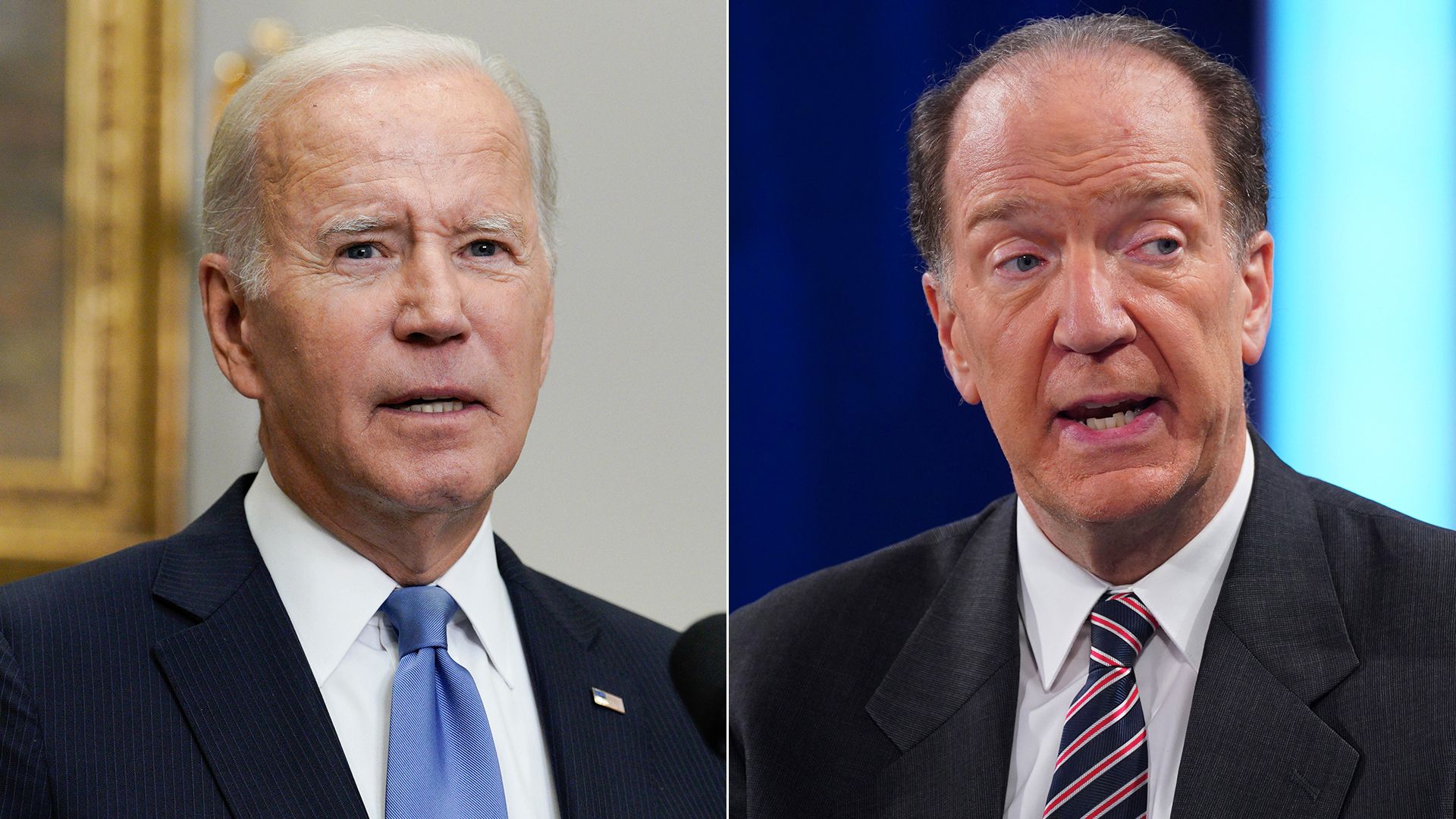
A wide constellation of climate groups — including players with close White House ties — is urging President Biden to seek the removal of World Bank President David Malpass, Ben writes.
Why it matters: A new letter from over 50 groups shows the breadth of climate movement upset over Malpass.
- They include the League of Conservation Voters, the Center for American Progress, the Natural Resources Defense Council and the Al Gore-founded Climate Reality Project.
- Others include Greenpeace and Friends of the Earth.
- The letter says the bank under Malpass has "slow walked and even deterred climate action."
Catch up fast: It comes two weeks after Malpass, at an NYT event, declined to say whether he agreed fossil fuels are "rapidly and dangerously warming the planet."
Malpass sought to clarify his views. But activists are angry that the bank has continued some fossil fuel backing and argue it's not aggressive enough on low-carbon energy.
The other side: The bank is defending its climate work, pointing to increased financing and other initiatives.
What we don't know: Whether the new pressure influences the White House. Axios' Hans Nichols reported recently that White House officials believe Malpass is weak on climate.
But officials know replacing Malpass would be messy and are unsure how — or even if — the U.S. can orchestrate it.
5. Energy transition milestones
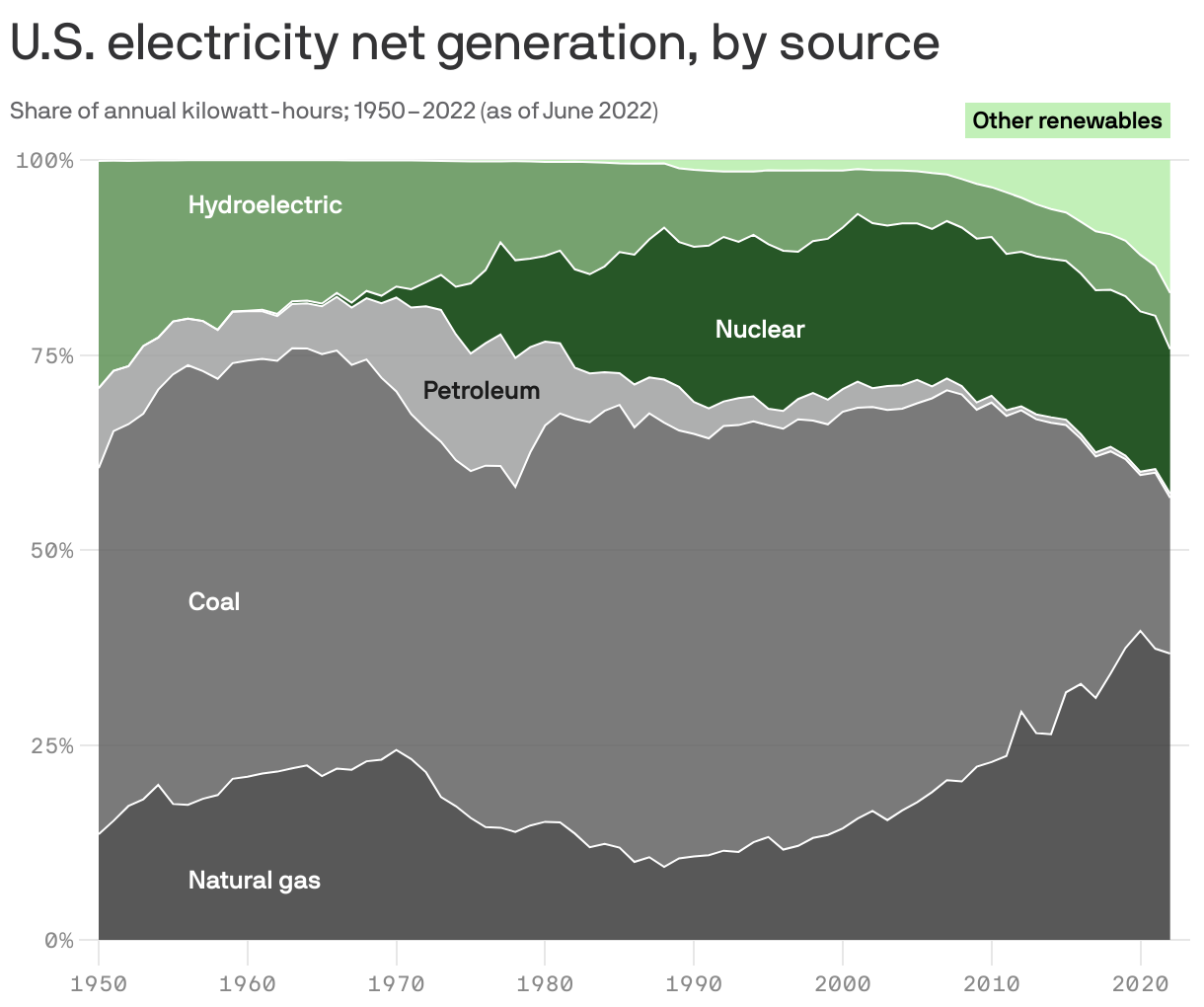
The chart above via the Energy Department shows the share of U.S. power generation from non-fossil sources hit 40% last year, Ben writes.
Zoom in: Meanwhile, BloombergNEF found that wind and solar together met a 10th of global power demand for the first time in 2021.
Yes, but: On a global basis, the growth of low-carbon power has been largely additive to gas and coal usage.
As BloombergNEF notes, power sector carbon emissions spiked 7% last year.
6. SCOTUS prods Biden team on climate
Illustration: Eniola Odetunde/Axios
The Supreme Court on Monday asked the Justice Department to weigh in on whether state and local climate lawsuits against giant oil companies should be heard in federal courts, Ben writes.
Why it matters: The requested brief from the Solicitor General "would offer the Biden Administration’s official position" on the question, ClearView Energy Partners said in a note.
The big picture: Exxon and Suncor have asked the high court to take up the question of venue in local Colorado officials' suit seeking damages for the effects of global warming.
Many similar lawsuits against oil companies are unfolding nationwide. State and city officials have filed in state courts, which are considered a friendlier venue.
Yes, but: Oil companies contend the lawsuits should be heard in federal courts.
- They argue climate policy is a matter for Congress and the executive branch.
- "Ad hoc and unpredictable decisions of individual state courts, seeking to govern the worldwide conduct of a handful of individual defendants, are not a sensible way to address issues of this scope and magnitude," the American Petroleum Institute said in a filing supporting the Exxon-Suncor petition.
📬 Did a friend send you this newsletter? Welcome, please sign up.
🙏Thanks to Mickey Meece and David Nather for edits to today's newsletter. We'll see you back here tomorrow!