Axios Generate

August 30, 2024

๐ธ Made it. Friday. We're closing the week with 1,207 words, 4.5 minutes.
๐ข๏ธ Situational awareness: Shell is shedding jobs in some of its oil and gas exploration and production units, part of CEO Wael Sawan's wider cost-cutting moves. Reuters has more.
๐งน Housekeeping note: We'll be off Monday for Labor Day, and back in your inboxes Tuesday. Have a great long weekend!
๐ถ This week in 2001, R&B legend Mary J. Blige released the album "No More Drama," which provides today's hall of fame intro tune...
1 big thing: A utility giant confronts the demand surge

Exelon CEO Calvin Butler welcomes data centers and other infrastructure that are boosting U.S. electricity demand, but it comes with a hefty to-do list.
Why it matters: Exelon is the nation's largest utility by customer count.
The big picture: "This is probably the most growth we've seen in our industry since the advent of air conditioning," he told Axios this week.
- "It's exciting, because load growth helps with affordability, because the more people are using the grid, the more the costs to operate the grid are spread out," Butler tells Axios.
A few highlights from our wide-ranging interview:
๐งฎ Planning for data centers: Exelon needs to judge which proposals will become reality, especially as developers sometimes float plans for the same project in multiple regions.
- Exelon already has a "high probability" pipeline of six gigawatts of new data centers across its service areas in the next 10 years.
- Butler said milestones that get projects into that "high probability" bucket include developers paying for engineering studies and putting down deposits on land.
โ๏ธ Worries about data centers: Butler wants to ensure co-locating data centers with nuclear plants won't offload costs onto electricity customers.
- Exelon and fellow utility AEP recently filed a protest with FERC about an Amazon data center campus adjacent to the Susquehanna nuclear plant in Pennsylvania.
- Butler sees a precedent-setting deal. "It has to be done the right way. ... It's not that it's a bad idea, but you can't do it in a vacuum and enact policy by an interconnection service agreement that has loose terms," he said.
โก๏ธ Next steps on policy: Butler called FERC's recent transmission planning rule a "significant step."
- But he said more high-level federal coordination is needed โ a case he's made to Energy Secretary Jennifer Granholm.
- He offered a cautious endorsement of the bipartisan Manchin-Barrasso Senate permitting legislation, calling it a "good start."
โก Bullish on better wires, and batteries: Exelon is eyeing higher investment in tech that boosts the capacity of existing transmission lines, called reconductoring.
- Elsewhere, he sees battery storage helping lessen the need for expensive new substations in areas seeing lots of new development. Batteries help meet higher demand peaks.
- "It's about reliability, resiliency and affordability, and that's what's key there," he said.
- One barrier: rules in states where they operate that largely bar transmission and distribution utilities from owning generation, which state regulators interpret as including storage. It's part of a wider discussion with state officials about how to ensure enough energy, Butler said.
๐๏ธ More natural gas? Yes. Butler said that more gas-fired generation will be needed, despite renewables and storage growth.
- "It has to be a managed transition," he said. "If you keep retiring the coal-fired generation ... at this clip, you have to have something to fill that gap."
2. From vibes to "values": Harris defends fracking shift
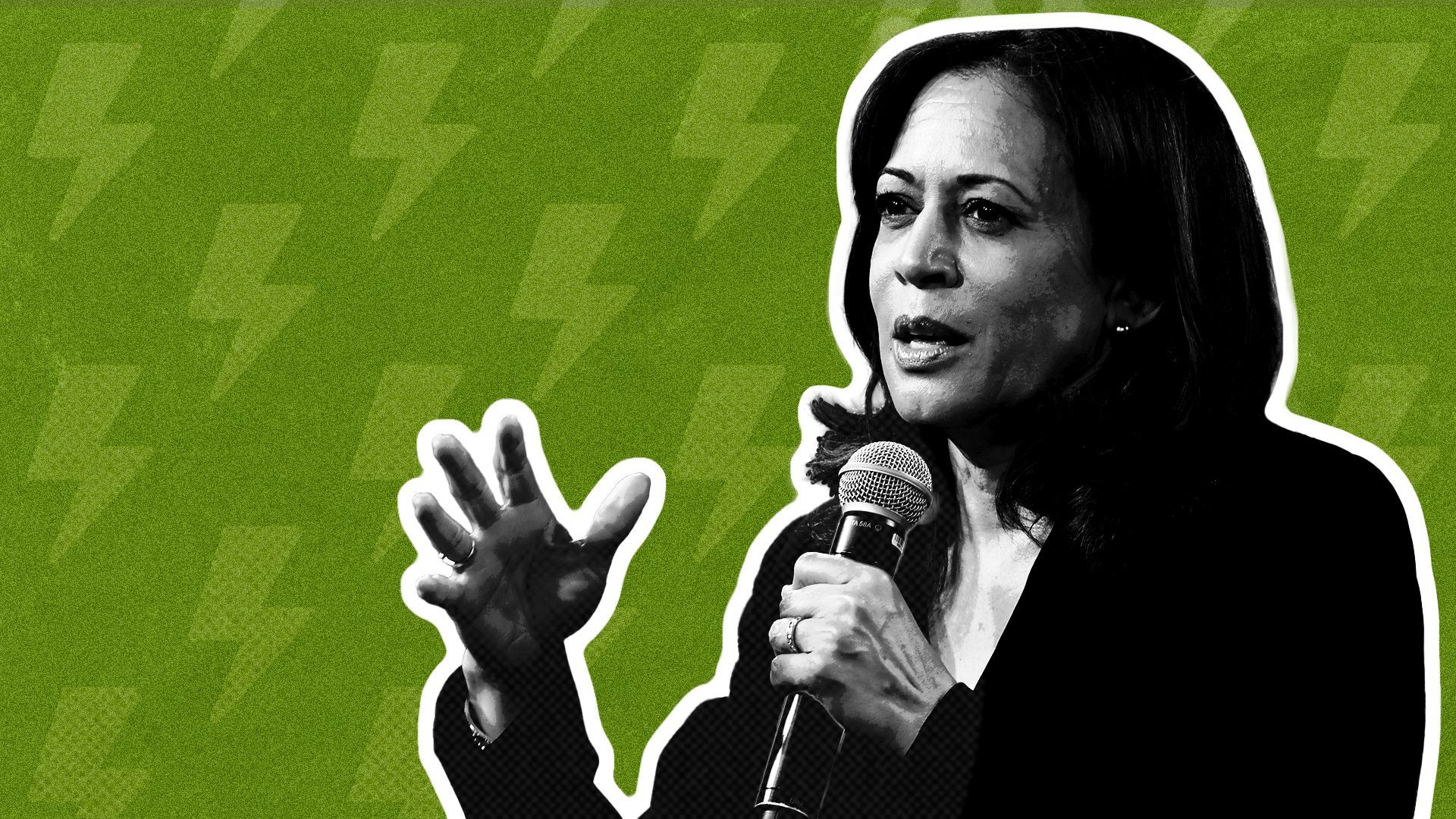
Kamala Harris said her "values" on climate remain intact despite abandoning key positions from her 2019 presidential run.
Why it matters: Her comments to CNN yesterday are the first time she has directly addressed the changes to her stances as the 2024 Democratic nominee.
Driving the news: CNN's Dana Bash asked about her 2019 co-sponsorship of the Green New Deal resolution and call for banning fracking.
- "The most important and most significant aspect of my policy perspective and decisions is my values have not changed," Harris said.
- Harris said "the climate crisis is real" and "urgent" and demands "metrics that include holding ourselves to deadlines around time."
๐ญ My thought bubble: Harris hopes to thread a needle as she tries to avoid political liabilities in gas-producing Pennsylvania, appeal to climate-conscious voters, and wrap the whole thing in an economic message.
- "What I have seen is that we can grow, and we can increase a thriving clean energy economy without banning fracking," she told Bash.
- She's also trying to cast the whole thing as old news, telling Bash she made her anti-ban stance clear during a debate in the 2020 general election.
The big picture: She touted the 2022 climate law and growth in "clean energy" jobs, and U.S. targets set under President Biden.
- Reminder: the non-binding U.S. pledge under the Paris Agreement calls for cutting emissions 50%-52% below 2005 levels by 2030.
Reality check: A fracking ban would require legislation that's never been in the offing politically.
๐ What we're watching: The polls in Pennsylvania as the contest there remains tight and the Trump campaign argues she's still a threat to fracking.
Go deeper: Harris vows not to ban fracking as president
3. ๐จ Bonus policy note: Treasury's expands IRA credit

Breaking: The Biden administration is trying to expand the reach of Inflation Reduction Act incentives for energy projects in low-income and tribal communities.
Why it matters: It's one of several programs that seek to distribute the climate law's generous subsidies to historically underserved areas.
How it works: The low-income communities bonus lets companies claim an additional incentive on top of the law's investment tax credit for zero-carbon power.
- It's already available for wind and solar. The latest Treasury Department guidance proposes to expand it to technologies like geothermal and hydropower.
4. Facebook parent Meta leaves carbon coalition
Meta is leaving Frontier, the coalition of corporate heavyweights that's working to jump-start markets for carbon removal services.
Why it matters: Removal remains a young industry, and the decision signals how the landscape will shift as companies tailor their purchase plans.
What they're saying: "Meta is proud to have helped found Frontier's advance market commitment and of the work we have accomplished," Meta said in a statement.
- "However, as our program has evolved and, after discussing with other founding members, we have decided we would like to source our own carbon removal deals."
Catch up quick: Frontier launched in 2022 with a goal of nearly $1 billion worth of carbon removal purchases by 2030.
- The coalition vets removal startups and enters into purchase agreements alongside other buyers.
- Frontier has contracted for $317 million worth of removal so far from a suite of startups, representing around 572,000 tons of CO2.
What's next: The group tells Axios that Meta's departure won't affect deals it's already part of, and that Frontier is en route to over $1 billion tons of purchases by 2030.
5. Mapped: America's fastest-growing job

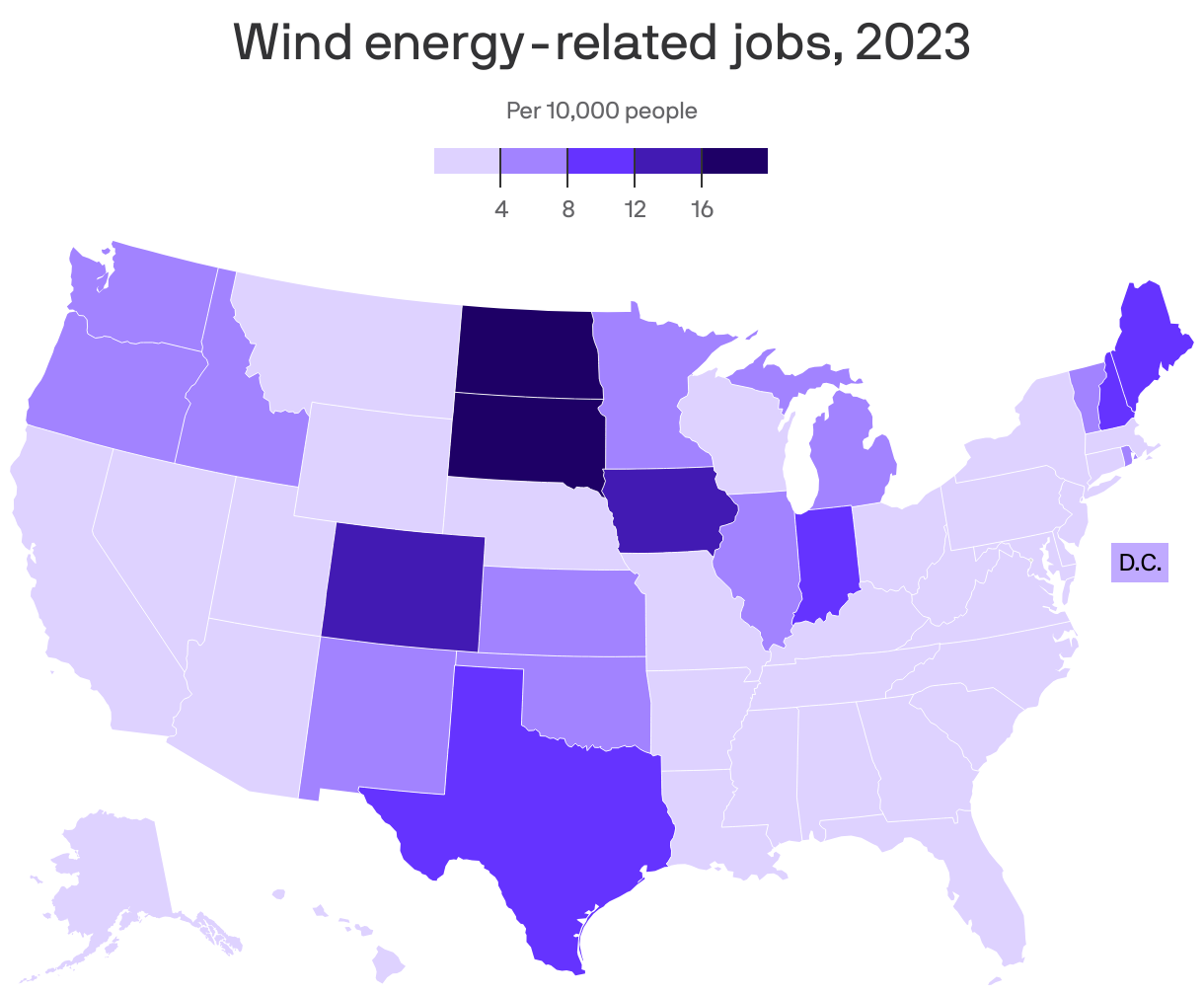
Want a career in America's fastest-growing field? Head to the Dakotas or Colorado, and look for jobs in wind energy.
Why it matters: Turbine service technician is the hottest job in the country, per the Bureau of Labor Statistics, with 60% growth projected between 2023-2033.
Driving the news: North Dakota (22.3), South Dakota (20.4) and Colorado (13.4) have the most wind energy-related jobs per 10,000 residents as of last year.
- That's according to DOE's 2024 U.S. Energy & Employment Jobs Report, plus 2023 census population estimates.
- Texas has the most overall, at nearly 27,400.
6. Record rains fall in the Sahara Desert
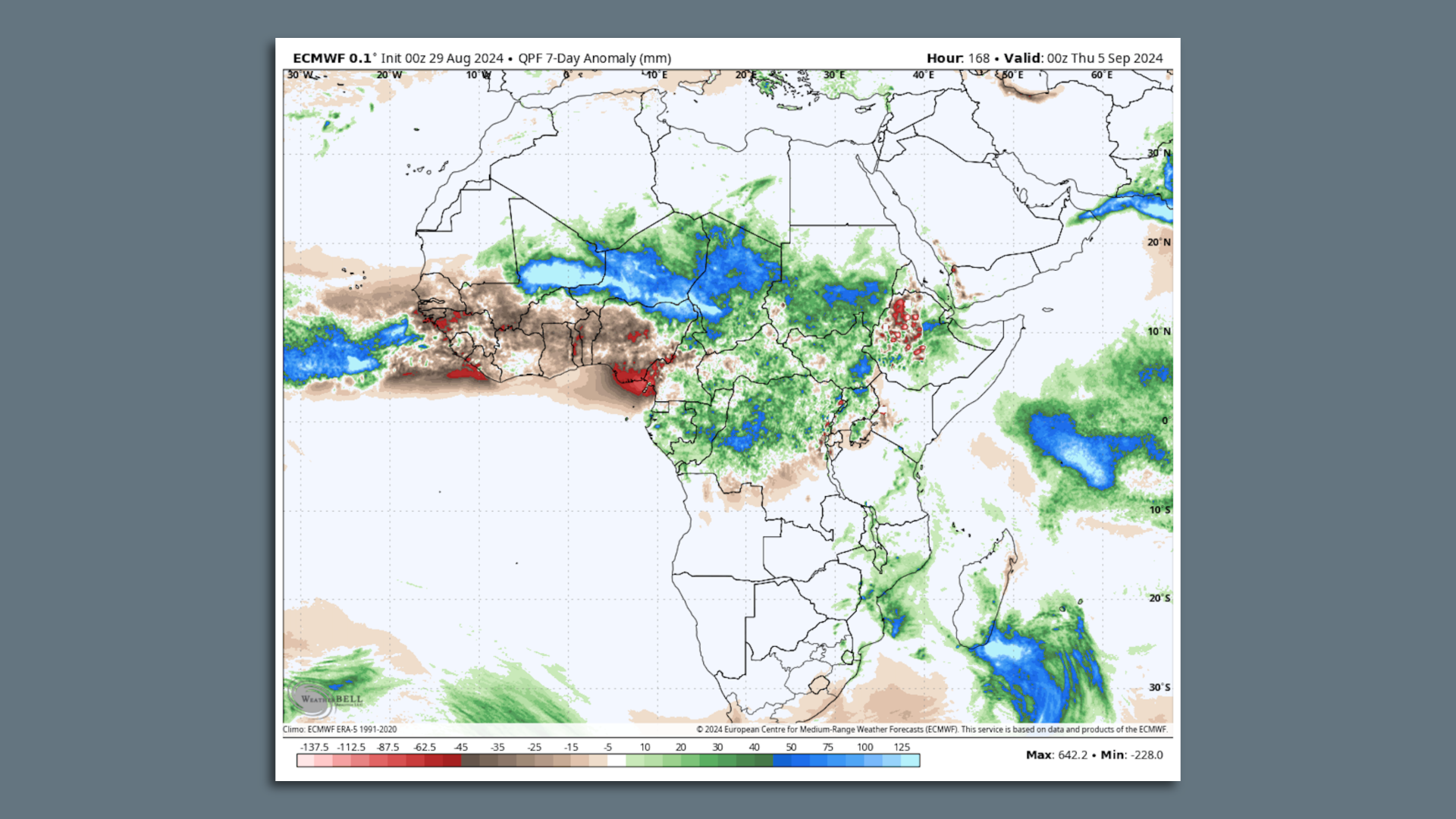
๐๏ธ This was not on my 2024 climate extremes bingo card: The Sahara Desert, which typically does not see a drop of rain at this time of year, is being inundated.
๐ Why it matters: The rains in Africa (paging Toto and Weezer) have been displaced hundreds of miles or more to the north of their typical location, into the Sahara Desert.
- This has links to the lack of Atlantic hurricanes during mid-to-late August, since the thunderstorms dousing the Sahara are emerging over cold waters near northwestern Africa, and quickly falling apart.
๐จ Did a friend, colleague or even a frenemy send you this newsletter? Welcome, please sign up.
๐ Thanks to Chris Speckhard and George Moriarty for edits to today's edition, along with the brilliant Axios Visuals team.
Sign up for Axios Generate