Axios Generate

May 18, 2022
🐪 That day again! Today's Smart Brevity count is 1,113 words, 4.5 minutes.
🚨 Breaking: European leaders released detailed plans to break reliance on Russian energy. They cover faster renewables permitting, diversifying gas suppliers and much more. Go deeper
🎶 This week in 1988, rap pioneers Run-DMC released the album "Tougher than Leather," which provides today's intro tune...
1 big thing: Troubling climate indicators
Key data released today underscores how swiftly human activities are reshaping the climate, Andrew writes.
Why it matters: The “State of the Climate” report from the World Meteorological Organization (WMO) is a stark reminder for policymakers and business leaders that if the world continues on its current course, climate impacts will escalate in severity and scope.
The big picture: The WMO report confirms the past seven years were the warmest such period on record.
- 2021 was comparatively cool, at 1.11°C above the pre-industrial level, due to a La Niña event in the tropical Pacific Ocean.
- Once that event ends, and an inevitable El Niño sets in, a new warmest year will be crowned.
Zoom in: Greenhouse gas concentrations reached a new high in 2021 and recently hit 420.23 ppm for the month of April 2022.
- Temperatures will continue to increase as long as carbon dioxide levels continue to go up, with a leveling off taking place once emissions reach zero.
- Ocean heat content hit a record high in 2021 — a telltale sign of a planet that is absorbing far more heat than it is releasing back into space. The vast majority of this extra heat goes into the oceans, with increasing temperatures in the upper 2,000 meters.
- Marine species are on the move as the ocean warms, and warming waters are altering the ocean’s ability to function as a giant carbon sink. Ocean chemistry is also changing as more CO2 is taken in, making waters more acidic.
Threat level: Heat waves aren’t just a phenomenon felt on land, either, with marine heat waves observed on a global scale during 2021, wiping out some coral reefs and damaging others.
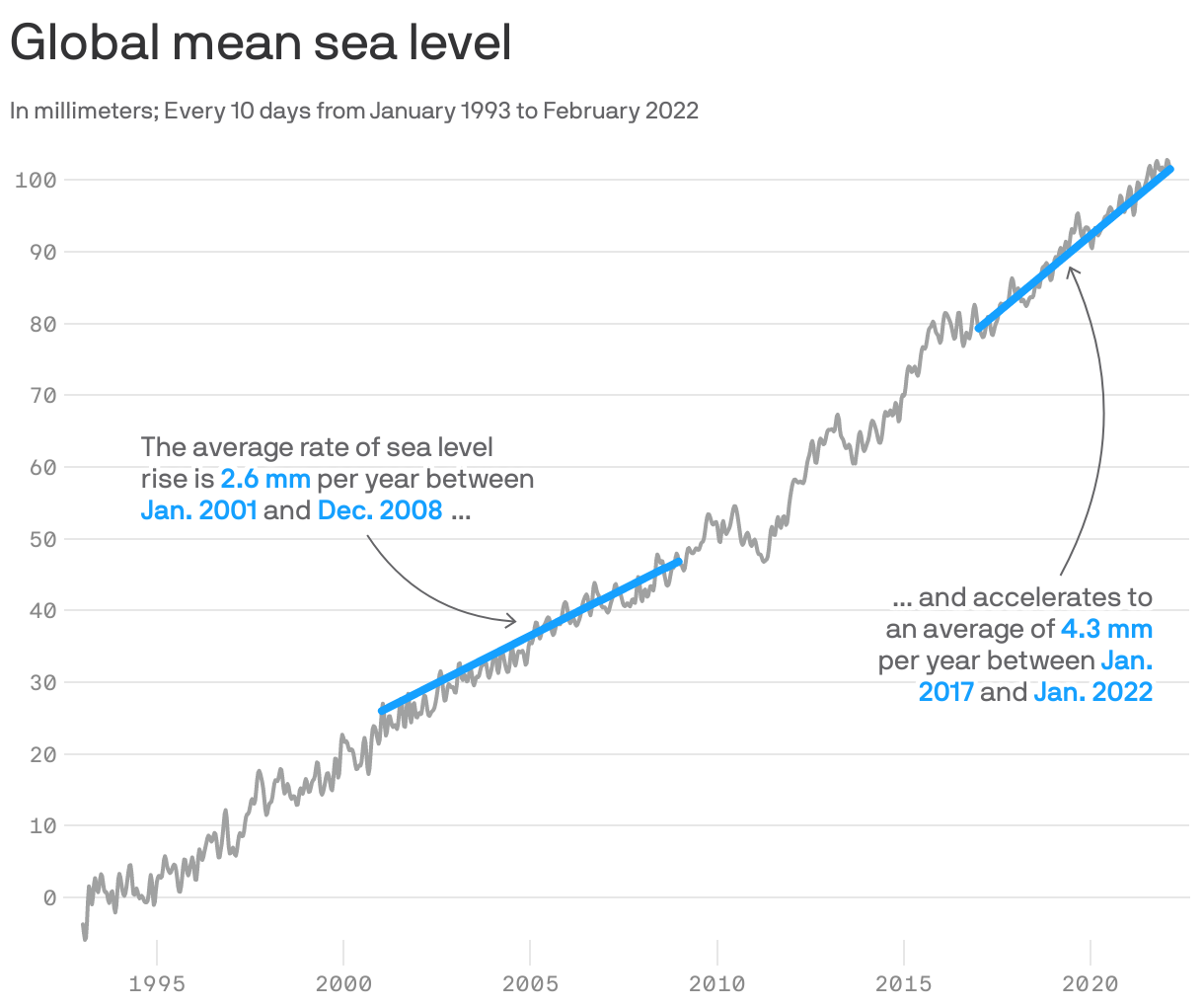
- Global mean sea level reached a record high too, with seas swelling at a faster rate than in the 1990s, which scientists have attributed to the growing ice melt in Greenland and Antarctica.
- The report highlights record ice mass loss among glaciers in Canada and the Pacific Northwest from extreme heat and wildfires last summer.
The bottom line: The report amounts to an annual climate report card, and the planet fails to earn a passing grade.
Yes, but: There are numerous solutions available to alter the planet’s trajectory if leaders act with urgency, as study after study has shown.
2. UN boss unveils new clean energy proposals
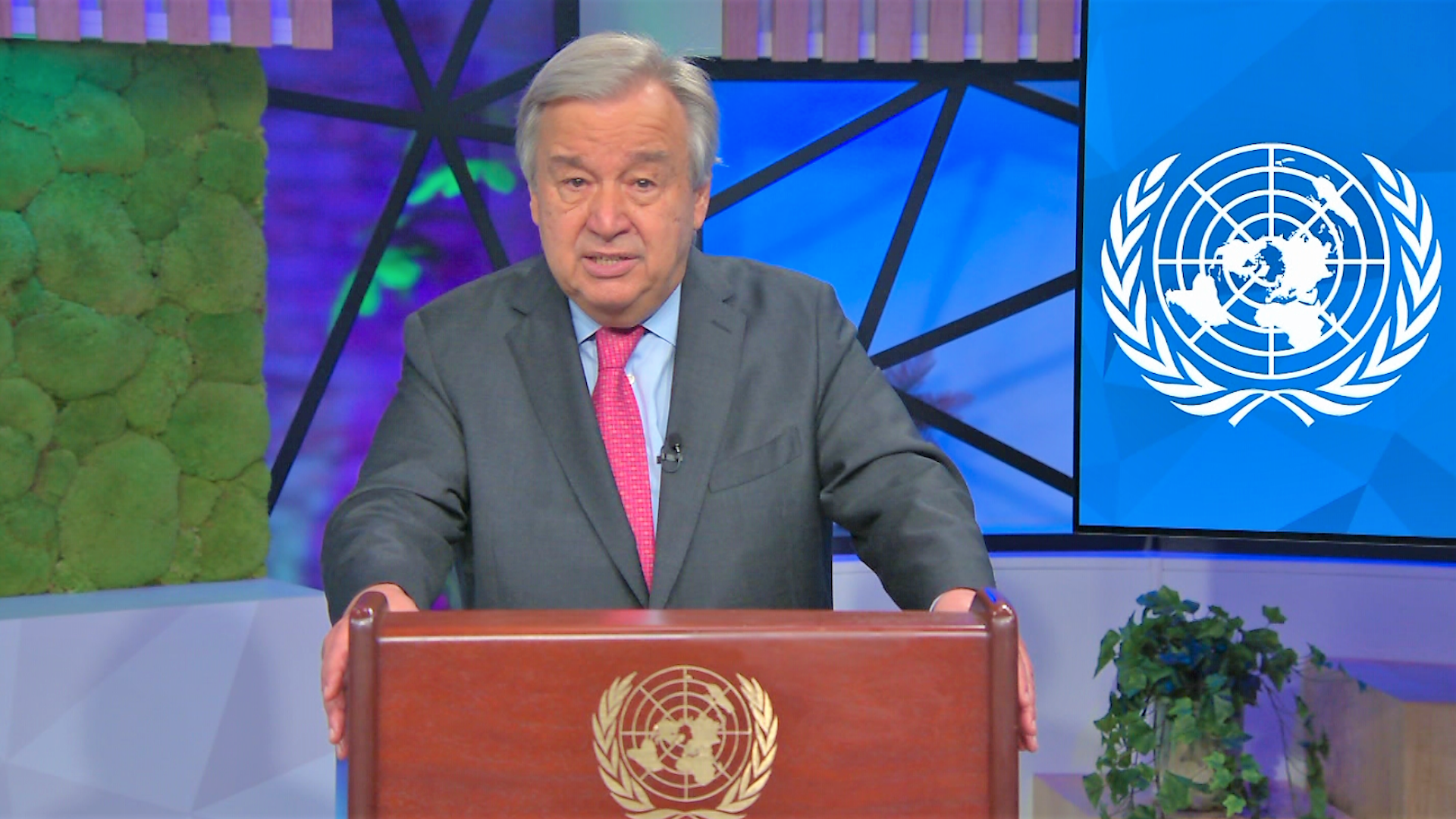
UN Secretary-General António Guterres on May 18. Photo courtesy of the United Nations
The United Nations is leading early discussions on forming a new global coalition to boost battery storage as part of a wider clean energy platform, Axios has learned, Andrew writes.
Driving the news: UN Secretary-General António Guterres laid out a five-point plan this morning to dramatically scale up renewable energy use worldwide, including tackling thorny technology sharing issues between the industrialized world and developed nations.
- A key part of his plan is to advance renewable energy storage.
The intrigue: It is likely the coalition would be led by a country or group of countries, rather than the UN itself.
- Tech companies, manufacturers and financial institutions would be involved in the coalition as well.
- Making such technology work is a key challenge to overcome for large-scale deployment of clean energy sources.
Details: In the video address accompanying the WMO report release, Guterres also said renewable energy technologies such as battery storage should be treated as “essential and freely available global public goods.”
- This would mean making it easier to share knowledge and technologies, free from intellectual property constraints, to help countries around the world shift to clean energy, he said.
Yes, but: Multiple climate agreements have called for technology sharing, but this has proved difficult to implement as companies and countries seek to hold onto their hard-won advances.
3. Al Gore's investment firm raises $1.7B for new fund

Illustration: Allie Carl/Axios
Generation Investment Management, a sustainability-focused firm co-founded by Al Gore, has raised $1.7 billion for its fourth fund, Axios' Kia Kokalitcheva reports.
Why it matters: While venture investing in climate tech and other sustainability areas has boomed since Generation raised its previous fund, the firm says the more crowded investor stable is just validation of its original undertaking.
Zoom in: To differentiate itself from a growing number of peer investors, Generation says its longer history, industry connections, and ability to write growth-stage checks give it an edge, according to Lila Preston, head of growth equity.
4. EVs are shoving aside real volumes of oil
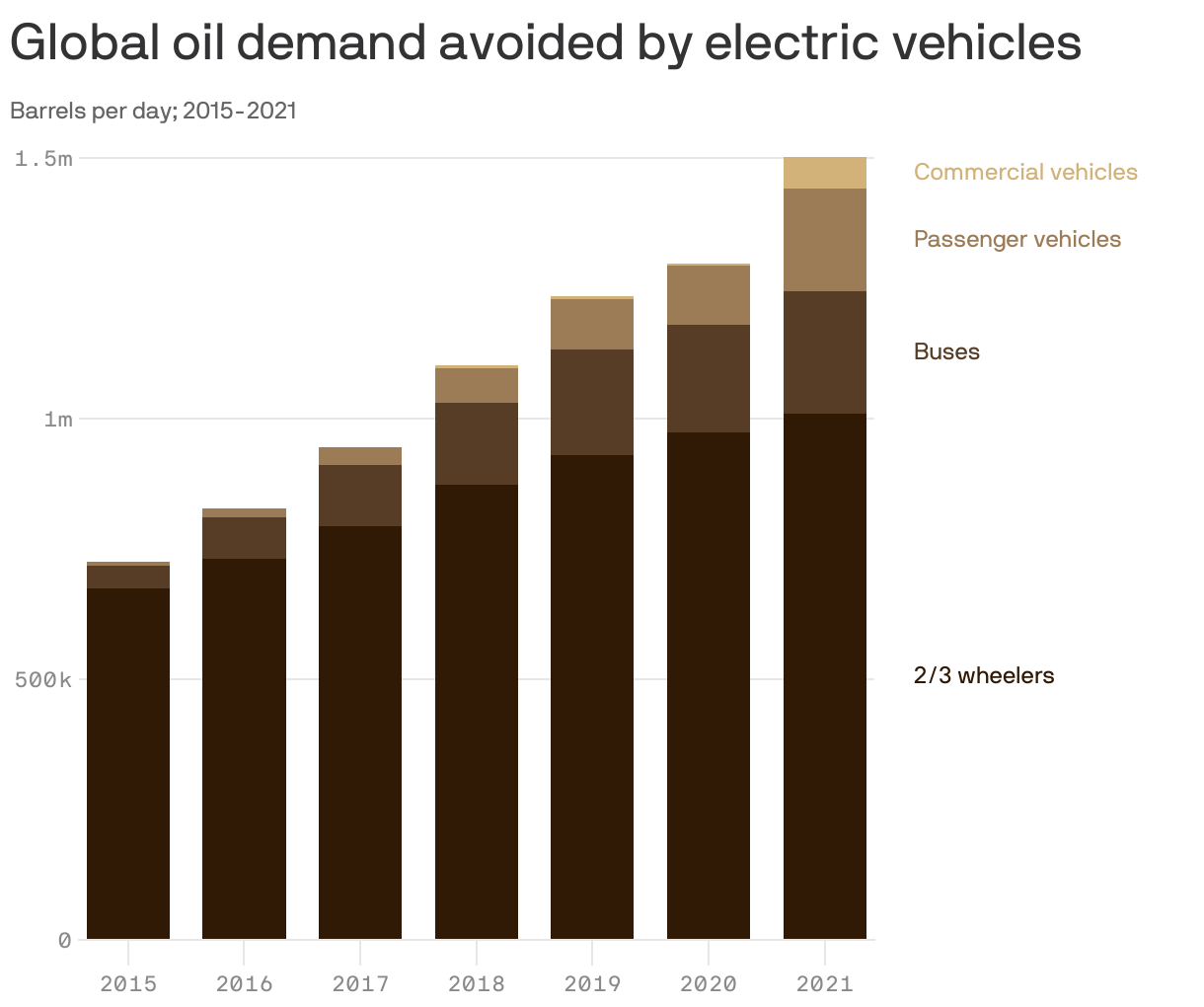
Electric vehicles displaced roughly 1.5 million barrels per day of oil last year, new analysis shows, an amount slated to grow as EV sales keep rising, Ben writes.
Why it matters: The new estimates from the research firm BloombergNEF help to show EVs are shedding their status as a niche climate technology.
- Total transportation fuel demand was 43.7 million barrels per day last year, the firm said.
- The amount EVs have displaced doubled over the last six years, BloombergNEF said.
The intrigue: What kinds of EVs are doing the heaviest lifting right now is surprising (to me anyway!).
- "Two- and three-wheeled EVs accounted for 67% of the oil demand avoided in 2021," the report notes, citing rapid adoption in Asia.
- Buses were next at 16% and then followed by passenger vehicles at 13%, though BloombergNEF adds that they're the fastest-growing segment.
The big picture: BloombergNEF said last year's displaced oil demand amounts to roughly one-fifth of Russia's pre-invasion exports.
5. White House looks to soothe solar probe furor

Illustration: Aïda Amer/Axios
White House officials told Democratic senators they’re committed to resolving the uncertainty the solar industry is facing because of an investigation into whether China is doing an end-run around tariffs on panels, Axios' Sophia Cai and Hans Nichols report.
Driving the news: National Economic Council director Brian Deese, White House director of legislative affairs Louisa Terrell, and White House deputy national climate adviser Ali Zaidi held a call with nine senators on Tuesday.
Why it matters: The investigation, requested by Auxin Solar, an American solar manufacturer, has led to a major slowdown in U.S. projects, developers and analysts say.
What they're saying: "They needed to resolve this yesterday," Sen. Sheldon Whitehouse (D-R.I.) told Axios.
6. Battery recycling player nabs $80M
Illustration: Maura Losch/Axios
The private equity firm Ara Partners is staking battery recycling startup Blue Whale Materials (BWM) with an $80 million equity commitment, Ben writes.
Driving the news: BWM recycles spent lithium-ion batteries into a "blacksand" product that enables recovery of cobalt, nickel and lithium.
The company, founded in 2015, hopes to build five processing facilities in the U.S. and Europe over the next two to four years, starting in the U.S.
Why it matters: Growth of electric vehicles and battery storage will require a lot more critical materials.
- But geopolitical competition for virgin supplies is getting fierce.
- New U.S. mines, meanwhile, have long development timelines and face environmental opposition.
What we're watching: The company plans to seek Energy Department funding, available via the bipartisan infrastructure law, for battery supply chain, recycling and "second life" uses.
📬 Did a friend send you this newsletter? Welcome, please sign up. Thanks so much for reading, and have a great day.
Sign up for Axios Generate

Untangle the energy industry’s biggest news stories