Axios Generate

May 14, 2025

πͺ Wednesday. We're opening with fresh EV data, then moving into Capitol Hill analysis and biz news, all in just 1,092 words, 4 minutes.
πΈ The Who's stunning concert album "Live at Leeds" arrived almost exactly 55 years ago and has today's intro tune...
1 big thing: Global EV sales are heading for a new milestone
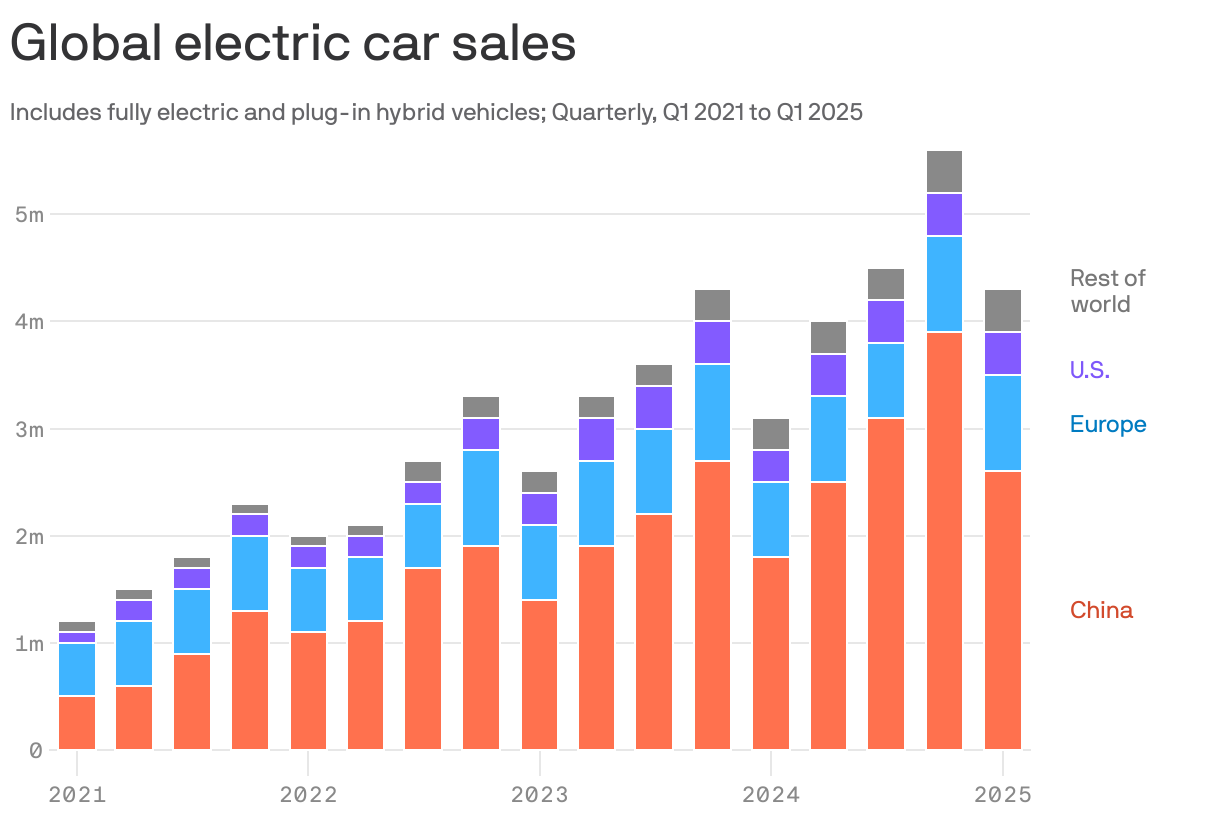
EVs are slated to reach one-fourth of global car sales this year despite trade and policy question marks, the International Energy Agency said.
Why it matters: The growth in cars β and, to a lesser extent, big trucks and other heavy vehicles β is affecting oil demand, the new report finds.
State of play: Last year EVs displaced roughly 1.3 million barrels per day in what's currently a 100 million barrel-ish daily market, IEA finds.
- That's slated to reach 5 million bpd in 2030 under nations' existing policies β and that's the most conservative scenario in IEA's modeling toolkit.
Yes, but: IEA sharply cut its U.S. EV growth estimate as Trump 2.0 officials and congressional Republicans reverse Biden-era subsidies and rules.
- The agency now sees EVs with 20% of the light-duty market β sedans, vans, SUVs and pickups β in 2030, less than half of IEA's projection in last year's analysis.
- And IEA projected slightly more 2030 oil displacement in last year's version of the annual report.
Friction point: IEA cautions more broadly that the global auto market landscape is quite fluid these days.
- "Uncertainty about the evolution of trade and industrial policy, downside risks to the economic outlook, and lower oil prices could affect EV uptake β but also car markets overall," the report notes.
The big picture: Other toplines from IEA's latest annual EV report on battery-electric vehicles and plug-in hybrids...
- They topped 20% light duty of sales in 2024, first and foremost in China, with the EU and U.S. as the next largest markets.
- The agency sees EVs snagging 40% of global new car sales in 2030 under current policies, with China maintaining a hefty lead.
- Sales are soaring in emerging markets. Southeast Asia and Latin America grew as much as 60% last year, but from a very small base.
- Big growth from a small base also describes electric heavy-duty trucks, with purchases surging 80% last year to reach 2% of global sales.
What we're watching: EV sticker prices are getting more competitive with petro-powered models as battery costs fall, but gaps persist in key markets outside China.
- The average gap in the U.S. is 30%, and it's 20% in Germany.

2. ποΈ Four takeaways from the House IRA moves
Here are a few things that caught my attention as House Republicans advance bills to greatly pare back the Democrats' huge 2022 climate law...
ποΈ A quietly major change could limit subsidies for "clean" power production beyond just starting to wind down access in 2029, a few years sooner than planned.
- State of play: The Ways and Means Committee plan mandates that access is available only once a project starts producing energy, as opposed to when construction starts.
- Why it matters: This means a "de facto sunsetting of the credits as early as 2026," the Rhodium Group said in a wider analysis of the panel's legislation.
β οΈ The bills are part of increasingly large pendulum shifts when power changes in D.C., ClearView Energy Partners said in a note. Statutory changes are joining the trend of big regulatory swings in the Obama-Trump-Biden-Trump era.
- The big picture: "The GOP's IRA reforms could create an unsettling precedent for investors and corporate leaders who previously viewed policy implemented via legislation as more durable β and therefore more investable β than on-again-off-again regulations," it states.
βοΈ Some Senate Republicans are "resisting the House's plan to gut clean energy tax credits, vowing to soften the blow for emerging technologies," Bloomberg reports.
- What we're watching: GOP senators Lisa Murkowski, Thom Tillis, Kevin Cramer, and Shelley Moore Capito have various misgivings about the House plan, per Bloomberg and E&E News.
πΌ Lobbying is intensifying. For instance, a large array of companies and trade groups β including players with GOP ties like the American Petroleum Institute β is urging Republicans to reverse plans to kill hydrogen credits.
3. π Catch up quick on business: GM, Aramco, Honda

π» General Motors aims to deploy the industry's first lithium manganese-rich (LMR) batteries on its next-generation electric trucks and SUVs, tapping an alternative chemistry that it claims will provide more energy at a lower cost.
- Why it matters: The biggest barriers that prevent truck customers from buying an EV are their limited driving range and high prices, GM says.
- What we're watching: The battery breakthrough means GM can offer electric trucks with a solid 400 miles of driving range at a lower price tag. Full story.
π΅ Via the WSJ, "Woodside Energy floated the possibility of Saudi Arabian Oil Co., known as Aramco, buying a stake in its newly approved Louisiana LNG project after signing a collaboration agreement with the giant producer."
βΈοΈ Via AP, "Honda Canada will postpone a $15-billion Canadian (US$10.7 billion) electric vehicle investment project in Canada's most populous province, including a proposed EV battery plant and retooled vehicle assembly facility."
4. π¨π³ On my screen: U.S. gasoline and Chinese coal finance

β½ U.S. gasoline thirst might have entered a permanent decline, UC-Berkeley business prof Lucas Davis writes in a new post.
- Why it matters: Gasoline is a big part of overall oil consumption and hence CO2 emissions.
- Catch up quick: With some exceptions, gas demand went steadily upward for many decades. But it then fell from 2007-2014 (high prices and then recession), then went back up from 2015-2018, and started sliding modestly again in 2019.
- State of play: Davis points to EVs, better mileage in gas-powered models, and post-COVID changes in driving habits in suggesting growth may be over.
- The bottom line: "It's tough to foresee what lies ahead, but I certainly understand why refinery owners are getting nervous," Davis writes.
π¨π³ China is following through in its 2021 pledge to stop financing coal plants abroad, but there's an asterisk on the data, a new analysis from BU's Global Development Policy Center finds.
- Why it matters: Coal is the most CO2-emitting fuel, and China is a major funder of infrastructure finance outside its borders.
- The big picture: "The composition of Chinese overseas energy finance...has shifted to green energy, and there has been no new investment in coal-fired power plants since 2021," it states.
- Yes, but: Overseas renewables finance remains "relatively small." And there was lots of coal in the pre-2021 pipeline, with 8 gigawatts coming online in 2022-2023 and more under construction. Full analysis.
5. βοΈ Tech number of the day: $1 billion-plus for fusion
Commonwealth Fusion Systems has raised over $1 billion in extension funding to build its first commercial power system, two sources familiar with the raise tell Axios.
Why it matters: A hyperscale data center developer is anchoring the larger-than-planned raise, signaling just how seriously tech firms are taking fusion energy.
Unlock the whole exclusive, and for a steady diet of scoops and smart analysis, talk to our sales team about Axios Pro Deals.
π§ Did a friend, colleague or an AI chatbot send you this newsletter? Welcome, please sign up.
π Thanks to Chris Speckhard and Chuck McCutcheon for edits to today's edition, along with the brilliant Axios Visuals team.
Sign up for Axios Generate