
Axios Generate

February 04, 2022
🍺 Happy Friday! Today's Smart Brevity count is 1,235 words, 5 minutes.
🛢️ Oil prices climbed to fresh 7-year highs this morning. Go deeper
🗓️ Join Axios virtually at our 1st What’s Next Summit on April 5. Register here for sessions on trends that will shape our future.
🎶 At this moment in 1976, the Ohio Players were #1 on the Billboard Hot 100 with a great ride that's today's intro tune...
1 big thing: The Fed's climate work is facing unprecedented scrutiny

Illustration: Sarah Grillo/Axios
A Senate hearing yesterday showed intense interest in the Federal Reserve's climate work as Republicans' fear of anti-oil banking policies gives a key nominee a rocky path to confirmation, Ben writes.
Driving the news: Senate Banking Committee Republicans pressed Sarah Bloom Raskin, President Biden's pick for the Fed's top banking cop, on whether she'd seek to limit credit to fossil fuel industries.
They've pointed to past writing that calls for financial regulators to play a role in steering Wall Street away from high-carbon assets.
The big picture: There's growing consensus among economists and scientists that climate change presents financial risks due to the costs of extreme weather, sea level rise and other impacts.
- The Fed's direction was in the spotlight even before Raskin's nomination, thanks to top officials' pledges to boost risk analysis; climate activists' push for financial regulators to act more aggressively; GOP worries about mission creep and policies that hurt fossil fuels, and other forces.
Here are a few takeaways...
1. Raskin sought to provide assurance on the limits of the Fed's role. While stressing the importance of the Fed's analysis of climate-related financial risks, she repeatedly said its rules and supervision should not pick winners and losers.
"Banks choose their borrowers, not the Fed," said Raskin, a Duke University law professor who formerly served on the Fed board and in the Obama-era Treasury Department.
2. This was the most revealing exchange: Sen. Jerry Moran (R-Kan.) asked Raskin: "If it is your view that the oil and gas industry, fossil fuels, need to be diminished in the role of this nation, in our economy... Is there any path for you to accomplish that as a member of the Federal Reserve?"
Raskin replied, "I certainly have not explored that and would imagine there is no such path."
3. Democrats sought to emphasize the importance of the Fed's climate analysis and called it a mainstream view.
- Sen. Elizabeth Warren (D-Mass.) yesterday noted Fed chairman Jerome Powell has also endorsed the need for a better understanding of banks' exposure to climate risks.
- "I don't support chair Powell's nomination for another term running the Fed. But even he thinks that it is just common sense that the Fed should work to mitigate the risk of significant economic loss triggered by climate change," she said at the hearing.
4. The confirmation battle will be close. GOP opposition to Raskin goes beyond the banking committee.
Sen. Mitch McConnell, the minority leader, yesterday attacked Raskin's nomination, and a number of oil and coal industry groups are urging no votes.
- Sen. Pat Toomey (R-Pa.), the committee's top Republican, said he's unconvinced by Raskin's assurances, calling them a "remarkable" case of "confirmation conversion."
- He sees the Fed's "scenario analysis" of banks' climate risks as a stalking horse for policies like exposure limits on fossil holdings.
- Unless some GOP members break ranks, Raskin would need support from every Democrat including Sen. Joe Manchin of West Virginia — a major gas and coal-producing state — who has not yet stated a position.
What they're saying: Capital Alpha Partners' Ian Katz, in a note, sees a 55%-60% chance of confirmation, noting he's unsure she'll get support from every moderate Democrat.
2. Biden extends but changes Trump's solar tariffs

President Biden plans to maintain former President Trump's tariffs on solar cells and panels, but loosen some restrictions on importing supplies from Asia to help combat climate change, Axios' Hans Nichols scooped this morning.
Driving the news: Biden will issue a proclamation today to extend the so-called Section 201 tariffs, due to expire Sunday, for another four years, an administration official said.
Why it matters: Biden's decision seeks to balance two competing priorities — both crucial to his presidency:
- Long term, he wants to bolster domestic manufacturing and stimulate U.S.-based supply chains. But in the short term, he needs to rely on imports for crucial materials and certain equipment to fight climate change.
- Labor unions wanted the administration to fully extend the Trump tariffs but were bracing for disappointment after Reuters reported last week that Biden was considering loosening some of them.
Zoom in: Biden will formally exclude bifacial solar panels, which are used in big-utility projects, to help importers and domestic installers increase solar capacity as part of his overall climate and clean energy goals.
The new rules will also increase the number of solar cells that can be imported duty-free, from 2.5 gigawatts to 5 gigawatts.
3. Chart of the day: Big Oil's big bounce-back
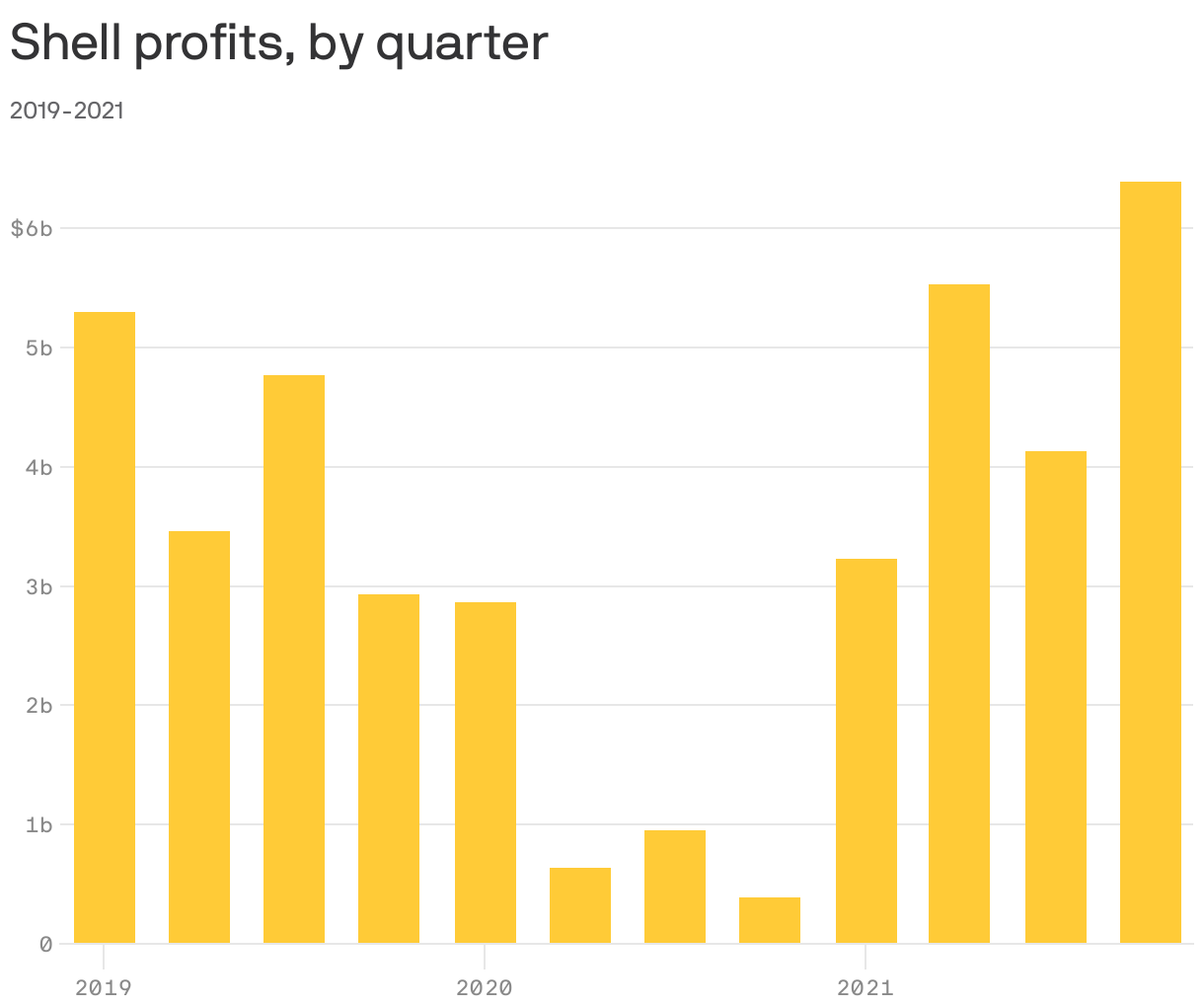
Shell's $6.4 billion fourth-quarter profit reported yesterday is the latest sign of Big Oil's recovery from the price and demand collapse during the pandemic restrictions of 2020, Ben writes.
It followed Exxon's $8.9 billion Q4 earnings announced Tuesday and Chevron's $5.1 billion Q4 haul reported last week.
4. The unequal burdens of a warming planet

Illustration: Sarah Grillo/Axios
The cost of a warming planet won't be borne equally. And some economists have used novel techniques to figure out where the damage to well-being will be particularly severe, Axios' Neil Irwin reports.
Why it matters: They find that globally, welfare is on track to decline 6% by 2200, but that is more like 20% in hard-hit places.
Even when factoring in steps aimed at adapting to a hotter planet, wider global inequality is likely to be a consequence.
What's new: A working paper by Princeton's José-Luis Cruz and Esteban Rossi-Hansberg of the University of Chicago built a model that factors in not just how much hotter different places will become, but how humans are likely to react.
Zoom in: Over long time periods people will move away from low-lying areas and the hottest places, and more investment will occur in locations with more congenial climates.
- They find that some of the most severely affected regions, including in sub-Saharan Africa and Southeast Asia, are also some of the poorest and highest-populated.
- Conversely, some places on track to experience improvements in welfare, including Siberia and Northern Canada, are currently sparsely populated.
Yes but: Their work focuses on temperature rise, and doesn't factor in other potential effects of global warming, like extreme weather and climate events.
And places in the far north may have their own challenges, like thawing permafrost damaging infrastructure.
Go deeper: Check out this new interactive about the research.
5. Federal officials open push for 24/7 clean power

Illustration: Eniola Odetunde/Axios
The Biden administration is taking initial steps to meet a tough goal: powering the government with zero-carbon power around the clock, Ben writes.
Driving the news: Yesterday the General Services Administration — the government's landlord — and the Defense Department announced a formal request for information (RFI) to solicit input.
It follows President Biden's December executive order that calls for 50% of federal power to be emissions-free on a 24/7 basis by 2030 and "produced within the same regional grid where the energy is consumed."
Why it matters: The federal government and the Defense Department, in particular, are massive electricity users, so their efforts can help drive the push for 24/7 clean power methods on a wider basis.
The information request aims is a preliminary step that's designed to better understand the industry's ability to provide hourly matching and the costs involved.
Catch up fast: Some corporations are procuring enough renewables to meet their aggregate annual power demand, but that's hardly the same as avoiding coal and gas entirely.
Avoiding any power from fossil resources on an hourly basis is an emerging challenge that can help deeply decarbonize grids, but is also much tougher.
It's one that some companies and local governments are taking on, with Google hoping to have its operations run 24/7 on clean power by 2030.
Sign up for Axios Generate

Untangle the energy industry’s biggest news stories


