Axios Generate

April 10, 2023
🥞 Good morning! Lots of EV news today with some oil and storage mixed in. But this newsletter still has a Smart Brevity count of just 892 words, 3.5 minutes.
🎸 This week in 1972, The Rolling Stones released the lead single from their masterpiece "Exile on Main St." and it's today's intro tune ...
1 big thing: Biden's EV policy adds sticks to the carrots

Illustration: Shoshana Gordon/Axios
Regulators, mount up: The Environmental Protection Agency is expected to float tough vehicle pollution rules this week that would speed transition to electric cars and trucks, Ben writes.
The big picture: While the new climate law relies heavily on tax incentives, the Biden administration is wielding prescriptive regulations to drive clean tech, too.
Why it matters: Transportation is the country's largest source of greenhouse gas emissions.
Zoom in: The New York Times reports the draft rules would effectively require EVs to account for 54%-60% of new car sales by 2030 and 64%-67% in 2032.
The Washington Post has the same figures, but notes they represent the most stringent of several options in the rule.
How it works: EPA auto rules don't specifically require EV levels, but strong CO2 emissions standards are a de facto mandate.
That's because more efficient gas-powered models alone can't achieve the required fleet-wide carbon cuts.
Yes, but: EPA did not confirm the EV levels the NYT and WaPo reported, telling Axios "the proposal process is not yet final."
Driving the news: Two draft emissions rules are expected this week, a federal source confirms, speaking anonymously ahead of the rollout.
- One addresses light-duty vehicles — cars, SUVs, pickups — from model years 2027-2032.
- The other sets rules for heavy-duty vehicles and engines.
What we're watching: The fine print. Officials will likely reveal more about how they see the climate law and 2021 infrastructure law driving market evolution.
What they're saying: Automakers are wary, even as the industry invests heavily in EVs.
- "A clear-eyed assessment of market readiness is required. The answer on rule feasibility is: it depends," states a memo from the Alliance for Automotive Innovation.
- Much depends on charging availability, supply chains and other variables, the industry group said.
What we don't know: Whether the rules will survive litigation that follows almost all big regulations once they're finalized. They could also be softened by a change in White House control.
2. Charted: the long road ahead to EV dominance


EVs are growing fast, but have a long ways to go before meeting the targets reportedly contemplated in the pending EPA auto emissions rules described above, Ben writes.
The big picture: Electric models were almost 10% of U.S. light-duty sales in December, per the Alliance for Automotive Innovation, an industry group.
3. On our radar: new oil data and analysis


The conventional wisdom since OPEC+ announced new production cuts is that the rate of U.S. production growth won't change much despite the decision's upward effect on prices, Ben writes.
What we're watching: Whether the next projections from the Energy Department's market analysis arm agree.
- The Energy Information Administration will release its latest outlook Tuesday.
- It's their first monthly report since the surprise OPEC+ decision last week to jointly cut roughly 1.2 million barrels per day through 2023.
- And keep an eye on the International Energy Agency's closely watched monthly oil market report coming Friday.
The big picture: U.S. crude production has been growing since the pandemic-fueled collapse, but still remains well below its pre-COVID peak.
- Capital discipline has been a big theme as producers and investors emphasize returns over volume. High input costs are also a check on production.
- The WSJ notes that the U.S. is just once source of added supplies but that some other nations have been growing faster in recent months.
4. Big in storage: Tesla's Shanghai factory
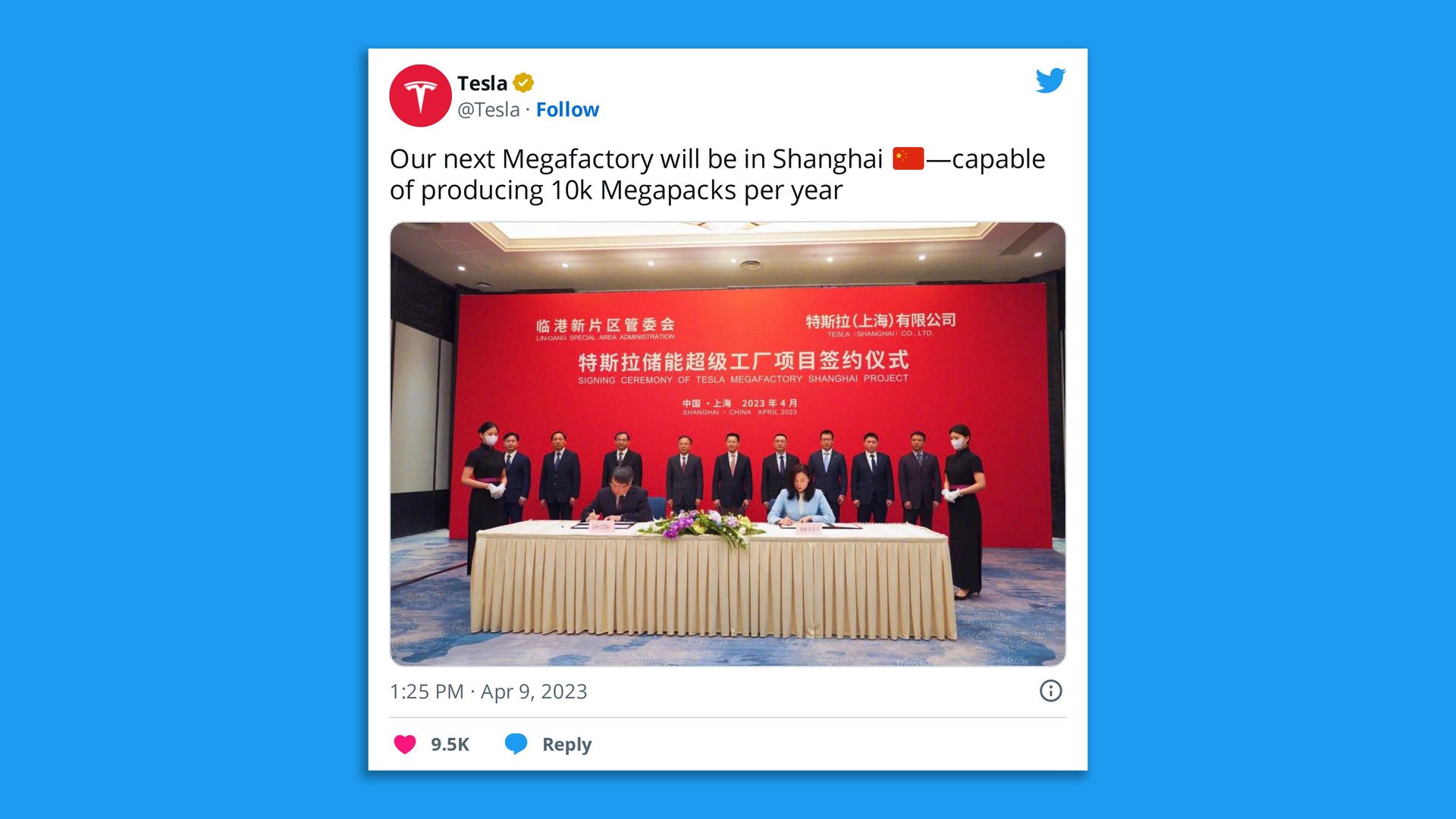
Image: Twitter
Tesla will build a factory in Shanghai capable of building 10,000 of its "megapack" utility-scale battery storage units annually, per the company and Chinese state media, Ben and Axios' Rebecca Falconer report.
Driving the news: Tesla is due to "break ground in the third quarter of the year and start production in the second quarter of 2024," company officials said at a signing ceremony in Shanghai, per Xinhua.
- It will "supplement" output from its factory for the storage product in California, CEO Elon Musk tweeted.
The big picture: Grid-scale battery storage is a far smaller business for Tesla than cars.
- But the global storage appetite is rising to help integrate intermittent renewables and boost grid resilience.
5. Why Walmart's charging move matters
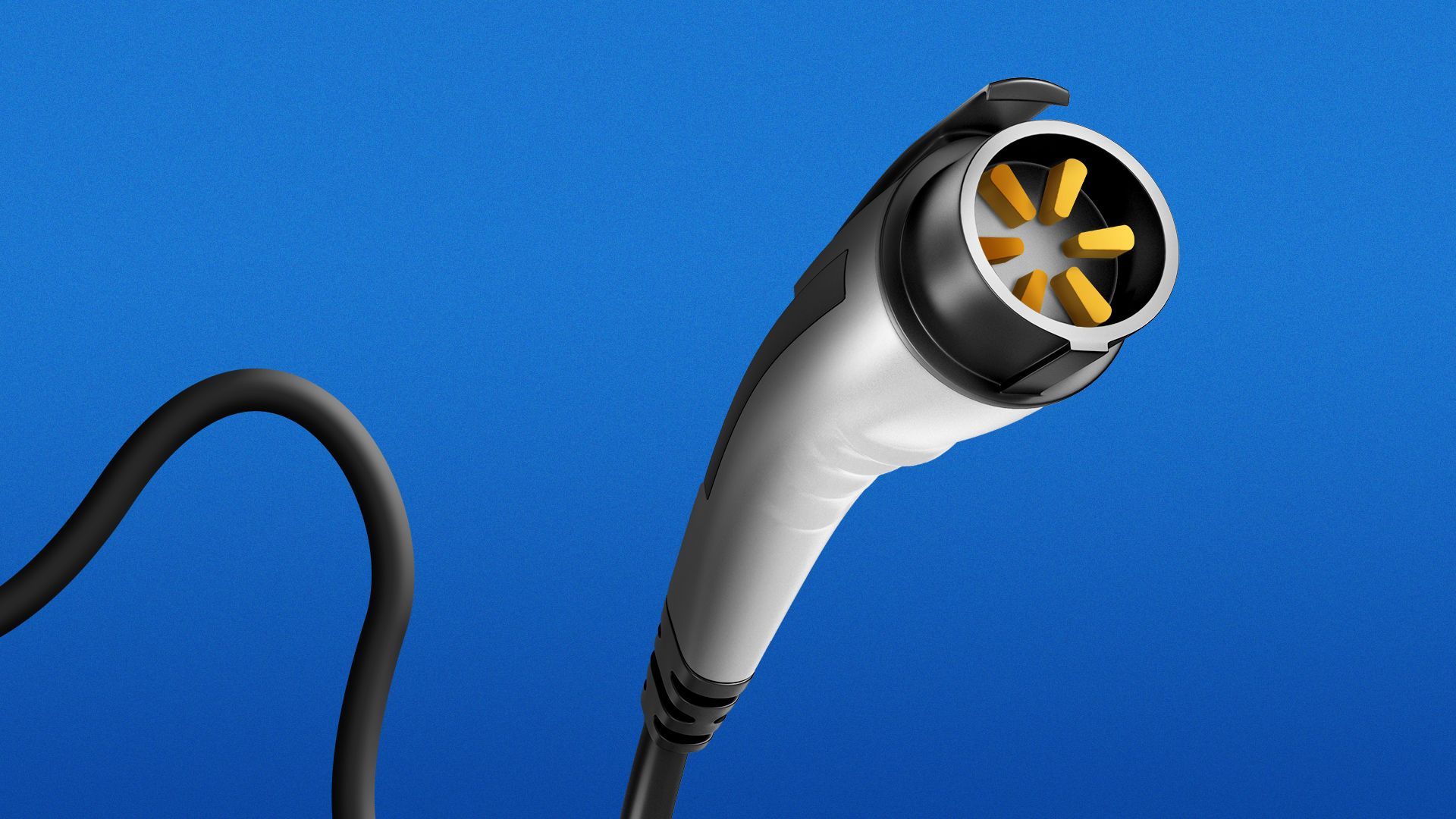
Illustration: Allie Carl/Axios
Walmart's plan to dramatically expand its EV fast-charger network is a big deal for the country's quickly developing car-charging infrastructure, Axios' Alex Fitzpatrick reports.
Why it matters: 90% of Americans live within 10 miles of a Walmart, the company says.
That underscores Walmart's potential to put fast EV charging within reach of far more drivers.
Driving the news: Walmart plans to install fast-chargers at "thousands" of Walmart and Sam's Club locations across the U.S. by 2030.
It already has nearly 1,300 such chargers available at over 280 locations.
6. 👀 On my screen: the rocky energy transition
Old energy security risks are giving way to new ones amid the transition to low-carbon sources — and fresh policy tools are needed, Ben writes.
The big picture: That's the upshot of a big new Foreign Affairs essay on the fraught geopolitics of energy transition. Some of the many points ...
- "The past 18 months have highlighted the 'feast before famine' dynamic facing traditional producers of oil and gas, whose power and influence will increase before it wanes," Columbia's Jason Bordoff and Harvard's Meghan L. O'Sullivan write.
- Despite the the U.S. climate law's industrial policy focus, heavy reliance on China and a few other nations for key materials used in low-carbon tech will remain.
- The U.S. will "need strategic stockpiles of the building blocks of clean energy, working with its allies to amass critical minerals such as lithium, graphite, rare earths, and nickel."
📬 Did a friend send you this newsletter? Welcome, please sign up.
🙏 Thanks to Lisa Hornung and Javier E. David for edits to today's edition.
Sign up for Axios Generate

Untangle the energy industry’s biggest news stories