
Axios Generate

April 23, 2021
Happy Friday! Today's Smart Brevity count is 1,217 words, 4½ minutes.
🎸 On this date in 1983, U2 kicked off the North American tour behind their album "War," which features a politically charged hit that's today's intro tune...
1 big thing: The Biden climate doctrine emerges
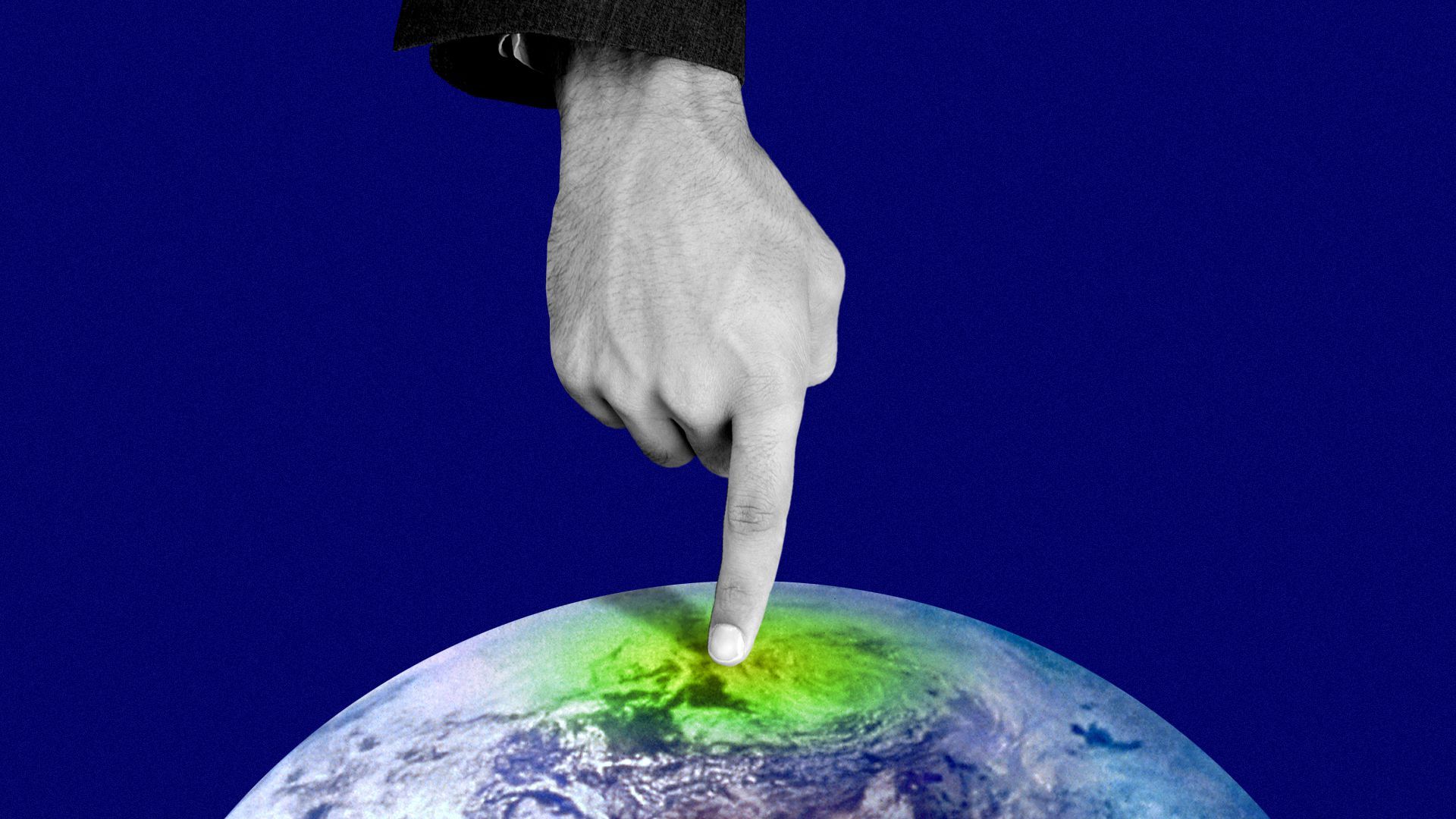
Illustration: Annelise Capossela/Axios
President Biden's climate summit is highlighting a White House approach that blends diplomacy, executive power, salesmanship — and a little faith.
Here are a few pillars of the emerging Biden doctrine...
1. Convincing the world that executive power can work. The White House is pulling out all the stops to sell the idea that every inch of the executive branch can be marshaled in ways big and small.
- The summit lineup features officials from across the government. The message is that strong progress is possible without Congress — a branch Biden didn't even mention in his summit-opening remarks.
- Or take the international finance plan unveiled yesterday. Yes, it calls for more money (hello Congress), but then pivots to how the U.S. development finance agencies can reorient their own work around climate.
2. Faith that an underwhelming global diplomatic apparatus can be effective.
- Special climate envoy John Kerry has been everywhere as the U.S., despite its own credibility problems, tries to get countries to toughen their commitments and then do the harder part — put meaningful policy heft behind them.
- One big bet is that a mix of collaboration and economic competition with China can lead the world's largest polluter to take tougher steps.
- Some of the pledges at the summit, including new commitments by Canada and Japan, are of the right scale to keep global warming within the limits of the Paris climate agreement if they're carried out. But that's a big if — and China and India made no new specific commitments.
- More broadly, the summit shows the U.S. is trying to make use of a range of bilateral and multilateral forums to begin sending global emissions sharply downward — something that's not happening yet.
3. The idea that big finance can be made into a climate ally.
- Top execs with Bank of America and Citigroup spoke at the summit Thursday.
- And one big UN-backed announcement this week, with the participation of Kerry and Treasury Secretary Janet Yellen, is a new financial sector umbrella group that looks to marshal huge amounts of private capital into clean technologies and pressure polluting industries to get cleaner.
4. Confidence in clean energy technology's growth.
- White House officials this week have made the case that growing competitiveness and cost declines can help with the heavy lifting toward their emissions targets.
What they're saying: In an interview with Axios, Google and Alphabet CEO Sundar Pichai says the company sees itself in part as a clean energy accelerator.
- "Moving to a world where we are able to operate by sourcing clean energy, for every location and every hour, and doing it across your operational footprint in everything you do, I think that's profound," Pichai says.
- "Our goal is not just to do it for ourselves, but share the knowledge and the solutions we come up with."
2. Exclusive: The White House makes its economic case
Illustration: Aïda Amer/Axios
The White House Council of Economic Advisers has prepared a detailed analysis arguing that big new investments in climate-friendly energy and infrastructure are crucial to U.S. competitiveness and to avoid increasing damage to the economy.
Why it matters: The forthcoming report is the most detailed White House effort yet to explain the economic case for its clean energy R&D and deployment proposals.
- The analysis, obtained by Axios, is part of a wider effort to marshal support for Biden's $2 trillion-plus infrastructure plan, which is heavy on climate-related spending.
- Part of a White House messaging blitz around this week's global climate summit, the report slated for release Friday morning comes as Republicans argue Biden's energy policies will hurt the economy and bleed jobs in traditional energy sectors.
The big picture: The report warns that unlike major trading partners, the U.S. lacks an effective strategy around R&D, deployment and supporting workers through the transition to lower-carbon energy.
- "Absent such a strategy, workers could be hit by the dual negative effects of declining jobs in high-carbon industries alongside too few new domestic jobs in the emerging carbon-free industries of the future," it states.
- The CEA says a mix of investment, targeted regulations, and policies to equitably spread benefits are needed.
3. Charting a source of global climate tension
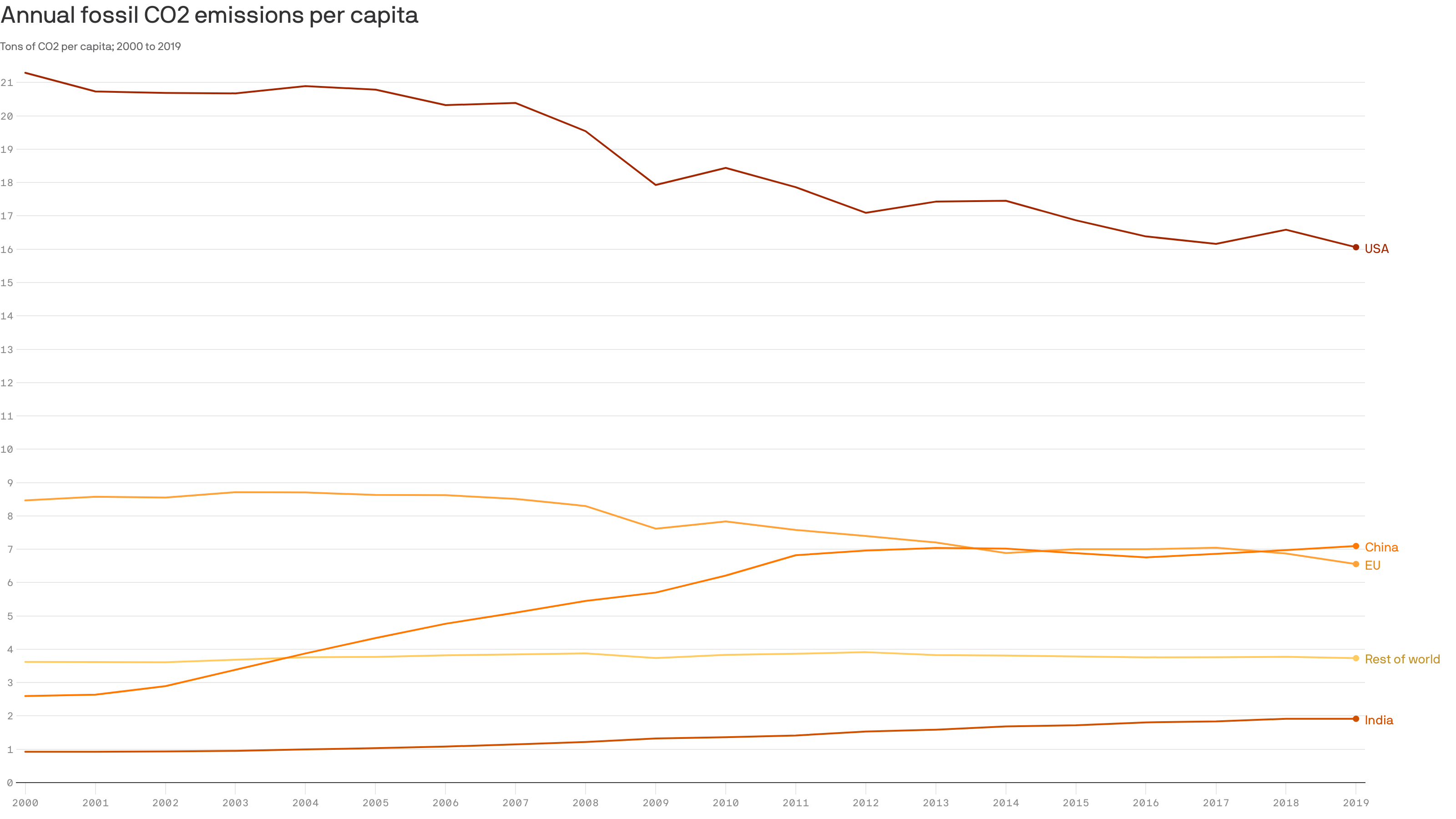
One durable theme of international climate negotiations has been the view that the industrialized countries should make the steepest emissions cuts, given that they are the biggest historical and per capita emitters.
Why it matters: Tensions between developed and developing countries were muted at the summit on Thursday, but still palpable.
They were evident in Brazilian President Jair Bolsonaro's speech, for example, in which he said...
"As we get together to discuss climate change we cannot possibly forget the major cause of the problem at hand, and that is the burning of fossil fuels in the past two centuries."
Context: The chart above shows how the U.S., which is the biggest historical emitter, is still the largest per capita source of greenhouse gas emissions, with Brazil falling into the "Rest of the world" category.
4. Interview: Norway's leader on EV adoption

Photo illustration: Sarah Grillo/Axios. Photo: Hollie Adams/Bloomberg via Getty Images
Norwegian Prime Minister Erna Solberg says electric vehicles have become a status symbol in her country, with widespread adoption spurred by government policies.
Why it matters: As shown in the viral Super Bowl commercials starring Will Ferrell, Norway is a potential model for how to implement policy incentives that other countries might follow to increase their adoption of EVs.
- Norway has the highest rate of EV adoption as a percentage of the auto market, reaching 54% of new cars sold.
The big picture: In a wide-ranging interview with Axios yesterday, Solberg said the government has subsidized EVs through tax policy.
- Even before EVs were widely available, policymakers decided to make them exempt from taxes applied to other vehicles.
- "It's of course huge incentives when you both take away [the] value-added tax and the special car taxation, and you give them free entry on toll roads, which we have especially in the cities," Solberg said.
- "What happened was that especially ... a family's number two car became [electric] quite early because that would used to be used for going to work in a city and not for long-distance driving."
Catch up fast: Solberg said over the past five or six years, the country saw "basically a Tesla revolution in the beginning, because they were the first one with real cars, as some of my male friends would say — real cars, not just the small ones."
The intrigue: As for those Super Bowl commercials, Solberg said Norwegians thought they were funny, and noted that it was a huge opportunity for publicity in the United States.
- "We know that the Super Bowl commercial is probably the time you meet the most Americans," she said.
5. Catch up fast: finance, NOAA, cars, summit

Money: The White House released an international finance strategy Thursday that aims to help other nations fight climate change. (Axios)
Science: The White House last night nominated Rick Spinrad, an oceanographer at Oregon State University, to head the National Oceanic and Atmospheric Administration.
- Why it matters: Filling the NOAA slot would complete the Biden administration's leadership on the climate and environment team. The agency, located within the Commerce Department, houses the National Weather Service and conducts much of the nation's climate science research. (Axios)
Vehicle policy: "The Transportation Department announced Thursday it was withdrawing part of a Trump-era rule that blocked states from setting their own tough car pollution standards, setting the stage for a return of broader power to California to fight climate change." (L.A. Times)
Pledges: "Multiple world leaders announced new targets for reducing greenhouse gases during President Biden's virtual climate summit, which featured more than 40 heads of state and other world and business leaders." (Axios)
Sign up for Axios Generate

Untangle the energy industry’s biggest news stories


