Axios Generate

November 01, 2024

🍸 Oh yes! Friday. We're heading into the weekend with a wide-ranging but tight 1,181 words, 4.5 minutes.
🚨 Situational awareness: U.S. super-majors Exxon and Chevron reported Q3 earnings that beat Wall Street expectations.
- But profits are down from the same stretch last year amid lower oil prices. Go deeper
🎸 This week in 1990, the late George Michael released an iconic single that's today's intro tune...
1 big thing: Tuesday's petro-stakes are high — but hardly limitless
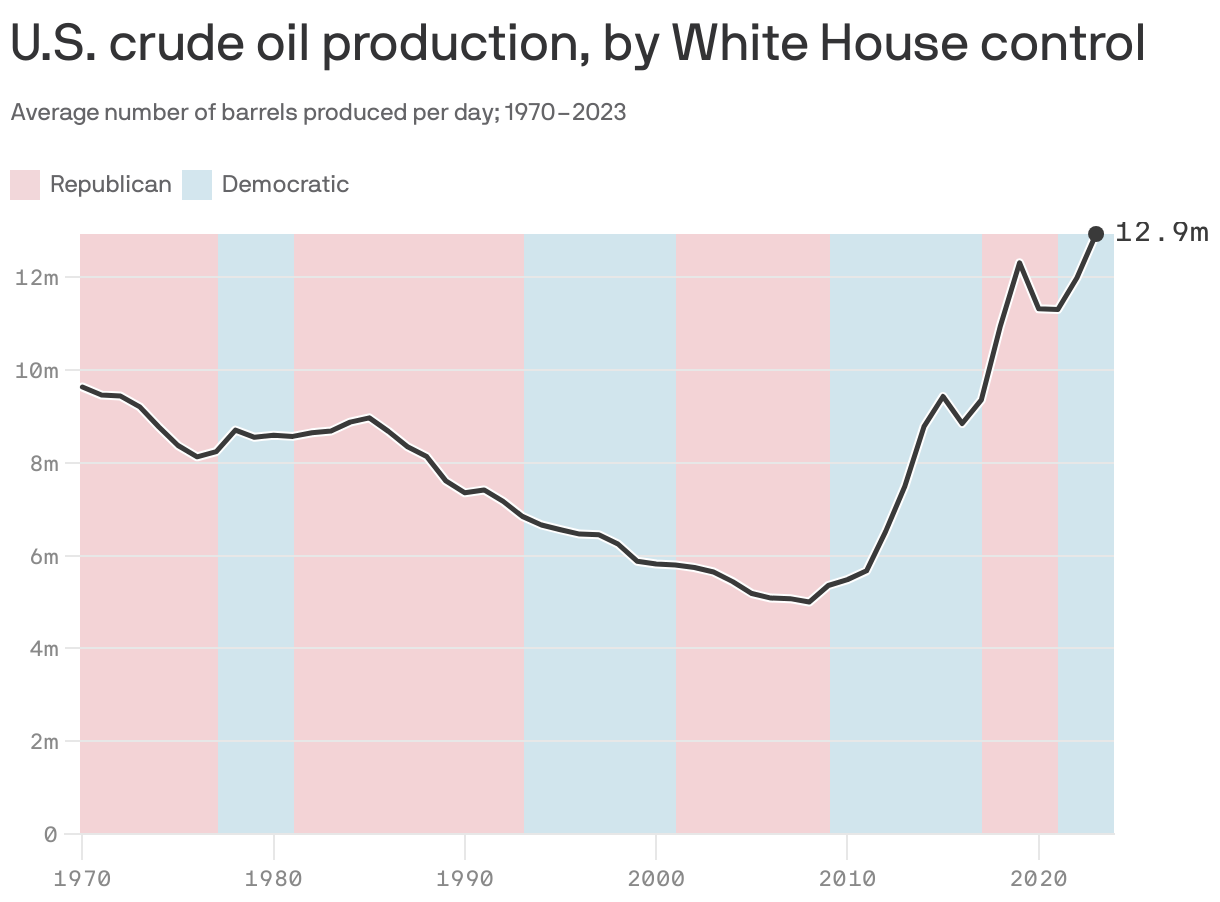
If past is prologue, Tuesday's election won't have much effect on U.S. oil and gas production anytime soon.
Why it matters: Yes, the divide between former President Trump and Vice President Harris is big.
- But federal policy is just one of many things that sway output, which has little historical relationship to the party in power (see above).
Here are a few checks on that influence in both directions...
♟️ Corporate strategy. "The industry's shift towards prioritizing shareholder returns and long-term growth through acquisitions has led to a more disciplined approach to investment," Rystad Energy analysts said of onshore shale.
- Their note says it's "uncertain" if Trump could increase shale production, which has been the main growth area, beyond its current upward rate.
🗺️ Geopolitics. U.S. production and exports provide strategic leverage during crises — something that hasn't been lost on Biden officials.
- Consider that Biden officials pushed for more oil output after Russia invaded Ukraine. High production also tempers the cost effect of potential Middle East supply disruptions.
- ClearView Energy Partners say Harris is "unlikely to wholly abandon the Biden administration's wartime fossil fuel pragmatism" even if today's conflicts end.
🧑🌾 Markets. Oil production levels are responsive to prices, and they're largely at the mercy of global markets and economic conditions.
- Regulatory changes and costs certainly affect producers' decisions, but that can be swamped by very attractive or very low commodity prices.
⚖️ The courts. Biden's energy transition policies face hurdles before a Supreme Court skeptical of federal agency interpretations of the law.
- But that could also affect Trump's deregulatory push. "A Trump administration could face a ruling binding it to certain IRA provisions it may oppose, such as the methane fee," Atlantic Council experts write.
🃏 Wild cards. Trump's policy changes could have unpredictable effects, even though they're quite supportive of the industry in the main.
- For instance, rolling back methane rules "could create potential headwinds for domestic producers looking to sell into increasingly regulated overseas markets," ClearView notes.
Yes, but: Mike Sommers, head of the American Petroleum Institute, says presidents can have major influence — though some of it takes years to become apparent.
- "I think what we've seen from the Biden era policies have been attempts to cut long term oil and natural gas production in the United States," he said in an interview, calling this "most dramatic in federal lands and federal waters."
State of play: He said one example is pared-back leasing in the Gulf of Mexico, where projects take many years to start flowing.
- Nearer-term, policies like the IRA's methane fee can affect production decisions, Sommers said.
The bottom line: I'm not trying to "lol nothing matters" the climate and energy policy differences — they're big and have international stakes.
- But on oil and gas output in particular, there's a lot more going on.
- "While Democrats will impose more restrictions than Republicans, supply will rise no matter who wins," the research firm BloombergNEF said in a note.
2. Ford's F-150 Lightning burned bright, then flickered

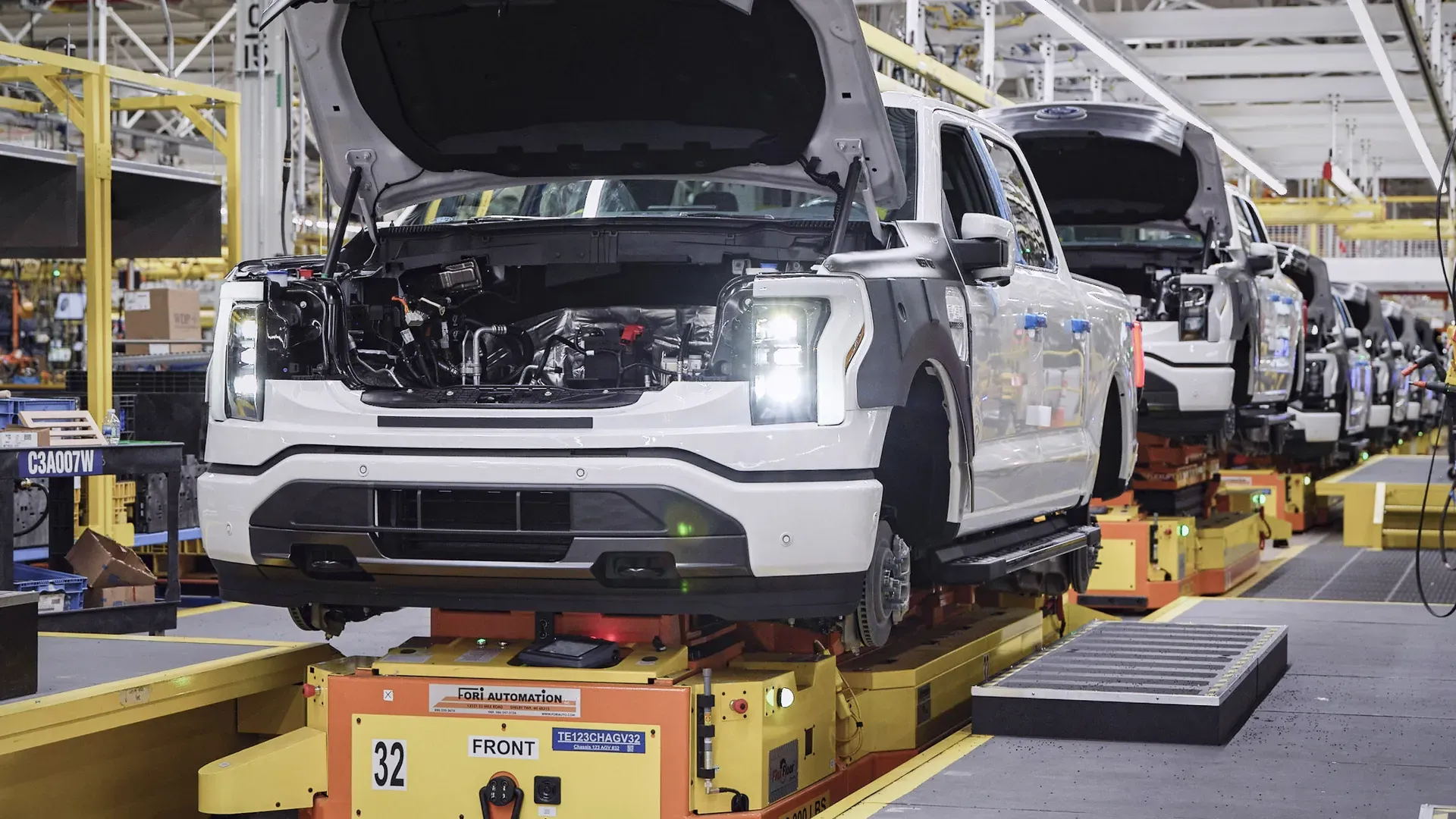
Ford Motor's F-150 Lightning electric pickup truck, once a beacon that signaled the arrival of mainstream EVs, hasn't quite delivered on that promise.
Why it matters: Consumers are still lukewarm on EVs, despite a plethora of new choices, which means Ford is paying the price for its early effort to lead in a nascent market.
Driving the news: After cutting output earlier this year, Ford is now stopping Lightning production altogether for the rest of 2024.
- The move is an effort to stem losses in its EV business, which hit $3.7 billion through the first nine months of 2024.
- Lightning production at Ford's Rouge Electric Vehicle Plant in Dearborn, Mich., will resume Jan. 6, the company said.
The intrigue: The Lightning remains among the best-selling EVs in the U.S. (behind models from Tesla, which has half the market).
- Sales are up 86% for the year, Ford crowed in a release last month.
- It's just not enough to support the heavy investment needed to produce them.
By the numbers: Ford spent millions to increase capacity at the Dearborn plant even before the truck went on sale.
- The plan was to build as many as 150,000 Lightnings a year.
- But it's sold only 22,800 through September, which (because of the shutdown) means it's likely on track to sell about 25,000 this year.
- Tesla's Cybertruck, meanwhile, in its first year on the market, sold more than 28,000, according to Cox Automotive, despite its $116,000 average transaction price and polarizing design.
The bottom line: There aren't that many buyers for electric pickups, and the ones capturing the sizzle tend to be the newest on the market.
Editor's note: Cox Automotive's parent company, Cox Enterprises, also owns Axios.
3. Microsoft goes against the grain on data centers

Engineered wood more commonly used in offices and apartment buildings is the latest low-carbon material that Big Tech is using to try to slash data center CO2 emissions.
Why it matters: Soaring energy needs aren't the only issue for the so-called hyperscalers.
Driving the news: Microsoft said two Northern Virginia data centers are being built with cross-laminated timber (CLT), a lightweight prefabricated wood material that's grown in popularity in Europe.
- Microsoft, in yesterday's announcement, called these some of the first examples of using the material for data centers.
- The tech giant says the use of CLT can lower the carbon footprint of the two data centers by 35% compared to using steel and 65% compared to typical concrete.
The big picture: Microsoft has also shown interest in low-carbon concrete and steel, backing startups like CarbonCure and Boston Metal.
- Amazon has used low-carbon concrete and steel in at least 43 data centers and also backs various startups in this space.
- Google has similar initiatives and has been working with Purdue University on using AI to design data centers using new and repurposed low-carbon materials.
Reality check: A major challenge with low-carbon building materials is higher costs than traditional ones.
Unlock the whole story, and if you need smart, quick intel on climate tech deals for your job, get Axios Pro.
4. 🏃♀️ Catch up quick: COP29 and electric aviation
🧳 Neither President Biden nor Secretary of State Antony Blinken are slated to attend the COP29 UN climate talks next month in Azerbaijan.
- Driving the news: The U.S. delegation unveiled yesterday does include John Podesta, the top climate diplomat, and various Cabinet secretaries.
- Why it matters: The officials face an uncertain landscape at the talks that begin a week after the U.S. election — which might not even be settled yet when the summit starts.
- What we're watching: How they navigate tricky talks over new finance goals, especially if there's a change in political control or things are in limbo.
💵 Electric flight startup Beta Technologies landed $318 million in Series C funding led by Qatar's sovereign wealth fund. Other investors include Fidelity Management & Research Company and TPG Rise Climate.
- Why it matters: The money will "support the continued production, certification, and commercialization" of its fixed-wing and vertical takeoff and landing models, Vermont-based Beta said.
5. 🧮 Number of the day: $75 million
That's how much oil and gas interests have donated to Donald Trump's campaign, the Republican National Committee and affiliated committees, per a New York Times analysis out this morning.
📨 Did a friend, colleague or even a frenemy send you this newsletter? Welcome, please sign up.
🙏 Thanks to Chris Speckhard and Chuck McCutcheon for edits to today's edition, along with the brilliant Axios Visuals team.
Sign up for Axios Generate