Axios Generate

August 21, 2025

🧭 Let's get closer to the weekend with a newsy 1,308 words, 5 minutes.
🌎 Axios House returns to NYC for Climate Week and the UN General Assembly from Sept. 22-24.
- We'll host a dynamic lineup of newsy conversations with leaders shaping the global agenda. Interested in attending? Let us know.
📻 This week marks 50 years since Linda Ronstadt released today's perfect intro tune...
1 big thing: Google looks under its own hood on AI
Breaking: Google unveiled measurements of energy, water use and emissions from text prompts using its Gemini Apps AI assistant — and it's calling for greater industry consistency in tallying AI's environmental effects.
Why it matters: The artificial intelligence boom is bringing a surge in power-thirsty data centers, but the energy needs and climate footprint remain a moving and often hazy target.
- Google's overall findings are "substantially lower than many public estimates," it said.
Driving the news: The tech giant released a detailed methodology that encompasses real-world electricity and water use from deploying AI at scale.
- That includes, for instance, energy used by idle chips and data center "overhead" — that is, equipment such as cooling that's not directly running AI workloads.
- Those are two of many factors covered in assessing the "full stack" of AI infrastructure, Google's new paper and blog posts explain.
What they found: The median energy use of a single text prompt on Gemini is equivalent to watching TV for less than nine seconds and consumes about five drops of water, the paper finds.
- It emits 0.03 grams of carbon dioxide equivalent, Google said.
- Better software efficiency and clean energy have lowered the median energy consumption of a Gemini Apps text prompt by 33x over the last year, and the CO2 by 44x, the company said.
"As the adage goes, with great power comes great responsibility," Partha Ranganathan, a Google VP and engineering fellow, told reporters this week.
- "With great computing power comes great environmental responsibility as well, and so we've been very thoughtful about the environmental impact of this increasing computing demand caused by AI," he said.
Yes, but: The analysis of text prompts doesn't cover video or image generation queries.
- Savannah Goodman, Google's head of advanced energy labs, said it's always looking to improve transparency. But there's been little consensus on how to measure the impact of even text generation, she said.
- "That's really the most consistent request we've gotten. And so we're really starting there with this paper," she told reporters.
- The paper also doesn't apply the new methodology to training AI models — a big part of the energy puzzle, though Google has done other research on this.
The big picture: Gains in per-query efficiency come as overall AI use is rapidly expanding, and data center energy demand along with it.
- Estimates vary. For instance, a late 2024 DOE report projects that data centers could account for 6.7% to 12% of U.S. electricity use by 2028.
- Google, in a recent report, said its data center energy emissions fell by 12% in 2024.
- But the company's overall emissions were up 11% amid increases in greenhouse gases from its supply chain, including manufacturing and assembling AI computing hardware, and building data centers.
What we're watching: Goodman hopes the analysis of "all of the critical factors" will help the industry overall.
- "We think that this full picture provides the most accurate view of AI's overall footprint, and by openly sharing this methodology and results, we're hoping to foster greater industry-wide consistency in calculating the impact of AI."
2. 💵 Gulf Coast risks billions in climate-linked losses

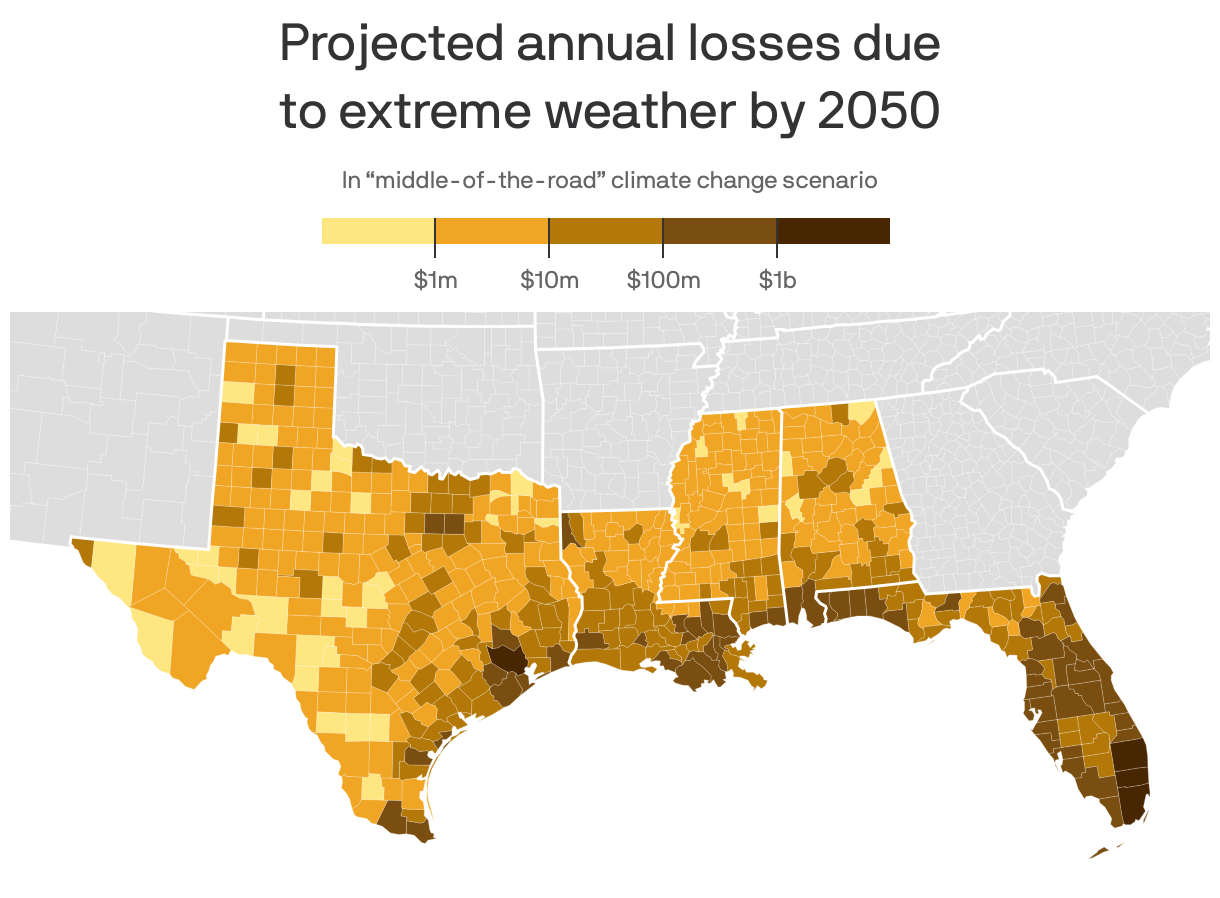
The U.S. Gulf Coast is facing billions of dollars in yearly property damage by 2050 due to extreme weather tied to climate change, per a new analysis.
Why it matters: Even as Gulf states are still reckoning with the aftermath of 2005's Hurricane Katrina, more pain and loss seems inevitable.
Driving the news: Damage from extreme weather will cost $32 billion annually across Texas, Louisiana, Mississippi, Alabama and Florida by 2050 in a "middle of the road" climate change scenario, per a new Urban Institute analysis using FEMA data.
- That's more than double the projected $15 billion when ignoring climate change.
How it works: The Urban Institute's analysis is based on FEMA's Future Risk Index, which estimated future costs associated with coastal flooding, extreme heat, wildfires, hurricanes and drought.
- FEMA published the tool last December. It's since been taken down amid the Trump administration's purge of publicly accessible federal data and info about climate change.
Zoom in: Dense, populous counties may see the biggest overall annual costs, like Harris County, Texas (about $2.6 billion by 2050) and Broward County, Florida ($2 billion).
- The researchers chose a more moderate emissions scenario because it's actionable and realistic for policymakers, Sara McTarnaghan, principal research associate at the Urban Institute, tells Axios.

3. 🏃 Catch up quick: Trade, fusion, Nord Stream and more
🤝 Breaking: The EU will provide "additional flexibilities" in implementation of its carbon border adjustment mechanism, per a new summary of the U.S.-EU trade deal.
- The CBAM aims to protect domestic industries from goods manufactured overseas with higher CO2 emissions.
💵 General Fusion, the Canadian fusion energy developer that publicly pleaded for investment this spring, raised $22 million to stay afloat through next year, CEO Greg Twinney tells Axios Pro Deals. Sign up.
👀 Via AP, "A Ukrainian citizen...suspected to be one of the coordinators of the undersea explosions in 2022 that damaged the Nord Stream gas pipelines between Russia and Germany has been arrested, German prosecutors said Thursday."
▶️ Via Nola.com, Louisiana regulators approved "Meta's largest artificial intelligence data center yet, to be built in rural northeast Louisiana, clearing the way for construction of three gas-fired electricity plants."
🛰️ CNN reports that NOAA is "narrowing the capabilities and reducing the number of next-generation weather and climate satellites it plans to build and launch in the coming decades."
4. 🏥 On my screen: "Climate-smart public health"
A new paper offers a replicable blueprint for knocking down silos between climate and public health as global warming creates evolving threats from disease, nutrition and much more.
Why it matters: "Existing public health information systems do not include primary exposure data related to climate and environmental change, inhibiting an understanding of critically important drivers of ill health," the paper in the Lancet states.
The big picture: Meet the "climate-smart public health" framework drawn from on-the-ground work in Madagascar.
- One pillar is better geographic and time-series data monitoring that combines climate conditions and public health info to better assess linkages. Another is improved risk assessments of climate-health relationships.
- "The team in Madagascar linked climate stressors (e.g., drought) to agricultural production declines and malnutrition, using AI to analyze spatial connections between weather and health records," a summary notes.
- Other aspects include data-driven, locally focused early warning systems for risks like malaria and harmful algal blooms; and locating and building health clinics that are climate-resilient.
What we're watching: The authors propose a new platform that incorporates methods used in Madagascar that can be replicated widely.
- It would link climate and environmental data with District Health Information Software 2, a widely used health management data system.
5. 🛢️ Quote of the day: oil and trade friction edition
"India is being picked on because its trade negotiations with the Trump administration have still not concluded ... The selective targeting for condemnation of India's oil purchases from Russia will be interpreted as exerting pressure on New Delhi's trade negotiators. The agenda is selfishly American, however sanctimonious the logic that cloaks it."— Ashok Malik, ex-adviser at the Indian Ministry of External Affairs, writing in the Financial Times
The piece comes as President Trump is vowing new tariffs on India over its Russian oil purchases but backing away from penalties on other importers of Kremlin-linked fuels.
- Why it matters: Malik is hardly alone in seeing trade, not pressure on Vladimir Putin, as the biggest reason for the penalties on India.
📧 Did a friend send you this newsletter? Welcome, please sign up.
🙏 Thanks to Chuck McCutcheon and Chris Speckhard for edits to today's edition, along with the brilliant Axios Visuals team.
Sign up for Axios Generate