
Axios Generate

May 11, 2021
Good morning! Today's Smart Brevity count is 1,238 words, 4½ minutes.
🚨 Breaking: "The Biden administration on Tuesday will announce its final approval of the nation’s first commercial-scale offshore wind farm," the New York Times reports on the Vineyard Wind project off Massachusetts.
🎶 On this day in 1981, Jamaican-born singer-songwriter Bob Marley died of cancer at age 36. A 1977 hit recorded with the Wailers helps us go jammin' into Tuesday...
1 big thing: Pipeline hack spotlights cyber risks to energy systems
Illustration: Aïda Amer/Axios
The ransomware attack against the Colonial Pipeline — the massive East Coast gasoline artery — is a stunning real-world example of the increasing risks that the energy sector faces from a cyberattack.
Why it matters: Different parts of the vast American energy system are vulnerable — from pipelines to power grids to individual power plants and plenty in between.
- While federal and state agencies, as well as companies, have spent years hardening their systems, the shutdown of the country's largest refined products pipeline, which carries over 100 million gallons per day, shows you can never be too prepared.
Between the lines: Ransomware has a distinct, perhaps less-pernicious goal: to lock users out of a system until they pay to have access restored.
- Most ransomware victims are put in impossible positions, incurring financial losses while wrestling with the decision of whether to pay the ransom.
- But as Axios' Felix Salmon noted, the Colonial Pipeline is not your everyday ransomware victim, given its status as critical infrastructure. Instead, the full resources of the U.S. government have been mobilized in the wake of this attack.
- All the disruption and attention even elicited an apology, of sorts, from DarkSide, the relatively new group the FBI said allegedly perpetrated the hack.
- “Our goal is to make money and not creating problems for society," the group said in a statement on the dark web.
The big picture: Axios' chief tech correspondent Ina Fried notes the attack highlights a growing dilemma facing cities, utilities and companies: The more that their processes go digital, the more vulnerable they are to financially motivated attacks.
- Moody's Investors Service, in a note, said pipeline operators have increasingly adopted digital tech to improve their operations.
- The problem? That also means operators of oil, natural gas and other pipelines are "offering new vectors for cyberattackers."
Threat level: Moody's says the pipeline sector is the oil-and-gas industry's most vulnerable segment.
- "A cyberattack that disrupts one or more long-haul pipelines would have global supply implications, regardless of the location of the attack," it notes.
- On the bright side, Moody's says the oil-and-gas sectors' cybersecurity investments have been growing.
Yes, but: Cybersecurity concerns also extend to other elements of the energy system, such as the electrical grid.
- The expensive and deadly power outages in Texas in February, caused by extreme cold, illustrated what can happen when the power goes out for an extended period.
Of note: The Colonial hack comes about five months after the disclosure of the far-reaching Russian SolarWinds hacking of a vast trove of corporate and government systems.
- This breach may have compromised parts of the American energy infrastructure.
2. Where it stands: Gas shortages, timeline, Biden
Here's the latest on the outage and the aftermath...
Driving the news: There are reports that some gasoline stations have run out of fuel.
- Per GasBuddy analyst Patrick De Haan's Twitter feed, the most widespread outages as of this morning were in Virginia at around 7.6%, and he notes the state-by-state estimates may be low.
- Via Bloomberg, "From Virginia to Florida and Alabama, fuel stations are reporting that they’ve sold out of gasoline as supplies in the region dwindle and panic buying sets in."
- AAA reports that the outage has pushed nationwide average gasoline prices to $2.99-per-gallon, the highest since late 2014 (a standing reminder that prices vary by region).
What's next: Colonial Pipeline said Monday that segments are being brought back online in a "stepwise fashion," with the goal of "substantially restoring operational service by the end of the week."
What they're saying: "We are monitoring supply shortages in parts of the Southeast and are evaluating every action the Administration can take to mitigate the impact as much as possible," White House Press Secretary Jen Psaki said in a statement.
What we're watching: Multiple lawmakers have called for the passage of cybersecurity bills in the wake of the attack.
- "That infrastructure package should have a giant allocation for improving cybersecurity across the United States," energy analyst Amy Myers Jaffe said on the latest Axios Pro Rata podcast.
3. This year is running cooler than recent years


With a moderate La Niña event in the tropical Pacific Ocean, global temperatures in 2021 are running decidedly cooler when compared to recent years.
Why it matters: The lack of a new warmest year record in 2021 could sap the sense of urgency among policymakers in the U.S. and abroad during a critical year for enacting stricter emissions cuts to meet the Paris Agreement's targets.
The big picture: According to NASA, March was the coldest such month globally since 2014.
New information from the Copernicus Climate Change Service, a European agency, shows that April was also relatively cool, coming in as the seventh-warmest such month since 1979.
- Europe was hit especially hard by cold snaps during April, breaking records in England and causing an agricultural disaster in France as winemakers saw their crops freeze on the vine.
Yes, but: Even with the recent cold in Europe and the cooling influence of La Niña, the planet is still headed for a top-10 or even top-5 warmest year finish, climate scientist Zeke Hausfather tells Axios. "This is well in line with the long-term warming trend."
Reality check: "Scientists know climate change is happening against a backdrop of natural climate variability: There will always be winters and summers, La Niñas and El Niños," NASA climate scientist Kate Marvel tells Axios.
- "I like to use a doping analogy: When an athlete uses banned substances, she's more likely to win. But she probably won't win every single time — nor is she expected to," Marvel said.
4. The rising estimates for renewables growth
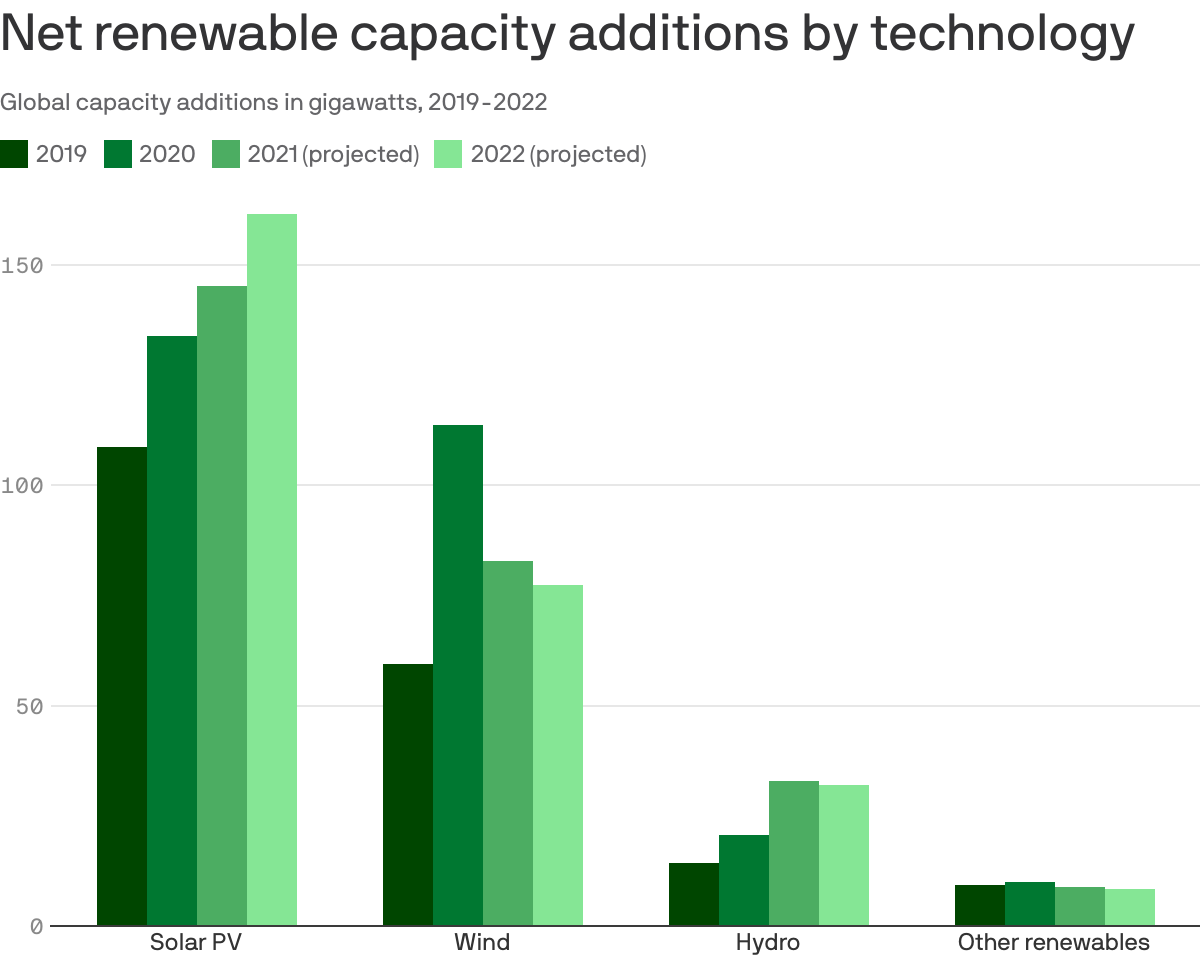
The International Energy Agency just issued a big upward revision to estimates of near-term global renewable power growth.
Driving the news: The agency's latest data shows that new capacity additions surged to almost 280 gigawatts last year despite the pandemic.
- That's 45% higher than 2019 and the largest year-over-year jump in two decades.
Why it matters: IEA said that scale of new capacity additions is the "new normal."
- They project about 270 GW this year and another 280 in 2022, with renewables accounting for 90% of power generating capacity additions globally.
- Those combined gigawatt levels are 25% higher than their prior projections in November, with IEA boosting forecasts for all major markets.
- Their 2021–2022 regional outlook sees growth slowing in China — the world's largest market — and slightly in the U.S. compared to 2020, but accelerating in Europe, India and Latin America.
The big picture: "Wind and solar power are giving us more reasons to be optimistic about our climate goals as they break record after record," IEA executive director Fatih Birol said.
Yes, but: The global power system is still dominated by fossil fuels and global emissions are far off track from the Paris Agreement goals.
- Governments must "build on this promising momentum" with policies that spur even higher investments in renewables and grid infrastructure, Birol said in a statement.
5. EV notes: Workhorse, Ford, Gordon Murray
Earnings: Shares of electric truck maker Workhorse Group tumbled 15% yesterday after its $521,000 in Q1 earnings fell way short of expectations and the company cut this year's production estimates.
- The big picture: The company, like other automakers, is citing supply chain problems.
- But the Q1 numbers are just the latest challenge for Workhorse, which recently lost out on a coveted U.S. Postal Service contract.
Calendar: Ford announced it will unveil the electric version of its popular F-150 pickup on May 19.
- The company said yesterday it will be called the Lightning, which CNBC notes is "a name used by the automaker for street performance trucks in the 1990s and early 2000s."
Plans: Via Reuters, "Supercar maker the Gordon Murray Group said on Tuesday it plans a 300-million-pound ($420 million) expansion over the next five years, which includes developing electric SUVs and delivery vehicles for carmakers as it shifts towards an all-electric supercar by 2030."
Sign up for Axios Generate

Untangle the energy industry’s biggest news stories
