
Axios Generate

September 23, 2021
🤗 Good to be with you again! Today's Smart Brevity count is 1,357 words, 5 minutes.
📊 Data point of the day: $100 per million British thermal units, the sky-high Asian and European natural gas prices Citigroup calls possible this winter.
📆 Today: Join Axios' Dan Primack and Niala Boodhoo at 12:30pm ET for a virtual event on how VC funds and governments are advancing climate tech. Guests include Senate Finance Committee Chair Ron Wyden and Galvanize Climate Solutions co-founder Tom Steyer. Register here
🎸 And yesterday marked the 1978 release of Buzzcock's second album "Love Bites" (h/t @JakeRudh), which provides today's intro tune...
1 big thing: White House seeks global credibility without Congress

Illustration: AĂŻda Amer/Axios
The White House just unveiled plans to phase down a class of powerful greenhouse gases, and officials have their eyes on a global audience ahead of the big United Nations climate summit, Ben writes.
Driving the news: Today EPA is issuing final regulations on hydrofluorocarbons (HFCs), which are commonly used in air conditioning, refrigeration and foams.
The White House also announced other executive steps to deter import and use of HFCs and bolster deployment of alternatives. Check out our coverage.
The intrigue: Cutting use of HFCs alongside other nations can help avoid significant amounts of warming.
But what's also notable is how the top White House domestic climate official framed the action on a call with reporters last night:
“It demonstrates to the world that while we work with Congress on delivering historic investments to tackle the climate crisis, we can continue and we will be continuing to take action to fulfill our climate commitments,” said Gina McCarthy, the White House national climate adviser.
Why it matters: The White House faces a potentially big problem heading into the UN summit in Glasgow, Scotland, in six weeks known as COP26.
- It's unlikely the U.S. can meet President Biden's emissions-cutting pledge under the Paris Agreement absent the big investments and incentives that Capitol Hill Democrats are struggling to move on a party-line vote.
- If legislation to speed deployment of renewables, electric cars and other clean tech is delayed, greatly watered down or dead come COP26, it's harder for the U.S. to push other nations to take strong steps.
What they're saying: Environmental Defense Fund president Fred Krupp said that if the Congress fails to deliver, "it would be very damaging to the whole world’s ability to come to a good agreement."
- “It’s up to Congress to pass the sort of policies that demonstrate [that] we will meet President Biden’s commitment of a 50% [emissions] reduction by 2030," Krupp said at an Axios virtual event this week.
- He said if that doesn't happen, U.S. credibility would be damaged, and it "dampens the likelihood" of achieving the global ambition needed even as the impacts of climate change have become so clear.
But McCarthy, in her remarks and separate comments at the Axios event, is seeking to show that the administration has credibility already.
She told Axios' Mike Allen that she expects Congress to act in the next couple of weeks on policies she called good for the climate and economy, but added:
"[W]e are not going to rely on that to get us where we need to go. We have the tools that we need available to us to make this the decisive decade, and we are going to keep using them."
2. Southwest drought is worst on record, NOAA finds


In a stark new report, a team of NOAA and independent researchers found the 2020-2021 drought across the Southwest is the worst in the instrumental record, which dates to 1895, Andrew writes.
- They also concluded that global warming is making it far more severe, primarily by increasing average temperatures, which boosts evaporation.
State of play: The Southwest is facing historic water woes, with the first-ever federal water shortage declaration at Lake Mead, the nation's largest reservoir by surface volume.
- This triggered cutbacks in Colorado River water allocations to Arizona and other states, a waterway that 40 million people rely on for irrigation and drinking water.
- A dangerous wildfire scenario continues to play out, especially in California, where the Dixie Fire is now the state's second-largest on record, approaching the rare category of a "gigafire," by charring at least 1 million acres.
- The report found that the 20-month period from January 2020 to August 2021 was the driest such period on record, as well as the third-warmest.
Threat level: The study ties the heat directly to climate change, and warns the severity of such drought events is sure to worsen barring reductions in greenhouse gas emissions.
Higher temperatures cause spring snowpack to disappear early and accelerates the drying of soils.
The big picture: The drought is occurring in the context of the first climate change-induced "megadrought," which research shows began in 2000 and is exceptional on millennial timescales, study co-author Justin S. Mankin of Dartmouth University, told Axios.
3. Why China's coal future is so important
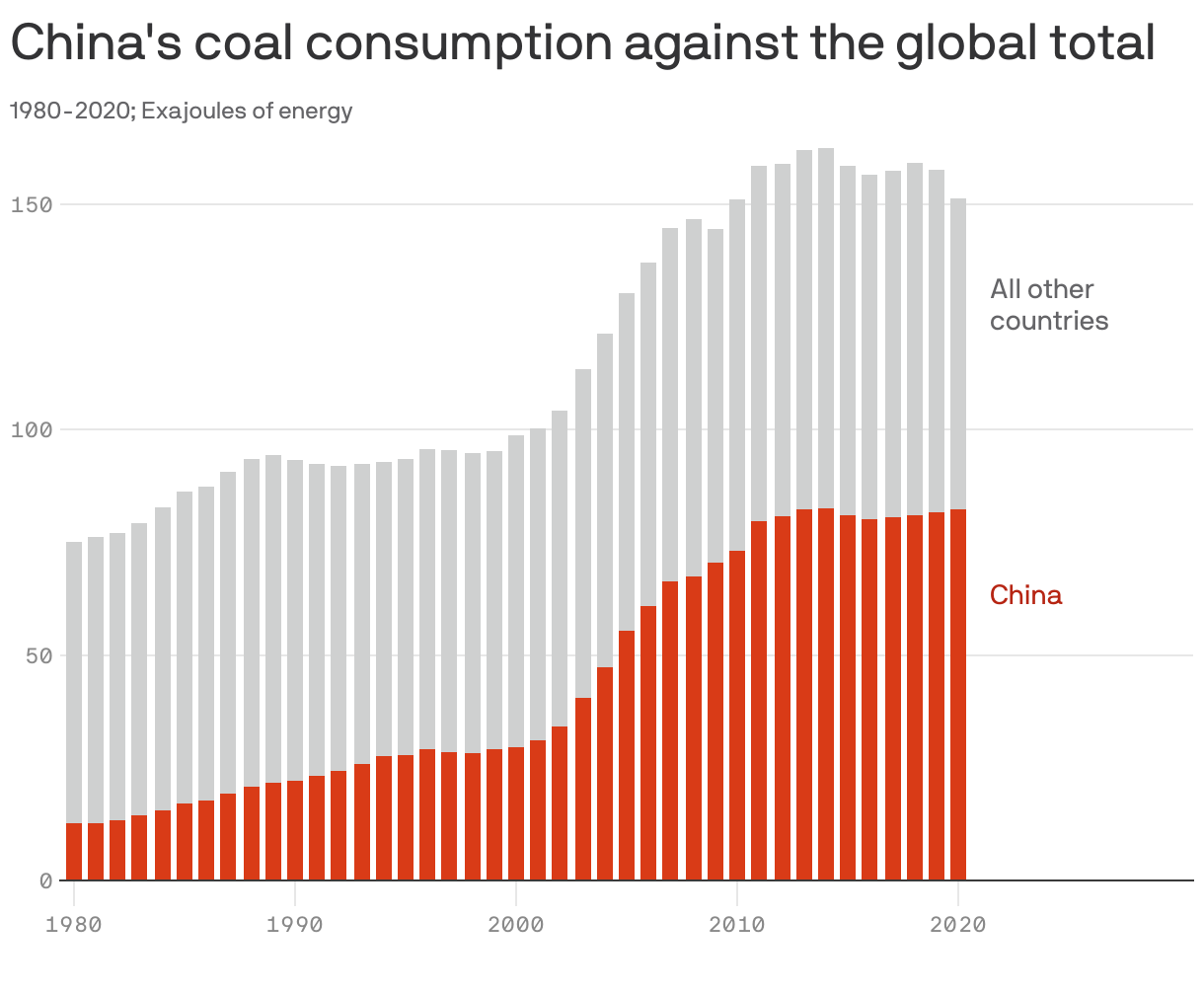
China's vow to end overseas coal-plant finance was a big deal, but a more consequential thing to watch is the country's domestic coal trajectory, Ben writes.
The big picture: China is the world's dominant coal consumer, accounting for around half of the global demand for the most CO2-emitting fuel.
What we're watching: That's whether the Chinese government pledges new efforts to curb use of coal ahead of, or at, the UN climate summit.
- President Xi Jinping has previously said the country would "strictly limit" increases through mid-decade and then reduce consumption in 2026-2030.
- But climate advocates are hoping for stronger steps. The Washington Examiner has more.
4. First look: DHS holds national climate resilience contest

A resident seeks relief during a heat wave in Sacramento on July 8, 2021. Photo: David Paul Morris/Bloomberg via Getty Images
The Department of Homeland Security is holding its first national contest focused on climate change. The contest, worth a total of $195,000, focuses on increasing heat wave resilience, officials shared first with Axios, Andrew writes.
Why it matters: With climate change making extreme heat events more likely and severe, the department’s science and technology division along with FEMA hopes to spur innovations that can protect people from the deadliest annual severe weather hazard in the U.S.
How it works: The contest, which will be announced today, will provide cash prizes for cooling solutions, particularly innovations for the most vulnerable people such as those without access to air conditioning.
- It's the first in a planned series of resilience-focused prizes that may expand to other extreme weather-related challenges, such as floods, wildfires and drought, all of which have slammed the country in recent weeks and months.
- The total cash prize, eligible to U.S. citizens and permanent residents as well as domestic-registered businesses, will include one grand prize winner who will take home $50,000, a runner-up for $20,000, and up to four winners who will receive $10,000.
- A DHS official told Axios that prize winners may be considered for mentorship support to help bring their proposal to fruition or be connected to other innovation development programs.
What’s next: The competition will be posted on challenge.gov, with submissions due by Dec. 7.
5. Owning an EV isn't the same as driving it

A huge share of households that own an electric vehicle also have an internal combustion car, a dynamic that could slow efforts to decarbonize transportation, Ben writes.
Driving the news: New research via UC-Berkeley's Energy Institute at Haas finds 90% of EV-owning households also have at least one fossil-fueled model as of 2017 — the last year with a nationally robust dataset.
And 66% of households with an EV also have an internal-combustion car that's driven more, and it's often an SUV, pickup or minivan, writes UC Berkeley business professor Lucas Davis.
Why it matters: "I’m worried...that this within-household substitution could undermine the environmental benefits of EVs," he writes in a blog post summarizing the work.
"This wouldn’t matter in a future scenario with 100% EVs, but it could matter a lot during a long transition period," Davis adds.
What we're watching: One question is whether more recent and future data would show significant changes to these findings.
As Davis notes, EVs with longer range are coming to market, as are electric pickups and SUVs, which are very popular vehicle types.
Nonetheless, there will long be millions of households with both EVs and gasoline vehicles, so "we need to understand better both how households decide which vehicles to purchase and how they decide which vehicles to drive," Davis writes.
6. Catch up fast: European crisis, Tesla, oil
Energy crunch: "Two more U.K. energy suppliers collapsed under the strain of surging energy costs, increasing the number of households caught up in the failures to 1.5 million, as Business Secretary Kwasi Kwarteng said the country should be prepared for higher prices in the longer term." (Bloomberg)
Auto rules: "Tesla Inc is pressing President Joe Biden's administration and a U.S. appeals court to move quickly to hike civil penalties for automakers failing to meet fuel economy requirements." (Reuters)
Shale: "US oil production is set to pick up steam again — this time led by little-known privately owned companies impervious to the demands of the stock market." (Financial Times)
Sign up for Axios Generate

Untangle the energy industry’s biggest news stories

