
Axios Generate

May 09, 2025

🍺 Happy Friday! COP30 leaders are already awaiting an RSVP from the new pope, small reactors might have new mojo, and Europe is making big decisions with U.S. stakes. Wow. We've got it all in just 1,260 words, 5 minutes.
🎹 Happy birthday to Dave Gahan, frontman of Depeche Mode, who have today's intro tune...
1 big thing: The world may have another climate pope

Don't expect Pope Leo XIV to file comments in EPA dockets, but he could build upon the late Pope Francis' unprecedented Vatican focus on climate change.
Why it matters: The pope has a massive bully pulpit as leader of a church with 1.4 billion members worldwide, and reaches people well beyond that.
- The Vatican lacks official power to sway policies, but lots of global climate architecture already operates on persuasion — the Paris agreement doesn't force nations to do anything.
- And there's scaffolding around papal climate efforts now, with Francis giving rise to the Laudato Si' Movement based on his 2015 encyclical on the topic.
Driving the news: Leaders of the next UN climate summit in Brazil quickly invited the new pope to attend.
- "The COP30 Presidency hopes to welcome Pope Leo XIV in Belem in November to help us reach a climate agreement that will mark a turning point in the creation of a more prosperous, safer, fairer and sustainable future," Ana Toni, the summit's CEO, said in a statement.
The intrigue: The career of Cardinal Robert Francis Prevost — now Pope Leo — offers a breadcrumb trail showing his interest in climate.
- Last year, per the Vatican's official news service, he told an environmental seminar that it's time to move "from words to action."
- He called for "reciprocity" with nature, cautioned against harms from technology and praised the Vatican's installation of solar panels and use of EVs.
- In 2017, he re-posted an X (then Twitter) post encouraging President Trump to read Francis' encyclical.
What they're saying: Arun Agrawal, a Notre Dame professor of development policy, offered initial thoughts on the new American pope while cautioning that it's early days.
- "[W]e can expect some continuity but we should also expect both innovation and new ideas to come from the new Pontiff as he leads the Vatican to address sustainability challenges," he said via email.
- He expects Leo's work to be informed by his long service in Peru and his background with church governance.
- Leo has "intimate familiarity with context where marginality, poverty, and vulnerability are widespread" that will inform his thinking on climate, water, sustainability and more.
What we're watching: Francis' encyclical had rather skeptical or at least complicated feelings about technology, and Agrawal sees some connective tissue between the two men.
- "I think both Pope Francis and Pope Leo have a critique of simply technological innovation being enough. Accordingly, the innovation has to be in our institutions and our hearts and minds and how to connect these changes to those in the world," he said.
The bottom line: There's no good way to gauge whether popes can really influence climate policies. But based on comments pouring in late yesterday, a number of activists have faith.
2. ⚛️ What's next after a big day for small reactors
A big question now that Ontario officials are really, truly going ahead with building a small modular reactor is whether this marks a turning point for the tech.
Why it matters: The project approved yesterday will be the first SMR in a G-7 nation, and backers called it a pivotal moment for the power source that faces several deployment hurdles.
Catch up quick: Ontario Power Generation will build a GE Vernova Hitachi Nuclear Energy BWRX-300 reactor adjacent to its existing Darlington Nuclear Station.
- The project, slated to start providing power in 2030, is the first of four GE Vernova SMRs slated for the site at a total projected cost of roughly $15 billion U.S. dollars.
What they're saying: "This is big. To this point, SMRs have been largely theoretical," Malwina Qvist, director of the nuclear energy program at the Clean Air Task Force, told me via email.
- "The OPG initiative signals the start of a new era of SMR global commercial reality, establishing a clear proof point that global order books can work and are working," she said.
What we're watching: "We hope that others will follow behind the OPG model as soon as possible," Qvist said, saying multiple orders of a standardized design enable lower costs.
3. 🎲 The U.S. stakes of Europe's gas future
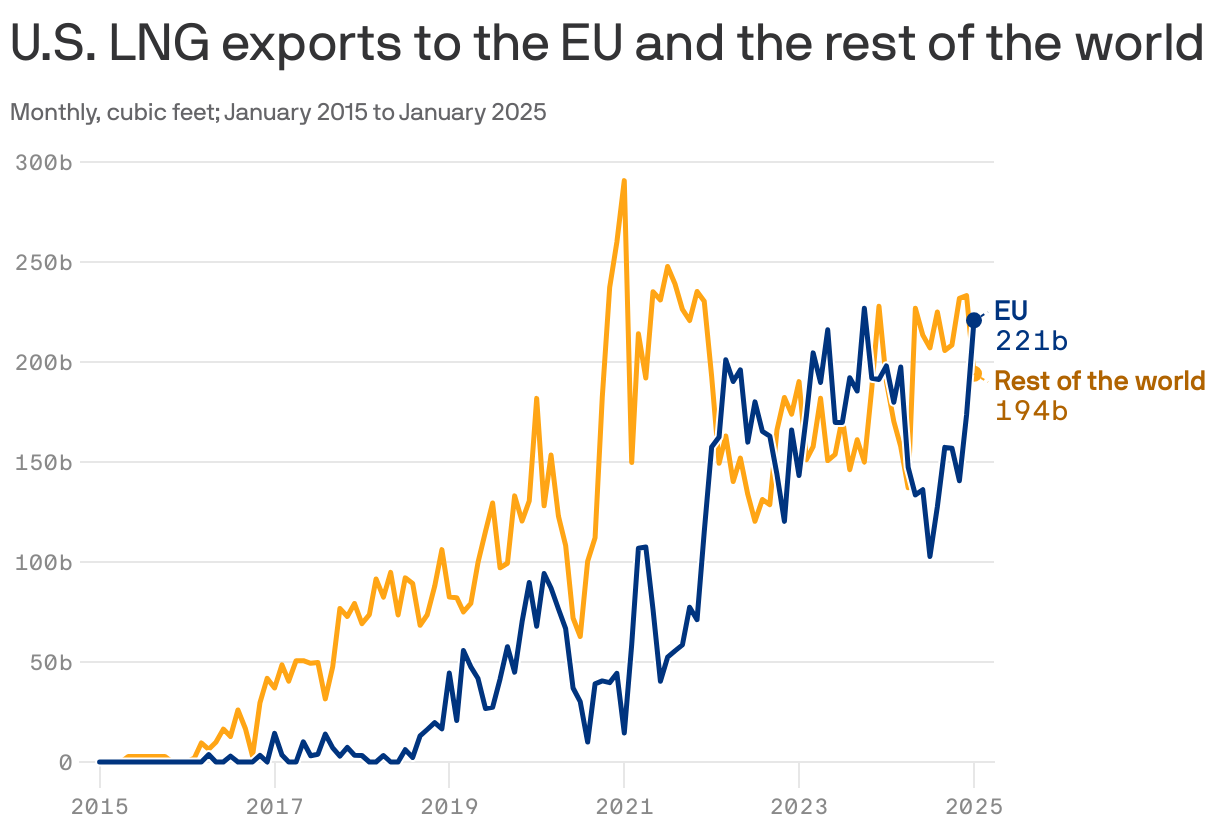
EU leaders face a pivotal stretch in their plans to fully break up with Russian energy — and new analysis sees high stakes for the U.S. LNG sector.
State of play: A new S&P Global Commodity Insights study games out the effects of phasing down remaining Russian gas vs. an "opening the taps" case where U.S. sanctions end and large volumes resume.
- The analysis, commissioned by the U.S. Chamber of Commerce, says reviving large-scale Russian flows would "derail significant new investment in US LNG projects."
Threat level: Resuming heavy dependence on Russia would risk 29 million tons per year in planned U.S. LNG export capacity still subject to final investment decisions, jeopardizing nearly $120 billion worth of investment, S&P found.
- That's compared to a "phasing down" scenario that squeezes out remaining Russian shipments to Europe, including Russian LNG that has actually grown.
What's next: This week EU leaders published a broad "road map" for fully ending reliance on Russian gas, oil, and uranium — including all remaining gas imports by 2027.
- The European Commission plans to unveil detailed legislative proposals next month.
- Russia met 19% of the EU's total gas imports last year, less than half the levels before Russia invaded Ukraine, but it's still a lot.
Yes, but: Anne-Sophie Corbeau, a researcher with Columbia University's energy think tank, tells me that it's not clear that ditching Russian LNG will definitely mean higher U.S. volumes to the continent.
- And check out her wider thoughts on the EU plan.
What we're watching: Wild cards in negotiations over ending the Kremlin assault on Ukraine.
- "[O]fficials from Washington and Moscow have held discussions about the U.S. helping to revive Russian gas sales to the continent," Reuters reports.

4. 🏃 Catch up quick on policy: nukes and NOAA
⚛️ South Carolina's GOP Gov. Henry McMaster has a blunt warning for Congress: don't screw up revival of a major nuclear effort in my state.
- Why it matters: He fears that budget reconciliation talks will scuttle federal financing needed for efforts to complete two large unfinished reactors at V.C. Summer Nuclear Station.
- Threat level: "[W]ithout the existing federal tax credits and loan programs for nuclear power that make financing new nuclear power generation possible, our efforts to finish V.C. Summer are dead. And Congress is on the edge of eliminating them in budget reconciliation," he writes in a new letter to his state's lawmakers.
🌀 NOAA said it's no longer updating its database of U.S. billion-dollar weather disasters.
- Why it matters: The info helps the public and others track the toll of extreme events, including disasters worsened by climate change.
- Yes, but: Some analysts fear the oft-cited tallies cloud public understanding, because costs reflect the growing value of what's in harm's way, rather than climate change's economic toll per se.
- The bottom line: Ending the updates is a "blow to the public's view into how fossil fuel pollution is changing the world around them and making extreme weather more costly," our friend and Generate alum Andrew Freedman writes for CNN.
5. 🛢️ Quote of the day: merger speculation edition
"We think the combination of BP's debt, hybrids, lease commitments and Macondo liabilities would present something of a poisoned chalice for Shell, a company that has typically been conservative with its balance sheet."— RBC analysis, quoted in Bloomberg, of whether a Shell bid for struggling peer BP would make sense
Why it matters: There's plenty of speculation lately about a megadeal to acquire BP.
- The FT reports this morning that Shell, Chevron, ExxonMobil and TotalEnergies and Abu Dhabi's ADNOC "have separately run the numbers."
- But their piece explores big reasons why a deal might not make sense for any of these giants.
📧 Did a friend, colleague or an AI chatbot send you this newsletter? Welcome, please sign up.
🙏 Thanks to Chris Speckhard and Chuck McCutcheon for edits to today's edition, along with the brilliant Axios Visuals team.
Sign up for Axios Generate