Axios Generate

April 15, 2025

✅ Tuesday. Come for the latest on tariffs' energy fallout, stay for news and analysis on AI and more, all in just 1,246 words, 4.5 minutes.
🎶 Exactly 30 years ago, Montell Jordan hit the top of Billboard's Hot 100 with an R&B classic that's today's intro tune...
1 big thing: China trade war risks stifling U.S. EV movement

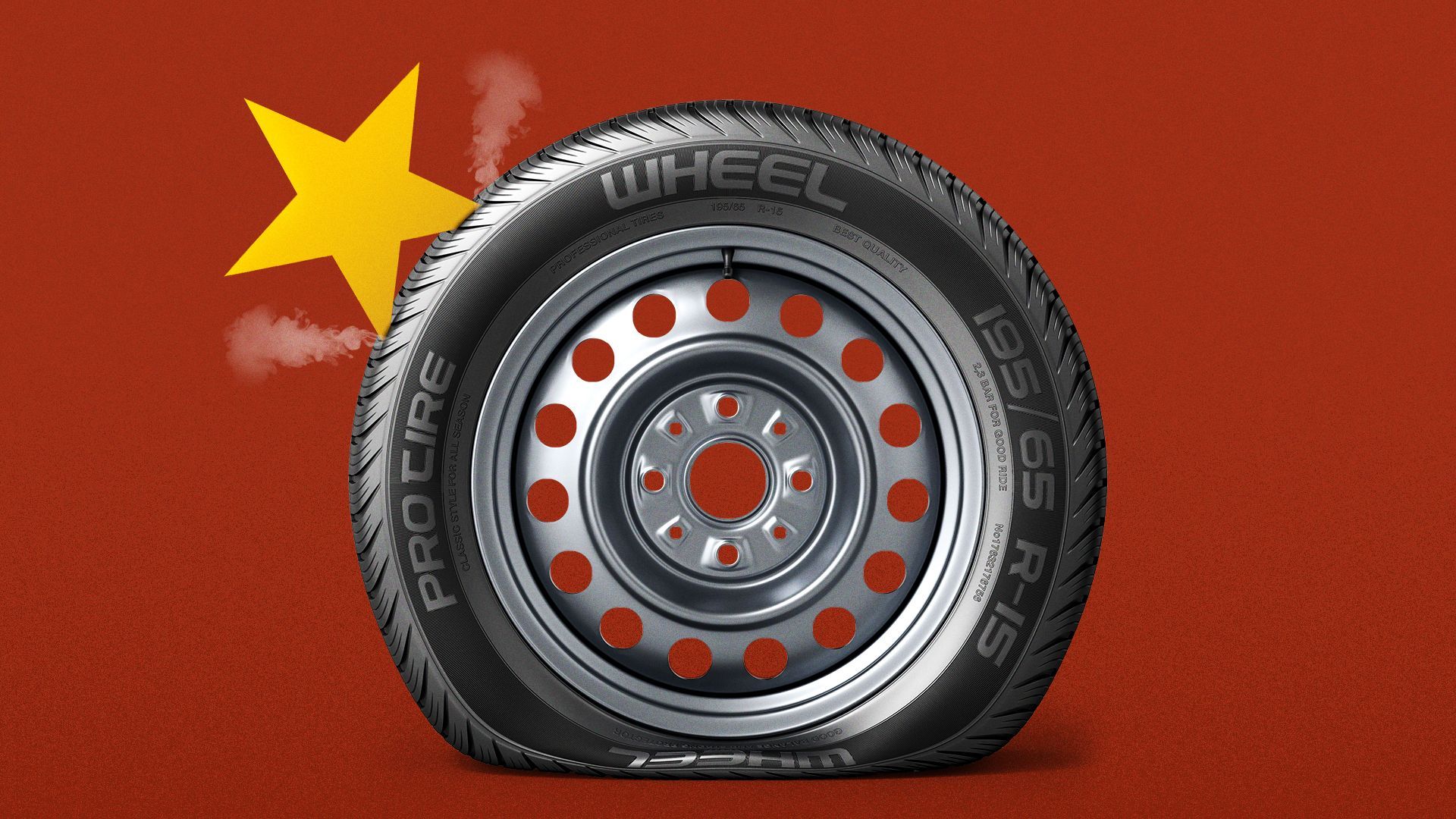
America's escalating trade war with China could choke off demand for electric cars in the U.S.
Why it matters: Simply put, the U.S. can't build EVs without China. Efforts to seed a domestic supply chain, which began under the Biden administration, need more time to mature.
- "We do forecasts out to 2040, and China is going to remain dominant in that time frame across all stages of [the] supply chain," said Adam Webb, head of battery raw materials at Benchmark Mineral Intelligence.
- In the meantime, the U.S. remains dependent on China for key inputs and technologies to produce electric vehicles — and those are getting tougher and more expensive to access.
Driving the news: China isn't just hitting back with higher tariffs to match U.S. taxes on Chinese imports.
- It's also using its control of critical minerals and refining technology to disrupt American supply chains for everything from cars and electronics to missiles and robots.
- For example, Beijing this month made it harder to export rare earth minerals and magnets that are essential for electric motors.
- The move follows earlier restrictions on minerals such as germanium and gallium, which are used in semiconductors and defense, as well as stricter controls on graphite, a critical material for battery anodes.
Where it stands: Higher tariffs on imported vehicles and components mean the U.S. will likely sell 2 million fewer cars and trucks annually, many forecasters agree.
- A shortage of batteries or electric motors for EVs could also choke off the transition away from gasoline cars that's just getting started.
The big picture: China is the world's top miner and processor of rare earths, a group of 17 elements used to make such things as cars, weapons, smartphones and wind turbines.
- It has also acquired mines in other countries with large deposits of other key minerals for EV batteries, including lithium, nickel, cobalt and graphite.
- China also produces most of the cathode active materials needed to make lithium-ion batteries and is home to CATL, the world's leading manufacturer of lithium iron phosphate (LFP) batteries, a lower-cost alternative.
The Trump administration is scrambling to source these minerals from elsewhere, but it doesn't help that the U.S. has alienated many of its trading partners.
- The U.S. has plentiful lithium deposits. But extracting such metals is an expensive, time-consuming process that can harm the environment.
The bottom line: Even if the U.S. can secure raw minerals, it's still reliant on China, which manufactures virtually all of the world's rare earth magnets and dominates the refining process that turns other metals into battery-grade materials.
- "We can have all the rare earths in the world but if we don't refine and make magnets, we don't have anything," MP Materials' CEO James Litinsky, tells Axios.
2. 🕵️ Why AI's climate impact remains a black box
AI's carbon footprint remains a riddle three years into the genAI revolution, thanks to AI makers' secrecy and the difficulty of accurate measurements at scale.
The big picture: AI consumes massive amounts of energy and water both during model training and when the models are responding to users — a phase known as "inference."
- But "massive amounts" are hard to visualize or to compare with the energy we use to play Fortnite, store our text messages in the cloud, mine bitcoin or stream the "White Lotus" finale.
How it works: One oft-cited rule of thumb suggested that querying ChatGPT used roughly 10 times more energy than a Google search — 0.3 watt-hours for a traditional Google search compared with 2.9 watt-hours for a ChatGPT query.
- Epoch AI, a research group that publishes third-party estimates of AI energy use, said in February that the 2.9 watt-hour calculation is likely an overestimate since AI models and the hardware running them are both more efficient now.
- But the rise of bigger models, especially deep research and reasoning models, could also be tugging this figure in the opposite direction.
Yes, but: The carbon footprint of training a model depends on many factors, including the number of parameters in the model, the total hours of training, and the type and efficiency of the power usage.
- OpenAI, Anthropic, xAI and Google did not share internal numbers on how much energy it takes to train and run their generative AI models.
3. 🛢️ Trade war hits oil demand growth
The International Energy Agency today slashed its 2025 oil demand growth estimate by roughly 30%, noting trade tensions have "negatively impacted the economic outlook."
Why it matters: IEA's monthly analyses are closely watched, often market-moving barometers of the supply and demand picture.
Driving the news: The Paris-based agency now sees global oil thirst rising by just 730,000 barrels per day (bpd) this year and 690,000 bpd in 2026.
Catch up quick: Multiple analysts are cutting the growth outlooks as trade battles bring macroeconomic headwinds. But estimates vary.
- For instance, the U.S. Energy Information Administration last week slashed 400,000 bpd off its 2025 outlook and sees a year-over-year rise of 900,000 bpd.
- Goldman Sachs sees the world's oil thirst rising by just 300,000 bpd this year, per Argus Media.
The bottom line: "With arduous trade negotiations expected to take place during the coming 90-day reprieve on tariffs and possibly beyond, oil markets are in for a bumpy ride and considerable uncertainties hang over our forecasts for this year and next," IEA said.
4. 👟 Catch up quick on tech: Microsoft and Google edition
👀 Microsoft and a unit of the energy infrastructure firm Fidelis signed what they're calling the world's largest deal for permanent CO2 removal.
- Why it matters: Tech giants, which have ambitious but non-binding climate targets, face pressure to stem emissions linked to data centers' voracious power needs as AI expands.
- State of play: Microsoft intends to buy 6.75 million metric tons of removal services over 15 years from Atmos Clear. It's planning a biomass energy plant in Louisiana with CO2 capture.
- Yes, but: The companies did not say whether the project would proceed if CO2 capture tax credits are repealed or scaled back, per Reuters, which has more on the plan.
🇹🇼 Google today announced its first geothermal energy deal in Asia. It's a power purchase agreement with geothermal developer Baseload Capital for 10 megawatts.
- What we're watching: The deal opens "pathways to scale geothermal development across the Asia-Pacific region and globally," Google says.
5. 😰 America's climate anxiety, mapped

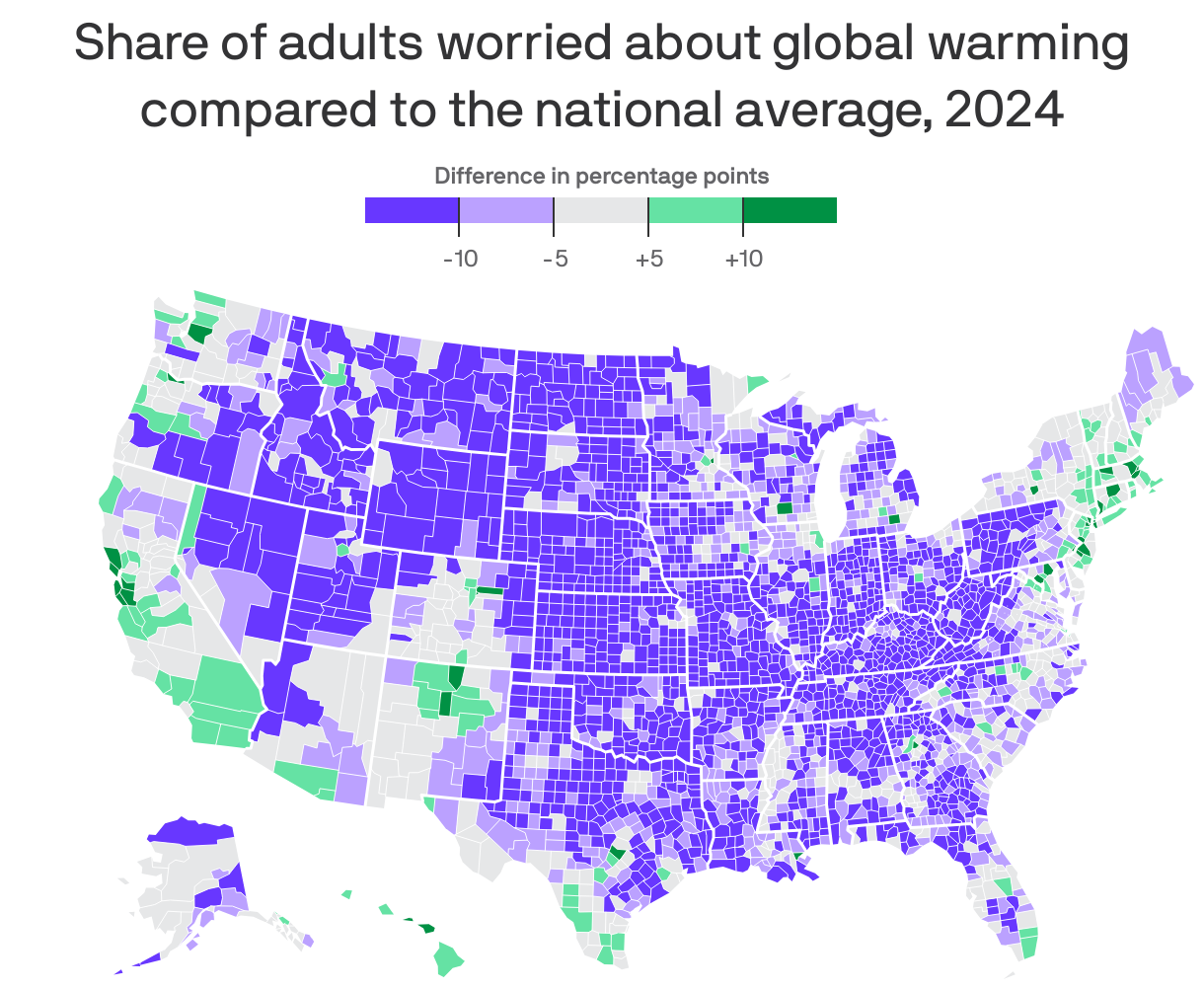
Climate anxiety is concentrated in big U.S. metros and some coastal communities, recent estimates find.
Why it matters: About 63.3% of U.S. adults overall are "somewhat" or "very" worried about global warming as of 2024, per Yale Program on Climate Change Communication estimates based on survey data.
- Yet attitudes vary widely by location, with comparatively low shares of adults expressing such concerns in many counties.
State of play: Some counties with especially high shares of adults worried about global warming — like Queens, New York (79.8%) — are coastal areas vulnerable to climate-driven threats like flooding.
- They also tend to be relatively populous, with 4 of the 10 most-worried counties having at least 1 million residents.
The bottom line: Individual attitudes are not based entirely (or perhaps even primarily) on local risk, with politics, education, and other factors playing big roles.
6. 🔥 Number of the day: 103%
That's the amount of job growth from 1990 to 2020 in the highest wildfire risk areas across 11 western states, per a new analysis from the nonpartisan think tank Resources For the Future.
- Why it matters: "It is up to policymakers to ensure that economic development and resilience policies are aligned so that new growth occurs in the safest locations," RFF senior fellow Margaret Walls, a co-author, said in a statement alongside the report.
- Full study
📧 Did a friend, colleague or an AI chatbot send you this newsletter? Welcome, please sign up.
🙏 Thanks to Chris Speckhard and Chuck McCutcheon for edits to today's edition, along with the brilliant Axios Visuals team.
Sign up for Axios Generate