Axios Generate

October 17, 2024

🧑🍳 We've got a tasty menu today, and it's light. This edition is just 1,304 words, 5 minutes.
🎵 This week marks 30 years since the genre-bending Jamiroquai released "The Return of the Space Cowboy," which provides today's intro tune...
1 big thing: Hot takes on SCOTUS' decision not to chill carbon regs

The hottest climate policy news this week is something the Supreme Court didn't do: freeze EPA's big carbon emissions rules for power plants.
Why it matters: The rules target a huge CO2 source — existing coal plants and future gas plants — and avoided being quickly forced into hibernation.
- The high court yesterday rebuffed red state and industry pleas to freeze the standards while appellate challenges play out.
Catch up quick: Justices Brett Kavanaugh and Neil Gorsuch wrote that opponents have "strong likelihood of success on the merits."
- But litigants don't even need to start initial compliance work until June, they noted. So there's time for the appellate case to end and possible new SCOTUS requests to follow.
- Justice Clarence Thomas wrote that he wanted to stay the rule. Samuel Alito didn't take part.
A few early takeaways...
⚖️ The EPA regs still face huge legal hurdles. SCOTUS' conservative majority looks askance at big rules unless Congress has given agencies explicit marching orders.
- That's apparent in two recent cases — the "major questions" ruling in 2022 and the 2024 decision to overturn "Chevron deference."
🌿 The order offers tea leaves. Jeff Holmstead, a partner with the firm Bracewell LLP, said via email that it "doesn't exactly bode well for EPA," noting three justices have signaled they think the rule is unlawful.
- "If the next administration doesn't revoke the rule and the DC Circuit upholds it, it will almost certainly go to the Supreme Court, and I think other justices will be skeptical of it, too," writes Holmstead, whose firm represents power companies but isn't involved here.
🗳️ The 2024 election will matter a lot. ClearView Energy Partners, in a note, said Donald Trump's EPA could stop defending it in court, or halt the regulation pending a rewrite.
📈 A little trend is afoot. It's the third time in recent weeks that SCOTUS refused requests to stay an EPA rule while lower court fights are active.
- It happened twice Oct. 4 with methane emissions and air toxics standards, though in June they did freeze a separate air pollution rule.
- Harvard environmental law professor Richard Lazarus, via email, said Chief Justice John Roberts and Amy Coney Barrett, another conservative, have "created a new majority" on stays with the court's three liberals.
- That said, Holmstead noted that granting such stays is exceedingly rare.
🗓️ A lot has changed since early 2016. That's when the Supreme Court stayed the Obama-era Clean Power Plan, which never wound up taking effect.
- The Biden rule is, relatively speaking, less central to federal climate policy than Obama's rule.
- That's because huge financial carrots — namely the IRA — are the biggest part of the current White House climate agenda.
🤷 Alito's absence is a wild card. Yesterday's brief order didn't explain why he sat out.
- But if he were recused from litigation against the rule SCOTUS might eventually take up, that's likely one less vote against it.
2. 🎉 Bonus policy note: Biden goes big on sustainable jet fuel

The Energy Department's loan office hopes to provide almost $3 billion for two projects to make sustainable aviation fuel and other products.
Why it matters: Aviation is a big and growing source of carbon emissions, while lack of SAF supply and high costs are barriers to adoption.
🎙️ Driving the news: DOE announced preliminary plans yesterday to offer loan guarantees to projects in South Dakota and Montana.
- A $1.46B package would help finance Gevo Net-Zero 1's corn starch-to-jet fuel plant in Lake Preston, South Dakota, that uses CO2 capture. It would also produce animal feed and corn oil.
- A separate guarantee of up to $1.44B would help Montana Renewables expand an existing plant to use vegetable fats to make mostly SAF but also naphtha and more diesel.
🖼️ The big picture: The airline industry accounts for 3.3% of total U.S. emissions, per DOE.
- Current U.S. SAF production is around just 30 million gallons annually, and the Biden administration target is 3 billion by 2030 and 35 billion by 2050.
🔭 What's next: The Gevo plant would make up to 60 million gallons annually.
The expanded Montana plant would produce up to 315 million gallons per year of biofuels, mostly SAF, per DOE.
3. Phoenix shatters extreme-heat records into fall


After having its hottest summer on record, Phoenix saw an unprecedented and sustained heat wave during parts of September through mid-October.
Why it matters: The latest stretch prolonged heat-related health threats and pointed to the growing challenge of how to be resilient in the face of scorching temperatures.
- This event wasn't limited to Phoenix, with much of the Southwest seeing record heat between mid-September and early to mid-October. But the Arizona capital saw some of the most jaw-dropping milestones.
By the numbers: The unprecedented fall heat wave catapulted the city to the top of the rankings for the number of days in a single year with high temperatures that reached or exceeded 110°F.
- On average, the city sees 21 such days per year, but in 2024 that figure stood at 70 days as of Oct. 16. This beat the 55 days set last year, during what was then the sprawling city's hottest summer.
- Phoenix-Sky Harbor International Airport set or tied a daily record high for 21 straight days, from Sept. 24th through Oct. 14th, according to Victor Murphy, who works with climate data at the National Weather Service.
According to Maricopa County, where Phoenix is located, 389 heat-related deaths have been confirmed so far in 2024, with 292 deaths under investigation.
Context: Studies of specific extreme heat events, such as deadly Mediterranean heat waves this past summer, have clearly shown climate change is playing a crucial role in making such conditions possible.
4. 🏃Catch up quick on tech finance: Nuclear, lithium, data centers

⚛️ The Energy Department opened the doors for applications to tap $900 million for deploying small modular nuclear reactors.
- Why it matters: There's growing federal and private sector interest in SMRs, but plenty of hurdles remain. Reuters has more.
⛏️ General Motors is entering a JV with Lithium Americas for developing the Thacker Pass mine in Nevada and providing $625 million in cash and credit.
- Why it matters: It adds to GM's prior $320M investment and extends an offtake agreement as the auto giant seeks domestic batteries materials.
- The intrigue: It also supplants and expands a second $330M tranche from their early 2023 deal that had been delayed. Lithium Americas' stock soared yesterday on the news. CNBC has more.
🖥️ $3.4 billion — that's the size of a new JV between Crusoe Energy Systems, Blue Owl Capital, and Primary Digital Infrastructure to build data center capacity in Abilene, Texas.
- State of play: They plan to deliver 200+ megawatts of capacity next year. Data Center Dynamics has more.
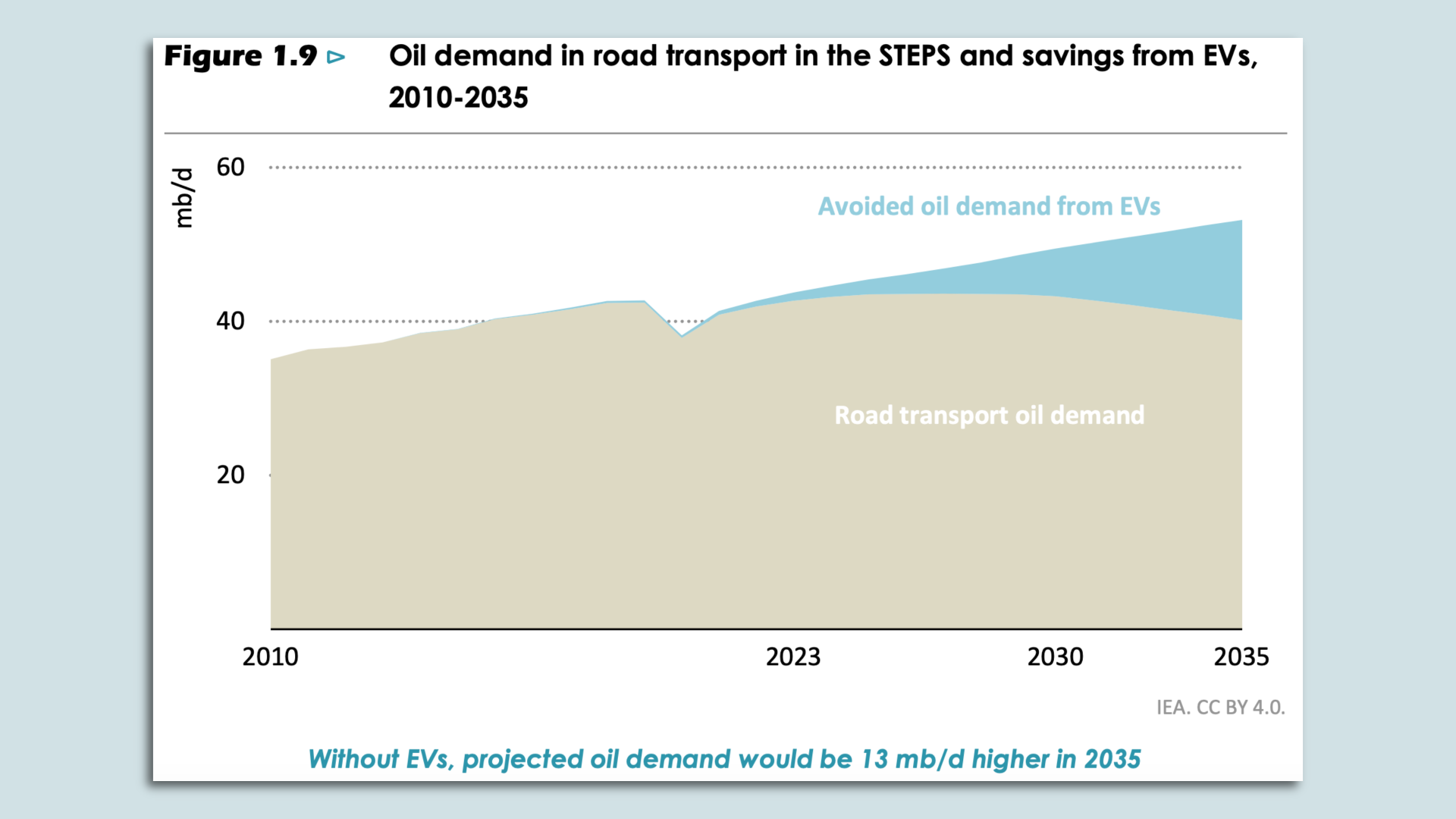
5. 🚗 Charted: how EVs displace oil
Electric vehicles are poised to take a hefty bite out of oil demand, the International Energy Agency's latest long-term outlook finds.
Why it matters: It's among the reasons why the agency — splitting with some analysts — sees global oil use peaking by 2030.
What's next: By 2035, they see EVs (including passenger cars and heavy trucks) displacing 13 million barrels per day.
That's not nothing! Consider today's market is around 102 mbd.
Go deeper: We had lots of angles on the wide-ranging IEA report in yesterday's Generate.
6. 🛢️ Number of the day: $12 billion
That's the value of U.S. upstream oil-and-gas deals in Q3, per Enverus Intelligence Research data.
Why it matters: It's a steep decline from Q2's $30B and the lowest quarterly total since Q1 2023.
The bottom line: Something had to give, with Enverus noting the recent M&A frenzy raised prices and cut the number of targets.
7. 💬 Quoted: COP29 edition
"The vital business of who pays and how much can be agreed in Baku, but we are not going there to renegotiate the Paris Agreement."— Simon Stiell, the top UN official overseeing the Paris Agreement, in remarks this morning
It's a warning to diplomats haggling over a new finance target at COP29: don't get bogged down re-litigating past disputes.
📨 Did a friend, colleague or even a frenemy send you this newsletter? Welcome, please sign up.
🙏 Thanks to Chris Speckhard and Chuck McCutcheon for edits to today's edition, along with the brilliant Axios Visuals team.
Sign up for Axios Generate