Axios Generate

September 02, 2022

We apologize for the delay this morning due to technical issues.
💃🏽🕺Made it! Friday. Today's newsletter, edited by Natasha Smith, has a Smart Brevity count of 1319 words, 5 minutes.
🧹 Housekeeping note: We're off Monday for Labor Day. Enjoy the holiday weekend, and we'll see you Tuesday.
🎶 Exactly 45 years ago The Emotions were No. 1 on the Billboard Hot 100 with a classic single that's today's intro tune.
1 big thing: The high cost of carbon emissions

Illustration: Megan Robinson/Axios
Federal regulators are way, way undercounting future economic harms from each added ton of carbon emissions, a major peer-reviewed analysis finds, Ben writes.
Driving the news: The study in Nature provides new estimates of the "social cost of carbon" (SCC), a metric used by agencies and scientists.
- It accounts for damages from rising seas and floods, heat-related health effects, farm output changes, and other effects of global warming.
- The Nature paper has a mean estimate of $ 185 per ton. The Biden administration's current value is $51, but that's a placeholder pending ongoing review.
- It finds that "temperature mortality impacts are the largest driver" of the total cost estimate.
Why it matters: The higher values "substantially increase" the benefits of avoiding emissions and "thereby increase the expected net benefits of more stringent climate policies," it concludes.
- "[O]ur study finds that carbon dioxide emissions are more costly to society than many people likely realize," co-author Brian Prest of the think tank Resource for the Future said in a statement.
- The paper also notes that the SCC concept is used by other governments, in corporate sustainability accounting and other areas.
What we're watching: How the new tallies may influence climate and energy policies.
- President Biden, in a 2021 executive order, tasked an interagency group with revising estimates and methodologies around the SCC. The paper's authors hope the research informs those efforts, Prest said.
- "We continue to assess how best to account for these costs in regulatory and budgetary contexts in the future," the White House budget office said in a statement to Axios.
The big picture: The study was years in the making and brought together a wide array of researchers across disciplines.
- It had two dozen coauthors, led by UC Berkeley and Resources for the Future scholars, but with contributors from Princeton, the University of Washington, Harvard and elsewhere.
- The effort flowed from 2017 recommendations by the National Academies of Sciences, Engineering, and Medicine that called for improved estimates.
- The authors said they incorporated a lot of new science on the impacts of climate change and also crafted a more robust model for calculating damages.
Go deeper: The Washington Post has a deep dive into the paper.
2. G7 seeks to cap Russian oil prices

Illustration: Sarah Grillo/Axios
Group of Seven finance ministers announced plans today for attempting to set an international ceiling on Russian oil prices in a tricky effort to curtail Kremlin revenues, per multiple reports, Ben writes.
Driving the news: The officials, in a joint statement, "confirm our joint political intention to finalise and implement a comprehensive prohibition of services which enable maritime transportation of Russian-origin crude oil and petroleum products globally."
- Those services would be allowed only if those commodities are bought at or below a to-be-determined price.
Why it matters: It would be among the most aggressive energy policy responses to Russia's invasion of Ukraine, but also reflects a fraught bid to isolate President Vladimir Putin without further wreaking havoc on oil markets.
- The plan is aimed at curbing Russia's revenues and "ability to fund its war of aggression" while at the same time "limiting the impact of Russia´s war on global energy prices," the document states.
The other side: Officials in Russia, a key oil exporter, threatened on Thursday — and again today — to withhold sales to countries that take part in the capping plan.
- "We will simply not supply oil and petroleum products to such companies or states that impose restrictions, as we will not work non-competitively," Deputy Prime Minister Alexander Novak said Thursday, CNN reports, citing Russian state news.
What's next: Crafting the specifics. The document invites input on the design, and says the initial cap will be "at a level based on a range of technical inputs."
What we don't know: Whether it will really work.
- It's highly unclear whether key buyers of Russian barrels, including China and India, will participate.
- And the Financial Times notes that while the European Commission backs the plan, it still needs buy-in from member states.
Yes, but: "U.S. officials have argued that the price cap could work even if many buyers don’t officially join the coalition, since they could still use the system for leverage in contract negotiations with Moscow," Bloomberg reports.
3. Heat roasts the West as wildfires erupt
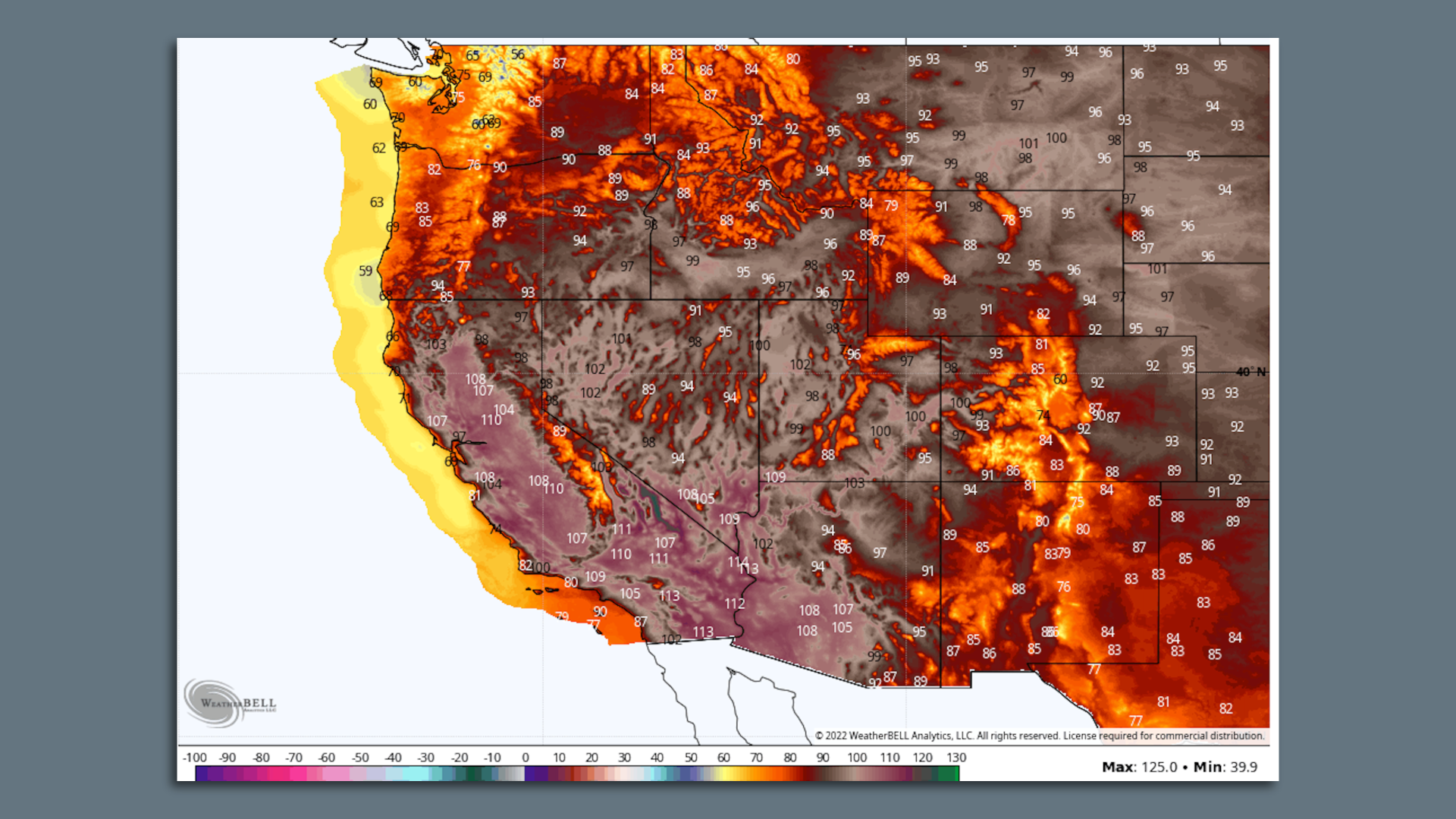
Photo: Weatherbell.com
The heat wave in the western U.S. will continue straight through midweek next week, making for a “scorching” Labor Day weekend for about 50 million people, according to the National Weather Service (NWS), Andrew reports.
The big picture: Heat warnings and advisories were in effect across six states as of Friday morning, from California to Idaho.
- In Death Valley, California, one of the hottest places on Earth, the temperature reached 124.4°F yesterday, just below that location’s monthly record of 125°F.
- Death Valley may equal or beat its monthly record in the coming days, and possibly tie the global monthly record of 126°F.
Context: Studies have shown that heat waves, such as this one, are becoming more frequent, intense and longer-lasting due to human-caused climate change.
Threat level: With extreme heat affecting California’s major cities, the operator of the California grid is calling for voluntary reductions in electricity use for the third day in a row. A Flex Alert is in effect Friday.
- The long duration of this heat wave, plus record warm overnight temperatures, threatens to cause heat-related illnesses and even deaths.
- It is also ramping up the wildfire risks in several states, with multiple large fires igniting Thursday into Friday, as Axios’ Rebecca Falconer reports.
4. Charted: California's changing power mix
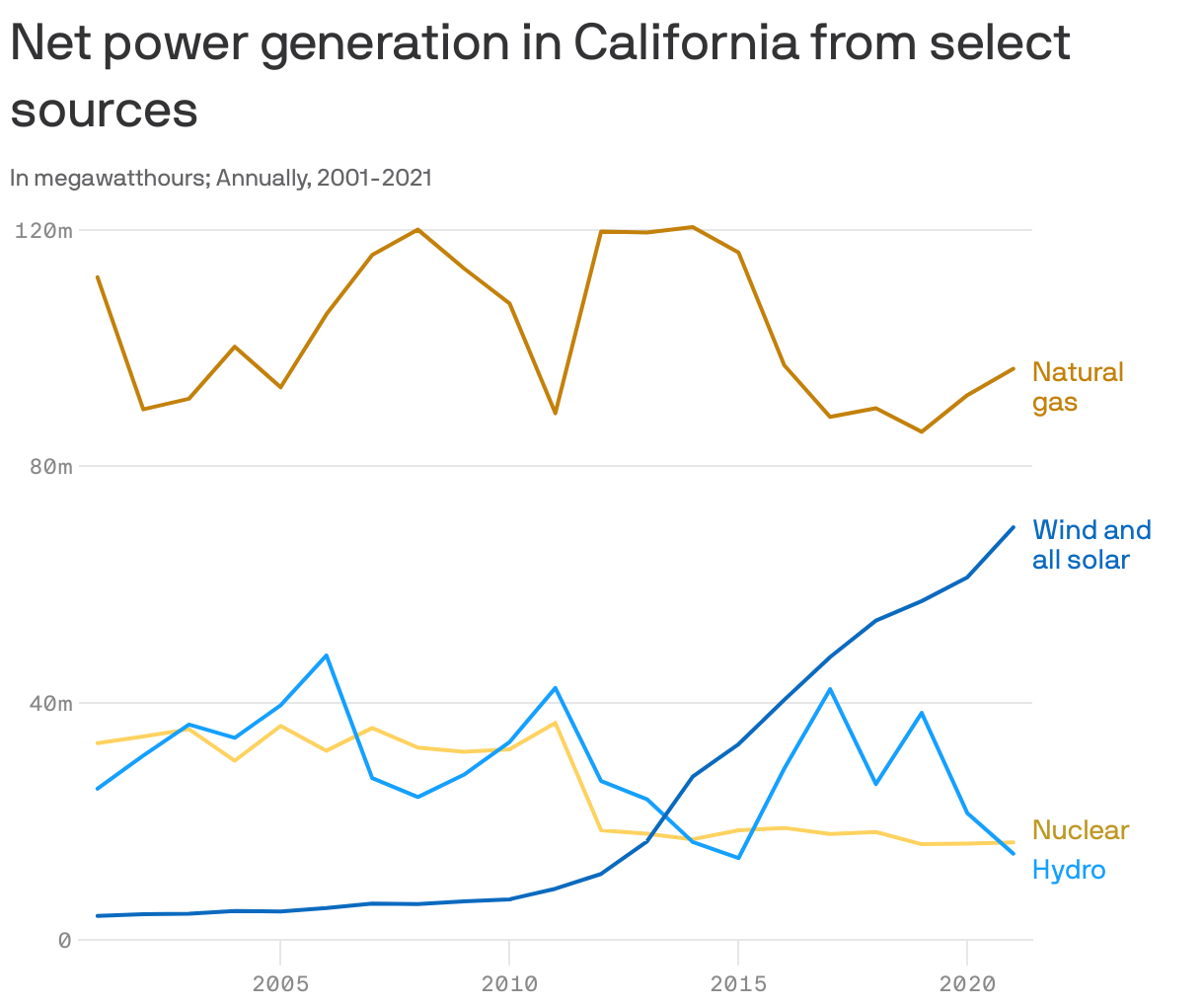
This chart helps to show the stakes of California policymakers’ decision this week to try and keep the Diablo Canyon nuclear plant running beyond 2025, Ben writes.
The big picture: With power demand spiking as the state contends with a major heatwave, California’s grid is under strain. Nuclear still provides about 10% of the state’s electricity — and a wider amount of its carbon-free generation.
What’s new: The state bill approved this week is part of a wider set of Gov. Gavin Newsom’s energy and climate proposals that California lawmakers sent to his desk. They include $54 billion over five years on clean energy and climate programs.
The intrigue: The New York Times notes that Newsom has “sought to portray himself as a climate leader as he has raised his national profile and begun drawing speculation about a possible White House run.”
5. Battery "passports" could help EVs take flight

Illustration: Allie Carl/Axios
If automakers want their electric cars to qualify for newly revised federal tax credits, they must be able to certify the provenance of their batteries — potentially through the use of a "battery passport," Axios' Joann Muller reports.
Why it matters: Strict supply chain requirements attached to the new climate law's restructured EV tax credits were meant to catalyze domestic manufacturing and bolster U.S. energy security.
- A rising percentage of critical minerals must be mined or processed in the U.S. or a trading partner, for example, for a vehicle to qualify. None of the materials can come from "foreign entities of concern," like China or Russia.
Yes, but: Tracing battery minerals from the mine, through multi-stage processing and, eventually, recycling is a huge challenge that many experts worry could end up slowing EV adoption.
What's happening: One company, Circulor, already uses blockchain technology to help carmakers like Volvo and Tesla trace their supply chains to avoid child labor and track carbon emissions.
🎉 Bonus EV notes: Plans and problems
➡️ “Nissan will more aggressively push electric vehicles to take advantage of a new U.S. law that gives up to $7,500 in tax credits, the Japanese automaker said Friday.” (Associated Press)
💼 Tesla has expanded its outside lobbying team by retaining the firm Ice Miller Strategies, a newly public filing shows. The firm expects to work on a suite of topics, including EPA regulations and battery supply chains, the document states.
⚔️ “South Korea views new U.S. rules that favor American-made electric vehicles and batteries as a ‘betrayal,’ a senior official in Seoul said, an issue that threatens to complicate economic and security cooperation between the close allies.” (Bloomberg)
📬 Did a friend send you this newsletter? Welcome, please sign up. Thanks for reading!