
Axios Generate

June 29, 2021
Good morning. Today's Smart Brevity count is 1,244 words, 4.7 minutes.
📊 Data point of the day: 117°F, the high temperature in Salem, Oregon, on Monday. This equaled the hottest temperature on record in Las Vegas.
🎧 Andrew discussed climate connections to the heat wave on the Axios Re:Cap podcast. Listen here
🎸 Tom Petty & The Heartbreakers' "Into the Great Wide Open" turns 30 this week and provides today's intro tune...
1 big thing: White House sells infrastructure deal amid green angst

Illustration: Sarah Grillo/Axios
The White House is trying to build support for clean energy and climate pieces of the $1.2 trillion bipartisan infrastructure outline at a time when activists are calling the plan far too modest, Ben writes.
Why it matters: The White House faces growing urgency to corral progressive lawmakers now that President Biden has abandoned threats to veto the plan unless a much larger, Democrats-only package moves too.
Driving the news: The sales pitch ramped up on several fronts Monday.
- Biden wrote an op-ed touting clean energy and climate provisions while acknowledging it's missing some "critical" climate pieces that he "intends" to pass under the Democrats' separate reconciliation plan.
- Two top White House aides, in a public memo, highlight the plan's $49 billion for public transit, $15 billion for electric vehicle infrastructure and buses, and $73 billion in grid investments, among various other provisions.
- White House press secretary Jen Psaki opened her briefing by claiming the plan would make "unprecedented strides in climate and clean energy leadership" — while also emphasizing that Biden wants to go further.
The big picture: The efforts aim to promote much more than environmental provisions. Biden and his aides are talking up the measure's spending on road, broadband, ports and more.
- But Democrats who prioritize global warming are among Biden's needed constituencies in the fraught climb to get a deal through both chambers of Congress.
- On Monday activists with the Sunrise Movement, joined by progressive lawmakers including Alexandria Ocasio-Cortez and Jamaal Bowman, rallied near the White House under the banner of "no climate, no deal."
- Even beyond Sunrise, which is on the green movement's left flank, more Democratic-aligned groups like the League of Conservation Voters and Evergreen Action are pushing for big measures in a reconciliation plan.
Yes, but: White House officials are trying to navigate all kinds of political crosscurrents.
- The infrastructure bill and the reconciliation package both face huge political hurdles (and neither bill even exists yet). Senate Minority Leader Mitch McConnell has powerful leverage over the bipartisan framework, Axios' Alayna Treene reports.
- The White House and Capitol Hill Democratic leaders face a thicket of competing interests — on both spending levels and policy — even within their party's ranks as they craft a separate reconciliation package.
- A Wall Street Journal story last night explored concerns among Democratic lawmakers in natural gas-producing states about proposals to curb reliance on natural gas.
What's next: Biden will pitch the infrastructure plan in a Wisconsin speech later today.
2. "Unprecedented" heat peaks in Pacific Northwest
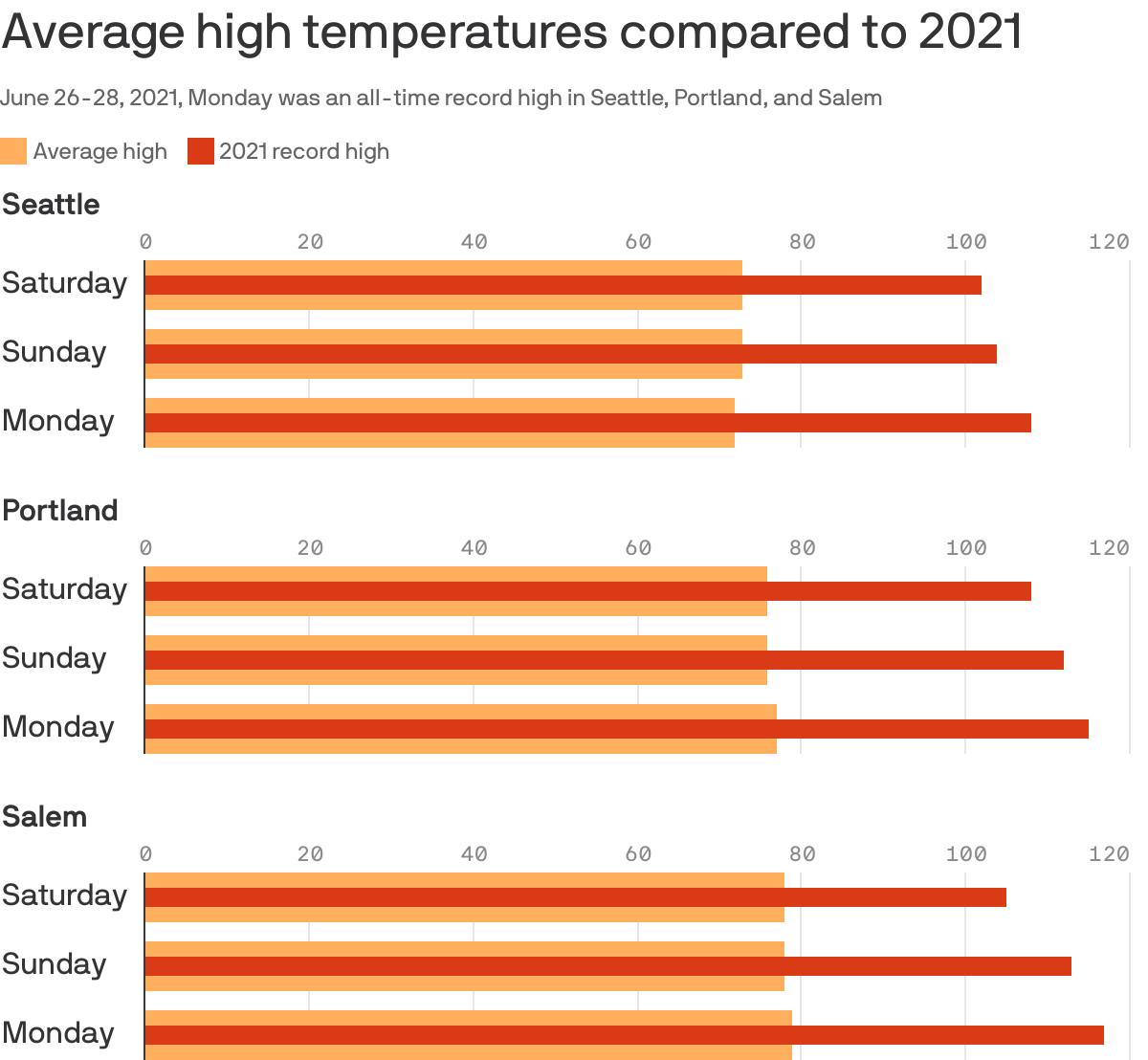
The heat wave scorching the Pacific Northwest and parts of Canada reached its climax on Monday, with results that were described by scientists as "bananas," "astonishing" and "unprecedented," Andrew writes.
Why it matters: Those living in the region have been facing an acute risk of heat-related illness and death due to the prolonged nature of the event. While relief is on the way for coastal areas Tuesday, inland portions of the Northwest will stay unusually hot for much of this week.
Threat level: Records shattered on Monday were enough to unnerve even veteran atmospheric scientists. The National Weather Service in Seattle put out a discussion Sunday night, noting unease about Monday.
- Temperatures would start the day already at unprecedented levels, the agency noted.
- "As there is no previous occurrence of the event we're experiencing in the local climatological record, it's somewhat disconcerting to have no analogy to work with," they wrote. "Temperature records will fall in impressive fashion."
By the numbers:
- Portland reached a staggering 116°F, beating the record of 112°F set Sunday.
- Seattle reached at least 108°F, topping the previous all-time record set the day before, of 104°F.
- Spokane reached at least 108°F, tying the mark from 1928 and 1961.
- Salem reached at least 117°F, beating the record set the day before.
- Quillayute, Washington, on the Olympic Peninsula, reached 110°F, shattering its previous record by a whopping 11°F — a nearly unheard of margin. Typically such milestones are eclipsed by fractions of a degree to a degree or two.
The bottom line: The overall weather pattern that contributed to the heat wave may have occurred to some extent without human-caused global warming.
But decades of greenhouse gas emissions have supercharged such extreme heat events to the point where such frightening milestones are now possible.
3. Climate lawsuits play catch-up on science
Illustration: Sarah Grillo/Axios
Many lawsuits against fossil fuel companies and governments for causing global warming have been dismissed for failing to prove a causal link between emitters and harm to plaintiffs. But a new study finds that could soon change, Andrew writes.
Why it matters: Courts are an important venue for cities, states and citizens’ groups seeking carbon-cutting mandates — especially as governments fail to slash greenhouse gases fast enough to avoid potentially devastating effects.
Driving the news: There have been a few recent successes in court cases, such as the move by a court in the Netherlands to require Royal Dutch Shell to make deeper cuts to its emissions.
Now a new study published Monday in Nature Climate Change that examined 73 court cases examined in 14 jurisdictions finds that plaintiffs aren't using the latest and most compelling scientific evidence in court.
- Such evidence, researchers argue in the study, could help plaintiffs prove that a particular fossil fuel company or government has caused them harm via global warming.
What they found: The study finds that ongoing improvements in climate "attribution" science could help plaintiffs meet evidentiary tests for showing causation.
That's the research field that explores the extent to which human-caused climate change is altering the likelihood and severity of extreme weather events, such as heat waves and floods.
- The researchers, from European institutions and Harvard Law School, conclude that limitations in the scientific evidence presented to courtrooms may have contributed to their failure.
4. More research notes: sizing up CO2 removal
A new paper in Environmental Research Letters sees risks and rewards in the long-term development of carbon dioxide removal (CDR) like direct air capture and bioenergy with carbon capture and storage, Ben writes.
The big picture: Technologies and steps like afforestation that remove atmospheric CO2 can eventually reduce warming beyond what would occur with emissions-cutting measures along.
Threat level: The paper explores the risk that the prospect of CDR can "dilute incentives" to cut fossil fuel emissions now, ultimately worsening warming.
What they're saying: "Heavy reliance on negative emissions is problematic because the feasibility of large-scale CDR is highly uncertain," the authors write in Carbon Brief.
"The promise of carbon removal could be used to delay or deter action in the present, but it could then fail to show up at scale when needed."
5. Catch up fast: Crude, coal, cars, climate talks
Markets: "Oil fell as a coronavirus resurgence raised concerns about demand ahead of an OPEC+ meeting this week that could see the alliance boost some halted output." (Bloomberg)
Finance: "The Japan Bank for International Cooperation (JBIC) will provide support for exports from coal power plants if they come with emissions-cutting steps such as carbon capture and storage (CCS) and co-firing ammonia, JBIC Governor Tadashi Maeda said on Tuesday." (Reuters)
Electric cars: "We now have a name for the new Honda EV that will arrive a few years from now: Prologue. Set to go on sale in calendar-year 2024, the 2024 Honda Prologue will be the first result of a partnership between Honda and General Motors on EV powertrains." (Car and Driver)
Negotiations: "India and other developing nations will oppose plans by the European Union and the U.S. to penalize imports of carbon-intensive goods to curb emissions at the global climate summit to be held in Glasgow this November." (Bloomberg)
Sign up for Axios Generate

Untangle the energy industry’s biggest news stories

