
Axios Generate

July 08, 2021
Good morning! Today's Smart Brevity count is 1,194 words, 4.5 minutes.
📊 Data point of the day: Up to $27 million. That's what DOE's awarding for R&D projects to push ocean wave energy toward commercialization. Go deeper
🎶 Parliament released "Up For The Down Stroke" almost exactly 47 years ago, and it provides today's classic funk intro tune...
1 big thing: Biden leans into clean power mandate despite hurdles
Illustration: Sarah Grillo/Axios
The White House is sending increasingly strong signals it will push for a zero-carbon power mandate in the energy and social safety net package Democrats hope to pass using filibuster-proof budget reconciliation rules.
Driving the news: President Biden, in a speech Wednesday, called for the policy that would require emissions-free electricity to provide a significantly growing share of power company sales.
"I want to set a clean electric standard that moves us to a fully clean and reliable grid," he said in Illinois.
Why it matters: Passing a "clean energy standard" (CES) would help advance Biden's goal of 100% carbon-free U.S. power by 2035.
The big picture: OK, so it's not news that the White House wants a CES in infrastructure legislation.
- But, well, they want all kinds of things! What's notable is that lately, the White House has been getting much more vocal about the CES.
- Last Tuesday top aides Gina McCarthy and Anita Dunn listed it among the priorities, and on Wednesday McCarthy called it one of the "bottom lines" for the reconciliation plan.
- And now I'm pretty sure Biden's speech yesterday is the first time he's publicly name-checked the policy since it was included in the big infrastructure wish-list the White House released in March.
The intrigue: How exactly backers will craft a plan to comply with reconciliation, which is designed for spending and revenue measures.
- The Washington Examiner reports that Democrats may set annual clean power targets for utilities to hit.
- "If utilities hit these targets, they would get financial support from the federal government. If they do not, they would face penalties," it reports.
What we're watching: Whether the votes are there. Sen. Joe Manchin has been skeptical of a CES, though his office did not respond to an inquiry yesterday about his current thinking.
And a CES would likely need to credit for nuclear power and natural gas with CO2 capture (which is not yet a thing commercially) to win over moderates, but some activists groups oppose those sources.
2. EU hits VW, BMW with $1 billion fine over emissions
European regulators today announced a $1 billion fine against the Volkswagen Group and BMW for running afoul of antitrust rules by "colluding on technical development in the area of nitrogen oxide cleaning."
Driving the news: The European Commission's Margrethe Vestager, the top antitrust official, said the settlement is about "how legitimate technical cooperation went wrong."
Volkswagen, Daimler and BMW had the technology to cut air pollution beyond what EU standards required, but "avoided to compete on using this technology's full potential to clean better than what is required by law," she said in a statement.
Why it matters: Reuters reports that the case "sets a precedent by extending the application of European competition law to technical-level talks between industry players."
Catch up fast: The fine addresses activities between 2009 and 2014. Daimler was not penalized because it "revealed the existence of the cartel" to officials, the announcement states.
3. Tallying drought's toll on California hydropower
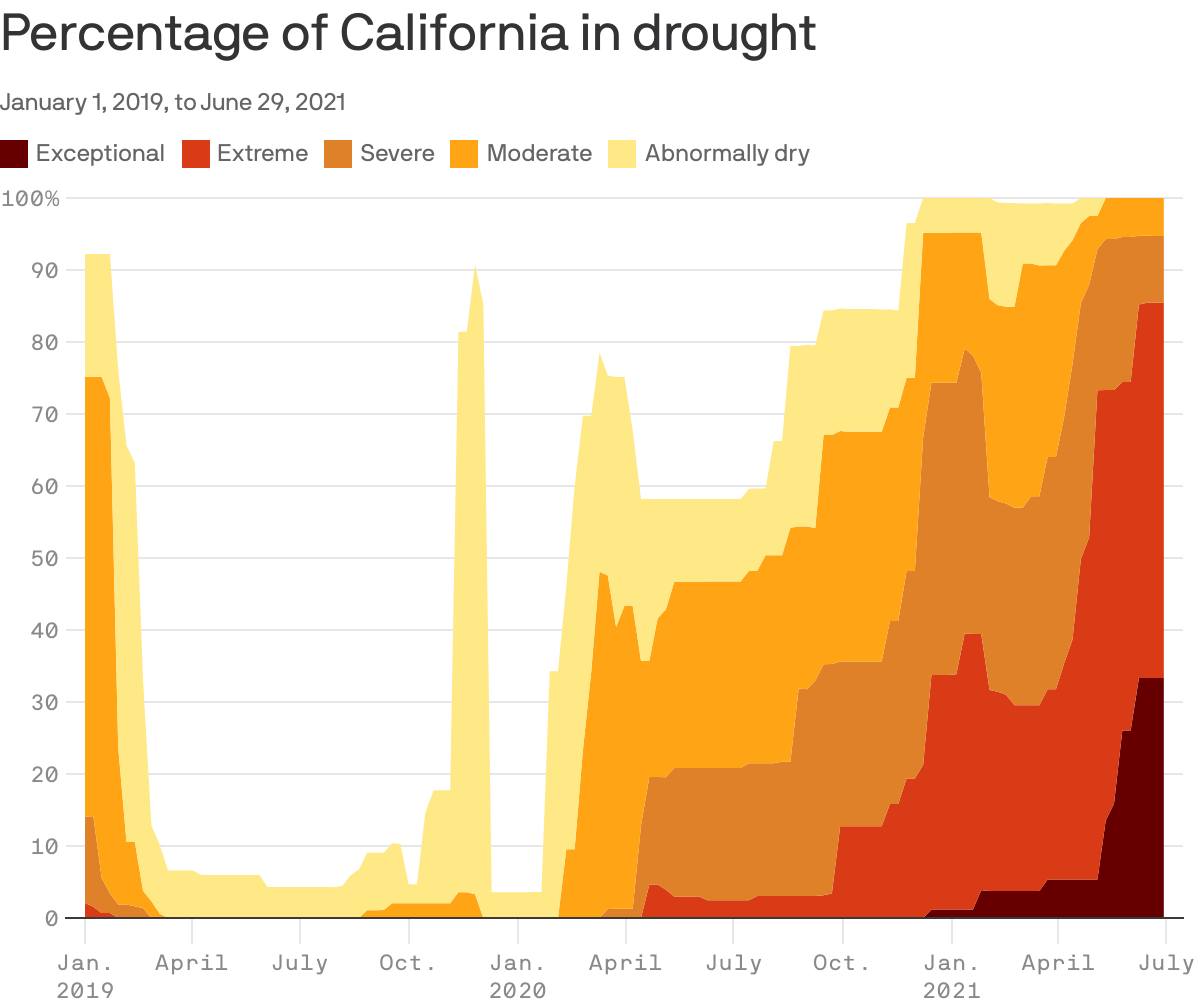
A new report from the Energy Information Administration gets to how much the bad western drought is sapping hydroelectric generation in California.
By the numbers: "In the first four months of 2021, hydroelectric generation in California was 37% less than in the same four months in 2020 and 71% less than during those months in 2019," notes EIA, the Energy Department's independent stats arm.
As of late June, 33% of the state was under "exceptional" drought conditions, the most severe classification.
Why it matters: It's another snapshot of how climate change can affect energy systems.
- Climate change increases the odds of extreme drought conditions, and hydro generation varies according to snowmelt and rainfall levels.
- The share of hydro in California's power mix bounces around depending on those conditions.
- It provided around 11% of in-state power generation in 2020, down significantly from the prior year, per state regulators.
Threat level: The drought-forced decline in hydro generation reduces one source of carbon-free power generation.
"Reduced hydro output could force California to lean heavily on natural gas-fired generation even as it pushes to reduce its use of carbon-based electricity," Bloomberg reported recently.
4. A satellite SPAC with climate implications
Illustration: Eniola Odetunde/Axios
The satellite company Planet announced Wednesday that it's planning to go public via a special purpose acquisition company, or SPAC, Axios' Miriam Kramer reports.
Why it matters: Planet operates the largest fleet of Earth-observing satellites, with more than 190 spacecraft taking photos of the world each day.
Its services have climate- and energy-related applications, such as tracking deforestation and pipeline monitoring.
Driving the news: Planet expects the deal to close in the last quarter of this year, and the company to be valued at about $2.8 billion.
- According to Planet CEO Will Marshall, the SPAC will allow the company to accelerate plans to offer updated analytical tools for their customers and invest more in sales and marketing.
How it works: Planet's data can be used to track relatively small changes on Earth from day to day, allowing customers to see things like deforestation from above.
- The investor presentation and call Wednesday delved into a wide range of business lines and market applications — including helping companies comply with sustainability pledges.
- The company is also involved with the Carbon Mapper project to monitor carbon emissions from orbit.
* * *
Speaking of SPAC deals, Reuters reports: "Bill Gates-backed solar power firm Heliogen Inc will merge with a special-purpose acquisition company (SPAC) to go public in a deal that values the combined entity at about $2 billion."
Bonus satellite news: Oil giants team up on initiative
Chevron, Shell and TotalEnergies are working with the satellite monitoring firm GHGSat on a new research initiative to explore detailed tracking of methane emissions from offshore oil-and-gas platforms.
Why it matters: Methane is a highly potent greenhouse gas, and offshore areas account for roughly 30% of global oil production and lots of natural gas too.
How it works: GHGSat said its infrared sensing tech can identify methane's unique "signature" as it absorbs sunlight.
"As water absorbs sunlight when viewed directly from above, GHGSat will take measurements at more acute angles, positioning the spacecraft’s sensor so it focuses on the point where the sun’s light reflects most strongly off the sea – the 'glint spot,'" the announcement states.
Bloomberg has more.
5. The human fingerprints on the Northwest heat wave
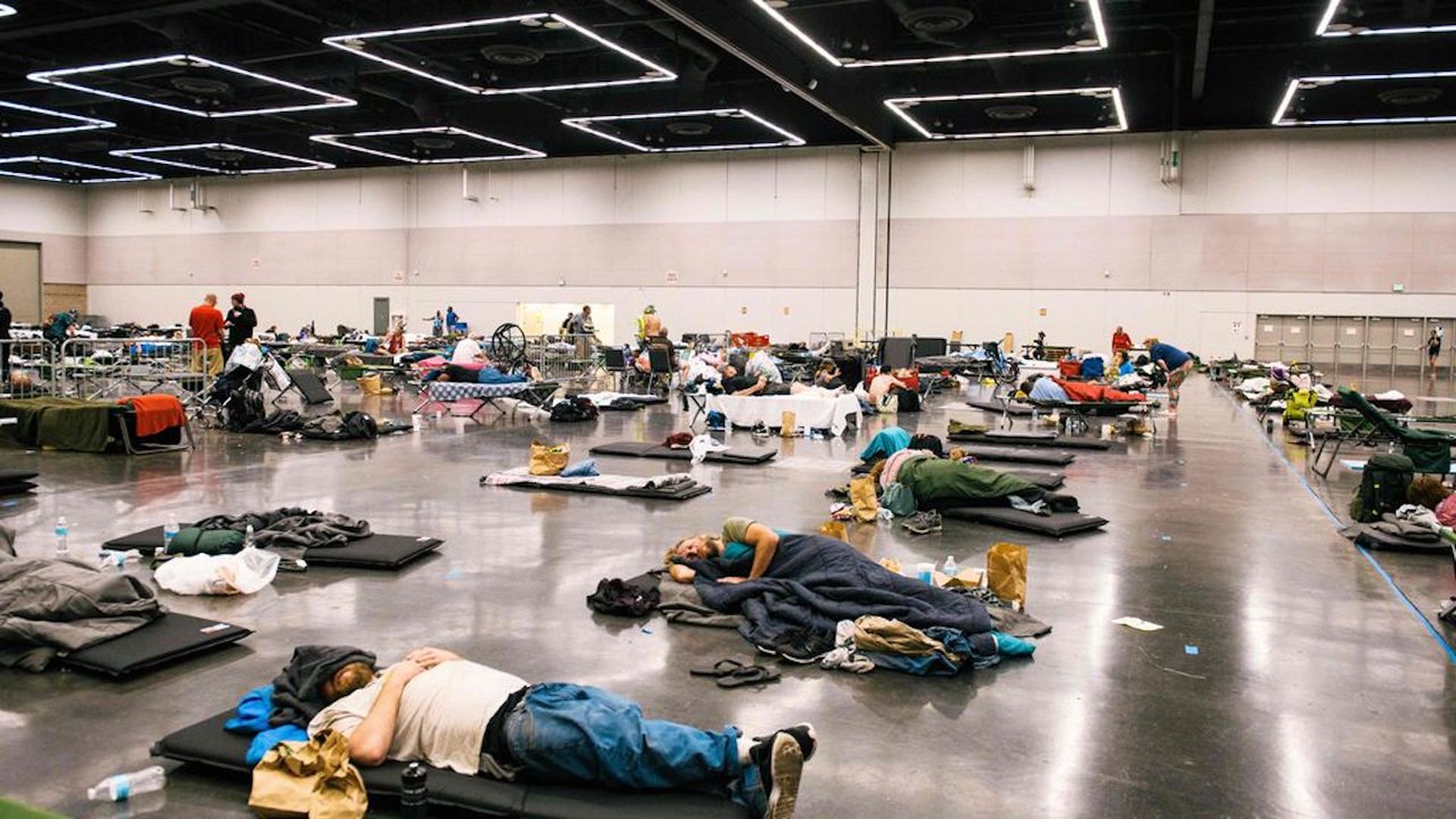
People rest at the Oregon Convention Center cooling station in Portland, Oregon. Photo: KATHRYN ELSESSER/AFP via Getty Images
Via Axios' Rebecca Falconer...The historic heat wave that struck the Pacific Northwest would have been "virtually impossible without human-caused climate change," an international team of researchers said in a new report.
The big picture: World Weather Attribution's analysis found that the record-setting heat that triggered wildfires and was linked to hundreds of deaths was a one-in-a-1,000-year event that "would have been at least 150 times rarer without human-induced climate change."
Driving the news: Multiple cities in Oregon, Washington and the western provinces of Canada recorded temperatures "far above 104ºF," the report noted.
- These included Lytton in British Columbia setting Canada's all-time high-temperature record of 121°F on June 29. One day later, a massive wildfire swept through the village.
- 27 researchers from several countries used 21 climate models to work out how much climate change influenced heat in areas around Seattle, Washington; Portland, Oregon; and Vancouver in Canada — covering a total population of more than 9 million.
- Although their study has yet to be peer-reviewed, the scientists used published peer-reviewed methods to conduct their analysis.
Sign up for Axios Generate

Untangle the energy industry’s biggest news stories


