
Axios Generate

October 22, 2021
🎉 Happy Friday! Today's Smart Brevity count is 1,364 words, 5.5 minutes.
🎶 At this moment in 1972, Curtis Mayfield's album and soundtrack "Super Fly" was #1 on the Billboard charts and provides today's intro tune...
1 big thing: The new offshore wind seascape
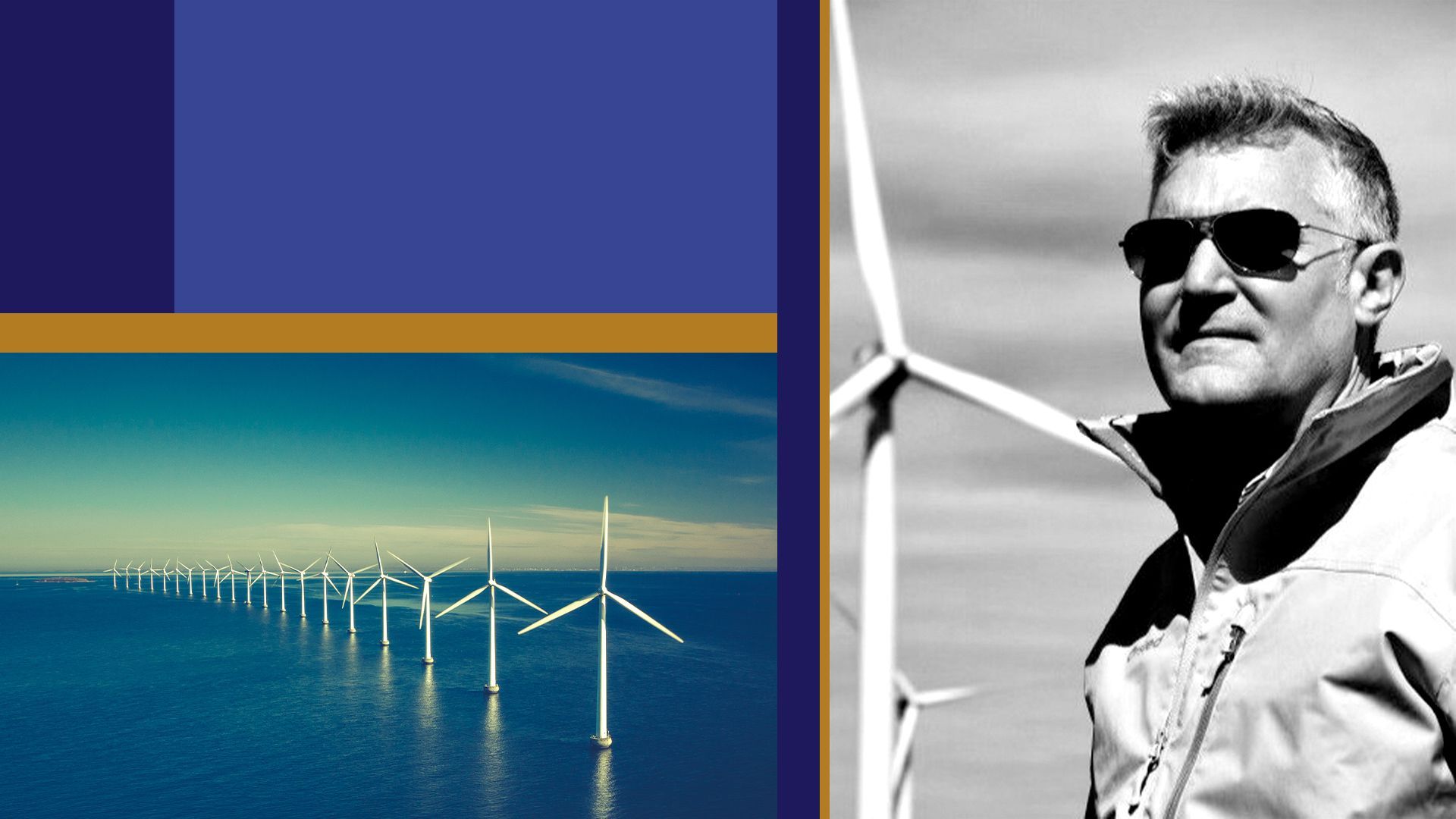
Photo illustration: Axios Visuals. David Hardy. Photo: Courtesy of Ørsted Offshore North America
Global offshore wind heavyweight Ørsted already sees a regulatory sea-change (sorry!) under President Biden, but also says Congress has an important role to play, Ben writes.
Why it matters: A number of companies are planning to build what will be the first large-scale U.S. offshore projects.
Ørsted, the global market leader, has a big project pipeline with four gigawatts of projects planned off New York, New Jersey and other Atlantic states throughout this decade.
What they're saying: David Hardy, CEO of Ørsted Offshore North America, sat down with Axios after testifying Thursday in Congress.
They're making up for lost time in the lengthy regulatory process. "The biggest short-term challenges are that these projects were delayed under the previous administration. And so we're trying to kind of make up for lost time. And now under this administration, we get we're getting quite a bit of positive support."
He said there was "very little progress" in permitting in the Trump era.
He's not sweating Big Oil. Denmark-based multinational energy company Ørsted is among the handful of companies that have been dubbed the clean energy "supermajors."
But oil-and-gas giants are moving into renewables too, with Equinor, Shell and BP already involved in proposed U.S. offshore wind projects. Hardy said he welcomes their push to develop clean power.
- "From a competitive landscape, it means that we've got to stay on our game we've got to really leverage the headstart that we have."
- He notes Ørsted's the biggest worldwide player, which means global supply chain relationships and large in-house engineering, procurement and construction capabilities.
Biden's target is very doable. The White House has set a target of 30 gigawatts of installed U.S. capacity by 2030 (it's almost zero today).
"Renewables have kind of beat every forecast. Onshore wind pricing came down faster. Solar came down faster. The build-out of onshore wind and solar grew faster. So I would I will not be surprised when offshore wind follows that same trend," Hardy said.
Congress has a role. Hardy cautioned the goal faces "risk" without steps from Congress like necessary funding for federal agencies involved in offshore wind permitting and review.
He also cited the need for "clarity" on tax policy (Congress is weighing significant renewable tax credit extensions and changes) and funding for port infrastructure and grid upgrades.
They're looking beyond the Atlantic. The Biden administration recently announced plans for offshore wind lease sales off the West Coast and in the Gulf of Mexico, as well as more Atlantic leasing.
"We're monitoring and watching all those markets," Hardy said, noting, for instance, that he's spoken with Louisiana's governor.
He wants to talk about dry land. Hardy, in our interview and his House testimony, emphasizes that offshore wind development will bolster domestic manufacturing and supply chains in many states.
Just one example: a Nebraska-based offshore wind substation supplier.
2. Key panel sounds alarm on climate's economic risks
Illustration: Annelise Capossela/Axios
The top U.S. financial coordinating organization, created in the wake of the 2008 recession, declared that it "[v]iews climate-related financial risks as an emerging threat to the financial stability of the United States," Andrew writes.
Why it matters: The Financial Stability Oversight Council's (FSOC) report marks the start of what is likely to be a long process of identifying all the ways that climate change could destabilize the American economy, and take action to bolster resilience.
The big picture: The major risks come from the disruptions that could occur while transitioning away from a fossil fuel-intensive energy system — known as transition risks, as well as the likelihood of physical damage from extreme weather events, sea level rise and other impacts of climate change.
Details: The near-term actions are largely procedural but not insignificant, with the FSOC forming two committees to help regulators better understand climate change-related risks.
- One will be the first formal committee created by the council in a decade, according to a senior Treasury Department official. The other committee will be the first-ever advisory committee created by the FSOC, they said.
- The report urges a forward-leaning posture, stating: "Council members recognize that the need for better data and tools cannot justify inaction, as climate-related financial risks will become more acute if not addressed promptly."
The bottom line: Treasury Secretary Janet Yellen, who chairs the FSOC, warned panel members that it would be "foolish" to confuse an "emerging threat" with a "hypothetical one."
- "It does not require a vivid imagination to see how climate change could threaten the financial system," she said.
3. Mapped: climate security flashpoints
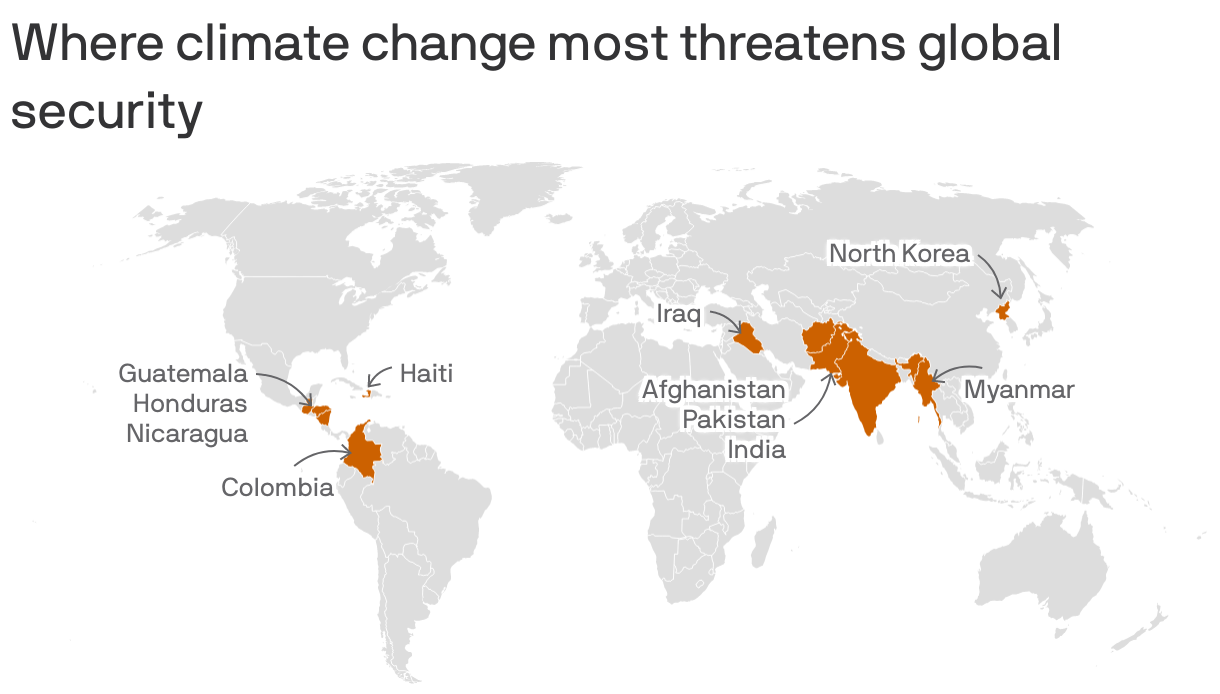
The newly minted National Intelligence Estimate on security risks from climate change offers plenty to worry about as global warming exacerbates geopolitical tensions and increases strains in unstable regions.
Threat level: While the first-time report sees wide-ranging global risks, it specifically identifies 11 countries (see above) and two regions — central Africa and small Pacific islands — of "great concern from the threat of climate change."
4. New wildfire risk monitoring tool unveiled
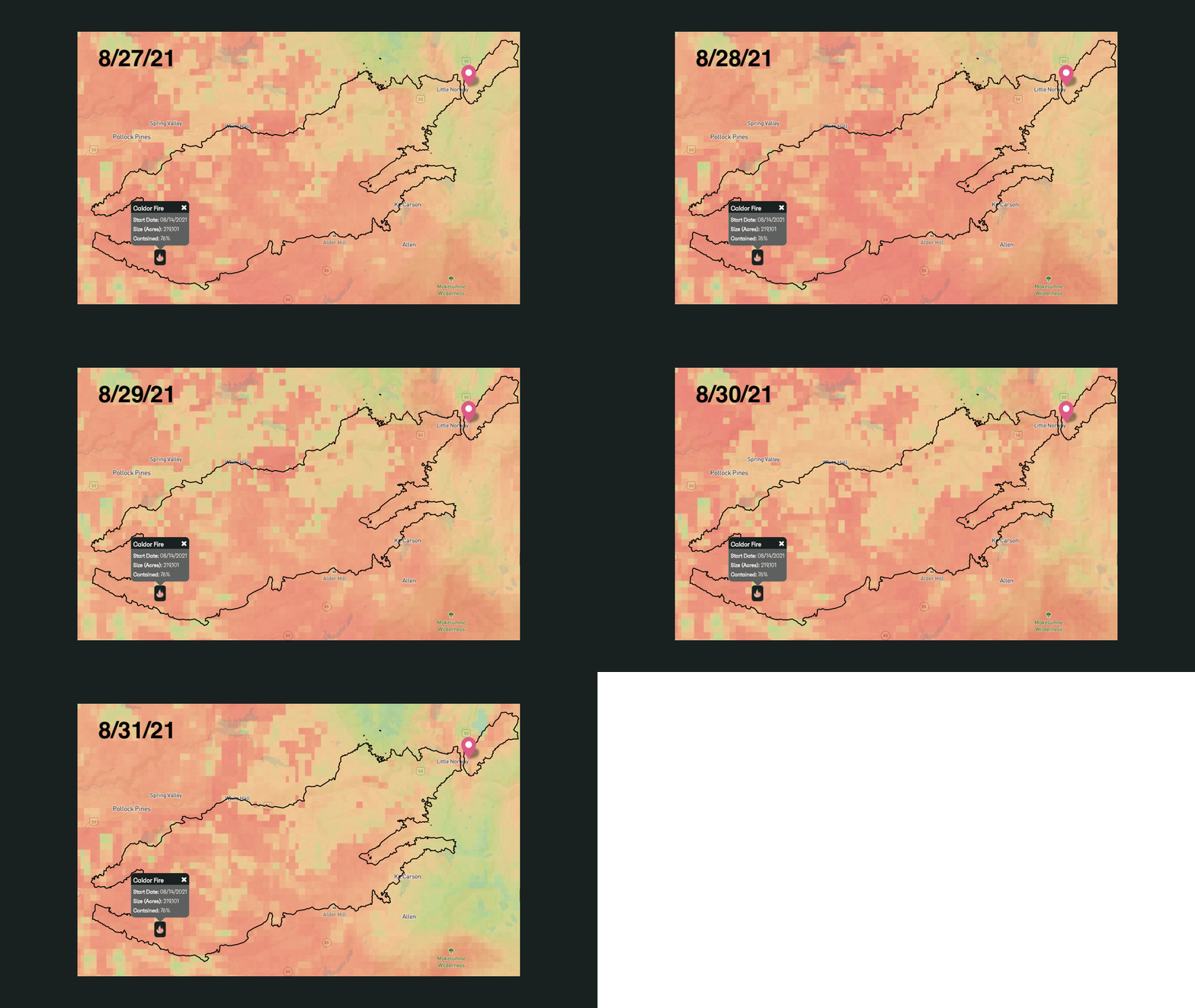
Animation of wildfire risk data during the Caldor Wildfire in California, from Terrafuse AI, showing the increase in risk from changing weather conditions. (Terrafuse AI)
Terrafuse AI, a climate and weather risk forecasting developer, launched a free public tool Thursday, known as Wildfire AI, that provides predictive modeling to track the changing risks of wildfires, Andrew writes.
Why it matters: Climate change and land use are leading to a huge increase in the risk of large wildfires in the West, especially California, posing challenges for the insurance industry and homeowners.
Context: Co-founder and CEO Hunter Connell told Axios she saw the need for better wildfire risk guidance after her family narrowly escaped the deadly 2017 Tubbs Fire in California.
How it works: Terrafuse processes Earth observation data, such as information on temperature, winds, humidity and vegetation dryness, along with observed wildfire events, using machine learning techniques processed on Microsoft Azure.
- The model output is expressed as a risk score, or annual exceedance probability, which quantifies the likelihood of a wildfire event to the microscale level of 100 feet.
- The company says it has validated its modeling against $1 billion of proprietary insurance claims data. It raised $4.5 million in its first round of funding last year (along with grants), Connell told Axios, with another raise planned for 2022.
- Company partners include Microsoft AI for Earth, Terrafuse partners include the Air Force, National Science Foundation and Lawrence Berkeley National Laboratory.
- Terrafuse AI also offers insurers and other customers an enterprise wildfire risk product for a fee.
What's next: "I think we're taking a fundamentally different approach to assessing risk," Connell said. The company has a large vision, which is to build climate risk into decision-making everywhere, scaling from peril to peril, she said.
Bonus: California's fiery era


While a series of powerful "atmospheric river" storms are effectively bringing the fire season to an end in Northern California, the southern part of the state is still vulnerable to additional blazes during a season that has given rise to the second-largest wildfire on record.
5. The economic spillover from high energy prices
The World Bank and International Monetary Fund are out with fresh warnings about the energy commodity run-up, but both also see some relief ahead, Ben writes.
Driving the news: The IMF, in a post on Thursday, projects prices will moderate in the coming months, but also says, "uncertainty remains high and small demand shocks could trigger fresh price spikes."
The bank's new commodities outlook says on a yearly basis, prices are projected to rise over 2% next year after this year's 80% jump, though Reuters notes they see prices declining in the second half of the year.
Threat level: The bank report says increasing prices "pose significant inflation risks" in many emerging markets and developing countries, and "could weigh on growth in 2022 among energy-importing countries."
6. New in business: Exxon, Stellantis, Ameresco
Carbon capture: "Exxon Mobil Corp. restarted work on a planned 1 million-ton-a-year carbon capture project in Wyoming and said operations could begin as soon as 2025, two years later than the previously proposed timeline." (Bloomberg)Â
Electric vehicle batteries: "The maker of Jeep SUVs and Ram pickup trucks on Friday announced plans for a second joint venture to build a second battery plant in North America — this time with Samsung SDI." (Detroit News)
Stationary storage: Via Andrew, Ameresco Inc. is partnering with Southern California Edison to design and build three battery energy storage systems at substations in California. They'll have a capacity of storing 537.5 MW with a four-hour duration, for a total of 2,150 MWh, to help boost grid reliability.
Sign up for Axios Generate

Untangle the energy industry’s biggest news stories


