
Axios Generate

September 19, 2024

🐣 Welcome to Thursday! We're racing into the day with just 930 words, 3.5 minutes.
🌏 Will you be in NYC next week for UNGA or Climate Week? Andrew and Ben will! Join Axios House from Sept. 22-24 for live interviews with Energy Secretary Jennifer Granholm, Malala Fund co-founder Malala Yousafzai, and many more newsmakers. Request an invite.
🎶 Happy birthday to producer, writer and musician extraordinaire Nile Rodgers, whose prints are all over today's intro tune...
1 big thing: Mapping the hot urban future
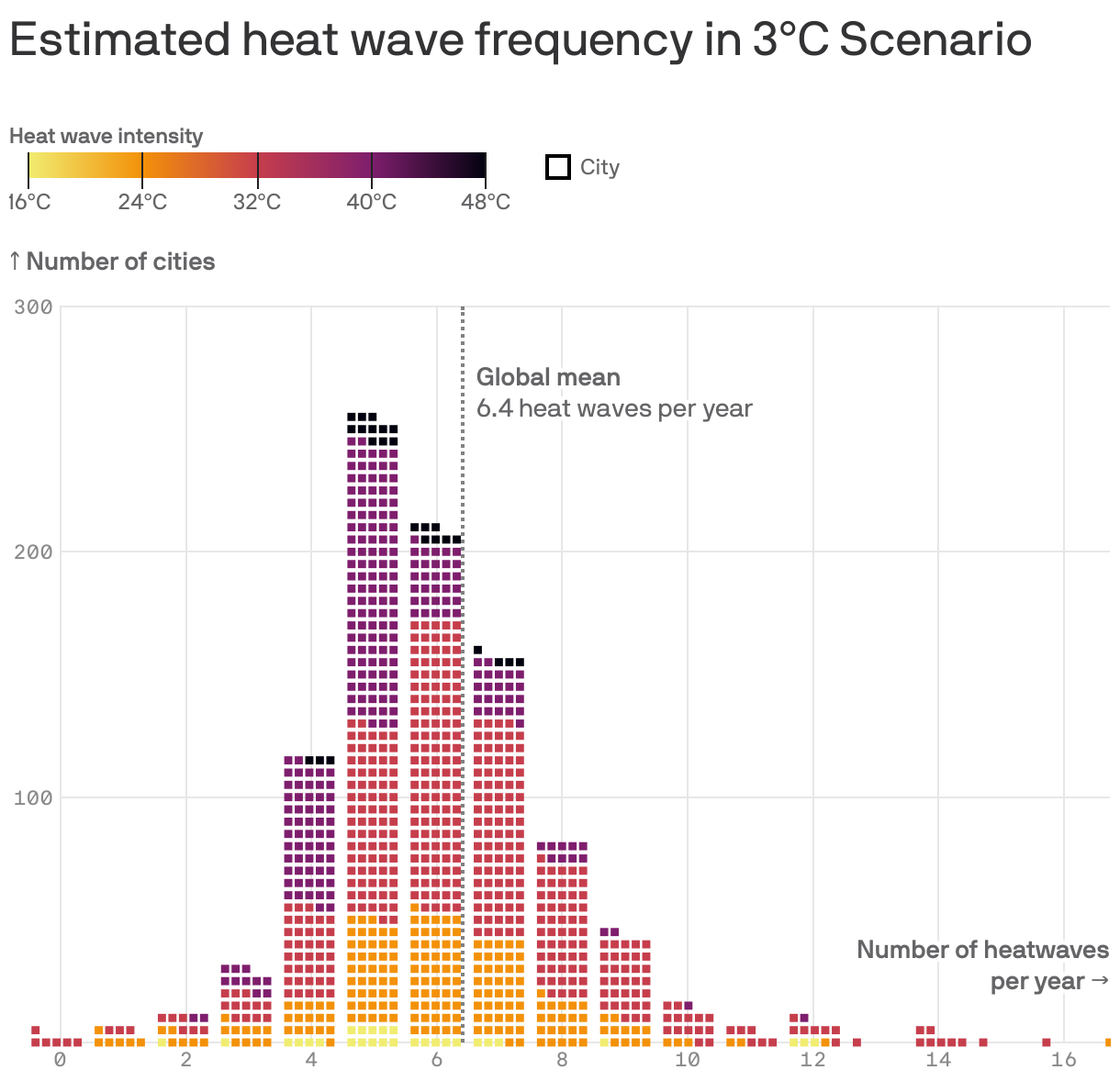
A new study sees the Earth's current warming path driving big increases in heat wave length and frequency in roughly 1,000 of the world's largest cities.
Why it matters: This city-by-city projection is unprecedented, per the World Resources Institute, which released the analysis.
- "This new global data provides a granular view never seen before at the subnational level," the nonprofit said of the peer-reviewed work.
What they did: Researchers modeled heat waves, insect-borne disease risk, and cooling demand if Earth warms 3°C (5.4°F) above preindustrial levels.
- They compared this to the Paris Agreement's stretch goal of 1.5°C, even though this has likely slipped away.
What they found: In a 3°C world, the average length of the year's longest heat wave would be 24.5 days.
- The 996 cities studied would average 6.4 heat waves annually.
- In a 1.5°C world, the longest average heat wave would be 16.3 days, and the average number of heat waves drops to 4.9.
What's next: With 3°C of warming, more than 16% of these big cities would see at least one heat wave lasting a month (!) or longer per year.
- WRI analysts see immense risks in regions already suffering from extreme heat.
- For instance, sub-Saharan Africa sees 56% more heat waves.
Threat level: Heat waves are deadly, sap economic productivity, and strain public health systems and infrastructure.
- "People in low-income cities are likely to be the hardest hit" by the greater risks, the authors' summary states.
Stunning stat: The findings are especially striking because by 2050, an additional 2.5 billion people will live in cities, with most growth in Asia and Africa, WRI notes.
- Over two-thirds of the global population will live in cities by 2050, the findings state.
How it works: It defines heat waves as 3 or more consecutive days where high temps equal — or top — the area's 90th percentile for daily maximums.
- But the analysis has limits, and the authors acknowledge multiple areas of uncertainty.
- They're likely underestimating some risks because they don't include the "urban heat island" effect, which keeps some U.S. cities up to 8°F hotter than surrounding areas.
Reality check: There's no universal, consensus view of precisely how much warming — regionally and overall — awaits under nations' current policies.
- The analysis examines several models. Authors also point to a 2023 UN report which sees 2.9°C (5.22°F) if countries implement existing voluntary pledges under the Paris Agreement.
What we're watching: WRI says the report highlights the need for tougher emissions-cutting policies.
- But they also urge more investment in adaptation and resilient infrastructure.
- They hope the analysis will help city policymakers plan, and spur even more detailed work.
The bottom line: "This data should serve as a wakeup call to every city and national government leader," Rogier van den Berg, the global director of the WRI Ross Center for Sustainable Cities, said in a statement.
Andrew Freedman contributed
2. The Fed's rate cut puts wind in renewables' sails
This X post from Columbia University economist Noah Kaufman sums up hopes that the Fed's big rate cut will boost renewables and other low-carbon projects.
Why it matters: Interest rates are one factor gumming up the economics of building offshore wind and other capital-intensive infrastructure.
Driving the news: The Fed yesterday cut its target interest rate by an extra-large half-percentage point and projected more rate cuts this year and next.
Go deeper: Heatmap, E&E News and the consultancy Wood Mackenzie have more on the topic.
3. 🏃 Catch up quick on biz: GM, ING, TotalEnergies
👐 General Motors has begun offering adapters that will enable drivers of its EVs to use Tesla's expansive Supercharger network.
- Why it matters: "Access to the network could encourage people to buy electric cars by alleviating fears about finding reliable places to charge them," the NYT notes.
🛢️ Via Bloomberg, banking giant ING "plans to further reduce the financing it provides to fossil-fuel companies as part of its effort to drive down emissions in its loan portfolio and achieve a net zero target by 2050."
📏 TotalEnergies this morning announced a 5-year extension of its LNG sales agreement to China's CNOOC out to 2034, signaling China's robust long-term desire for the fuel.
4. Climate finance "pain points" and more money notes

😧 The Brookings Institution dropped detailed analysis of nine "pain points" thwarting larger and more equitable private sector climate finance.
Why it matters: Current spending is too low to meet Paris Agreement targets and protect vulnerable populations from climate harms.
Driving the news: The buckets of problems in the private and public sectors include:
- "Immature" climate accounting and "lack of consensus" on tallying benefits and costs. This makes it harder to raise project finance.
- Current financing models favor polluting projects that use established tech.
- Political timelines are often misaligned with project delivery timelines, while fragmented authorities create investor uncertainty.
The bottom line: "[I]t is time for all parties to move past virtue signaling and decide on new rules of engagement," co-author Adie Tomer said in a statement.
👀 Speaking of money and rules of engagement, Bloomberg explores how the financial sector is pushing back against it calls unrealistic expectations.
- State of play: Their piece features the Institute of International Finance, an industry group aiming to re-frame debate on their members' role in energy transition.
- Friction point: IIF's new(ish) memo says stakeholders are greatly overestimating banks', insurers', and investors' capacity to sway "strategies and actions of clients, counterparties, and investees in regulated financial markets."
5. 🚚 Number of the day: Slightly over 1.5%
That's the share of medium- and heavy-duty trucks sold worldwide last year that are zero-emissions (mostly EVs), per a new BloombergNEF report.
Why it matters: That's actually fast growth from a tiny base.
- But the road freight sector is not on a climate-friendly path, and cost and other hurdles remain.
📨 Did a friend, colleague or even a frenemy send you this newsletter? Welcome, please sign up.
🙏 Thanks to Chris Speckhard and George Moriarty for edits to today's edition, along with the brilliant Axios Visuals team.
Sign up for Axios Generate