Axios Generate
December 13, 2024


1 big thing: For data centers, it's everything everywhere all at once

The past 48 hours have brought data centers' role in the electricity future into sharp relief.
Why it matters: The mix of sources that meet AI's energy thirst will help set the course of power sector CO2 emissions.
State of play: This week brought the latest revelations about plans for gas and renewables alike to handle hyperscalers' future demand.
- I'm not even capturing everything, but here's what caught my eye...
🛢️Big Oil enters the chat. Exxon revealed it's well into engineering and design of a gas plant with CO2 capture that could directly power data centers.
- And a Chevron exec on Wednesday offered a little more info on CEO Mike Wirth's revelation last week that Chevron is also looking at building behind-the-meter gas for data centers.
🧾 Gas turbine orders pile up. Via Bloomberg, "GE Vernova Inc. has signed multiple contracts to sell natural gas turbines for data centers that will use enough power to light up major cities, the company's top executive said."
☀️ New mojo for renewables. Google, Intersect Power and the TPG Rise Climate fund said they're teaming up to "develop industrial parks with gigawatts of data center capacity in the U.S., co-located with new clean energy plants to power them."
- They're talking up renewables paired with storage and want the first co-located projects to arrive in 2026.
💵 Money, money, money. The AI infrastructure firm Crusoe Energy closed a $600 million Series D round at a $2.8 billion valuation led by Founders Fund.
- Google and TPG are leading a new $800M investment round in Intersect, they said alongside this week's announcement on their collaboration.
- These are just the latest examples of cash pouring into data centers and energy for them.
Catch up quick: The biggest storyline has been tech giants looking to small modular reactors despite long development timelines, and buying power from large nuclear plants — including revival of Three Mile Island.
The intrigue: A mix of sources — some fossil, some not — will power the data center boom. But there's competition for hyperscalers' attention and dollars, too.
- For instance, here's Exxon CFO Kathy Mikell's discussing their gas idea at a wider investor presentation Wednesday:
- "Projects like this are fully detached from the grid. That means they're independent of utility timelines, so they can be installed at a pace that other alternatives, including U.S. nuclear, just can't match."
What we're watching: How the incoming Trump team — including AI "czar" David Sacks — approach the topic.

3. 📊 Charted: Microgrids rising — especially in Texas
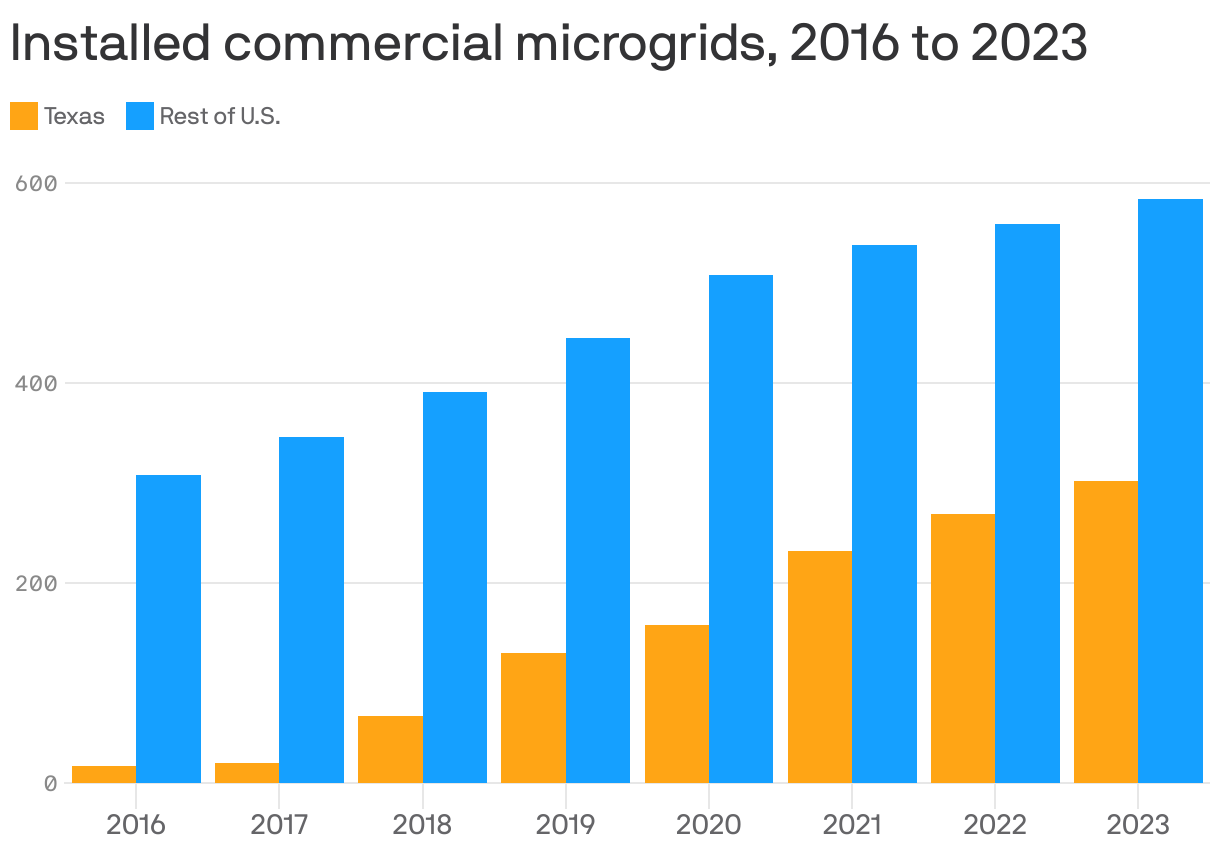
Microgrids are rising fast in Texas and two big forces — data centers and oilfield electrification — could help drive future growth, a Dallas Fed primer shows.
Why it matters: Texas' vulnerability to weather extremes, and rising pressure on the grid, has led various sectors like grocery chains to install these isolated systems.
The big picture: Natural gas powers that vast majority of Texas microgrids.
- The Dallas Fed researchers tracked Texas' systems in a wider Energy Department database.
- For these purposes, microgrids means "distinct networks of energy resources and energy consumers that can be connected and disconnected at will from the larger utility grids."
What we're watching: Further growth as data centers proliferate and more oil companies electrify operations — two industries the analysis calls ripe for going micro.
- And keep an eye on solar and storage making more inroads.

5. 🚘 Number of the day: 450 miles
Axios Generate