
Axios Generate

August 26, 2021
☕ Good morning. Today's Smart Brevity count is 1,274 words, 5 minutes.
📊 Data point of the day: 3 years tops. That's how soon Audi sees EVs becoming as profitable as internal combustion models, via MarketWatch.
🎶 This week back in 1998, this remarkable album, "The Miseducation of Lauryn Hill," was released. Her hit, "Doo-Wop (That Thing)" bumps us into Thursday as today's intro tune.
1 big thing: Chuck Schumer's high-stakes climate play

Photo Illustration: Shoshana Gordon/Axios. Photo: Samuel Corum/Bloomberg via Getty Images
It's just over two months until a pivotal United Nations climate summit, and if Capitol Hill's importance to the equation wasn't already clear, it sure is now, Ben writes.
Catch up fast: Senate Majority Leader Chuck Schumer released an analysis showing the Democrats-only reconciliation plan — and to a much lesser degree the bipartisan infrastructure deal — would essentially put the U.S. on track to meet President Biden's pledge under the Paris Agreement.
The April pledge, called a "nationally determined contribution (NDC)," vows a 50%-52% cut in U.S. greenhouse gas emissions by 2030.
Why it matters: Schumer's analysis Wednesday of the energy and climate parts of the wider $3.5 trillion plan — which his office says is based on expert input — could help the U.S. show the pledge has teeth.
- But that's only true if the bill avoids lots of political landmines and passes. If it fails or gets gutted, that would raise doubts about the U.S. ability to make good on the NDC.
- If other big polluters think the U.S. is serious about slashing planet-warming emissions, it may help spur more tangible action.
Between the lines: White House officials say there are multiple ways to achieve the NDC, and the administration has an expansive executive agenda.
But Schumer's analysis says the quiet part out loud: The tough path runs straight through Capitol Hill.
The big picture: The Beltway debate comes as scientists are issuing dire findings about effects of climate change already arriving and danger in store absent immediate, deep and sustained global emissions cuts.
- The outcome of the reconciliation plan is uncertain on both sides of Capitol Hill.
- House Speaker Nancy Pelosi needs to corral restive moderates while keeping support from progressives, while Schumer can't lose a single Democrat.
What we're watching: Whether Schumer's move helps convince moderates wary of the bill's size that it's worthwhile spending and progressives — who have angled for more aggressive measures — that it achieves plenty.
How it works: Two key parts of the Senate reconciliation plan are focused on electricity: payments and penalties that push utilities to speed up zero-carbon power deployment, and new and expanded clean energy tax credits.
- "It will be much harder to claim we are on track for our own NDC commitment without the program to achieve 80% clean electricity by 2030 and the very significant clean energy incentives that are part of the reconciliation package," Jason Bordoff, head of a Columbia University energy think tank, tells Axios.
What they're saying: A White House spokesperson said the reconciliation bill and the bipartisan plan are "critical to unlocking the full economic opportunities that come with taking on the climate crisis."
"Congress can and must position our communities and workers to seize these opportunities and meet the moment.”
2. Greenland's melt ponds come with a warning

Satellite photo of the southwestern portion of the Greenland Ice Sheet aquired on Aug. 21. EU Copernicus Sentinel-2 Imagery.
Recent satellite images of the Greenland Ice Sheet show the existence of cerulean blue pockmarks — phenomena that provide scientists with a worrying message about sea-level rise and the risk of massively consequential changes in ocean behavior, Andrew writes.
Why it matters: The melt ponds, rivers and moulins, which are cracks in the ice where surface water can plummet more than a mile to where the ice sheet meets bedrock, are a symptom of a summer season that has brought large spikes in melt extent.
- This is significant because ice melt from Greenland is the largest contributor to global sea-level rise.
- In addition, there's increasing evidence that the cold fresh water coming from the ice sheet may be helping to disrupt one of the most important ocean circulation systems on Earth, which includes the Gulf Stream.
Driving the news: The melt ponds and other surface water formations are partly the result of a heavy rainfall event and widespread melting that occurred during mid-August. (See what the ponds look like from a low-flying plane.)
Details: On Aug. 14, rain was observed for the first time on record at the National Science Foundation's Summit Station.
- The station is located at the top of the Greenland Ice Sheet, some 10,551 feet in elevation, and is typically the coldest spot on the island.
- There have been three Summit Station melt events, or periods with temperatures above freezing, in just the past 10 years: 2012, 2019 and this year. This frequency is itself a huge departure from the past.
Context: According to University of Liege scientist Xavier Fettweis, during the warm episode, a total of 7 billion tons of rain fell on the ice, which is about 20% of the annual rainfall total for the typically frigid island.
What's next: The rain at higher elevations of Greenland may set the ice sheet up for a "huge" sea-level rise contribution next summer, Fettweiss noted.
3. Electric robotaxis may have a climate problem
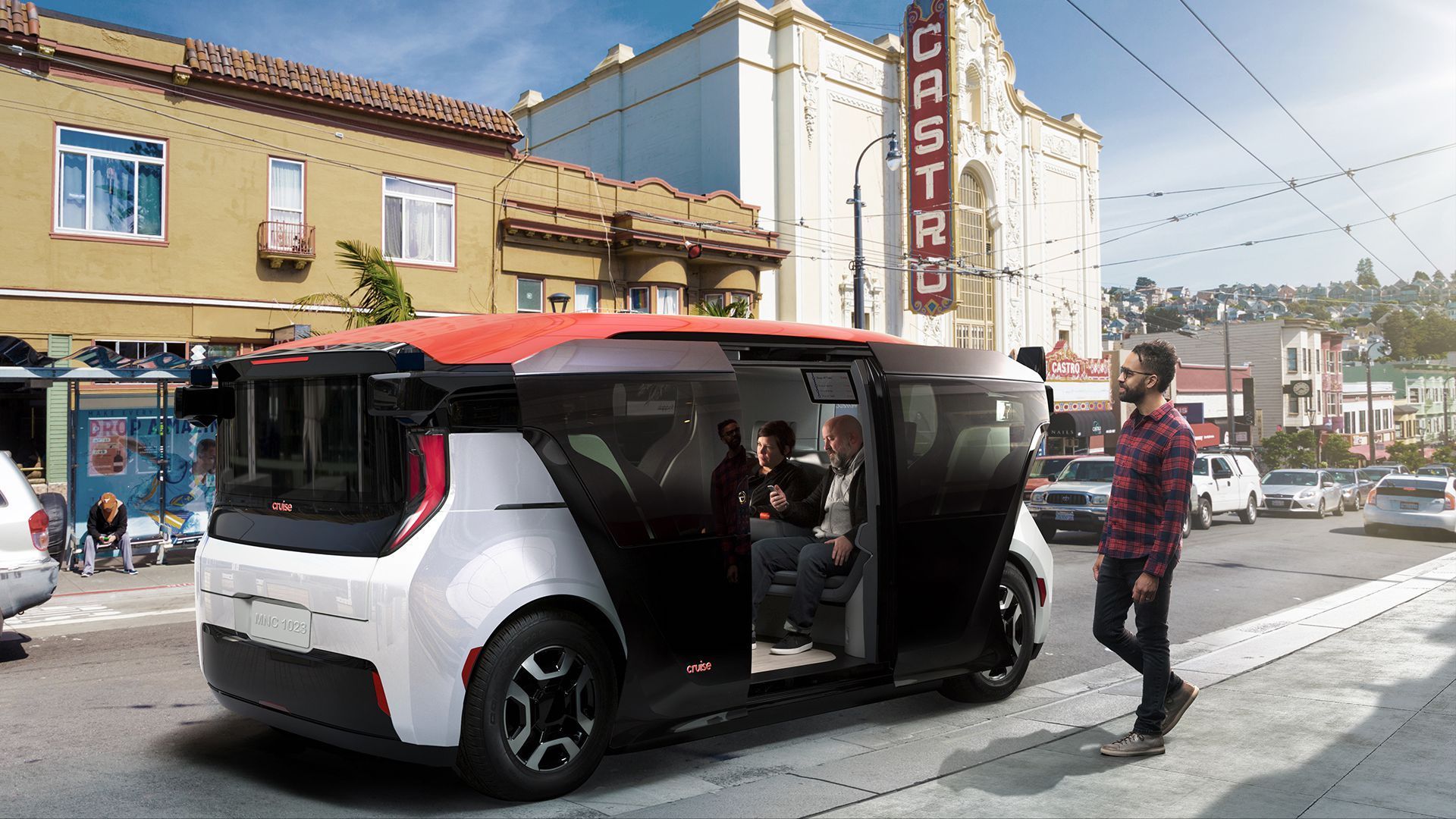
People will need to share electric robotaxis to avoid increased emissions, a study found. Photo: Cruise
A new study finds that electric, self-driving taxis might not be the answer to our climate problems that many people think, Axios' Joann Muller reports.
Why it matters: Transportation is the largest contributor to U.S. greenhouse gas emissions, which is one reason that the Biden administration is pushing for a rapid shift to electrification.
- But instead of reducing energy consumption and emissions that contribute to climate change, widespread deployment of electric robotaxis could exacerbate those problems, the joint Harvard-MIT study found.
What they're saying: “While electric vehicles themselves have lower emissions than traditional gasoline-powered ones, our work shows that deploying electric robocabs en masse on America’s streets could actually increase the number of trips, miles driven and overall emissions,” says Harvard law professor Ashley Nunes, the study's lead author.
How it works: By studying data from San Francisco, Nunes’ team concluded that the convenience of ubiquitous fleets of robotaxis would increase demand for rides, generating more trips and more vehicle miles traveled — erasing the electric vehicles' environmental benefits.
- To avoid worsening emissions, electric robotaxis would need to be 55% cleaner than today's EVs — or people need to stop riding solo.
- Without more renewable energy sources, as many as 75% of rides would need to be shared, up from 20% today.
What's needed: The researchers offered several policy recommendations, including:
- Clean up the electricity grid, using more renewable energy sources.
- Rather than subsidizing EV purchases, federal and state governments could offer discounts for ride-pooling.
4. Chart of the day: the power toll of drought


The latest monthly electricity report from the Energy Information Administration shows how persistent drought in western states has cut hydropower generation.
Driving the news: The most severe and widespread drought so far this century is gripping the West, with reservoir levels dwindling to the lowest on record in Lake Mead in Nevada and Arizona. Water is so low at the dam at Lake Oroville, Calif., that authorities shut off hydropower production there.
Details: At the start of the water year in September, 32% of the West was in “extreme” to “exceptional” drought, the two worst categories. That has now ballooned by a factor of two, with 64.16% of the region in those categories.
- June year-to-date hydro generation of 112,256-gigawatt hours for the western United States is 17% below the June year-to-date water year five-year average, the EIA found.
Context: Climate change is worsening the drought by raising temperatures and increasing evaporation.
5. Catch up fast: Arctic oil, coalitions, pipelines
Capitol Hill: "Congressional Democrats and their environmentalist allies are increasingly confident they’ll be able to stop drilling in the Arctic National Wildlife Refuge in the reconciliation process." (E&E News)
Diplomacy: "Denmark and Costa Rica are trying to forge an alliance of countries willing to fix a date to phase out oil and gas production and to stop giving permits for new exploration." (Reuters)
Transition: "The US oil and gas pipeline industry is looking for new opportunities to lay steel in the ground with pipes that carry the carbon dioxide produced when fossil fuels are burnt." (Financial Times)
Thanks so much for reading! Tell your friends to sign up for this newsletter here, and have a great Thursday.
Sign up for Axios Generate

Untangle the energy industry’s biggest news stories


