Axios Generate

July 09, 2025

🐪 Halfway there. We've got eyes on a high-profile Senate hearing later this morning, coal finance, OPEC strategy and more, all in just 922 words, 3.5 minutes.
🎸 This week in 1971, Funkadelic dropped the album "Maggot Brain," which burrows in with today's intro tune...
1 big thing: Don't coal it a comeback
Financial industry pledges to move away from coal haven't translated into reduced worldwide funding, per a new analysis from environmental groups.
Why it matters: Coal is the most CO2-intensive fuel, and its future trajectory will help dictate how much global warming occurs.
Driving the news: The report from German NGO Urgewald and other groups traces funding since the 2021 UN climate conference in Glasgow, Scotland.
- The summit featured many non-binding country pledges to phase down coal and major bank vows to wring CO2 out of their portfolios over time.
What they found: The analysis of 650 commercial banks worldwide, which explores finance for thermal coal production and coal-fired power, shows $130 billion in loans and underwriting in 2024.
- That's up from $123B in 2023 and similar to the $132B in 2022, the year after COP26.
- China was by far the biggest source of finance in 2022-2024 at $248B.
- The rest of the top five are the U.S. ($51B), Japan ($21B), Europe ($20B) and Canada ($12B).
The intrigue: A number of major banks — including U.S. giants — have been leaving various industry climate alliances.
- "Since this exodus, Citi is the only US bank with a public commitment to phase out coal financing," the report states, though it also finds Citi has increased financing since Glasgow.
- And Bloomberg reports that "after an initial flurry of action to pare back their financing, some banks have relaxed their coal restrictions in recent years."
Zoom out: The data comes as global energy demand is rising, bringing new consumption records across sources.
- "In 2024, oil, gas, coal, nuclear, hydro and renewable energy all registered increases, that is, all forms of energy saw an increase in demand[,] something that last occurred in 2006," per the recent Statistical Review of World Energy.
The bottom line: "It's as if Glasgow never happened," Katrin Ganswindt, Urgewald's director of financial research, said in a statement.
2. 🧁 Bonus: Coal's near-term global future
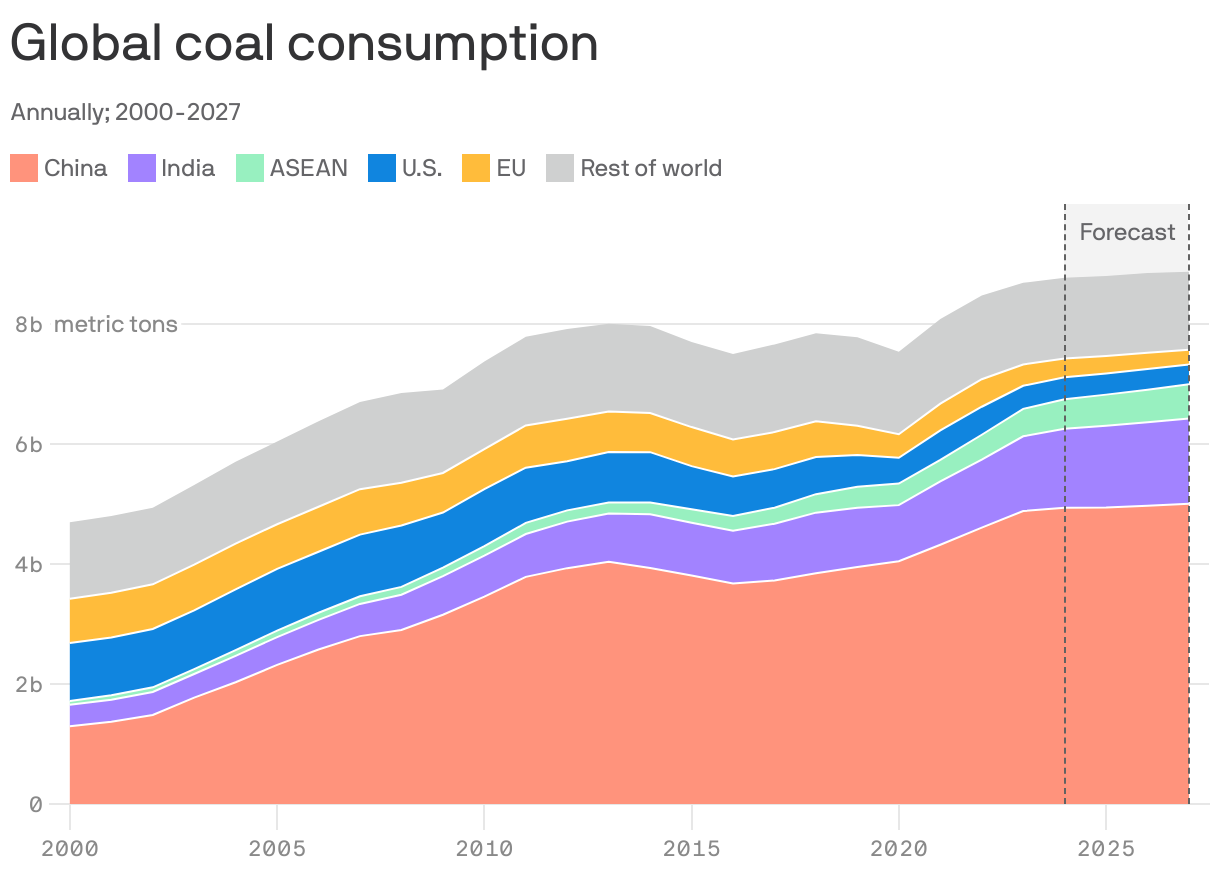
Coal demand is still rising — albeit more slowly — as consumption growth centered largely in China and India outpaces declines in advanced economies.
What's next: Global use might plateau through 2027 as renewables growth helps meet rising energy demand, the International Energy Agency projects.
- Coal plant development is slowing, per projects tracked by Global Energy Monitor.
3. 🌀 Trump's NOAA pick vows strong weather forecasting amid criticism
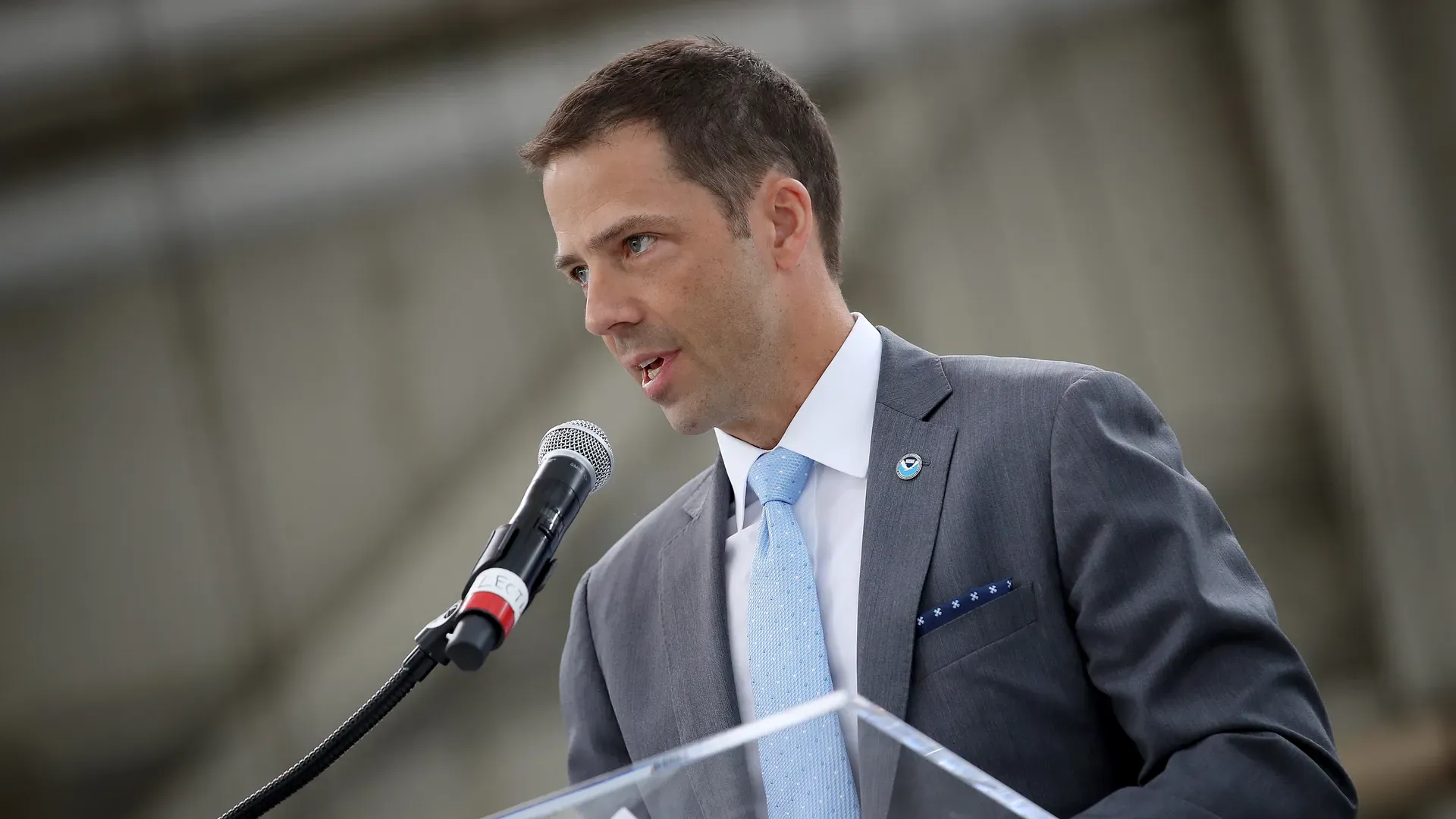
President Trump's pick to head NOAA — which includes the National Weather Service — will tell Congress today that he wants to make the U.S. a weather forecasting leader.
Why it matters: Neil Jacobs' nomination hearing arrives as Democratic critics wonder if NWS staffing reductions hampered performance in the deadly Texas flooding — and whether proposed budget cuts will hinder the very forecasting improvements he's vowing.
Driving the news: "If confirmed, one of my top priorities is to return the United States to the world's leader in global weather forecast modeling capability," he plans to tell the Senate Commerce, Science, & Transportation Committee today, per prepared testimony obtained by Axios.
- "As a matter of public safety, national security, and national pride, we will restore American technological superiority for this vital service for the country and our military serving around the world," it states.
- This requires new tech, "novel" approaches, and partnering with industry, it states.
The big picture: NWS issued multiple flood warnings and watches well ahead of the storm. But it faces questions about other aspects of the tragedy.
- Miami-based meteorologist John Morales said on X the vacancies did not impact the warning process, but may have affected coordination with emergency managers.
Friction point: Many meteorologists have defended NWS' performance.
- White House spokesperson Abigail Jackson, in a statement to outlets including Axios, called criticism of the NWS' action and funding cuts accusations "shameful and disgusting" and accused critics of seeking to politicize a disaster, Axios' Rebecca Falconer reports.
State of play: The Trump administration is proposing deep cuts to NOAA's fiscal year budget and nixing some research areas altogether, and the recently signed budget law rescinds some FY '25 funding.
What's next: Look for Democrats to question how budget cuts will affect the agency.
4. 🏃 Catch up quick on climate: Temps and DOE

🌡️ Last month was the third-warmest June in temperature records that date back to the 1800s, per Europe's Copernicus Climate Change Service.
- Stunning stat: "It was only the third month in the last 24 with a global temperature less than 1.5°C above the pre-industrial level," it found. And Western Europe had its hottest June on record. Go deeper.
💼 Via the NYT, "The Energy Department has hired at least three scientists who are well-known for their rejection of the overwhelming scientific consensus on climate change."
5. ⛏️ Mining number of the day: 32%
That's the share of global chip production projected in 2035 to rely on copper supplies that are at risk from climate-related disruption, up from 7% today, per a new PwC analysis.
Why it matters: Copper is a key input for semiconductors, and mines require lots of water that's at risk from drought, per the report. It offers advice on managing supply chain risk.
Stunning stat: "Processing copper ore from a single mine can consume enough water every seven weeks to fill an 80,000 seat stadium." Full report.
Go deeper: Copper prices hit record high after Trump previews 50% tariff
6. 🛢️ Quote of the day: OPEC+ strategy edition
"They're putting their barrels where their forecast is."— Bob McNally, president of Rapidan Energy Group, on OPEC+ accelerating the unwinding of production cuts
Why it matters: McNally tells Bloomberg the group doesn't share the market's pessimism about demand growth and macroeconomic weakness, and it has a more cautious view of non-OPEC supply growth.
- "They see a higher demand for their oil, and so far they've been right. The oil market is tight," he said. Full interview.
📧 Did a friend, colleague or an AI chatbot send you this newsletter? Welcome, please sign up.
🙏 Thanks to Chuck McCutcheon and Chris Speckhard for edits to today's edition, along with the brilliant Axios Visuals team.