Axios Generate

February 24, 2025


☕ Good morning. We're exploring the energy fallout of a tragic anniversary, and then we've got lots of news. Today's edition is 1,305 words, 5 minutes.
🚨 Situational awareness: Brookfield Asset Management is buying National Grid's onshore U.S. renewables business in a deal valued at $1.7 billion.
- National Grid has 1.8 gigawatts of U.S. solar, wind and storage assets in operation, and another 1.3 GW under construction. Go deeper.
🎸 This week marks 30 years since Blues Traveler released an infectious single that's today's intro tune...
1 big thing: How Russia's war on Ukraine reshaped the energy world

Russia's invasion of Ukraine upended global petro-flows — maybe forever — but the effects on the low-carbon transition are tougher to parse.
Why it matters: Today marks three years since the launch of the attack. Based on a mix of data and vibes, here are some big effects ...
🌏 Climate crosscurrents. There was plenty of chatter when the war started that it would speed energy transition in Europe and perhaps beyond.
- Yes, but: It also put the spotlight on U.S. LNG as shipments to Europe grew, while then-President Biden in 2022 urged U.S. oil producers to boost supply.
- Driving the news: The Atlantic Council's new global survey of energy experts — from industry, academia, government and more — is mixed on this question.
- What they found: 38% see the conflict slowing the process toward net zero, 31% see an accelerant, while the remainder see no effect. And just 25% see a major impact in either direction.
🗺️ It's a new map. Europe's efforts to shun Russian oil and pipelined gas have redirected shipments, deepening Kremlin energy ties with China and India.
- Zoom in: China's oil imports from Russia rose to 2.4 million barrels per day last year, per IEA data. India's increase has been stunning, rising from roughly 100,000 barrels per day in 2021 to roughly 2 million in 2023 and 2024, per IEA.
- State of play: Europe vastly curbed imports of gas from Russia, once its dominant supplier, thanks to cutting pipelined supply. LNG shipments from its eastern neighbor have risen, but overall Russia now has just a small fraction of its prior 40% share of European gas imports.
⚔️ Real but limited economic pushback on the Kremlin. Russia's "shadow fleet" of tankers has stymied the effects of oil sanctions and the G7-led price cap (we've got more in item 2).
- The big picture: Volumes have declined slightly, but Russian oil has been an "enduring" presence, said Landon Derentz, senior Atlantic Council energy analyst. The conflict has not deterred a "meaningful portion of Russian oil flows from reaching the market," he said.
What we're watching: U.S. talks with Russia over ending the war.
- U.S. Treasury Secretary Scott Bessent has raised the prospect of tougher oil sanctions to force talks, and easing restrictions as an incentive.
- Meanwhile, there's chatter about what once sounded far-fetched: resumption of large-scale Russian pipeline gas flows to Europe, which is grappling with high prices, if the war ends.
2. 💵 Russia's export cash persists, study finds
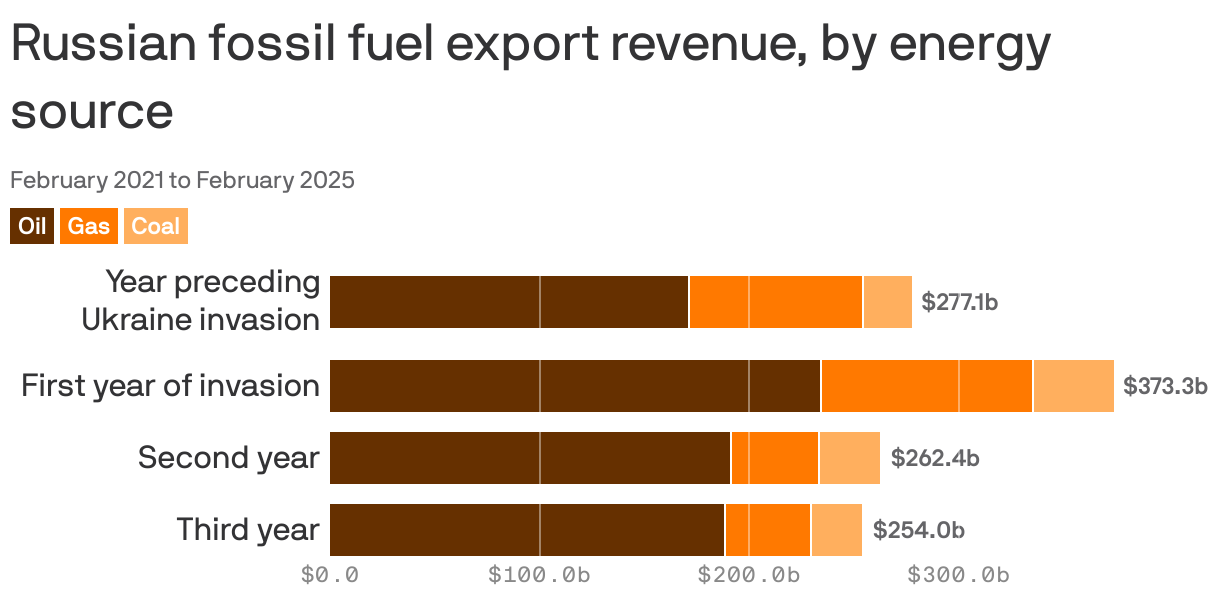
U.S. and EU sanctions have had just limited success crimping Russian's fossil fuel export revenue, a new analysis finds.
Why it matters: It's partly thanks to Russia's "shadow" fleet of oil tankers avoiding the G7 price cap, the Centre for Research on Energy and Clean Air said.
- But other factors are in the mix, like higher coal prices.
3. 🌀 Nvidia unveils AI weather forecasting advance
/2025/02/23/1740334051652.gif?w=3840)
A new, AI-based computer model could improve forecasting of hazardous weather by zooming in from national to local levels, according to its creator Nvidia.
Why it matters: The new model allows for more efficient and rapid simulations of upcoming weather at ultra-high resolution. This could help significantly improve forecasts, especially those in the short and medium range.
- AI-based forecasting is more efficient, can be done much faster, and generally doesn't require supercomputers.
Driving the news: A study on the model, known as "NVIDIA CoreDiff," and its capabilities was published today in the journal Communications Earth & Environment.
- The company says the model can capture extreme weather events, including ones that depart from historical records. This is important given climate change-related extreme weather trends.
- Nvidia claims CoreDiff is 500 times faster and up to 10,000 times more energy-efficient than traditional high-resolution weather prediction models.
The big picture: The model is one in a series of AI forecasting advances during the past few years that are poised to remake how weather and climate hazards are predicted.
- Nvidia may be best known for its chip-making business. But it, along with companies such as Microsoft and Google, have used the data-heavy challenge of predicting weather to explore and prove the superiority of artificial intelligence.
- Traditional forecast methods rely on slower, expensive and energy-intensive physics-based computer models. To generate forecasts, these models use hundreds of equations describing how the air, land and ocean function.
The intrigue: The new model is a generative AI model that allows for local-level forecasts of wind, temperature and precipitation type and amounts, the company said in a statement.
- The model takes coarse weather data from another simulation and zooms in on specific regions to reveal new details through generative AI, in a new way of conducting a process known as "downscaling."
4. 🤷 Agencies grapple with Elon Musk's blast email


The government-wide email sent Saturday evening to about 2.3 million federal employees elicited different responses from some departments dealing with climate and energy.
Why it matters: The confusion across the federal government created further tumult among an already beleaguered workforce going through personnel cuts, mission changes and downsizing.
Zoom in: At the Department of Energy, for example, management sent an all-hands email over the weekend instructing staff to await further guidance.
- Then yesterday evening, Energy Secretary Chris Wright sent an email directing staff to pause any replies. The email stated the department would rely on established performance reviews and send a "coordinated" response.
- At NOAA, which is a top global climate and weather forecasting agency, staff at most of its divisions were told to prepare a response to the email that originated with DOGE's Elon Musk.
- However, employees were instructed not to send a response yet but to await further guidance from NOAA leadership or top management at the Department of Commerce, which houses the agency.
Yes, but: One NOAA arm, the National Weather Service, did tell its workers that it had authenticated the OPM message and to go ahead and reply after discussing it with their supervisor.
Zoom out: Other agencies, such as the FBI and Defense Department, also opted to rely on their own performance management standards.
5. 🏃Catch up quick: IRA, IEA, China

💵 Seventy-seven percent of $524 billion in pending U.S. investment in "clean" energy projects is slated for GOP congressional districts, a new analysis finds.
- Why it matters: Supporters of the IRA, which helps drive investment, hope money flowing into red states will make the law more durable.
- Driving the news: The latest data from Rhodium Group and MIT analysts tallies planned spending on projects announced or under construction. Full report.
🛢️ The International Energy Agency may revive projections based only on nations' "current policies" as it crafts its next long-term global outlook, the agency said.
- Why it matters: The move comes amid GOP criticisms that IEA is downplaying the persistence of fossil fuel demand. In recent years even its most conservative model weaves in "announced" policies.
- State of play: IEA's modeling team is in the "early stages" of crafting the next "World Energy Outlook" due in late 2025, the agency said. "As always, it will include a range of scenarios, and the Current Policies Scenario is one of those under consideration," it said (h/t Bloomberg).
- What we're watching: Whether IEA's potential move softens Republicans' plans to pressure the multilateral agency, including its funding.
🇨🇳 President Trump is demanding stronger federal steps to thwart Chinese investment in the U.S. — including holdings in energy and minerals.
- State of play: His new memo vows use of "use all necessary legal instruments," notably the Committee on Foreign Investment in the U.S. (CFIUS), which vets foreign investment for security concerns.
- What we're watching: The wider memo on investment policy vows expedited environmental reviews for proposals over $1 billion.
6. 🧮 Number of the day: $7 trillion
That's how much transmission grid companies must invest through 2050 to decarbonize global power networks, per new Boston Consulting Group estimates.
Why it matters: It's far above current amounts.
- But power companies face hurdles, like the need to avoid offloading big costs on customers, and supply chain constraints, per the report that offers strategy advice.
- Full analysis
📧 Did a friend, colleague or an AI chatbot send you this newsletter? Welcome, please sign up.
🙏 Thanks to Chris Speckhard and Chuck McCutcheon for edits to today's edition, along with the brilliant Axios Visuals team.