Axios Generate

March 27, 2024

🐫 Happy Hump Day, readers!
Today's edition brings you the best of all worlds: A new energy buzzword, best practices in climate tech, and even a vacation dispatch (of sorts) from Andrew. All that in 1,139 words, 4.5 minutes.
🚨 Situational Awareness: Treasury Secretary Janet Yellen is expected to travel to a solar cell plant in Norcross, Georgia. In prepared remarks, she takes China to task for "overcapacity [that] distorts global prices and production patterns and hurts American firms and workers, as well as firms and workers around the world."
🎼 Today's song is a banger that's guaranteed to power you through happy hour (thank you, Nick and Valerie)...
1 big thing: Unstoppable force, immovable object
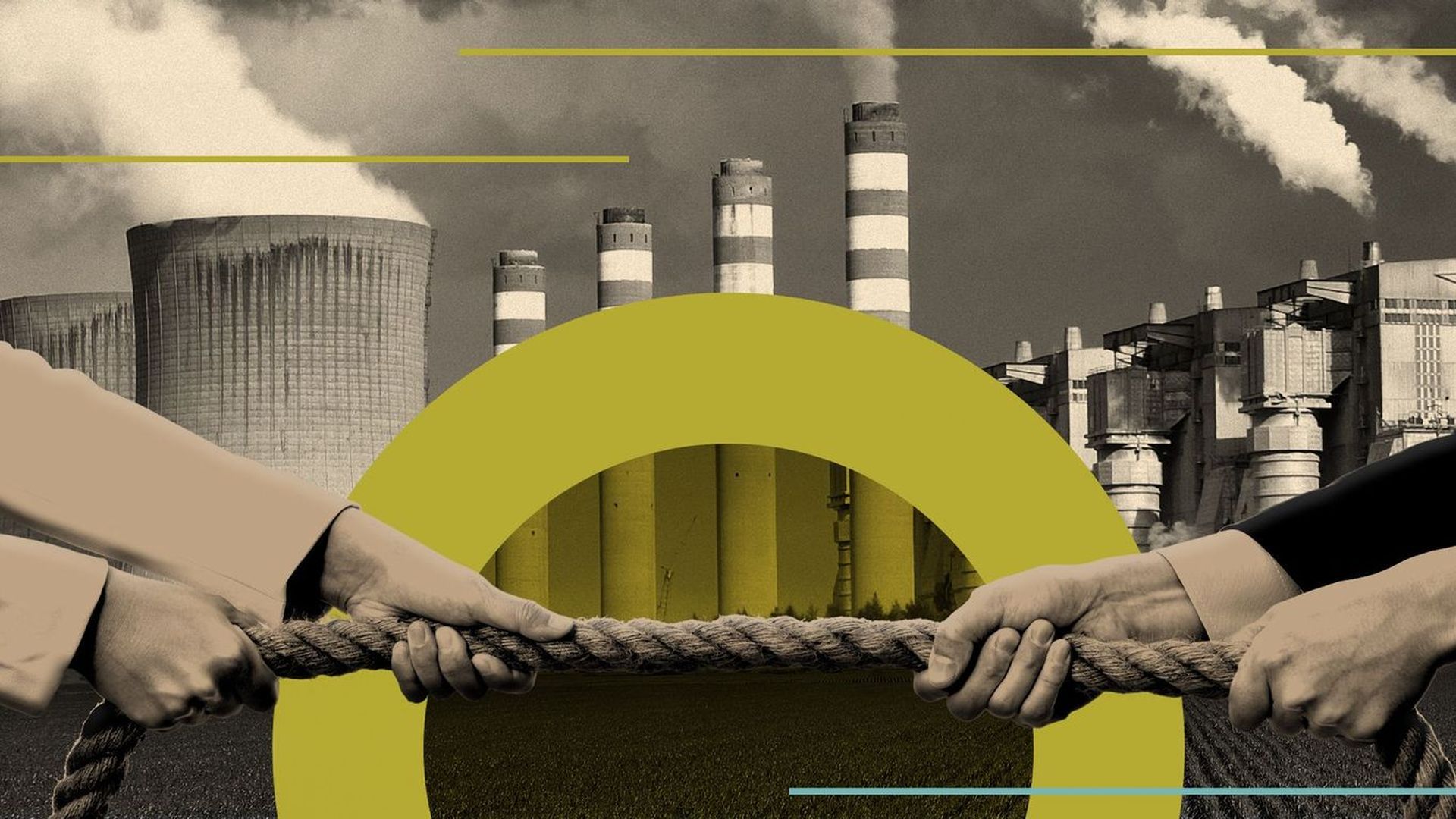
Illustration: Gabriella Turrisi/Axios
In his yearly dispatch to shareholders, BlackRock CEO Larry Fink waxed eloquently about the world's efforts to decarbonize — with nary a mention of the politically charged "ESG" moniker that's drawn scorn from right-leaning politicians and investors.
Why it matters: The unfolding energy transition isn't happening as quickly as some would like. And the subtext of Fink's letter yesterday contained a reality that can be summed up fairly succinctly, Javier writes.
- Decarbonization is a near-unstoppable force;
- Renewables are great but don't always get the job done. That's why fossil fuels (and lots of them) — or something that can satisfy the world's implacable demand for energy — are still very much needed.
Context: Fink's pragmatic view helps explain the tone at CERAWeek in Houston last week, where oil and gas executives sought to temper expectations that a timetable to a carbon-free future would unfold rapidly.
- Even as wind and solar displace coal, voracious energy needs will continue to drive up demand, the Rhodium Group wrote in February, as economies continue to expand.
- But "in the absence of additional policy or technology innovation, fossil fuels will continue to supply a substantial share of global energy demand by mid-century— 33 to 44% in our likely range — relative to 67% today," the firm added. [Emphasis mine]
What he's saying: Fink cited both Germany and Texas — both power users of wind and solar — as prime examples of the limits confronting the energy transition.
- "[S]ometimes the wind doesn't blow in Berlin, and the sun doesn't shine in Munich. And during those windless, sunless periods, the country still needs to rely on natural gas for 'dispatchable power,'" the CEO wrote.
- Meanwhile, "without an additional 10 gigawatts of dispatchable power, which might need to come partially from natural gas, [Texas] could continue to suffer devastating brownouts," he adds.
The bottom line: Current needs and future demand — especially in light of the gathering storm of artificial intelligence computing — will need to be satisfied.
- But barring a dramatic technological leap in renewables or alternative fuel sources in the near term, the only thing that can get it done at scale is oil and gas.
2.🌪️ The cost of Mother Nature's wrath: $280B

Illustration: Tiffany Herring/Axios
Global losses from natural catastrophes in 2023 amounted to about $280 billion, Andrew writes.
Why it matters: A new Swiss Re Institute report warns that global insured disaster losses are sharply increasing, and climate change is a small but growing driver.
Driving the news: About 38%, or $108 billion, of the total were insured losses, and this category is growing rapidly, the reinsurance giant found.
- During 2023, which was the planet's hottest year since the start of modern instrument data, there were a record high 142 natural catastrophe events, Swiss Re notes.
- Losses from severe thunderstorms, including their hazards such as large hail and high winds, also set a new high, at $64 billion, and much of these costs were incurred within the U.S.
- Overall, natural disaster insured losses have increased at a faster rate than the global economy during the past three decades, the report found, and it expects this to continue.
- The insured loss burden has more than doubled between 1994-2023, Swiss Re found, and it projects the next doubling to take place within just the next decade.
Between the lines: The summary of natural disaster losses during 2023, along with recent trends, notes that while climate change is increasingly affecting certain types of extreme weather events, such as hurricanes and extreme precipitation events, it is not the primary cause for rising costs.
When combined with other research from Swiss Re, it becomes clear this disaster loss burden will be unevenly distributed worldwide, with countries with the most at-risk assets, and greatest exposure to climate change-linked perils, likely to be hit the hardest.
What's next: According to Swiss Re, which along with its competitors has long been sounding the alarm on climate change, it won't be enough to simply raise the costs of insurance to compensate for more loss expenses.
- This will simply price too many people out of insurance markets, as is already being seen in Florida, Louisiana and California.
3. 🥁 Keeping the "drumbeat" on climate solutions

Scott Tierney. Photo illustration: Tiffany Herring/Axios; Photo: Courtesy of Valo Ventures
There's a woeful lack of investment in climate tech adaptation, writes Axios Pro: Climate Deals' Katie Fehrenbacher.
Why it matters: Climate change is already happening, and a warmer world will need new types of infrastructure and services.
Catch up quick: Scott Tierney is a partner with venture firm Valo Ventures, and co-founder of Google's growth fund CapitalG.
Katie's interview with Scott was lightly edited for clarity.
What in your view has been the biggest news in climate tech investing so far this year?
- "We've got thousands of business leaders, policymakers and investors headed to Houston for CERAWeek, the largest annual energy conference, and it happened in a state that just experienced its largest wildfire with over a million acres in the Smokehouse Creek Fire.
- With the continuing evidence of climate change, it's important that we keep the drumbeat on to accelerate the digitization, decarbonization and adaptation."
What would you add to the narrative?
- "We're woefully under-invested in adaptation, and I expect this will become an increasing area of time, attention and focus.
- The expectation is that we're going to have a lot more outages. I worry that that's going to create a public backlash against the energy transition.
- We're very focused now on carbon-free firm power, and the best sources for firm power are nuclear small modular reactors and next-generation geothermal."
🔓Unlock the full story — and a steady diet of scoops and smart analysis — by talking to our sales team about Axios Pro: Climate Deals.
4. Catch up quick

Illustration: Lindsey Bailey/Axios
🌬️ Ørsted has the wind at its back, thanks to the Department of the Interior's approval of a 924 MW wind farm off Long Island's coast.
- The details: Located 30 miles east of Montauk (or 'The End,' as we Long Islanders call it), the Sunrise Wind project is expected to be the largest offshore wind project in the U.S. once completed.
- Zoom in: It will have the capacity to juice hundreds of thousands of N.Y. homes, will bring $700 million in investments to Suffolk County, and will create 800 jobs, according to the company.
🔌 Veir is preparing to raise at least $50 million to replace strained power lines with high-capacity superconductors, CEO Tim Heidel tells Axios Climate Deals' Alan Neuhauser exclusively.
- Why it matters: Upgrading existing grid infrastructure is one of the only ways to meet surging energy demand.
- Big picture: Power-hungry data centers are driving an explosion in energy consumption.
5. 🏠 Quote of the day
"High interest rates are disastrous for US climate goals, as capital-intensive clean energy projects benefit from lower financing costs and are penalized by higher rates."— Joe Webster, a senior fellow at the Atlantic Council's Global Energy Center, in a new analysis explaining why the housing crisis is a drag on the climate transition.
📫 Did a friend send you this newsletter? Welcome, please sign up.
🙏 Thanks to Chris Speckhard and Javier E. David for edits to today's edition, along with the brilliant Axios Visuals team.
Sign up for Axios Generate
Untangle the energy industry’s biggest news stories