Axios Future of Mobility

June 25, 2025

Guess what? Today's my birthday! 🎂
- 💰 I'm old enough to remember when Detroit automakers were making money hand over fist in China.
- 🎁 My gift to you is a deep dive into why that's no longer the case, how Chinese cars became the new benchmark — and what companies are doing to compete.
1,780 words, a 7-minute read.
1 big thing: Chinese cars are the ones to beat
The spectacular rise of China's auto industry — seemingly overnight — has rattled industry leaders and policymakers, catching many off guard.
- The big question is, how did the U.S. fall behind so quickly?
- In fact, the seeds were sown decades ago when companies like General Motors, Ford and Volkswagen shared their technology with Chinese partners in order to gain access to that growing market.
Why it matters: Now China makes cars more efficiently than everyone else, and there's a dawning realization across the industry that China's ascendance is both an existential business threat and a national security risk.
The big picture: Disruption is nothing new for automakers, but they've never had to contend with the mountain of complex issues they face now — tariffs, geopolitical tensions, shifting regulations, broken supply chains, artificial intelligence, electrification.
- The emergence of powerful Chinese rivals, though, is a more ominous and permanent threat, experts agree.
- Inside China, foreign automakers' combined share of car sales has collapsed, from 76% in 2010 to 33% today, as consumers gravitate toward domestic brands.
- Everywhere else in the world — except the U.S. — brands like BYD, Geely and Chery are expanding, opening super-efficient factories and selling hybrids and EVs at prices no one else can touch.
- Now China makes 70% of the world's EVs and plug-in hybrids.
Yes, but: China's auto industry has gotten so big, and so competitive, "it's starting to implode on itself" under the weight of aggressive price cutting, warns Bank of America analyst John Murphy.
- If that happens, he said, China could lean more heavily on other markets, including North America, ahead of a likely consolidation.
What they're saying: "The Detroit Three (GM, Ford and Stellantis) used to think of China as their playscape — a land of endless growth and profits. Not anymore," China auto expert Michael Dunne, CEO of Dunne Insights, tells Axios.
- "When it comes to China, Detroit has shifted 180 degrees from full-tilt offense to a panicked defense."
Between the lines: Chinese carmakers have a 30 to 40 percent economic advantage over their competitors, says Terry Woychowski, president of benchmarking analysis firm Caresoft Global.
- They're more vertically integrated than traditional automakers, producing most components in-house, for example. They also use common parts across more vehicles, enabling lower prices.
- Government support — loans, land and incentives — surely helps, as well.
- Chinese carmakers received $231 billion in government subsidies between 2009 and 2023, according to the Alliance for Automotive Innovation, which represents the U.S. industry.
What to watch: Automakers have responded to the challenge in a variety of ways.
- Keep driving down costs. Tesla, for example, is developing a more affordable version of the Model Y and aims to reduce production costs by at least 20%, per Reuters.
- Partner with the enemy. Volkswagen bought a stake in XPeng and Stellantis invested in Leapmotor to develop EVs.
- Buy the rights to Chinese technology. Ford licensed battery tech from China's CATL to develop a low-cost EV platform in the U.S. (Read more below)
- Cut your losses. GM restructured its primary joint venture in China, taking a $5 billion write-off. It's also deepening ties with Korean partners, including Hyundai, while investing in a vertical battery supply chain outside of China.
2. How China outsmarted the world's carmakers
China didn't take over the auto industry by accident.
Flashback: In the late 1990s, the Chinese government allowed foreign automakers to enter its emerging market if they formed a joint venture with a Chinese partner and gave them at least 51% control.
- In retrospect, it might sound risky, but at the time, China's car market was just taking off and the opportunity was too good to pass up.
- For years, the JV structure proved beneficial for both sides — Western carmakers pocketed billions of dollars selling cars to China's growing middle class, and fledgling Chinese carmakers got to learn from the world's best.
- Then, in 2015, China introduced a sweeping industrial plan, "Made in China 2025," to upgrade its industrial base across various sectors, with "new energy vehicles" (NEVs) as a core pillar.
- China spent the next decade lining up battery supply chains, including raw materials and processing, and perfecting its capabilities in vehicle engineering and manufacturing.
"Imitate, improve and increase" are three words that sum up China's strategy, according to Caresoft's Woychowski, whose company specializes in dismantling cars down to their smallest bits for benchmarking purposes.
- A textbook example, he said, is the XPeng G6, which at first glance could be mistaken for a Tesla Model Y.
- In 2022, Tesla stunned the industry by introducing a manufacturing process that used die-casting to produce large sections of the Model Y in a single piece, eliminating hundreds of welded parts. That saved labor, weight and engineering costs.
- A year later, when XPeng launched the G6, it had already improved upon Tesla's giga-casting innovation.
- Compared to the Model Y, said Woychowski, "they are much more refined castings. They are thinner, they are smaller, they are lighter, they are less expensive and they're stiffer."
The bottom line: Chinese efficiency is the industry's new benchmark.
- Tesla CEO Elon Musk warned Chinese carmakers as so good they "will pretty much demolish" the rest of the industry.
- Or as Ford CEO Jim Farley says: "Everyone talks about how good they are or how cheap they are. What they should be talking about is how fast they are."
3. Ford defends using Chinese tech
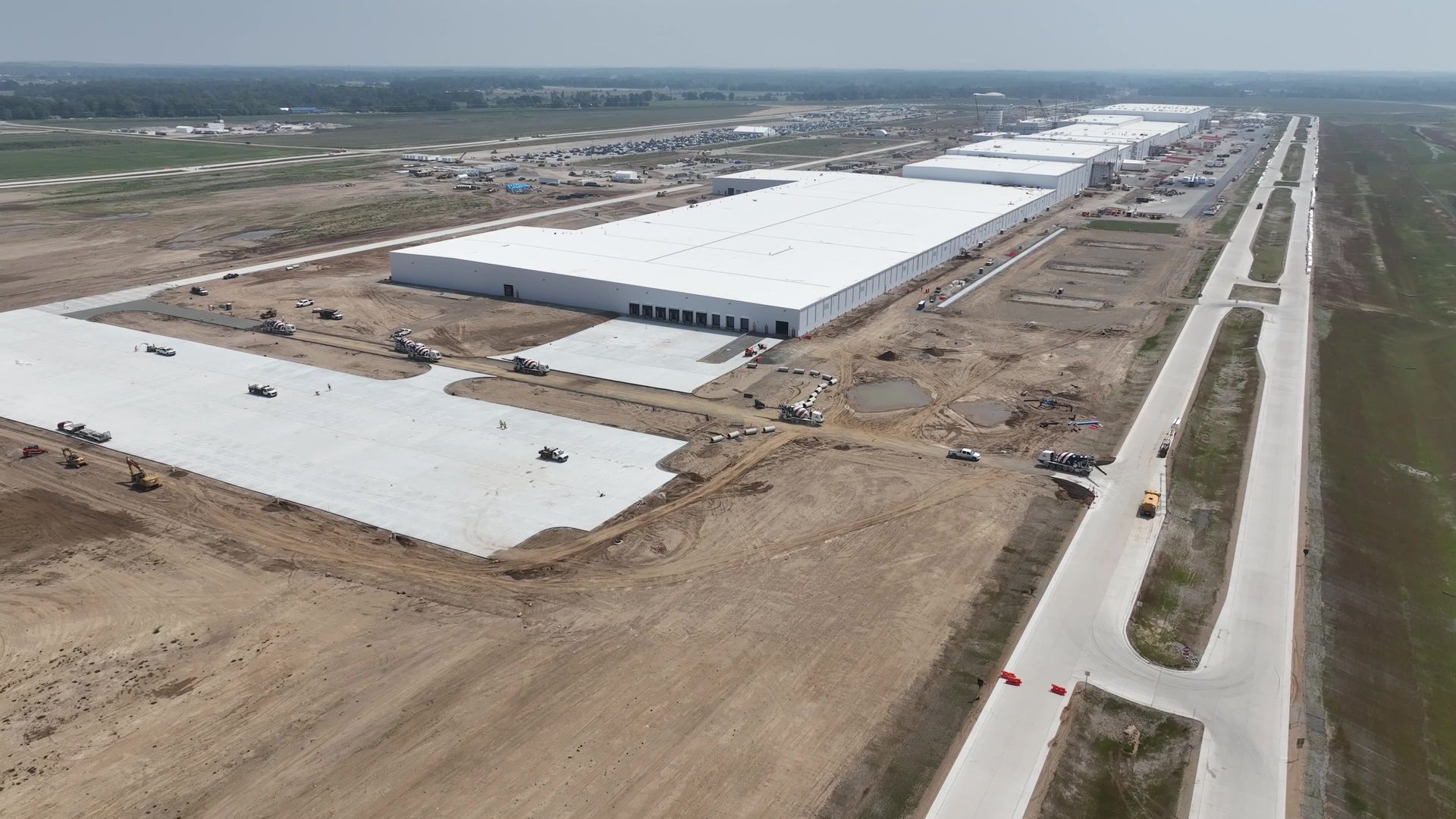
There's some logic in Ford's argument that licensing Chinese battery technology will help the United States catch up faster to its rival.
Why it matters: Ford has faced political blowback since its 2023 decision to build a battery factory in Michigan using CATL's technology. Now, lucrative Biden-era tax subsidies that made the project financially feasible are at risk, too.
Driving the news: Ford earlier this week showed off progress on the plant, about 100 miles west of Detroit, and said it will move ahead regardless of looming policy changes in Congress.
- The Republican-controlled Senate could vote this week on a budget bill that would rewrite policies incentivizing EV production.
- An earlier House version effectively killed the battery production tax credits that would offset nearly one-third of Ford's $3 billion investment.
Between the lines: Ford defends its decision to license LFP battery technology from CATL, because it will accelerate the reshoring of manufacturing expertise long ago ceded to China.
- "We're creating jobs with technology we need to complete globally. We need to learn to do it by ourselves," Lisa Drake, Ford's vice president of technology platform programs and EV systems, tells Axios.
- It will also allow Ford to further improve LFP batteries, she said.
- "It's hard to innovate something when you've never seen it with your own eyes. That's why we need to bring it here."
- "I'm convinced this is the right thing to do for the United States," she said.
The big picture: Lithium-iron-phosphate, or LFP, batteries are less expensive than those containing nickel and cobalt, which is why they're key to making EVs more affordable. They're also ideal for backup energy storage.
- LFP batteries were invented in 1997 at the University of Texas, but, as often happens with U.S.-developed technology, they ended up being industrialized in China during the 2010s.
- Chinese companies like CATL and BYD invested heavily in R&D to improve LFPs, and now China controls most of the patents and manufacturing know-how.
- "It probably would have taken us a decade to catch up and have LFP technology on our own, with our own R&D," Drake told reporters during a tour of the plant this week.
- "If Ford has capital, we want to spend our investment creating the manufacturing jobs here."
What to watch: The Michigan-made batteries will be used in a new line of affordable Ford EVs coming in 2027 and beyond.
4. Exclusive: Beep gets AV transit deal in Jacksonville
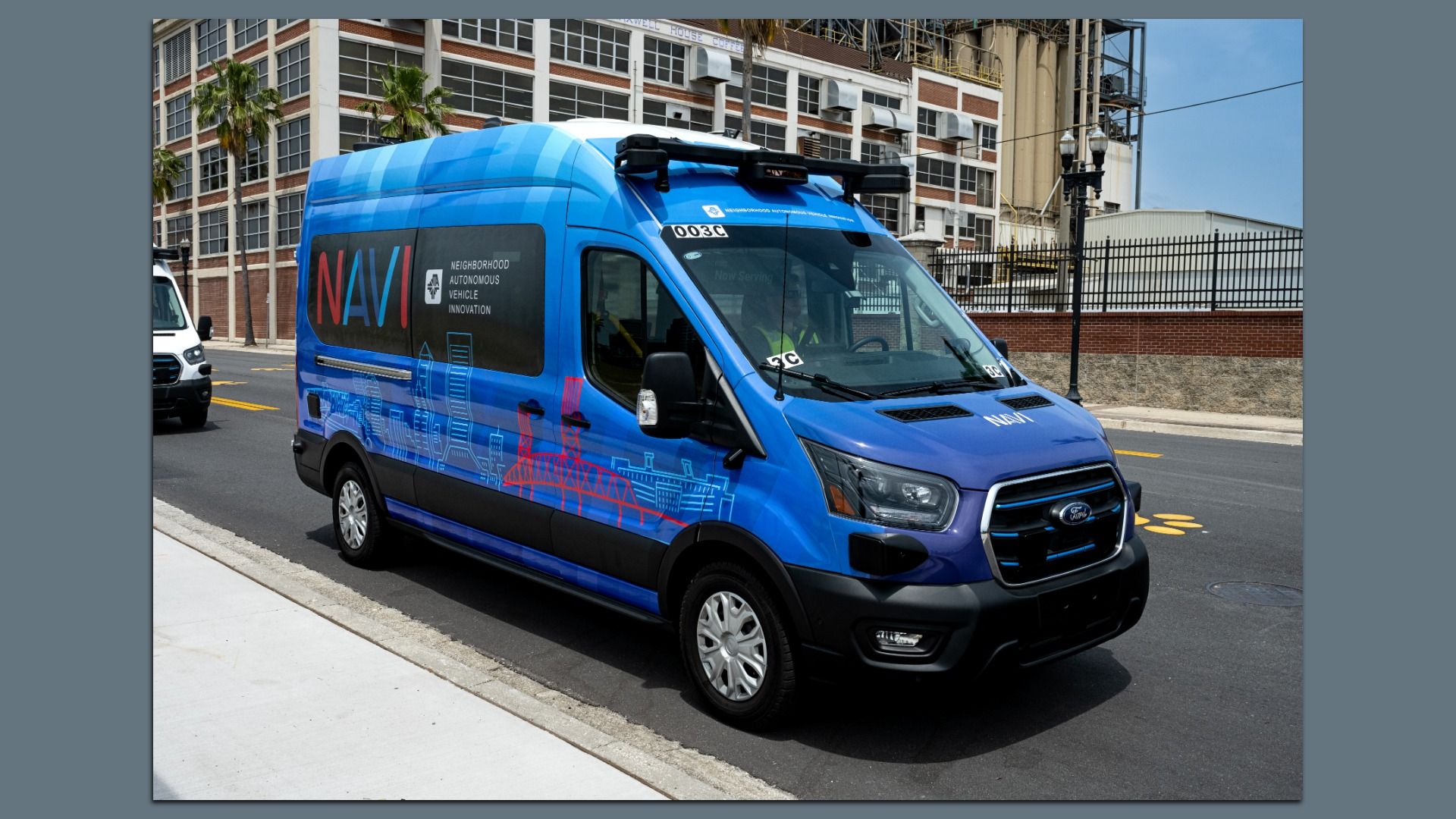
Beep, a shared mobility startup, is unveiling a new autonomous public transit system in Jacksonville, Florida, next week, Axios is first to report.
Why it matters: NAVI, short for Neighborhood Autonomous Vehicle Innovation, is the nation's first fully autonomous public transit system, according to Beep.
Zoom in: Beep will operate the urban circulator service under a $36 million contract awarded by the Jacksonville Transportation Authority.
- It includes a fleet of 14 Ford eTransit vans integrated with Oxa's automated driving technology.
- A safety operator will be in the driver's seat in case of emergency, Beep cofounder and newly appointed CEO Kevin Reid tells Axios.
- Each of the ADA-compliant vans is equipped with a ramp for wheelchair passengers.
Between the lines: The Jacksonville transit system represents a new level of maturity for Beep, which has previously deployed 38 AV pilot programs across nine states.
- The route will cover 13 stops across a 3.5-mile route, connecting key parts of downtown Jacksonville, from the Central Business Core to the Sports and Entertainment District, in an effort to encourage downtown revitalization.
- In the future, Beep will go further into Jacksonville's neighborhoods and offer more on-demand rides, Reid said.
Related: Beep just raised $53 million in a funding round co-led by Intel Capital and Blue Lagoon Capital.
- The new financing brings Beep's total capital raised to $98 million, and will be used to expand further into key markets.
5. Drive-thru
Catching you up on news you might have missed ...
⚠️ Tesla's long-awaited robotaxi service began last weekend in Austin, Texas, but some videos posted online by early riders raise questions about unsafe behavior. NHTSA says it is looking into it. (Axios, CNBC)
- The federal safety agency is also questioning Ford about its BlueCruise hands-free driver-assistance system as part of its yearlong investigation of two fatal crashes involving the software. (TechCrunch)
🚖 Waymo robotaxis are now available on the Uber app in Atlanta. (Axios)
⚖️ A federal judge ordered the Trump administration to release billions of dollars in funding for the build-out of electric vehicle chargers in more than a dozen states. (AP)
6. What I'm driving: 2025 Infiniti QX80
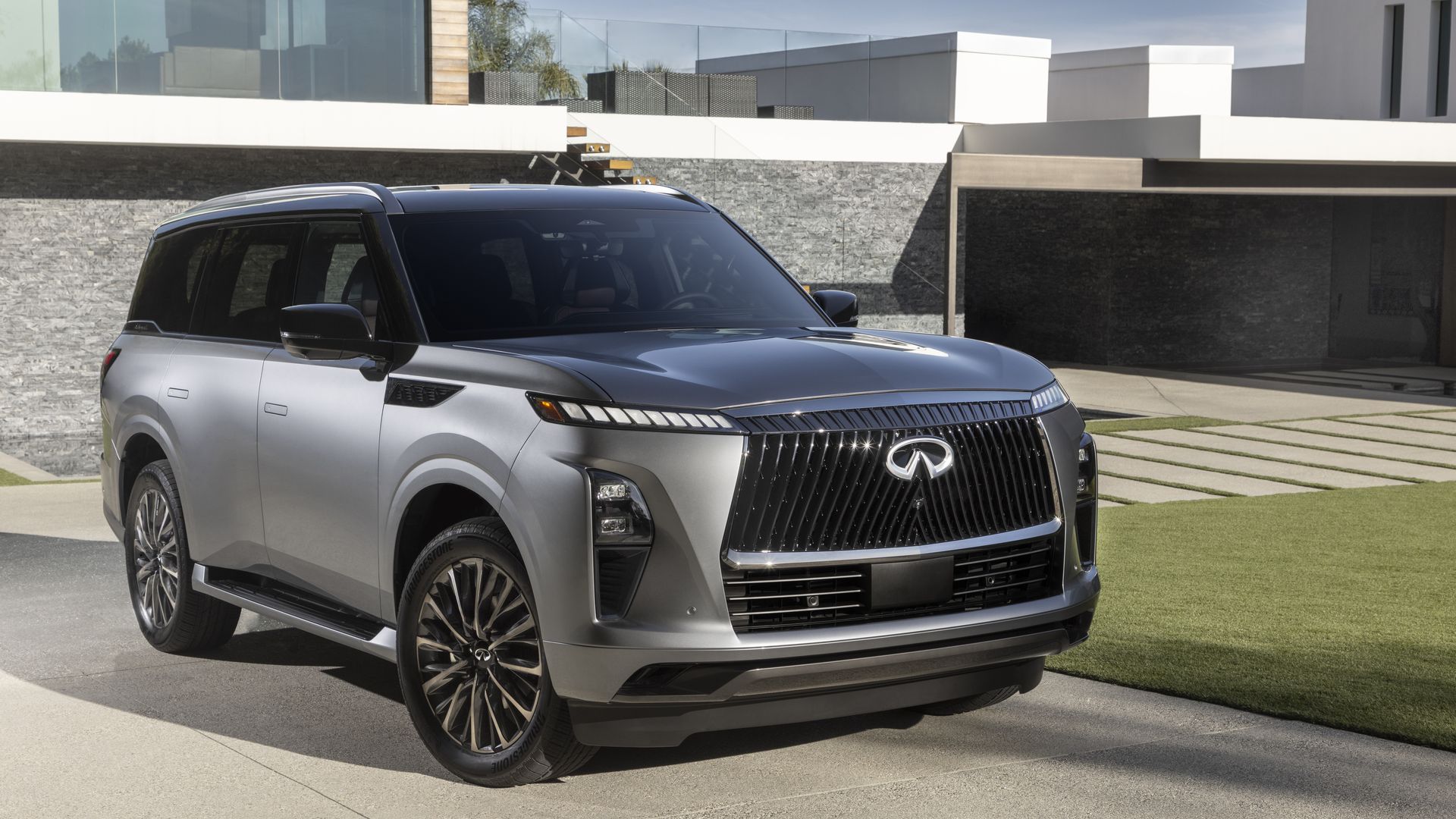
This week, I was going to review Infiniti's QX80, the first new model in the Japanese luxury brand's product renaissance, but I ran into some issues with the car I was given to test drive.
- The company says they're looking into them; I'll withhold judgment until I'm confident it looks and behaves like a $113,000 luxury SUV should.
I test-drive vehicles in my role as a juror for the North American Car and Truck of the Year awards. Opinions are my own.
Thanks for reading! Please encourage your friends and colleagues to sign up.
Thanks to Ben Berkowitz and Bill Kole for editing.
Sign up for Axios Future of Mobility