Ford plows ahead on EV battery factory amid political storm

Add Axios as your preferred source to
see more of our stories on Google.
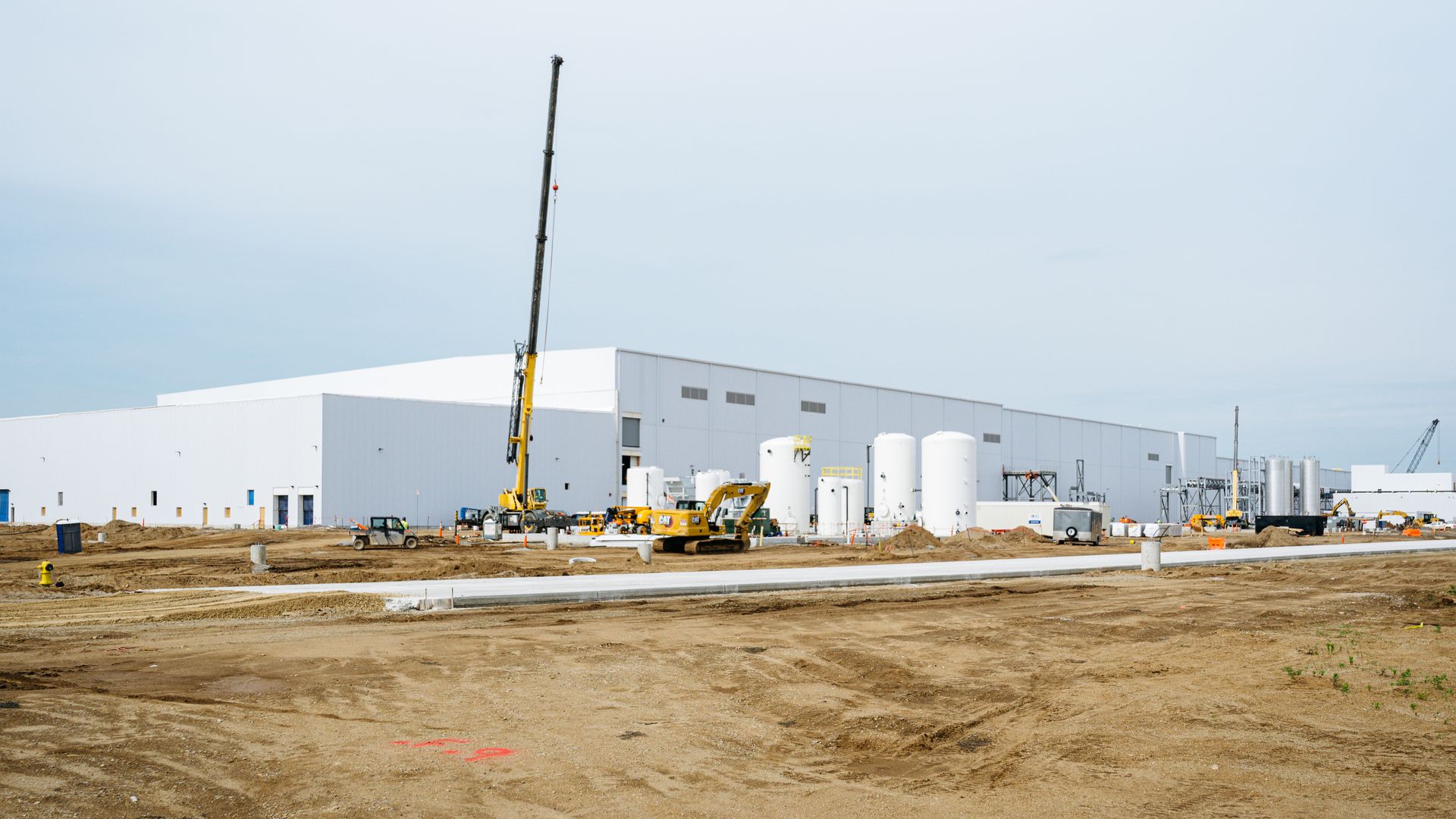
Ford BlueOval Battery Park in Marshall, Michigan. Photo courtesy of Ford
Ford Motor is pushing ahead with a politically controversial battery factory in Michigan, even as Congress moves closer to eliminating the lucrative Biden-era tax subsidies that made the project financially feasible.
Why it matters: Ford's argument is that by building batteries using technology licensed from China's leading battery producer, CATL, it is helping to re-shore important manufacturing expertise that was long ago ceded to China.
Driving the news: Ford on Monday gave reporters a tour of the 60%-complete factory in Marshall, about 100 miles west of Detroit.
- The stated objective was to provide media access to the plant before "clean room" equipment is installed and tours would be off-limits.
- But Ford clearly wanted to also show off its $3 billion commitment to the facility ahead of an expected Senate vote this week on a budget reconciliation bill that could wipe out many electric vehicle incentives provided under the 2022 Inflation Reduction Act.
Zoom in: Consumer tax credits for EV purchases get the most attention, but for manufacturers, the far more lucrative incentives come in the form of production tax credits.
- Companies could receive a tax credit of $35 per kilowatt-hour for each U.S.-made cell, and another $10 per kilowatt-hour for each battery pack.
- With an annual production capacity of 20 GWh, Ford's battery plant could potentially receive a $900 million tax credit, offsetting almost one-third of its investment.
The big picture: In the quest to make more affordable electric vehicles, lithium-iron-phosphate batteries have emerged as a reliable, cost-effective solution.
- LFP batteries were invented in 1997 at the University of Texas, but, as often happens with U.S.-developed technology, they ended up being industrialized in China during the 2010s.
- Today's China's Contemporary Amperex Technology Co., Limited (CATL) is the world's leading manufacturer of LFP batteries.
- Ford wanted to use cheaper LFP batteries in its next-generation of EVs, but didn't have the technology, so it made the decision to license CATL's intellectual property in order to be globally competitive.
What they're' saying: "LFP batteries are produced all around Europe, and the rest of the world," said Lisa Drake, Ford's vice president of technology platform programs and EV systems.
- "How can we compete if we don't have this technology? Somebody has to take the lead to do this," she said, adding that it will lead to homegrown innovation and the seeding of a domestic supply base.
- "I'm convinced this is the right thing to do for the United States," she said.
Between the lines: Drake said the tax subsidies are even more important in the face of slower-than-expected EV demand.
- "When EV adoption slowed, it just became a huge headwind," she said. "The [production tax credit] allows us to keep on this path, and to keep going."
- "We don't want to back off on scaling, hiring or training in an industry we need to be competitive in the future," she said.
- "It would be a shame to build these facilities and then have to scale back on the most important part of it, which is the people. These are 1,700 jobs. They don't come along very often."
Where it stands: The Republican-controlled Senate could vote as early as Wednesday on a budget bill that would rewrite language around EV tax credits.
- A House version of the bill passed last month effectively killed the production tax credits for manufacturers by severely tightening the eligibility requirements.
- It also specifically prohibited credits for batteries made in the U.S. under a Chinese licensing agreement — a direct hit on Ford.
What to watch: A Ford spokeswoman said that draft language in the Senate version appears to be "more workable."
The bottom line: Nothing's certain until the two chambers agree on something.
