Axios Future of Mobility

May 07, 2025

π± Hey Wednesday! Today we're diving into the software conundrum for carmakers. Why can't the digital experience in your car be as seamless as your phone?
1,400 words, a 5.5-minute read.
1 big thing: Cars aren't smartphones
The digital transformation of the auto industry has hit a speed bump: Slower-than-expected electric vehicle adoption has delayed the rollout of intelligent, software-defined vehicles.
The big picture: Automakers are forecasting billions of dollars in recurring revenue from software and services that improve over time through constant updates.
- That requires a next-generation electrical architecture β think of it as the car's brain β to handle everything from ride dynamics and safety functions to the in-car experience that consumers want.
Automakers dream of being more like Apple, with an elegant operating system like iOS that enables the same digital experience across all their vehicles.
- Tesla and other EV startups already have such platforms, and they regularly send software updates to add features or improve performance.
- But they had an advantage: Their modern cars were designed from scratch.
- Legacy automakers are saddled with complex software networks cobbled together from more than 100 electronic control units that manage specific functions like braking or infotainment.
- Even minor software updates are a hassle with such a fragmented system.
The shift to electric vehicles seemed like the ideal time for many automakers to toss out those antiquated architectures in favor of a Tesla-like approach.
- Many companies who yoked software modernization to their EV development plans, however, are now thinking better of it.
Driving the news: Ford recently pulled the plug on an ambitious next-generation software project, deciding instead to pour those efforts into improving its existing architecture.
- The fully networked vehicle project (FNV4) was to have been the foundational software platform for a future lineup of smart, connected vehicles.
- In a blog post explaining the pivot, Doug Field, Ford's chief EV, digital and design officer, noted: "The world has changed since automakers, including Ford, laid out plans to rapidly redesign their vehicles for an electric future."
- EV adoption has been slower than expected, he noted, and Ford's digital transformation shouldn't leave behind customers who prefer gasoline or hybrid vehicles, he wrote.
- Instead, Ford will take a more incremental approach to software, building upon the digital experience launched recently in the Ford Explorer and Lincoln Nautilus and Navigator and deploying it across its full portfolio of vehicles.
- The move will save money, Ford CEO Jim Farley told analysts this week, and even make future products more affordable.
Between the lines: The software conundrum demonstrates why a car is not a smartphone and Detroit will never be like Apple.
- Phones are replaced every two or three years; cars stay on the road for 10 to 15 years or more.
- That means automakers are often stuck spending money to keep old technologies alive, even as they're investing billions to develop more sophisticated, modern vehicles.
- "Having a new electrical architecture on some vehicles and a legacy architecture on other vehicles and maintaining them all at the same time is not a good strategy for this new world," Field wrote.
What's next: Ford is still moving ahead with a clean-sheet strategy for its "skunkworks" low-cost EV platform coming in 2027.
2. The new low-cost hubs for building cars


China is no longer tops among the cheapest places to make vehicles β today Morocco, Romania and Mexico are the auto industry's emerging low-cost production centers, according to a new labor-cost analysis by Oliver Wyman.
Why it matters: Amid all the disruption in the auto industry β geopolitical tensions, economic headwinds and rising competition β automakers must reconsider where it makes sense to produce future vehicles.
The big picture: In normal times, it's a balancing act between productivity and costs. Whenever possible, carmakers prefer to build cars in the region where they're sold.
- And certainly, President Trump's supersized tariffs are pressuring companies that sell cars in America to build more factories here.
- But the decision for companies is not always so simple for a variety of reasons β tooling up for local production of a niche model, for example, often doesn't make economic sense.
Driving the news: Oliver Wyman examined the labor cost per vehicle for 250 vehicle assembly plants worldwide.
- Since labor typically represents 65% to 70% of the cost of production, the metric is a useful proxy for understanding the global competitiveness of a plant, manufacturer or even a country.
Premium European car companies such as Mercedes-Benz, BMW, Audi and Jaguar Land Rover had the highest labor cost per vehicle, averaging $2,232.
Electric vehicle companies had the next-highest labor costs, averaging $1,660 per vehicle; Their non-union wages are offset by generally low production volumes.
Mainstream car manufacturers have an average labor cost of $880 per vehicle, thanks to their sprawling manufacturing networks, older factories and lower depreciation rates.
Chinese car companies have achieved significant efficiencies, with labor costs averaging $585 per vehicle, thanks to newer factories, low wages and fewer model variations.
3. No pilot? No problem
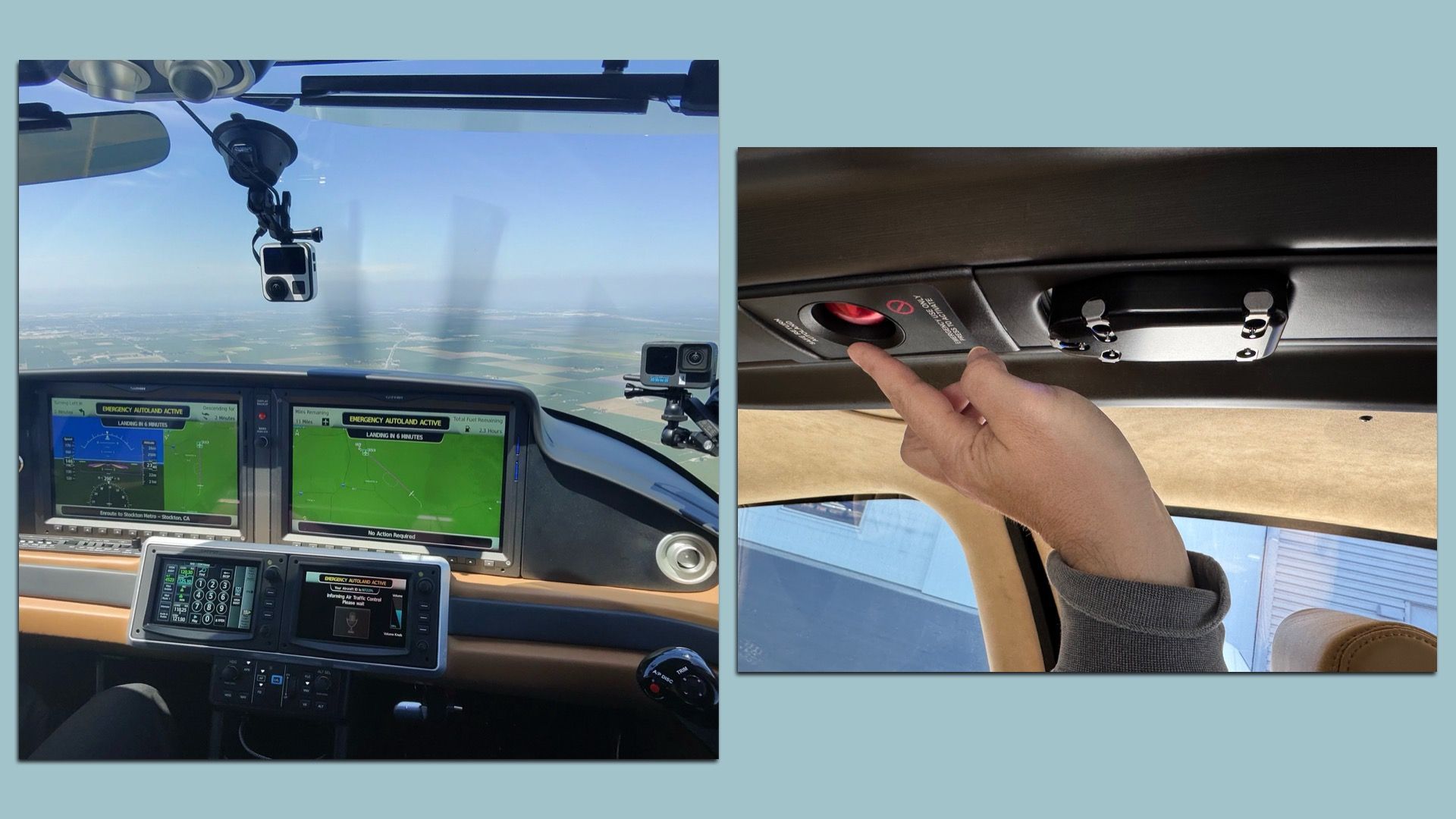
Cirrus, a leading maker of small planes, is adding a feature to its G7 model that allows it to land itself in an emergency, Axios' Ina Fried writes.
Why it matters: The move is a step toward autonomous passenger travel, though landing a plane in an emergency is a long way from removing pilots from the cockpit.
How it works: A red button in the new G7 allows any passenger to initiate the self-landing procedure should the pilot become incapacitated.
- The plane can also land itself automatically if it detects a lack of pilot input or erratic behavior.
- It'll find the nearest safe airport, communicate with air traffic control and complete the touchdown itself.
Inside the cockpit: Ina had a chance to try it out on a recent test flight out of San Jose airport.
- Once she pushed the button, the plane was doing all the work, from identifying Modesto as the nearest airport to touching down a few minutes later.
- The landing was a bit bumpy, she says, but no rougher than other flights.
π My thought bubble: I never really worried about an incapacitated pilot until watching the 1970s disaster-movie spoof "Airplane!"
4. Drive-thru
Catching you up on news you might have missed ...
π΄ Buttons and knobs are back! European safety officials say automakers should make wipers, lights, turn signals, horn and hazard warning lights accessible with physical switches rather than touchscreens if they want to earn a five-star safety rating. β Wired
- π If automakers are smart, they'll do the same in the U.S., before regulators make them.
π Zoox has resumed robotaxi testing after a minor crash in Las Vegas that prompted it to issue a software recall for 270 of its vehicles. β CNBC
π Tesla has started taking orders for a cheaper version of its newly redesigned Model Y amid warning signs of soft demand for its best-selling EV. β Electrek
π²π½ Ford is hiking prices on three popular models built in Mexico, becoming one of the first major automakers to adjust sticker prices because of Trump's tariffs. β Reuters
5. What I'm driving: 2025 Hyundai Kona EV
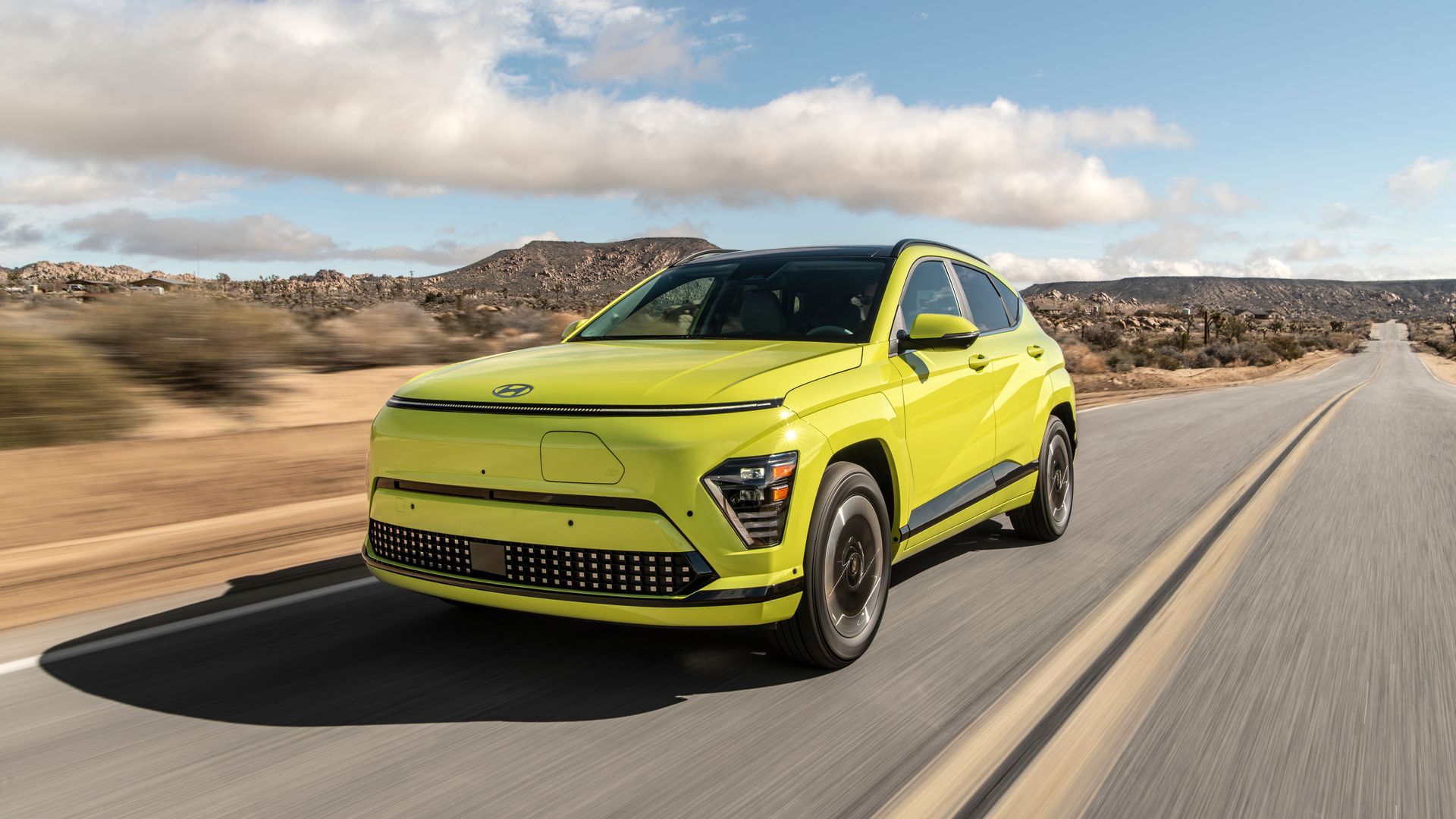
One of the most affordable electric vehicles on the market might not be for much longer βΒ assuming you can even buy one.
The Hyundai Kona Electric is stylish, comfortable, roomy and surprisingly fun to drive.
Pricing starts at $32,975 and goes up to $41,150 for the Limited version I drove.
- Yes, but: U.S. tariffs will almost certainly make it more expensive because it's built in South Korea with a Chinese battery β the same reasons it doesn't qualify for a federal tax credit.
- Hyundai has said it will hold pricing steady until June 2, but after that, it's anyone's guess.
The base Kona EV has a smaller battery and a driving range of 200 miles. I think it's worth getting the larger battery for a more respectable 261 miles.
One neat feature available in the Kona EV Limited is Hyundai's remote smart parking assist, which helps park your car in a tight location like a parking garage.
- Using the key fob, you can move the car forward or backward while remaining outside of the vehicle. (No rubbing up against dirty cars while trying to exit the car.)
The bottom line: If you're considering a Kona EV, better act fast.
I test drive vehicles in my role as a juror for the North American Car and Truck of the Year awards. Opinions are my own.
Thanks to Ben Berkowitz and Bill Kole for editing. Please tell your friends and colleagues to sign up!
Sign up for Axios Future of Mobility


/2025/05/07/1746593186190.gif?w=3840)