Axios Future of Mobility

March 18, 2026

🥳 This newsletter is 1 year old today! (Although I've been writing about the future of transportation since the invention of the 🛞. ) Thank you for your loyal readership!
- 📍 In D.C.? Join me tomorrow, March 19, at 8am for an Axios Live event exploring the future of autonomous vehicles, featuring conversations with Rep. Bob Latta (R-Ohio), Sen. Gary Peters (D-Mich.) and Advocates for Highway and Auto Safety president Cathy Chase. RSVP here.
- Out of town? Catch the livestream.
Today, we're exploring the next wave of robotaxis, which won't have a steering wheel or brake pedals.
- What's weirder: not having them, or seeing them move by themselves? If you've ever ridden in a Waymo, you know it feels a bit like being chauffeured by a ghost. 👻
Let's get going ... 1,388 words, a 5-minute read.
1 big thing: Feds clear path for no steering wheel
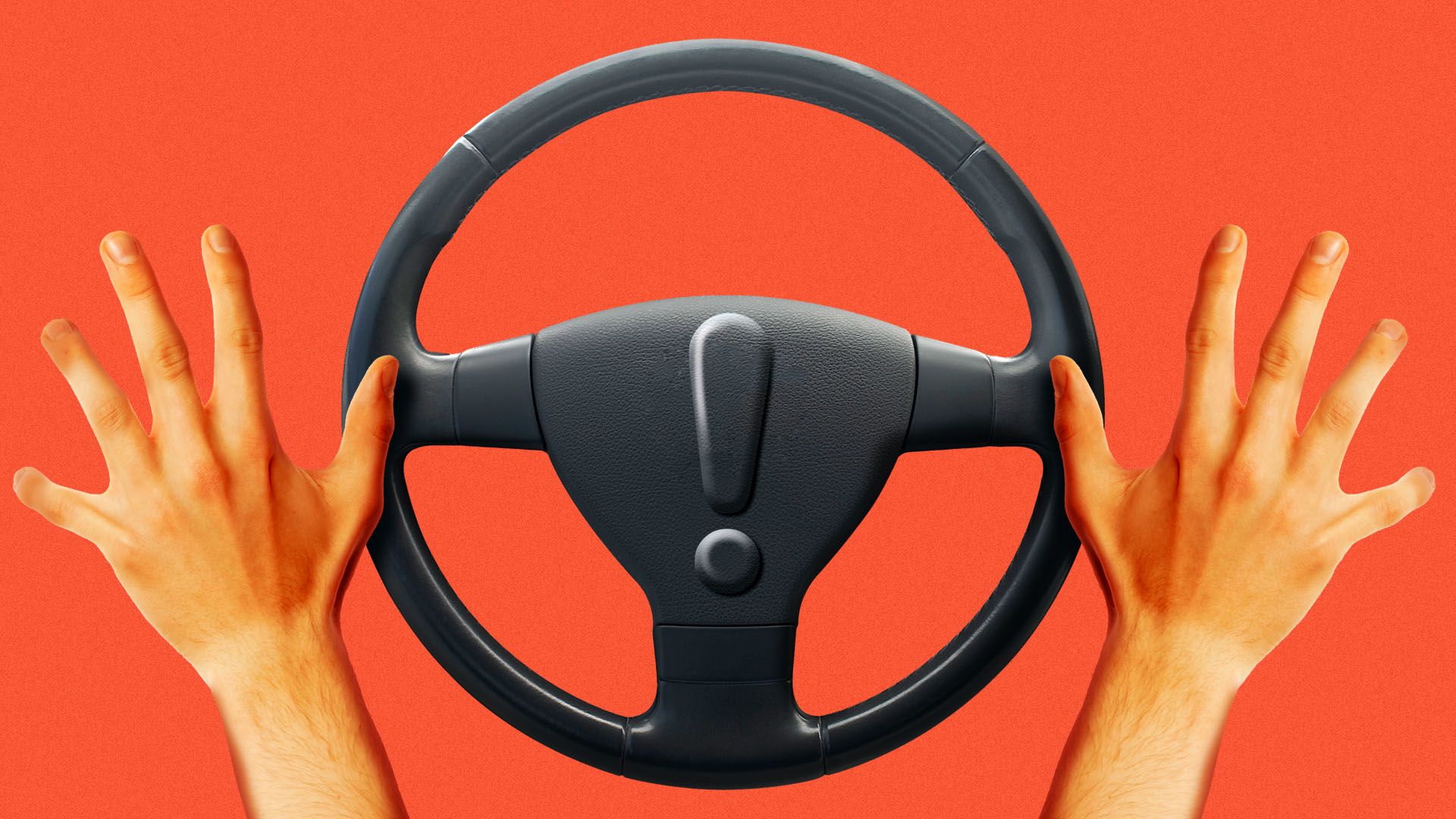
The federal government is trying to clear a regulatory path for new types of vehicles that drive themselves and don't have a steering wheel or pedals.
Why it matters: Fully automated robotaxis don't need driver controls, but the law still requires them. Updating federal standards could determine who leads the global race in autonomous vehicle technology.
- "We are in a race, right? Everyone is trying to have the best technology that will be deployed around the world," Transportation Secretary Sean Duffy told stakeholders at an AV safety forum in Washington, D.C., last week.
- "I want the technology to be developed in America, I want the jobs in America, and I want the rest of the world to use American technology," he said, emphasizing his concern that Chinese AVs could take over the world.
- "This is a national security issue. This is an economic issue. This is a safety issue."
Catch up quick: Robotaxis currently deployed on U.S. roads are based on conventional vehicles outfitted with self-driving technology.
- They operate under a patchwork of state laws, with minimal federal guidance.
- Efforts to pass federal AV legislation have been stalled for nearly a decade.
Driving the news: Despite the lack of federal legislation, the National Highway Traffic Safety Administration just announced several policy actions to try to advance AV technology in other ways.
- It's fast-tracking its review of a petition by Amazon-owned Zoox to deploy up to 2,500 purpose-built robotaxis with no steering wheels.
- NHTSA also wants to toss out motor vehicle standards that don't apply much to AVs, starting with requirements for windshield wipers, defrosters and defoggers.
- "You might want those, they might be nice, right?" said Duffy. "But do I need them if I don't have a driver?"
Between the lines: Getting rid of human-centric requirements would speed commercialization of robotaxis by allowing companies to focus on innovation and the latest technologies, instead of spending time and money on features not needed in an AV.
Also coming this year is new safety guidance for AV developers — the first major update to safety recommendations since NHTSA published its AV 2.0 guidelines in 2017.
- "A great deal has changed since then, and we know a lot more about technology and safety related to AVs," NHTSA Administrator Jonathan Morrison said at the AV Safety Forum.
- "Just as AV 2.0 helped set a baseline for companies, communities, law enforcement and safety experts to work from for the last eight years, we expect the next set of guidance to shape the industry's approach to safety for years to come."
What we're watching: Two AV bills are circulating in Congress that could be folded into a mandatory highway funding bill later this year.
- The Self-Drive Act, sponsored by Rep. Bob Latta (R-Ohio), has been kicking around in some form for nearly a decade. It would create a national AV standard and would require companies to disclose more safety information.
- The Motor Vehicle Modernization Act, sponsored by Rep. Brett Guthrie (R-Kentucky), would dramatically increase the number of vehicles without human controls that manufacturers can deploy. The current cap is 2,500 vehicles a year. Guthrie's bill would allow 90,000 per year.
The bottom line: AV technology is racing ahead. Policymakers are trying to keep up.
2. Lots of screens, but no steering wheels
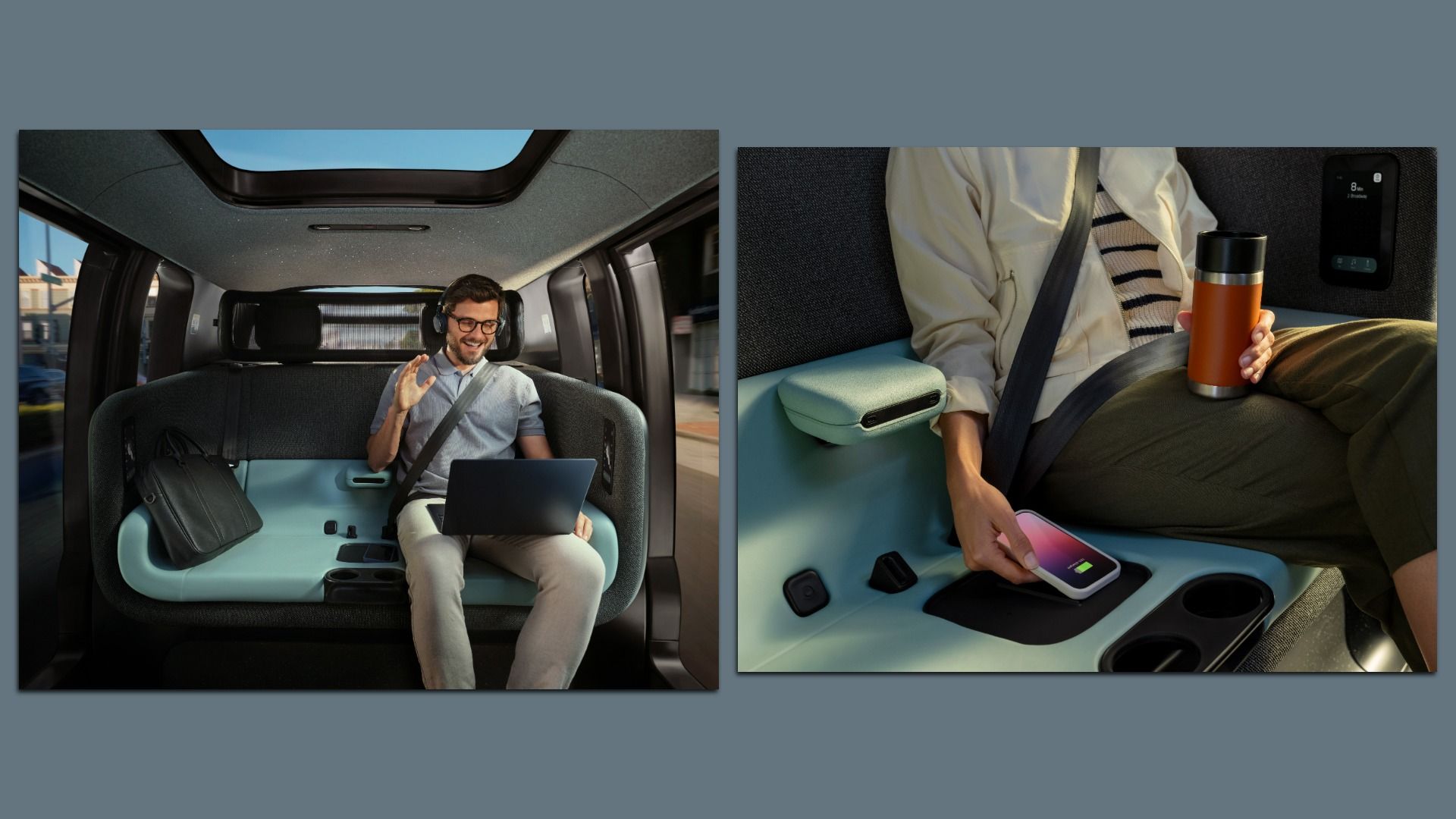
Future robotaxis are being designed for passengers, not drivers.
Zoom in: With no steering wheels, pedals or other driver controls, creature comforts take center stage.
- That means personalized music, lighting and climate settings. And plenty of screens.
- With unique seating arrangements, riders can party with friends or lie back and relax.
Zoox is the first to deploy a purpose-built robotaxi with no human controls in parts of Las Vegas and San Francisco.
- It's not a car, says Zoox; it's a bidirectional robot with a top speed of 75 mph.
- Inside the vehicle: Passengers face each other in carriage-style seating accessed through subway-style doors and have access to touchscreens, cupholders and wireless charging pads.
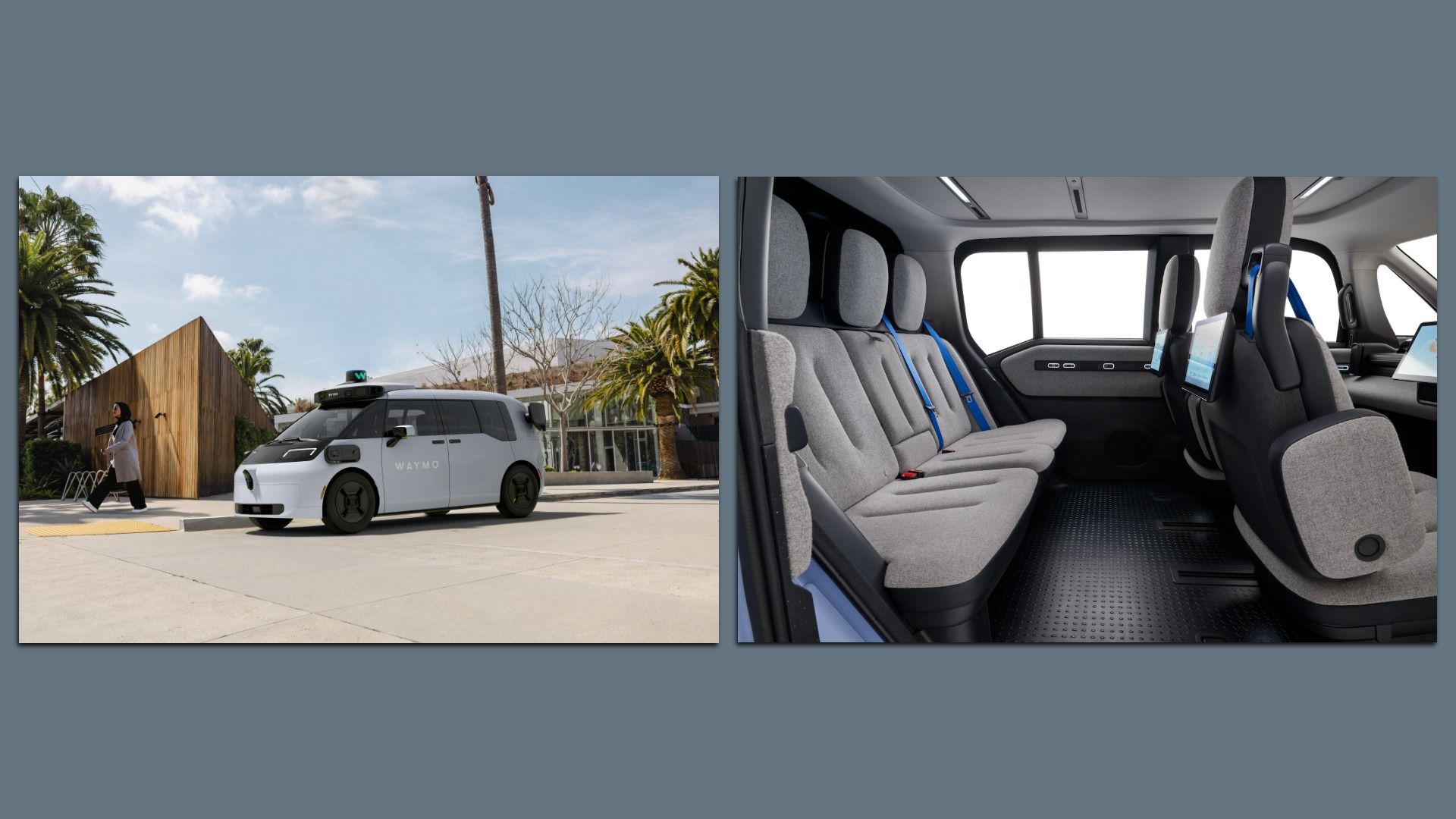
Waymo has its own purpose-built robotaxi coming soon.
- The Ojai, outfitted at a factory near Phoenix, is based on an electric van imported from China's Chery Automobile.
- It has a high ceiling, low step-in height and room for four passengers plus luggage.
- It's currently being tested in several cities with Waymo's 6th-gen AV technology.
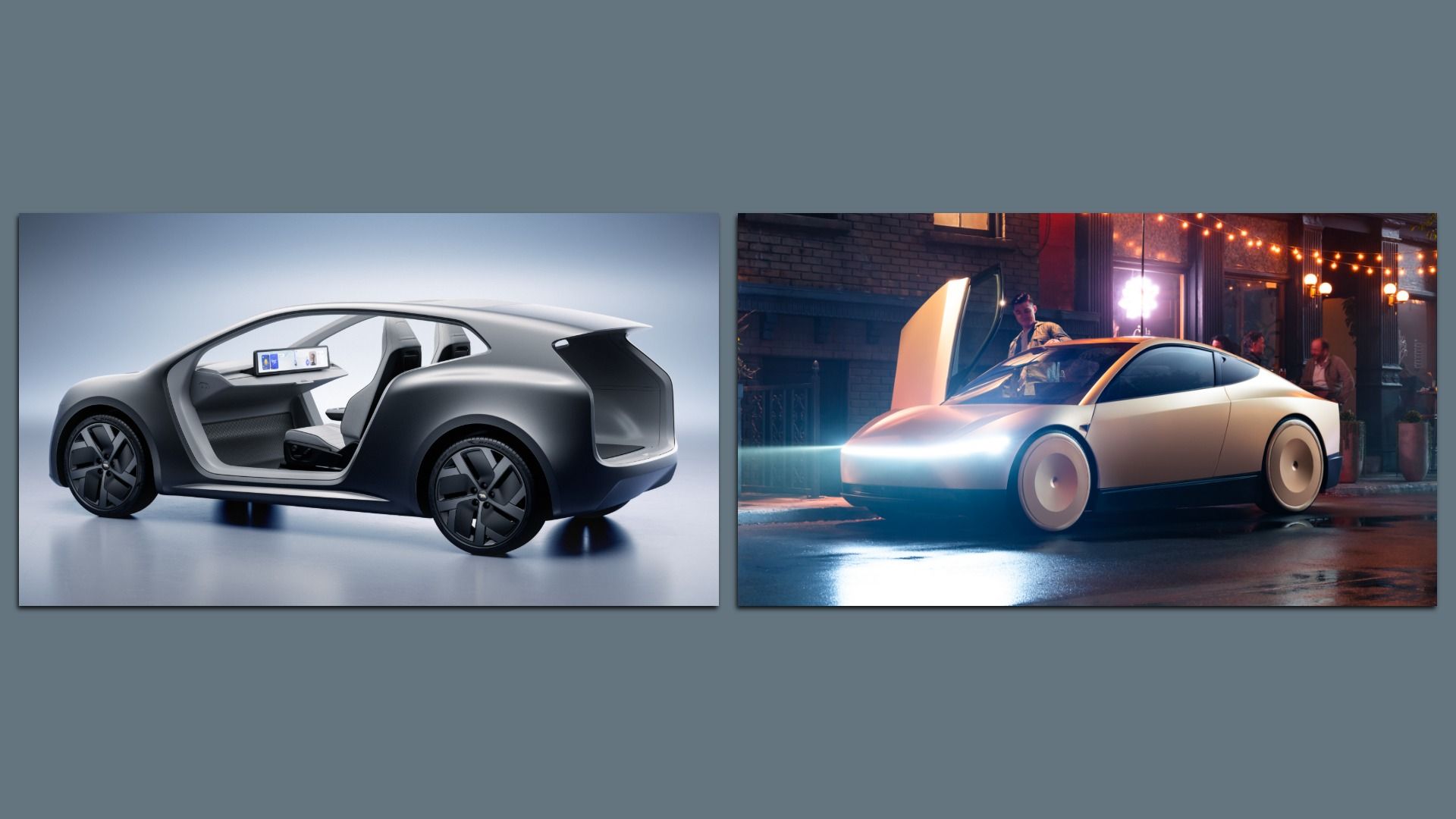
What's next: Tesla has the Cybercab, and Lucid just debuted its own robotaxi concept called Lunar.
- Both are two-seaters — the vast majority of taxi rides are for just one or two people.
3. Robotaxis try to learn from their mistakes
Robotaxis, like any new drivers, often make mistakes.
- As more of them get deployed in U.S. cities, the tech companies behind them are learning important lessons from things they could have done better.
Why it matters: AV technology is brand new — it will take time for developers to figure out what they don't know. But every incident — every dumb or potentially dangerous error — is being scrutinized as they work to earn public trust.
In one infamous incident, many of Waymo's robotaxis stopped operating and blocked traffic during a chaotic power outage in San Francisco that knocked out traffic signals and cellular networks.
- Waymos are trained to call for remote guidance when they encounter a traffic light that's not working.
- But when an entire section of the city went dark, remote operators were quickly overwhelmed with requests, explained Allison Drutchas, a Waymo attorney, at NHTSA's AV Safety Forum.
- The usual safety redundancy was actually counterproductive in that situation, she said.
"What we learned from that is to have the capability to sort of identify areas or times when that extra level of conservatism is no longer appropriate, and the car should sort of trust its opinion and proceed, even if it hasn't gotten a response from remote assistance," she said.
- That means treating the intersection like a four-way stop, and yielding appropriately to other traffic, she explained.
In another incident, some Zoox robotaxis got stuck in an area blocked by police activity in Las Vegas, a problem that took about 10 minutes to resolve even with the help of remote assistants, said John Maddox, senior director of safety strategy and operations.
- "We're treating it as a huge learning opportunity," he said.
- "If we don't learn from those events, we will never, ever get better. We'll never be able to scale fully, so it really is incredibly important to learn from your operations."
The bottom line: Waymo's co-CEO, Tekedra Mawakana, describes the challenge as "advancing safely."
- "How do you advance a technology that is so nascent, while earning public trust, while demonstrating that the benefits are worth the reasonable risk exposure that comes from a technology that cannot be completed in a lab?"
4. Drive-thru
🤖 Uber Technologies co-founder Travis Kalanick has launched a new venture, Atoms, which will focus on creating "gainfully employed robots" for the food, mining and transport industries. (Bloomberg)
⚠️ Honda gave up its EV strategy, canceling its Zero Series SUV and Saloon, as well as the Acura RSX EVs, and taking a massive $15.7 billion writedown. (Automotive News)
- Volvo is discontinuing the battery-powered EX30 and EX30 Cross Country in the U.S. after 2026. (Car and Driver)
- Zoom out: The industry has taken nearly $70 billion in charges tied to EV investments so far, with more likely to come, per Automotive News.
- Yes, but: BMW is unveiling a fully electric model in its popular 3-Series in Munich. The new all-electric i3 promises roughly 560 miles of range and improved fast-charging. The new lineup is a big bet on demand. (Bloomberg)
Thanks for reading, and thanks to editors Pete Gannon and Bill Kole. Please ask your friends to sign up here!
Sign up for Axios Future of Mobility