Axios Future of Mobility

June 17, 2026

👋 Hey! I'm glad you're here.
Today, we're taking a closer look at the legwork Uber is doing to secure real estate and charging depots for its future robotaxi fleets.
- It's a big strategy shift, but well worth it, the company tells me.
📣 Plus, there's a new way to measure reality vs. hype in robotaxis.
1,492 words, a 5½-minute read.
1 big thing: Uber's ground game
Location is everything in real estate — and that applies to robotaxi fleet infrastructure, too.
Driving the news: Uber this morning said it has signed a long-term lease for a 50,000-square-foot Houston depot, with plans to house 40 EV chargers and 15 maintenance bays, laying the groundwork for a robotaxi launch in the Bayou City in 2027.
Why it matters: Behind every robotaxi fleet is a lot of physical infrastructure — and Uber's race to secure it is taking place in cities well before its driverless cabs ever hit the streets.
The big picture: Uber's bet is that controlling infrastructure in the right locations — the charging and maintenance depots — is central to winning the robotaxi battle.
- It's a strategic shift for the intentionally "asset light" ride-hailing company, which doesn't own any cars or employ Uber drivers.
- After shedding its own in-house self-driving business in 2020 and focusing on its traditional ride-hailing network, Uber is now investing in AV companies, developing real estate and committing to buy tens of thousands of vehicles.
It's a plan that could cost as much as $10 billion over the next few years (if its AV partners hit various milestones), according to one tally by the Financial Times.
- The cost of the infrastructure piece isn't fully known, but in February, Uber said it would spend $100 million to develop new fast-charging hubs at AV depots in San Francisco, Los Angeles and Dallas, with more cities to come.
Between the lines: Autonomous vehicles change the balance sheet math. The investments are necessary, Uber execs say, to establish the company as a preferred robotaxi provider.
- "We do think making smart investments in the infrastructure will enable us to bring down cost per mile," Samarth Kejriwal, Uber's global head of autonomous fleet operations, tells Axios in an exclusive interview.
- Owning that layer gives the company more influence and leverage, compared to outsourcing it and paying third‑party margins.
- "At the end of the day, if we think 10, 15, 20 years out, consumers will care about price and reliability," he says.
Zoom in: To identify optimal locations for AV depots and pit stops, Uber developed an in-house tool to leverage what it already knows about its ride-share customers in any given city using anonymized trip data.
- It's a kind of heat map showing the most popular pick-up and drop-off locations, as well as where drivers spend the most time on the road, which helps Uber maximize network efficiency and avoid "deadhead" miles, explains Philip Henry de Frahan, Uber's head of AV infrastructure.
"This is where a lot of AV players are making mistakes, and where Uber is able to avoid those mistakes because we have that data," he says.
- Choosing the wrong location will be costly. "This is a mistake you're going to eat for the next 10 to 20 years," he says.
The latest: Uber's newly announced plan for Houston follows the planned launch of its robotaxi service with Lucid and Nuro later this year in San Francisco.
What's next: After Houston, Uber said it plans to bring Lucid robotaxis to "dozens" of additional markets over the coming years — and it's scouting real estate for all of them.
2. Filtering out the AV hype
Waymo is the clear robotaxi leader, but if you thought Tesla and Zoox were close to catching up, think again — it's actually three Chinese companies, according to a new database shared first with Axios.
Why it matters: Autonomous vehicles are real, but it's still a hype- and headline-driven industry, so it can be hard to discern who's actually making progress toward commercialization.
- The Road to Autonomy Indices, debuting today from AV research and advisory firm Autnmy AI, uses a proprietary AI algorithm to try to measure what's really happening amid all the noise.
- And among robotaxis, it finds that Baidu's Apollo Go, Pony.ai and WeRide are well ahead of Tesla and Zoox.
How it works: The rankings reward commercialization, not promises, using publicly disclosed information.
- The algorithm is heavily weighted toward fully autonomous operations generating revenue — not demos or pilots still operating with safety drivers.
- Six factors are scored on a scale of 0 to 100: autonomous operations, scale, revenue, commercial partnerships, manufacturing and safety transparency.
- The first three account for 70% of a company's composite score, and the closer to 100, the higher their ranking.
- There are separate indices for robotaxi companies, autonomous truck operators, AV licensing companies and robot delivery firms.
What they found: The narrative from AV companies doesn't always match reality.
- And AVs are a global industry: Three of the top five robotaxi players are Chinese.
Zoom in: "Chinese companies are scaling," says Grayson Brulte, who, along with former Cruise executive Rob Grant, cofounded Autnmy AI.
- "I don't really think it's well-recognized how far along the Chinese are in robotaxis," he says. "To me, it's a wake-up call."
State of play: Waymo's U.S. momentum earned the Alphabet unit the index's number one ranking. It's providing more than 500,000 paid robotaxi trips per week across 11 cities and its fleet currently stands at 3,500 vehicles.
- Apollo Go, Pony.ai and WeRide rank second, third and fourth, respectively, because of their growth outside the U.S.
- All are deploying paid robotaxi services in partnership with Uber, Lyft, Bolt and Grab across cities in Europe, Asia and the Middle East.
- Tesla, with fully driverless robotaxis in three cities — Austin, Houston and Dallas — ranks fifth, but regulatory restrictions are limiting CEO Elon Musk's ambitions for rapid scaling. (A new Texas database says Tesla has 69 registered robotaxis in the state, up from 42 two weeks ago.)
Among autonomous truck operators, Kodiak AI ranks first. Applied Intuition is the top AV licensing company and Starship Technologies ranks highest for delivery robots.
Go deeper: Details on the companies in each of the four indices are here.
Editor's note: This story has been corrected to note that Waymo is providing more than 500,000 paid robotaxi trips per week (not 250,000), and has 3,500 vehicles in its fleet (not 1,500).
3. Rivian plugs in to ChargeScape
Rivian is the latest EV company to enroll its vehicles in ChargeScape's utility-managed charging programs to support the electricity grid.
Why it matters: EV owners who opt in to participating utility programs can save money on their home energy bill, while helping utilities manage electricity demand.
Catch up quick: ChargeScape is a vehicle-grid integration platform that officially connects automakers with power utilities.
- It works by helping EV owners charge at optimal times and allowing them to send energy back to the grid during peak demand.
- The company is backed by BMW, Ford, Honda, and Nissan. Other automakers, including Tesla and Stellantis, also use ChargeScape's platform.
State of play: EV owners — now including Rivian — can opt into ChargeScape's growing network of utility programs across North America.
- GM is promoting its own vehicle-to-grid (V2G) capabilities.
Reality check: V2G programs have been touted for years but remain mostly in the pilot phase.
- For V2G to scale, more utilities need to participate by offering attractive incentives for EV owners.
- ChargeScape is one of the middlemen trying to make that happen.
4. Drive-thru

🤖 Rivian's Mind Robotics has raised $1 billion and will introduce its first product in about a year, says CEO RJ Scaringe.
- But humanoid robots will be colleagues, not replacements, for human workers, he says. "Dark factories" run entirely by robots are a long way off. (CNBC)
🚖 Self-driving technology supplier Mobileye is launching its own robotaxi service starting in 2027 in a major U.S. city. Within five years, it plans a fleet of roughly 17,000 robotaxis.
- The intrigue: The move will put Mobileye in direct competition with some of the customers that use its Mobileye Drive technology in their cars. (CNBC)
🪖 General Motors and Lockheed Martin plan to collaborate, at the urging of the Pentagon, to speed up weapons production and bolster national security. (Axios)
- GM has also held talks with LTX and L3Harris Technologies about boosting weapons production, Bloomberg reported.
5. 🚀 One fun thing: Porsche's ultimate toy
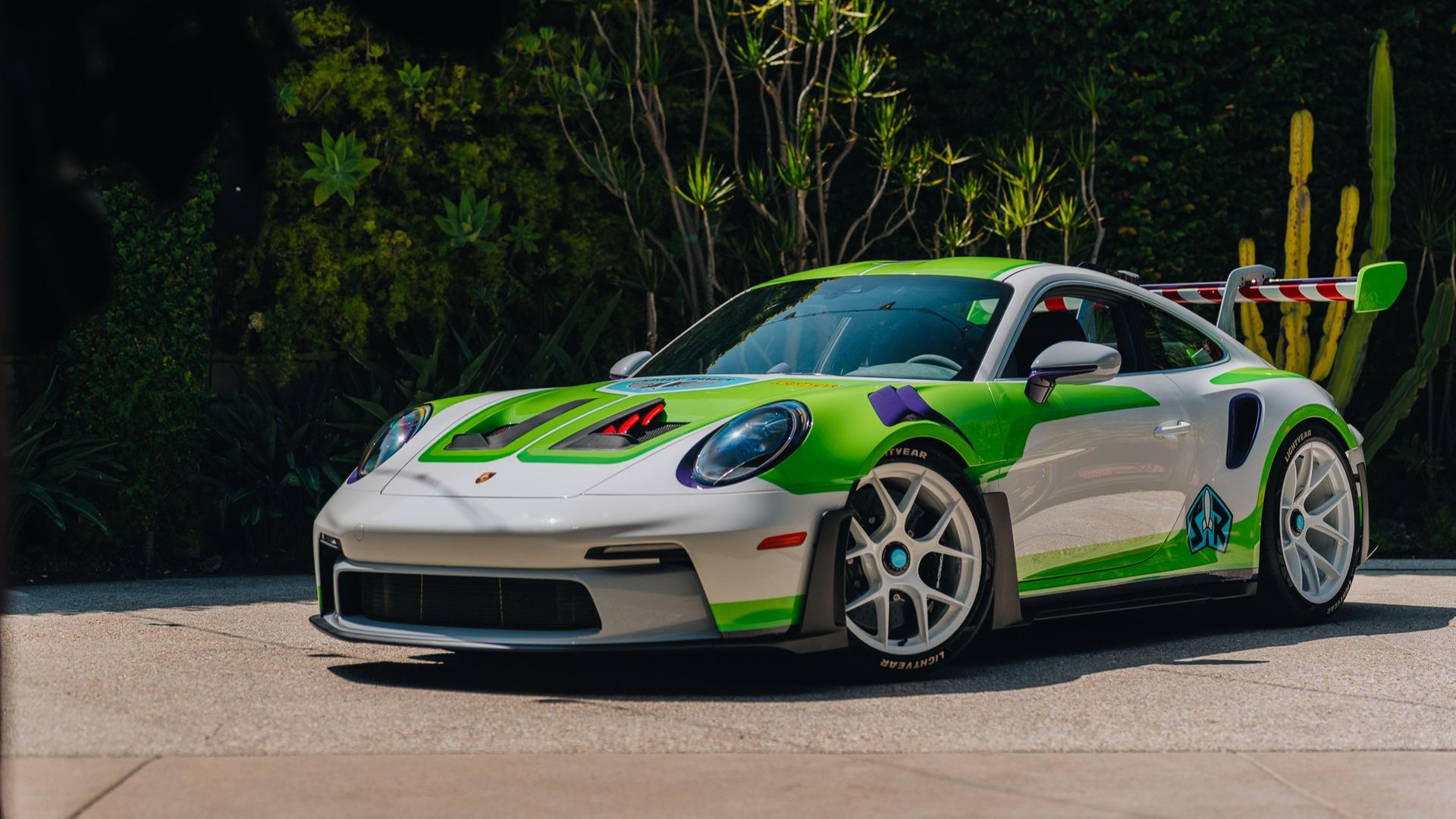
If you're having a midlife crisis, buying a Porsche — especially one that looks like Buzz Lightyear — can make you feel like a kid again.
Driving the news: To celebrate this weekend's release of Disney and Pixar's "Toy Story 5," Porsche designed three one-of-a-kind 911 models inspired by Woody, Buzz Lightyear and Jessie.
Zoom in: Each car sports Goodyear tires, but the Buzz Lightyear vehicle features "Lightyear" tires with custom lettering, notes Axios Cleveland's Troy Smith.
Fun fact: Goodyear is actually going to the Moon in 2028 by providing tires for the Lunar Outpost's Pegasus Lunar Terrain Vehicle as part of NASA's Artemis program.
What's next: The "Toy Story 5" cars will be auctioned off, with proceeds supporting Big Brothers Big Sisters of America, the American Red Cross and Starlight Children's Foundation.

Thanks to editors Pete Gannon and Bill Kole. If you're a fan of this newsletter, please ask your friends to sign up, too.
Sign up for Axios Future of Mobility