Axios Future of Mobility

November 19, 2025

👋 Hello again! Did you miss me? I'm happy to be back, and incredibly grateful to Nathan Bomey for keeping this newsletter going while I was recuperating.
- Make sure you sign up to get Nathan's Axios Closer business newsletter delivered to your inbox every afternoon.
🚗 Situational awareness: S&P Global Mobility's latest auto production forecast, out today, shows a sharp divergence between China's explosive growth and North America's tariff headwinds.
Let's get moving ... 1,743 words, a 6½-minute read.
1 big thing: Ford's heavy metal problem
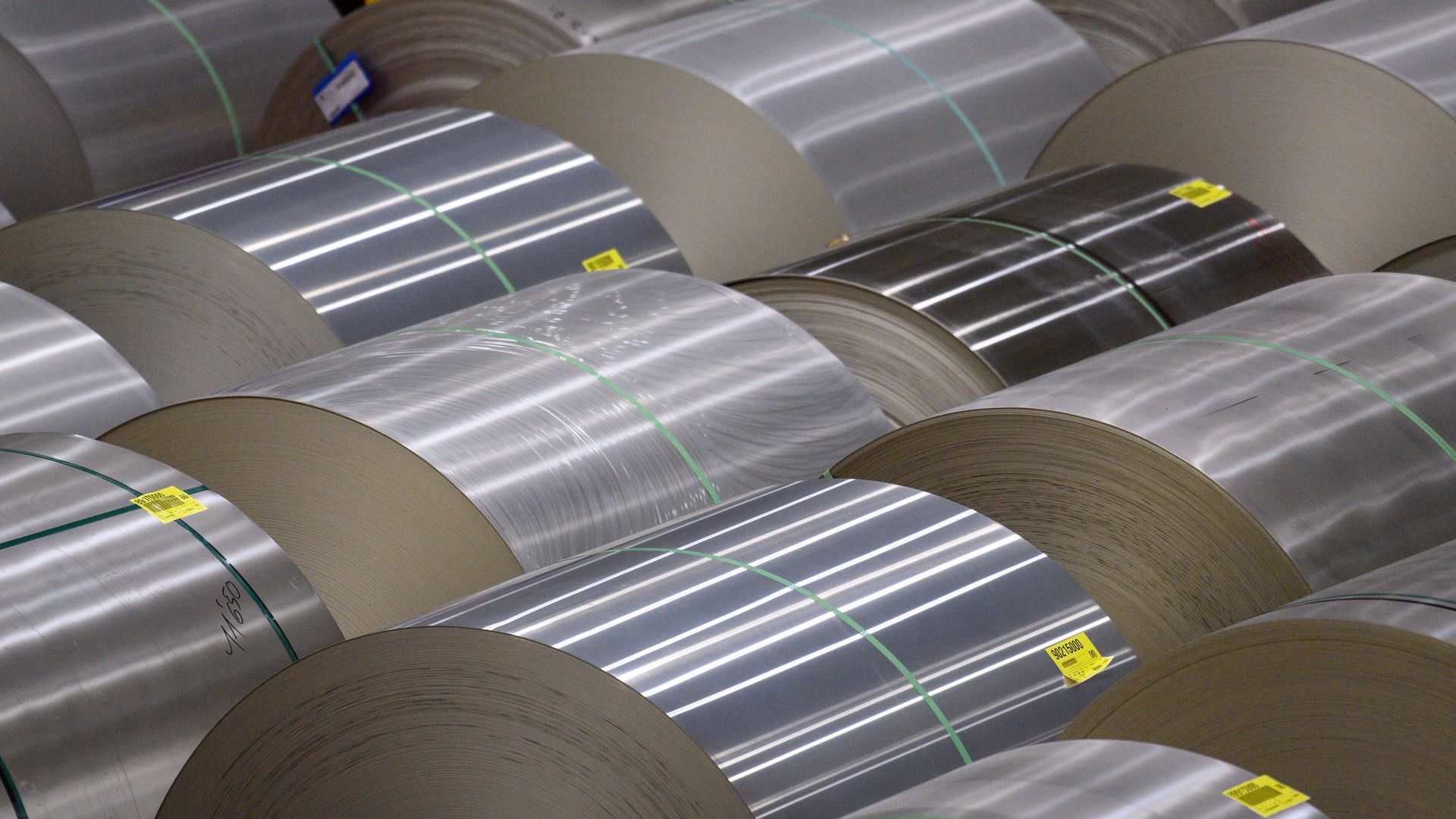
Automakers will do whatever it takes to keep their factories running — even if it means absorbing the extra cost of flying highly tariffed aluminum, two gigantic coils at a time, on airplanes from across the globe.
- Ford and a key supplier have been taking such extraordinary steps in order to keep producing its best-selling and highly profitable F-series pickup trucks after a devastating fire at an aluminum mill in upstate New York.
The big picture: Aluminum is in high demand, especially in the auto sector, as carmakers shift to lighter-weight hybrid and electric vehicles.
- But producing aluminum is extremely energy intensive, one reason the U.S. has closed all but four of its two dozen aluminum smelters over the past decade.
- Instead, the U.S. relies mostly on Canada or China for smelting.
Yes but: manufacturers are reeling from President Trump's decision to slap 50% tariffs on aluminum imports.
- So when one of the few domestic sources of rolled aluminum goes down — as happened in September when Novelis' plant in Oswego, New York, caught fire — carmakers have few options.
Air freight is an expensive last resort that carmakers typically use only to fly high-value parts like electronics or specialty equipment to the U.S.
- It's a different equation when you need to fly humongous, 24,000-pound rolls of aluminum sheet across the ocean.
- But given the choice between idling vehicle production or paying through the nose to expedite critical materials, manufacturers will swallow the extra costs every time, explains Jason Miller, a supply chain professor at Michigan State University.
- "This is not a cheap proposition," he tells Axios. "But shutting that plant down is far more expensive."
Between the lines: Air freight is typically 10 times the cost of ocean freight, Miller says.
- A back-of-the-envelope calculation, assuming a shipment of 40,000 pounds of aluminum from Europe to the U.S. at the going rate of about $1.89 per kilogram, puts the air freight cost at more than $34,000, he figures.
- Moving that same freight domestically by truck would cost a couple thousand dollars, he says.
Plus, aluminum prices in the U.S. are at record highs, driven by Trump's import tariffs and tight supplies globally.
- "This is coming at the worst time imaginable for aluminum prices," Miller says.
Zoom in: Novelis supplies about 40% of the aluminum sheet used by the domestic auto industry. Ford, its largest customer, has been especially hard-hit by the fire.
- The carmaker redesigned its popular F-series pickups in 2016 with high-strength aluminum body panels to boost fuel efficiency.
- Each Ford F-150 uses approximately 700 pounds of aluminum.
- By that measure, one 24,000-pound roll of aluminum sheet is enough to produce roughly 34 trucks.
Where it stands: Crews have been working around the clock to try to restore Novelis' damaged hot mill, where aluminum ingot and scrap are melted and rolled into thin sheets that automakers later stamp into vehicle parts like doors, hoods and truck beds.
- Novelis says the mill should resume production before the end of the year — faster than originally expected, a company spokesperson tells Axios.
- In the meantime, Novelis will continue to ship aluminum to the U.S. from other plants in Switzerland and South Korea, while repurposing plants that produced aluminum beverage cans.
- Two new rolling mills are slated to open next year in Alabama and Mississippi — the first new U.S. mills since 1980 — boosting U.S. sources.
What to watch: Ford says it will likely lose about 100,000 units of F-series production in 2025 as a result of the disruption, with a hit to profits of $1.5 billion to $2 billion.
- But the company will add about 1,000 jobs early next year to recoup those lost units. The net financial impact over two years will be less than $1 billion, Ford said.
2. State EV mandates fading away

California is reassessing plans to phase out gasoline cars by 2035, even as it vigorously fights President Trump over its right to do so.
Why it matters: California's strict emission rules, blocked by the Trump administration in June, had been a template for other states that share its ambitious climate goals.
- But as they look to replace those rules, state regulators are signaling that a requirement for all new cars to be electric by 2035 might not be practical anymore.
- Affordability concerns, vanishing tax incentives and insufficient EV charging infrastructure make it unlikely that automakers can achieve escalating EV sales targets.
Catch up quick: California kicked off a new rule-making effort last month, with the goal of having revised state emissions standards in place by 2027 for 2031 model year vehicles and beyond.
- Phasing out gasoline cars by 2035 will be "a very active area of discussion," Lauren Sanchez, the new chair of the California Air Resources Board, recently told Politico.
- The 2035 EV target "remains a very ambitious goal, and I am grateful ... that we now have the time to rethink creatively what that goal should be going forward," she said.
Where it stands: California is suing the Trump administration for what it calls "illegal and unconstitutional actions" to revoke its waiver under the Clean Air Act to set its own emissions standards.
- Attorneys general from nearly a dozen other states joined the lawsuit.
- "We cannot enforce these rules at the moment," Christopher Grundler, deputy executive officer at the California Air Resources Board, told participants at a CARB workshop last month.
- "And so we are focused like a laser beam on what more can we do to fill this emissions hole we find ourselves in."
- Other states, including Maryland, Washington and Vermont, paused enforcement of their EV sales targets, too, and are rethinking their plans.
What they're saying: Automakers don't want states to set their own emissions rules, saying it adds complexity and drives up costs for consumers.
- "Toyota supports a consumer-focused single national approach to improving fuel economy and reducing carbon emissions," Tom Stricker, group vice president, Regulatory Affairs and Compliance, tells Axios via email.
- "Because no single powertrain — including battery-electric vehicles — can meet every customer's needs, we believe policies should offer consumers affordable choices to meet their lifestyles."
The bottom line: Plenty of us will still be driving gas cars in 2035.
3. First stop for electric air taxis: Middle East
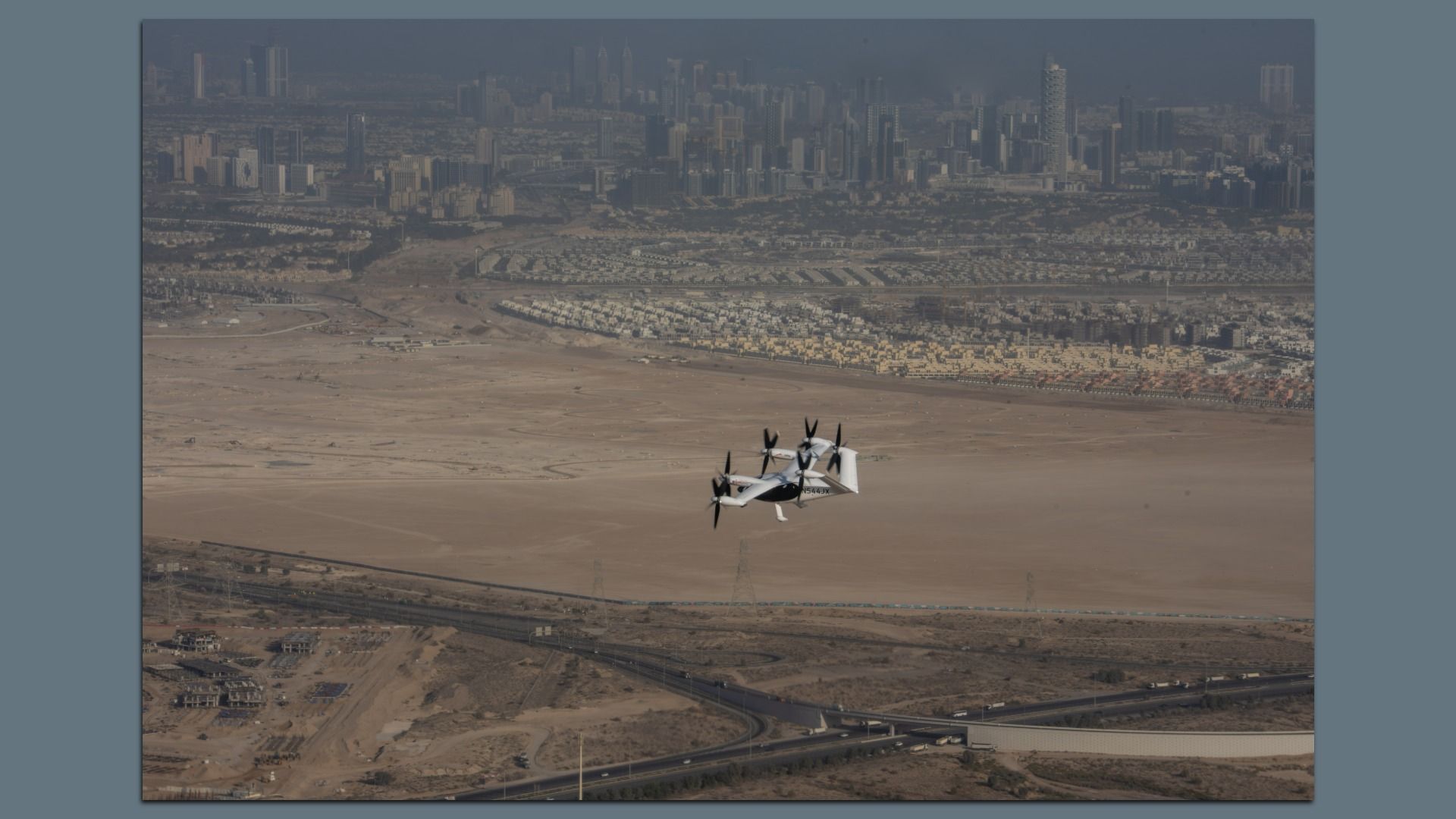
U.S. companies are the leaders in advanced air mobility, but the first passengers to fly in their Jetsons-like electric air taxis will likely be in Dubai or Abu Dhabi, not New York or L.A.
Why it matters: Americans are great innovators; bringing products to market sometimes takes longer.
- In the case of electric vertical takeoff and landing aircraft (eVTOLs), FAA certification is the final holdup.
- But in the United Arab Emirates, which closely mirrors FAA standards, regulators are fast-tracking the technology, with plans to approve commercial service in 2026, likely ahead of the U.S.
Driving the news: This week's Dubai Airshow had lots of eVTOL news, including flight demonstrations from Joby Aviation and announcements from various companies about their commercial momentum in the region.
- Joby announced three more vertiports in Dubai's electric air taxi network, a week after completing the first point-to-point eVTOL flight in the UAE. Air taxi service is expected to begin there next year.
- Rival Archer Aviation, which is targeting Abu Dhabi as its launch market, also signed a deal in Dubai to supply its electric powertrains to defense partner Anduril for its Omen autonomous aircraft.
- Both Archer and Joby announced plans to fly in Saudi Arabia, too.
- Vermont-based Beta Technologies, meanwhile, announced a deal with logistics provider e-Smart Group for up to 20 of its electric ALIA aircraft.
What to watch: In the U.S., the Trump administration is soliciting bids for advanced air mobility pilot programs next year ahead of FAA certification.
4. Drive-thru
🇰🇷 Some South Korean workers have returned to a Hyundai-LG battery factory in Georgia after the State Department reissued their visas, in a bid to undo the damage from a large workplace immigration raid in September. (New York Times)
🇳🇱 The Dutch government lifted an order seizing control of Chinese-owned chipmaker Nexperia, after automakers warned of a semiconductor shortage. (CNBC)
🚖 Amazon-owned Zoox is inviting members of its public waitlist to ride for free in its purpose-built, toaster-shaped autonomous vehicle in San Francisco. (The Verge)
- Waymo is expanding to Dallas, Houston, San Antonio, Miami and Orlando in 2026. (CNBC)
⚡️ Month-to-month EVs: Entrepreneur Scott Painter, who's been trying to crack the digital automotive space for decades, is expanding the fleet of EVs available for subscription at Autonomy, his latest startup.
- Painter's been busy: He's also buying back TrueCar, the digital auto marketplace he founded 20 years ago, for $227 million.
5. What I'm driving: 2026 Hyundai Palisade
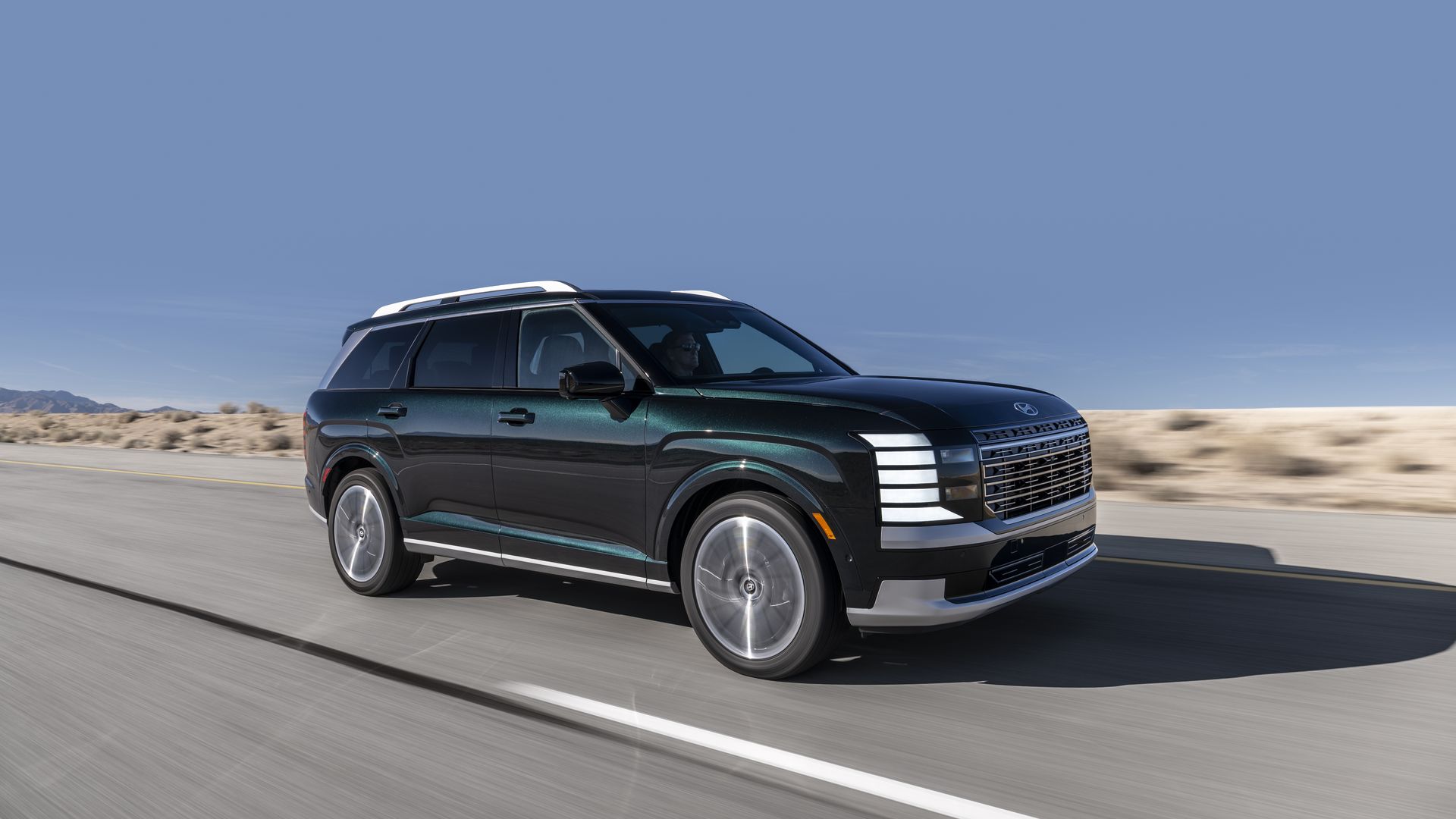
The family wagon is more handsome than ever.
I always liked Hyundai's Palisade SUV, which debuted in 2020. But man, the redesigned 2026 version really commands your attention.
- Its boxier lines, bold lighting and silver rear pillar give it a unique, modern look.
- Inside, the rounded edges of the leather-clad dashboard are inspired by mid-century-modern furniture, lending the Palisade an aura of a much higher-priced luxury vehicle.
I drove the all-wheel-drive Calligraphy model, which sells for $57,800.
- It isn't exactly cheap, but you get a long list of premium features, along with a suite of standard safety technologies.
- With a second-row bench seat, the Palisade seats up to eight passengers. But I liked the Calligraphy's second-row captain's chairs that can recline and deploy footrests for long trips.
- We folded down the third row and had plenty of room for luggage on a family road trip to Chicago.
Zoom in: A 287-hp V-6 engine is standard, but the Palisade is also available as a 329-hp hybrid, which I haven't driven yet.
- The base model, starting just under $40,000, gets an EPA-rated 19 mpg city and 25 mpg highway (though fuel economy is slightly lower with all-wheel drive).
- There's also a new XRT Pro model, with a higher suspension and terrain-specific driving modes, for off-road adventures.
I test-drive vehicles in my role as a juror for the North American Car and Truck of the Year awards. Opinions are my own.
Thanks to Ben Berkowitz and Bill Kole for editing. Ask your friends to sign up here.
Sign up for Axios Future of Mobility