Axios Future of Mobility

October 01, 2025

🚛 Breaker, breaker ... I think I need a good CB radio handle now that I'm a trucker. 👇 Any suggestions?
- Plus: Get a glimpse inside the airport hangar in Bentonville, Arkansas, where people with big ideas and fat wallets spent three days plotting the future of transportation.
- ✈️ If you were wondering (like me, as I prepare to fly today), TSA workers and air traffic controllers are still on the job even during the government shutdown.
1,733 words, a 6.5-minute read.
1 big thing: I'm a trucker now
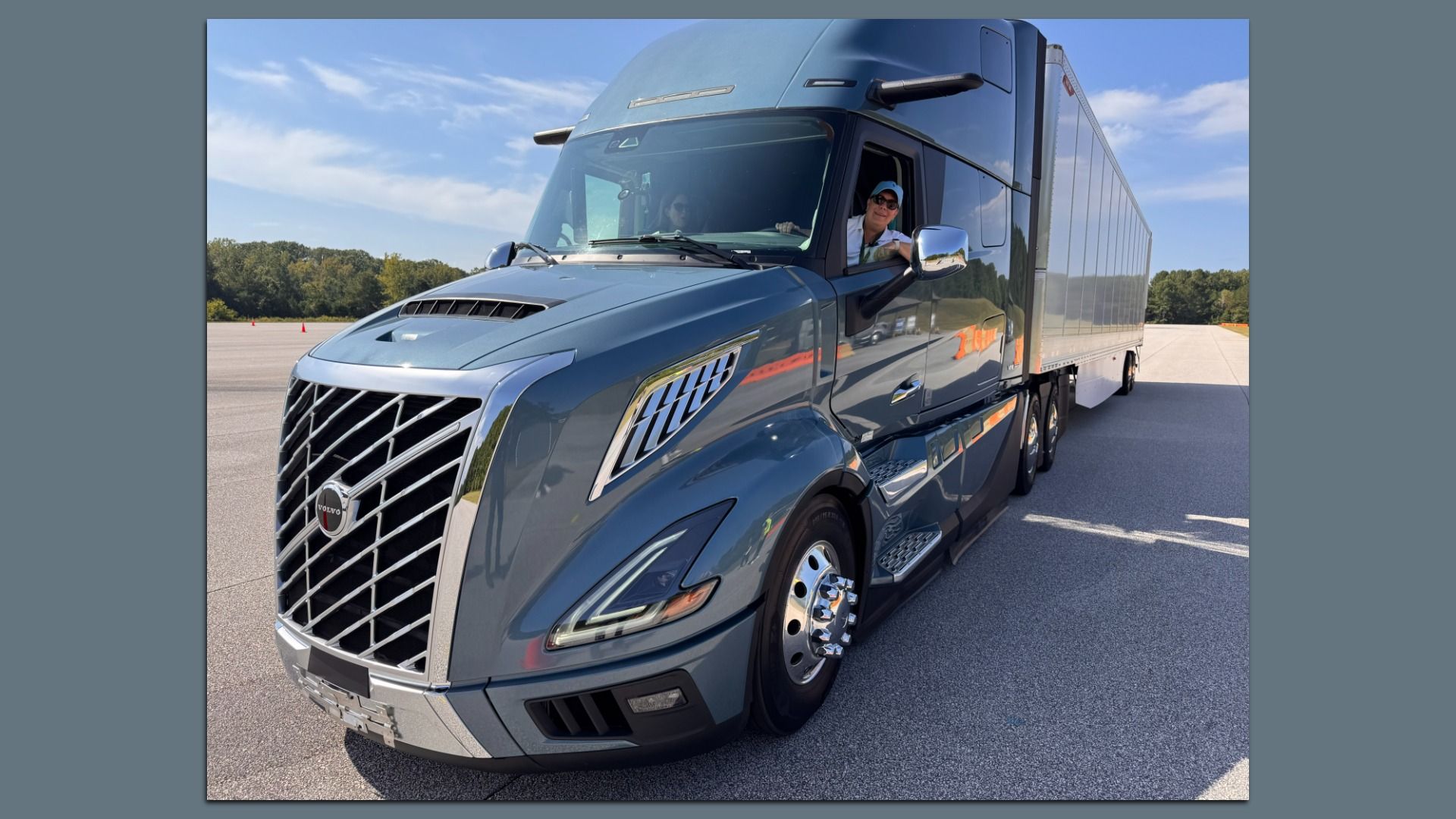
If someone hands you the keys to a sports car and says, "Take it for a spin," you'd probably say yes.
- That happened to me last week — only it was an 80,000-pound semi truck, not a sports car.
Volvo invited me to drive its new VNL model at Michelin Laurens Proving Grounds near Greenville, South Carolina. (It had to be on private roads since I don't have a commercial driver's license.)
- And there was a twist: I could also spend the night in the sleeper cab. (More on that below.)
- My response? Hell, yes.
Why it matters: The VNL truck line is Volvo's first all-new heavy truck platform since 1993 and was designed specifically for the North American market with a focus on fuel efficiency, safety and driver comfort.
- The company invested $2 billion in development, and another $400 million to retool its Virginia factory.
During a walkaround, Volvo engineers explained how its wedge-shaped design and other aerodynamic tricks improved the VNL's fuel economy by 10% over Volvo's previous model.
- While most trucks get around 7 or 8 miles per gallon, the VNL can get up to 11 mpg — tens of thousands of dollars in savings that go right into a truck owner's pocket.
- Future versions might have an electric or hydrogen powertrain, they said.
An autonomous VNL is being tested with partners on limited routes in Texas, but Volvo officials believe widespread deployment of self-driving trucks is still years away.
- That's why the new VNL was designed for a human driver.
- There's a long list of assisted-driving features — adaptive cruise control, lane-keeping assistance, automatic emergency braking and pedestrian detection.
- Volvo is also the first to make side-impact air bags standard in a heavy truck.
💭 Thought bubble: The experience gave me a profound appreciation for the challenges truck drivers face every day.
- It's a far more taxing job than I realized. Just climbing in and out of the cab is a challenge, requiring deft coordination of all my limbs.
- It's mentally challenging too: I wasn't just driving a giant tractor rig. I also had to keep an eye on that 50-foot-long trailer behind me, using exterior camera monitors.
Plus, people are jerks. Cars cut in front of semi trucks all the time (myself included, I confess), which reduces their stopping distance and increases the risk of a crash.
- In one demo, a car cut in front of me, as might happen as traffic starts to back up on a busy highway.
- With adaptive cruise control engaged, the truck stopped by itself and then inched forward automatically, as if we were in stop-and-go traffic.
Driving impressions: As someone who evaluates cars regularly for a living, I've come to appreciate electric vehicles' instant torque and tight handling around curves.
- It's a totally different feeling when you're sitting up high in the cab of a diesel-powered semi truck hauling 70,000 pounds.
- The truck shuddered and rumbled as I pressed the accelerator, and the cab rocked a bit from side to side.
- As I picked up speed, I could feel the automated manual transmission as it shifted through each of the 13 gears.
- It took a while to get up to 50 mph, and that's as fast as I wanted to go.
The bottom line: The trucking industry is in the midst of a prolonged downturn after a spike in demand during COVID.
- When the recovery comes, shipping companies will be looking to replace their aging truck fleets.
- Volvo hopes the driver-friendly features in the VNL will enable it to take market share from rivals like Freightliner, Kenworth and Peterbilt.
2. ⭐️ 5-star truck sleepover
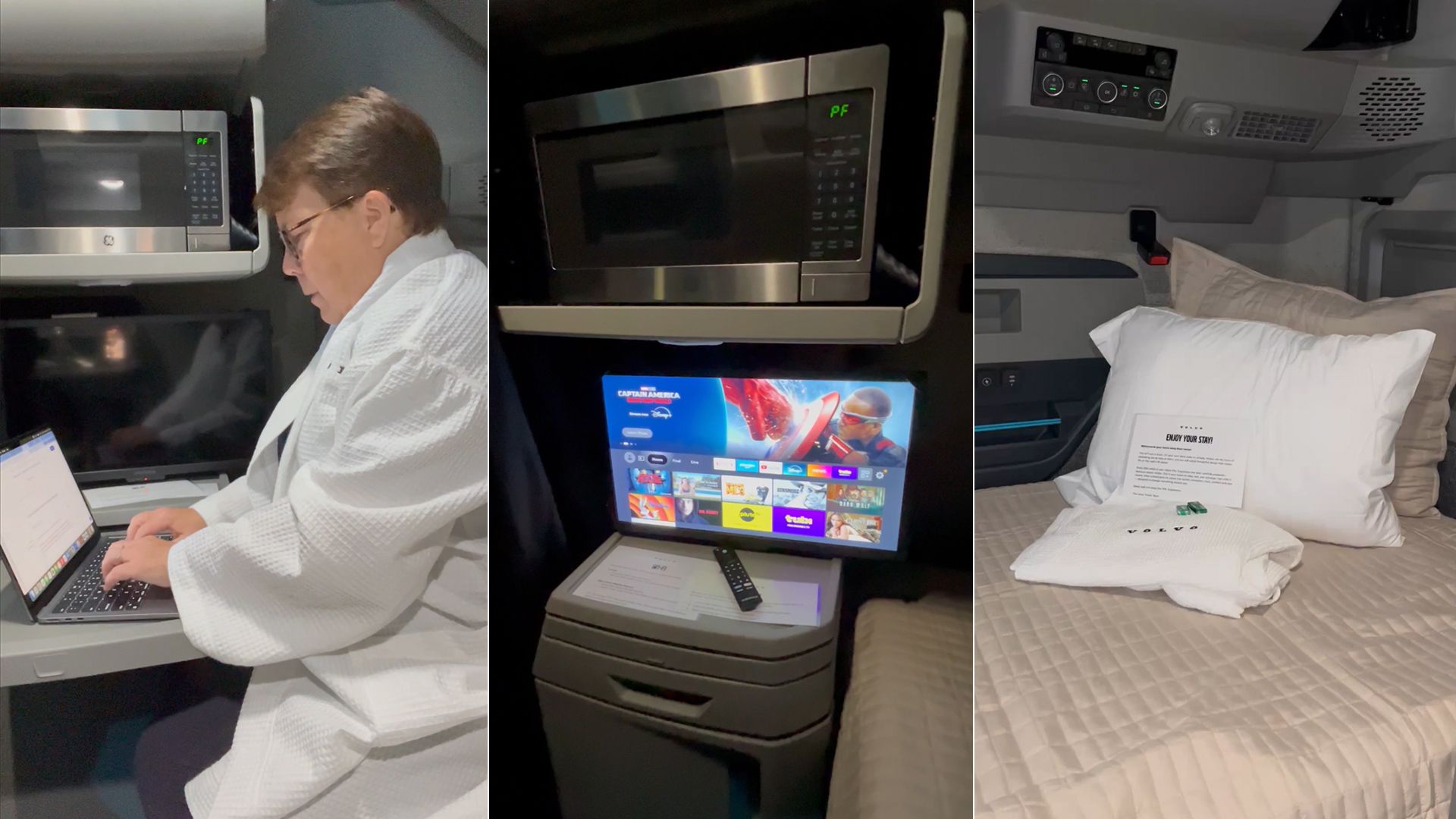
My overnight stay in the sleeper cab of Volvo's new long-haul truck had all the trappings of a 5-star experience, right down to the monogrammed robe and the mints on the pillow.
Why it matters: Driving a truck for a living is grueling, both mentally and physically, and turnover rates are high.
- Volvo's bet is that prioritizing a good night's sleep for drivers can reduce fatigue-induced crashes and even help truck fleets recruit and retain employees.
The solo slumber party was perhaps the weirdest offer I've received in three decades as an automotive journalist, but how could I resist?
- There was a backup plan: If I got uncomfortable, I could always go back to my room at the hotel where the truck was parked overnight.
- I didn't.
Peeling apart the magnetic curtains behind the driver's seat, I was slightly flabbergasted to find a tiny hotel room with a comfy-looking twin bed with two fluffy pillows and the aforementioned cotton robe and Andes mints.
- A second bunk had been pushed toward the ceiling to make the space appear even bigger. (Some versions even have a reclining bunk, like an easy chair.)
- To my left was a mini-fridge, a TV and a microwave. Sandwiched between the TV and fridge, there was a pull-out table and a storage drawer.
- To my right, a roomy half-closet could hold at least a week's worth of clothing. The bedside table above it was stocked with snacks and even had a designated nook for a C-PAP machine.
- There were plentiful USB and 120V outlets to plug in my laptop, phone and smartwatch overnight, and lots of storage spaces.
I plopped down on the supportive mattress and fiddled with the control panel above the bed.
- From here, I could change the cabin lighting, access Bluetooth audio, lock the doors, set an alarm and control the thermostat.
Zoom in: The VNL has a new integrated, battery-powered cooling system that keeps the cab and sleeper comfortable during rest periods without idling the engine, conserving fuel.
As I settled in for the evening, I dimmed the lights, leaving a blue-tinged glow under the bunk in case I had to get up during the night.
- The VNL has just about everything — except a toilet.
- Luckily, the hotel was only steps away.
The bottom line: It sure beats placing a piece of plywood across the truck's seats to catch a few zzzs, which is what truck drivers used to do before sleeper cabs came along.
3. Transportation dreamers convene in Arkansas
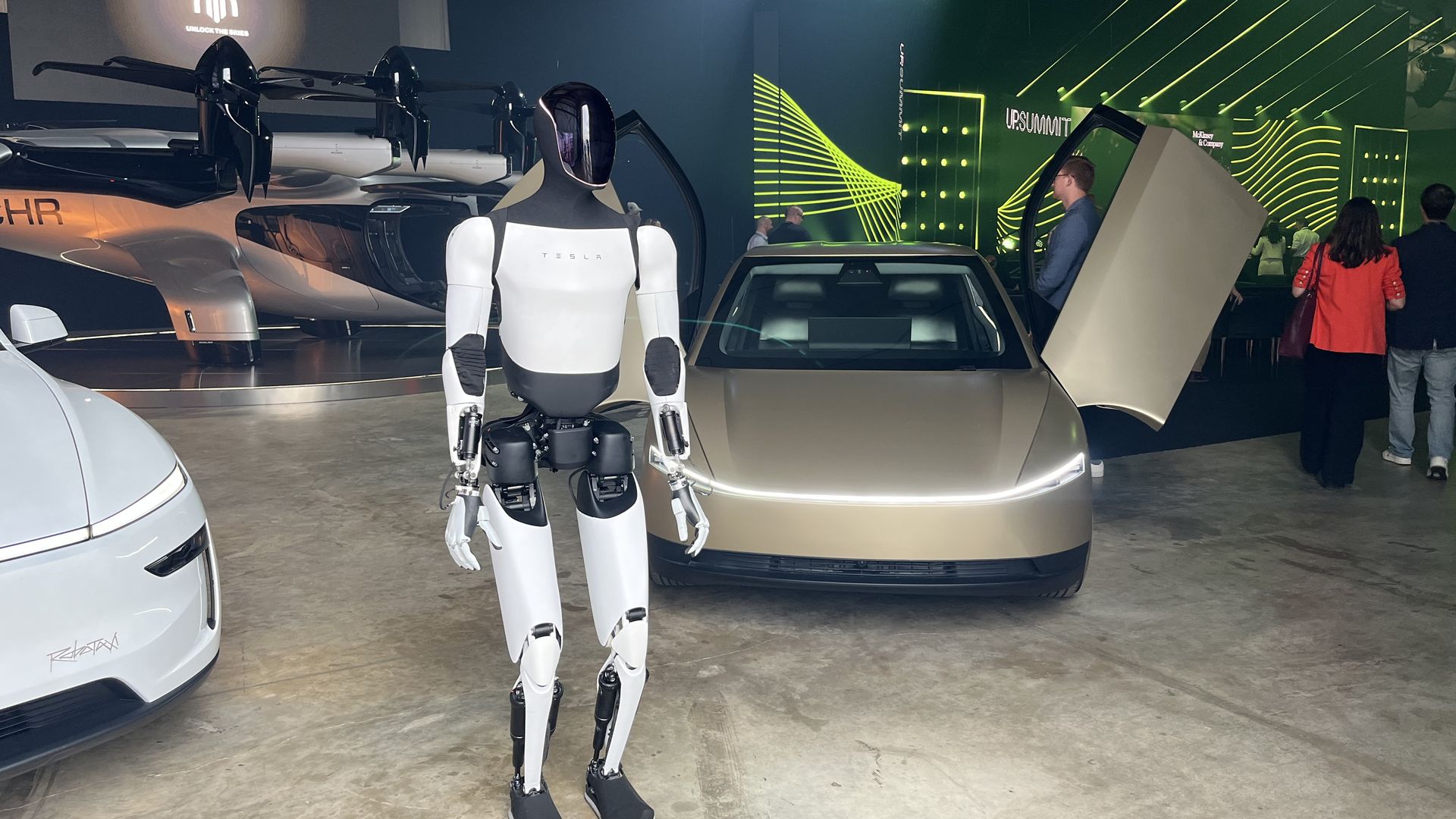
A municipal airstrip in Bentonville, Arkansas, was the showplace this week for some of the most ambitious ideas in transportation — from ultrasonic jets and flying taxis to customizable electric cars and humanoid robots.
Why it matters: The UP.Summit is an invite-only gathering of 350 entrepreneurs, investors, corporate executives and government leaders with a shared mission to reimagine how people and goods move.
Now in its eighth year, the private event is hosted by investment firm UP.Partners, whose cowboy hat-sporting co-founder, Cyrus Sigari, is the head cheerleader for envisioning "the future we were promised as kids."
Inside the hangar: A parade of entrepreneurs gave a series of 10- to 15-minute talks explaining their personal journeys and why their technology would change the world.
Outside on the tarmac: Their toys were showcased for exploration, even if most were only mockups, not quite ready to be deployed.
💭 Thought bubble: The enthusiasm — call it hype if you prefer — is infectious when everyone in the room is dreaming of what could be the next big thing in transportation.
- And investors seem eager to jump on board, particularly when it comes to backing the physical AI that will define the next phase of American innovation.
- But a lot of the ideas at the UP.Summit won't ever come to fruition, whether due to a lack of funding or, more likely, a poorly conceived business plan.
Yes, but: There are still success stories like Wing, the drone company owned by Google.
- Three years ago, CEO Adam Woodworth stood on the UP.Summit stage and promised that drone delivery technology was on the cusp of reality.
- Fast-forward to today, and Wing now makes more than 1,200 deliveries a day to Walmart customers in Dallas, with other markets coming soon.
- "Most of these other technologies are on the precipice of what's coming. This tech is here," he said, referring to drone delivery.
What to watch: Drone companies like Wing and Zipline were beneficiaries of an early commercialization program funded by the FAA during the first Trump administration.
- Trump just signed an executive order to launch a similar pilot program for urban air mobility, which should give a boost to electric air taxi companies like Joby, Archer and Beta.
Go deeper: Flexjet to buy super-efficient business jets from startup Otto
4. Drive-thru
🚨 Police in Northern California pulled over a Waymo taxi after it made an illegal U-turn, only to find no driver behind the wheel and therefore no one to ticket. (AP)
- The incident highlights a gray area in law enforcement's ability to cite robot cars when they violate traffic laws.
🇨🇳 BYD's monthly sales fell for the first time in more than 18 months amid fierce competition among electric vehicle makers in the Chinese market. (Bloomberg)
💰 Woven Capital, Toyota's growth fund, has launched a second $800 million fund to invest across mobility, energy, AI and climate, my Axios Pro colleague Katie Fehrenbacher scooped yesterday. (Subscribe to Axios Pro Deals)
5. 🔮 1 Future Thing

Toyota has opened the first phase of Woven City, its living lab to test new forms of mobility.
Why it matters: The experimental town, located at the base of Mount Fuji, is being billed as "a tugboat that will pull the mothership into the era of new mobility," Woven by Toyota CEO Hajime Kumabe tells Automotive News.
Driving the news: The first of about 300 "Weavers" — Toyota employees and their families — have begun living in the development, with plans to accommodate 2,000 residents in future phases.
- The complex includes a nursery school for Weaver children, whose parents will ride three-wheeled scooters and use robots to get their groceries or park their cars.
- About 20 partner companies are working within Woven City to pioneer new approaches to moving people, things, energy and information.
💭 Thought bubble: It sounds like the perfect setting for a futuristic psychological thriller.
10-4, good buddies! See ya on the flip side. Thanks to Ben Berkowitz and Bill Kole for editing.
Sign up for Axios Future of Mobility