Flexjet to buy super-efficient business jets from startup Otto

Add Axios as your preferred source to
see more of our stories on Google.
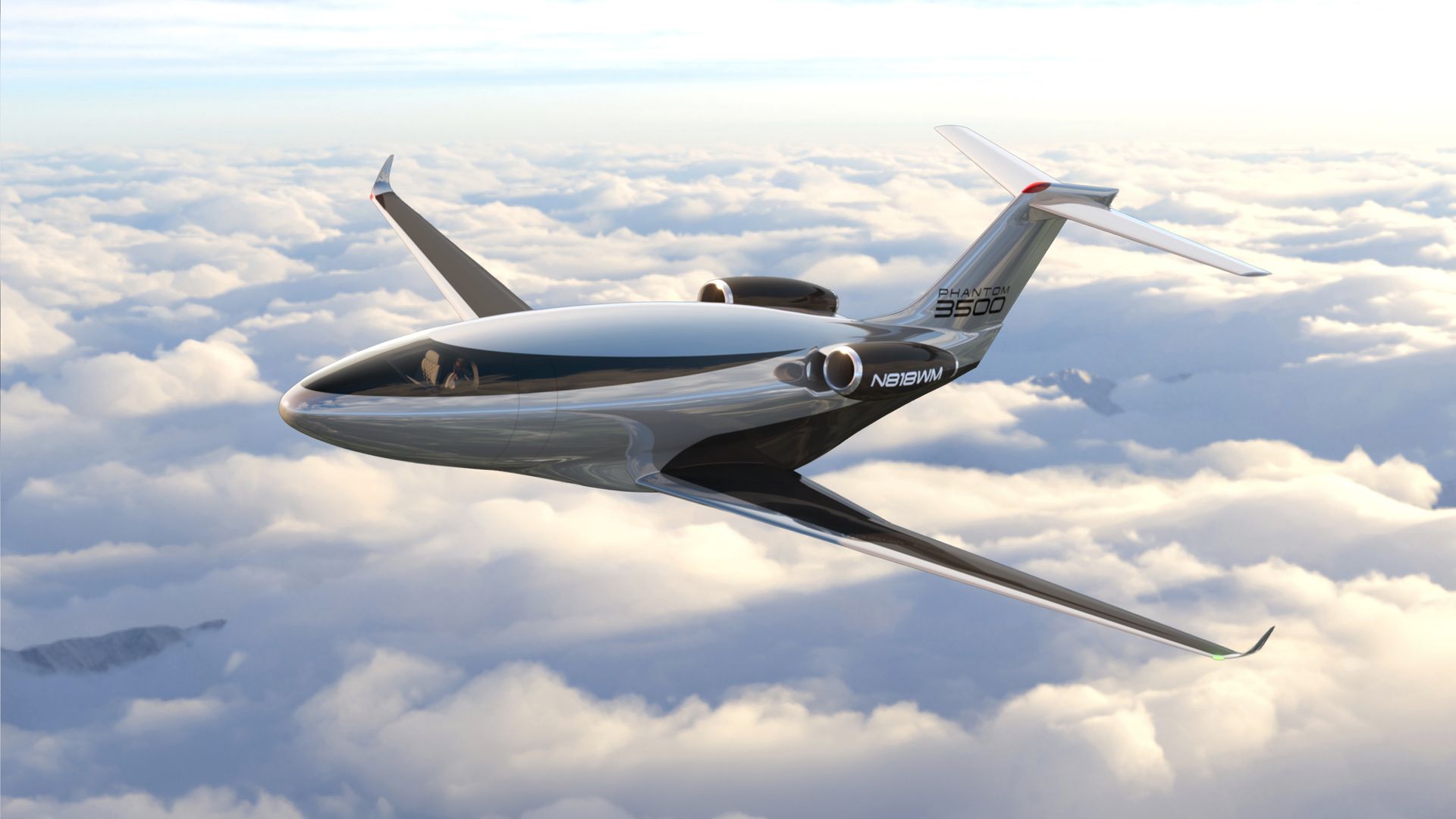
Otto Aerospace's sleek Phantom 3500 achieves breakthrough fuel efficiency.
An aviation startup called Otto Aerospace says it has designed an ultra-efficient business jet and has already attracted its first fleet customer.
Why it matters: Aviation is one of the biggest contributors to greenhouse gas emissions, and the industry will need innovative aircraft and fuels to achieve its net-zero goals by 2050.
Driving the news: Fort Worth, Texas,-based Otto said the first fleet customer for its Phantom 3500 business jets will be Flexjet, the fractional jet ownership company.
- Flexjet plans to buy 300 of the sleek jets over a six- to eight-year period, with the first deliveries expected in 2030, the companies said.
- The Phantom 3500 promises to burn 60% less fuel than similar business jets — or up to 90% less if operating on sustainable aviation fuel.
- Otto plans to build the plane at a new high-tech factory it intends to build in Jacksonville, Florida, supported by a $515 million incentive package from the state of Florida.
Reality check: It's taken nearly two decades for Otto to perfect the design of the clean-sheet aircraft, which features super-efficient, laminar-flow aerodynamics and precision carbon-fiber composites.
- But its first flight won't occur until 2027 and it still needs FAA certification.
The big picture: Otto is one of dozens of ambitious mobility companies participating in at the UP.Summit, an invite-only gathering of 350 entrepreneurs and investors in Bentonville, Arkansas.
- The event is a mix of dreamers, scientists and financiers with a shared mission to make transportation cleaner, faster, safer and cheaper — whether it's on the ground, in the air, at sea or in space.
- Now in its eighth year, the private event is hosted by investment firm UP.Partners, Walmart scions Steuart and Tom Walton, and businessman Ross Perot Jr.
What to watch: Aviation is on the cusp of the biggest transformation since the introduction of the jet engine, which revolutionized air travel.
- Breakthroughs in aerodynamics, manufacturing, energy and AI have opened the door to flying taxis, supersonic jets and private space travel.
The bottom line: While each of these technologies is promising, they still need to be proven and certified for flight.
