Axios Future of Mobility

March 19, 2025

🏎️ Welcome to the first issue of our new weekly newsletter examining the powerful trends upending the global auto industry.
I'm your driver, Joann Muller. I've been covering autos for 35 years, so I've seen a thing or two. But nothing compares to the breathtaking changes we're witnessing now. Buckle up!
- And remember, this is a two-way street: Send feedback and tips to [email protected].
One more thing: I'll be interviewing Lyft CEO David Risher and Serve Robotics CEO Ali Kashani onstage at the Axios What's Next Summit next Tuesday, March 25, in Washington, D.C.
- Have any questions for them? Email me at [email protected]. Want to attend or watch the livestream? Click here.
Off we go ....
In 1,490 words, a 5.5-minute read.
1 big thing: Wagering on an uncertain future
The emergence of intelligent, electric, automated vehicles is every bit as monumental as the shift away from the horse-and-buggy in the early 20th century.
Why it matters: Gigantic leaps in artificial intelligence and other technologies are enabling a future where cars don't crash, or pollute the air, and everyone can go where they want, regardless of their age, abilities or the size of their wallets.
This is the vision I'll be writing about each Wednesday in this newsletter:
- Robots will handle most of the driving, while passengers relax (or work) in cabins customized to their personal preferences.
- Cars will learn passengers' routines, tailoring the ride experience to their mood, and automatically suggesting reminders or conveniences.
- Gasoline stations will gradually disappear, replaced by EV charging stations decked out with restaurants, workspaces and other amenities.
- On-demand robotaxis will cruise efficiently about cities, eliminating the need for land-gobbling parking lots.
Automakers are betting heavily on this future, with multibillion-dollar investments in EVs, AVs and software-defined vehicles.
- In 2021, automakers and suppliers were projecting to spend $330 billion globally on EVs by 2025. Two years later, their projections grew to $616 billion by 2027, according to AlixPartners.
- But predictions don't always play out as expected, and the regulatory and competitive landscape keeps changing.
The big picture: Geopolitical uncertainties, rising tariffs and slower-than-expected EV adoption rates are changing the calculus that informed automakers' decisions just a few years ago.
- The stunning rise of innovative, low-cost competitors from China is an existential threat that has heightened the sense of urgency.
- "Everyone talks about how good they are or how cheap they are," Ford CEO Jim Farley said, referring to Chinese carmakers, at a recent investor conference. "What they should be talking about is how fast they are."
- Meanwhile, the frenetic regulatory overhaul of the Trump administration, an exploding trade war and an uncertain economy present new threats.
With pressure building from all sides, automakers are rethinking their strategies and rebalancing competing priorities.
- General Motors scrapped its ambitious Cruise robotaxi effort, while Ford hired a bunch of Tesla veterans to design a low-cost EV platform in California, far away from its own engineering hub in Dearborn, Michigan.
- Tesla is hoping a robotaxi launch this summer will distract from its plunging EV sales, while Stellantis, reeling from a disastrous 2024, is looking for a new CEO to lead the maker of Jeeps and Ram trucks.
- Expect even more global alliances like GM-Hyundai and Volkswagen-Rivian, as companies look for help shouldering the risks and costs associated with new technologies.
The bottom line: The once-in-a-century transformation of the auto industry has reached an inflection point.
- Carmakers need to do something different, and do it quickly.
- The auto industry is likely to change more in the next five years than it did in the last 100.
2. Where the big bets stand

Three technology themes will define the future of the auto industry, so expect you'll be reading about them regularly here:
Electric vehicles
EVs have grown to about 9% of all new cars sold in the U.S., but despite big discounts and more choices, charging and affordability are still a hindrance.
- Even the market leader, Tesla, is struggling. Sales have plummeted worldwide as rivals compete for attention and controversy grows over CEO Elon Musk's political activity.
- If President Trump yanks tax credits and manufacturing support for EVs as promised, higher prices and slower EV adoption are likely.
- Republican lawmakers are also looking for a legal path to repeal California's EPA waiver, which permits it and 11 other states to set EV mandates phasing out gasoline cars by 2035.
- 'It would take a miracle" for carmakers to hit the states' first target for 35% of 2026 models to be electric, the industry's trade association says. Consumer demand just isn't there.
- Without a repeal of the waiver, they'll have to dump EVs at fire sale prices to comply, and limit consumers' choices.
What to watch: China's BYD might have just changed the game by lowering one of the barriers to EV adoption.
- The Chinese manufacturer unveiled a new EV platform that can recharge in as little as 5 minutes — about the time it takes to fill a car's gas tank.
- But boosting the appeal of EVs will also require lower-cost batteries and high-volume manufacturing to bring down prices.
Autonomous vehicles
After years of frustration and slow progress, only one company — Waymo — operates a real commercial robotaxi service today.
- Waymo provides 200,000 driverless trips per week in San Francisco, Los Angeles and Phoenix, and is beginning to add robotaxis to Uber's platform in other cities.
- Meanwhile, autonomous trucks are getting closer: One company, Aurora, plans to go fully driverless next month in Texas.
The intrigue: Huge leaps in generative AI are enabling a new approach to autonomy using end-to-end, self-learning systems.
- Instead of driving millions of test miles and then manually coding instructions for every edge-case scenario, AV 2.0 systems use advanced AI to train a virtual driver how to reason like a human — even in unfamiliar driving situations.
Stunning stat: U.K.-based Wayve says its AI easily adapted to U.S. roads (including driving on the opposite side of the road!) after just 500 hours of local training.
Software-defined vehicles
Tesla pioneered the upgradeable "computer on wheels" back in 2012 with the introduction of the Model S. But the rest of the industry is taking a long time to catch up.
The dream is that the car will one day become a digital platform — like a smartphone or tablet — that generates billions of dollars in recurring revenue.
- With over-the-air updates, problems can be easily fixed and buyers can add features or services that weren't available at the time of purchase.
Yes, but: That requires replacing scores of tiny computers embedded in individual components with a centralized electronic system that controls everything from drive-by-wire steering to entertainment.
- Automakers lack that systems expertise, which is why they're furiously recruiting talent from Apple, Google and other tech giants.
The bottom line: All three trends are within reach but require more time, effort and investment.
3. What's next: Pop-up message projectors
A regular feature on technology coming soon to cars ...
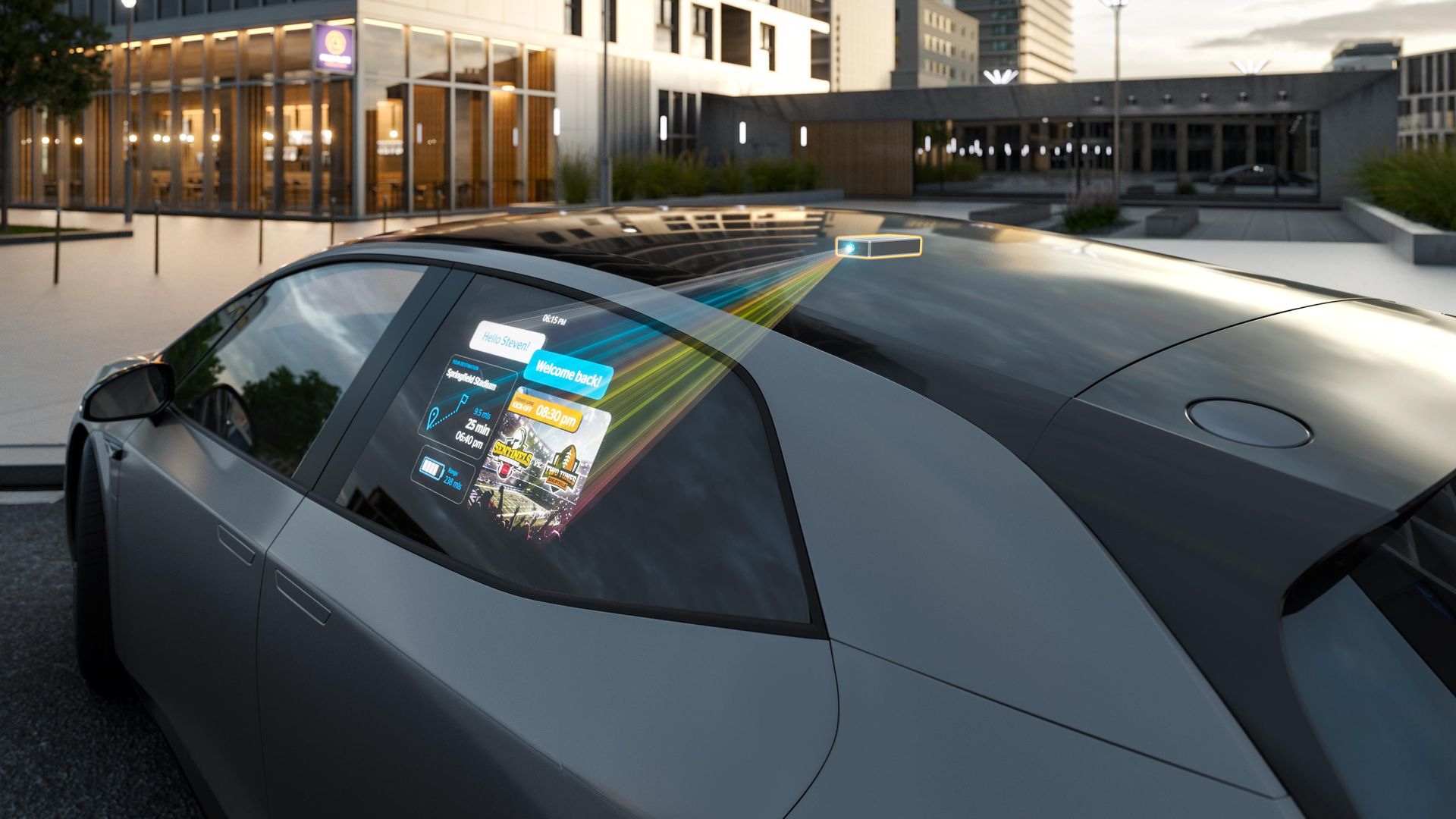
Continental has developed a tiny, high-definition projector that beams content onto a vehicle's side windows, visible to people outside the car.
How it works: The mini-projector is embedded in the car's headliner.
- When activated, the AI-enabled system darkens the rear windows to display personalized, context-based information in high resolution.
- Intelligent software co-developed with Banbutsu, an AI digital platform, makes suggestions based on real-time data from the vehicle's sensors, learned preferences and other contextual data.
Why it matters: One way it could be useful is helping to locate your Uber at the airport.
- Instead of trying to read license plates from a distance, you see your name and image projected on the side of an approaching car and know instantly that's your ride.
Yes, but: For the sake of privacy, I wouldn't want an Uber to project my destination on the car's window, as Continental demonstrated.
💭 Thought bubble: It's only a matter of time before cars are using this technology to project advertisements on their windows.
4. Drive-thru
Catching you up on worthy news you might have missed ...
🚙 Carmakers are reinventing the gear shifter and drivers are lost - Wall Street Journal
🤖 GM teams up with Nvidia to bring AI to robots, factories, and self-driving cars - TechCrunch
⚠️ 'Deeply concerned': Crash victims' families ask DOT not to water down Tesla oversight - Politico
5. What I'm driving
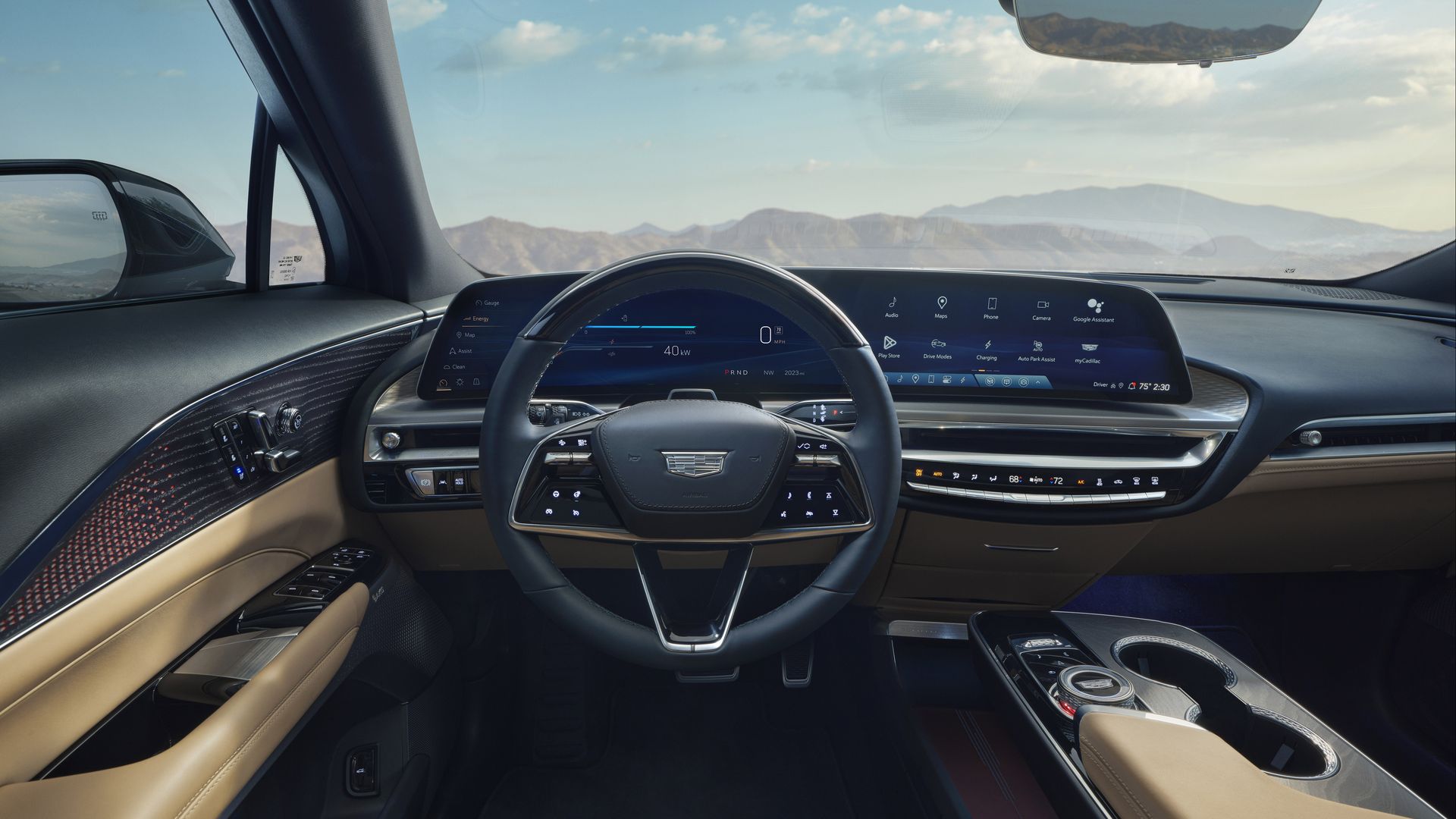
As a juror for the North American Car & Truck of the Year awards, I test drive 50 or 60 new cars a year. Each week, I'll share a little about what's in my driveway. (The cars are loaned to jurors for evaluation purposes and my opinions are my own.)
2025 Cadillac Lyriq Sport 3
Starting price: $58,595; Price as tested: $79,090
- It's the original entry in Cadillac's growing EV lineup, featuring 300+ miles of driving range.
What I loved: The futuristic interior, with a large, curved 33-inch dashboard screen, and GM's hands-free Super Cruise technology.
One gripe: The flush door handles pop up when you approach the car, but grasping the angled handles still felt awkward. What's wrong with traditional door handles?
Coming in 2026: A high-performance version, the 615-hp Cadillac LYRIQ-V.
6. How it started ...

You'd think from this photo that I've been a car lover my whole life.
Like most automotive writers, I stumbled into it. I was a cub reporter at the Detroit Free Press in the late 1980s and quickly learned that if I wanted to be on Page 1, I needed to write about autos.
- Except for a few years covering tech at the Boston Globe, I've been covering the auto industry ever since.
- Lots of people ask me for car advice, which is funny, because they don't really want my advice. They just want validation for the choice they've already made.
I'd love to hear your feedback on this newsletter (or your car), so stay in touch!
Thanks to Ben Berkowitz and Bill Kole for editing. Please share this newsletter and encourage your friends and colleagues to sign up!
Sign up for Axios Future of Mobility