Axios Future of Health Care

June 14, 2024

Good morning! This week a big picture view of one of the most interesting topics in health care, and one we'll be going deeper on in coming weeks...
Today's word count is 966, or a 3.5-minute read.
1 big thing: The health care wild card
When I've asked CEOs what they see as the wild card that will shape health care's future, almost all of them have mentioned emerging technology, especially AI.
Why it matters: AI and other scientific and technological breakthroughs could radically change the care available to patients while solving some of the health system's most vexing or existential problems.
- Alternatively, the vast majority of these developments may never live up to their hype. Or they could, for one reason or another, never make it to market.
- Or they could exacerbate existing inequities, or make the system even more expensive. And of course, reality often lies somewhere between complete failure and complete success.
- That's the nature of a wild card — we just don't know! But decisions being made today could make a big impact on the ultimate success or failure of some of the most exciting prospects.
Where it stands: The development pipeline is stacked.
- AI-based products designed to aid clinicians, including through reducing administrative tasks like note-taking, are already on the market, as are hundreds of AI-enabled medical devices. AI also holds enormous promise for drug discovery, diagnostics and precision medicine.
- The first gene-editing CRISPR product was approved last year. Cell and gene therapies are rapidly coming to market, and thousands more are under development.
- Elon Musk's Neuralink is only one of several companies testing brain implants that would allow users to control tech devices simply by thought.
- And AI could even allow for forecasting someone's risk for disease similar to how we can forecast the weather, Scripps Research's Eric Topol recently wrote in Science.
Friction point: The U.S. regulatory system is very good at testing products before they make it to market for safety and effectiveness.
- But it could struggle to handle everything that's coming down the pipeline at once — in addition to new post-marketing monitoring that AI products and gene therapies likely require.
- "All of these are coming at us at the same time, each with a potential 'eureka,' and our pipeline — our capacity to study them all, separate the wheat from the chaff," is going to be a challenge, said Amy Abernethy, a former senior FDA official.
What we're watching: Health care access and outcomes are already characterized by glaring inequities. But this new wave of innovation could exacerbate them and create a class of products primarily accessible to the select few who can afford them.
- "These innovations are where our current regulatory frameworks, our current ways of thinking about equitable access are going to break down if we're not careful," Abernethy said.
- To some extent, this is already happening with access to GLP-1s for obesity treatment. Demand is so large and the cumulative costs so high that only a small, though growing portion of those who could benefit from the drugs have been able to use them.
When it comes to AI, Topol told me, a common assumption is that it's not going to help people having the hardest time accessing health care.
- But "there's already evidence that if you work at it, you can actually go the opposite direction" and reduce health inequities.
The bottom line: The upside could be enormous for patients, providers and health care companies that stand to profit.
- "There's going to be all these new inventions … I feel like we're going to have one of these step changes in performance in health care in the world, which is exciting," said Bob Kocher, a partner at Venrock.
2. Axios interview: Drug discovery revolution
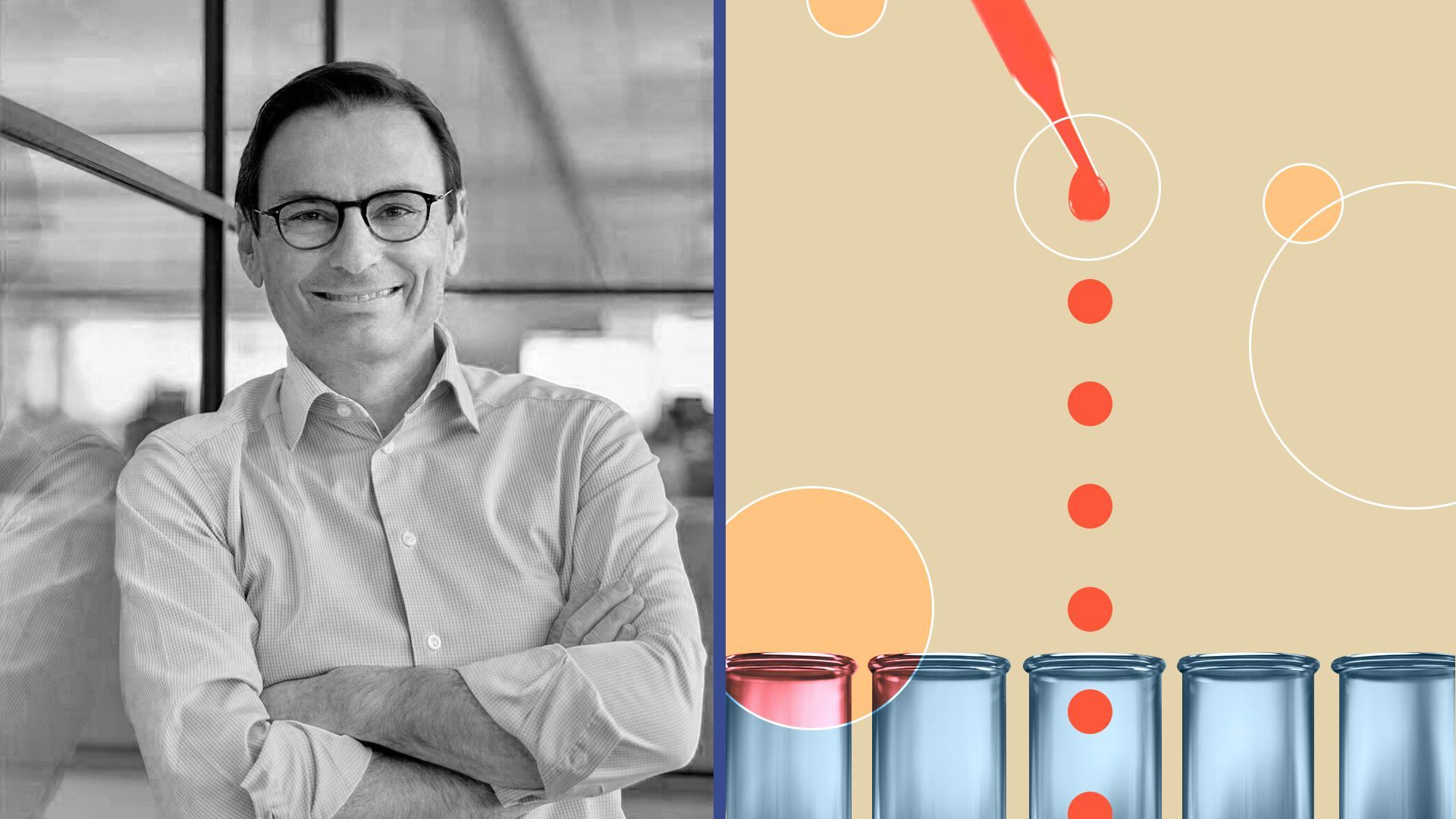
Axios headquarters had another cool guest recently: Fabrice Chouraqui, CEO of Cellarity, a Flagship Pioneering-backed biotech that's using AI and machine learning for drug discovery, including by better understanding the biology of disease.
- Its focus is on blood disease, immunology and metabolic disease, and its early-stage pipeline includes a pill for treating sickle cell disease.
- Chouraqui previously was the president of U.S. pharmaceuticals for Novartis — which isn't exactly a small biotech.
- Most pharma companies are using AI to make the drug discovery process more efficient, Chouraqui said, but he believes "that AI can really help solve a new kind of problem."
Q: What is transformative about what you are working on?
A: What's transformative about the Cellarity platform is it allows us to see biology that others can't and create drugs that are in a sense out of reach with the traditional methods of drug discovery.
Q: One trend transforming health care that we're not paying enough attention to?
A: Populations across the world have access to information and therefore, they want to be treated with the best possible medication. And if they cannot afford it, that creates immense frustration. … I believe that [will] create even more tension to ensure that all parties in the health care ecosystem create an environment for innovation to be accessible.
Q: Biggest challenge health care faces?
A: The cost of innovation and the access to innovation as a consequence. ... We are on the cusp of a new era of research that will bring tremendous innovation. The question is who is going to pay for it?
Q: Biggest opportunity?
A: To fully harness what specifically AI and other technologies can offer to unlock treatments for vast areas of disease.
Q: Biggest wild card?
A: Science is unpredictable. ... For me, it's inevitable that AI will actually bring tremendous value. ... Perhaps what's unpredictable is to what extent AI is going to revolutionize not only drug discovery, but health care as a whole, including the delivery of health care.
Q: What's your go-to piece of advice?
A: Treat people the way you want to be treated. That's what I heard from my parents!
Q: When/where do you do your best thinking?
A: When I don't have access to my mobile phone.
Q: Favorite piece of technology that you own?
A: My iPhone.
Thanks to Nicholas Johnston and Jason Millman for editing and Matt Piper for copy editing.
Sign up for Axios Future of Health Care